
Cash on Delivery Dropshipping: Where the Profit Actually Goes
 By Ana GelevskaNovember 18, 2026
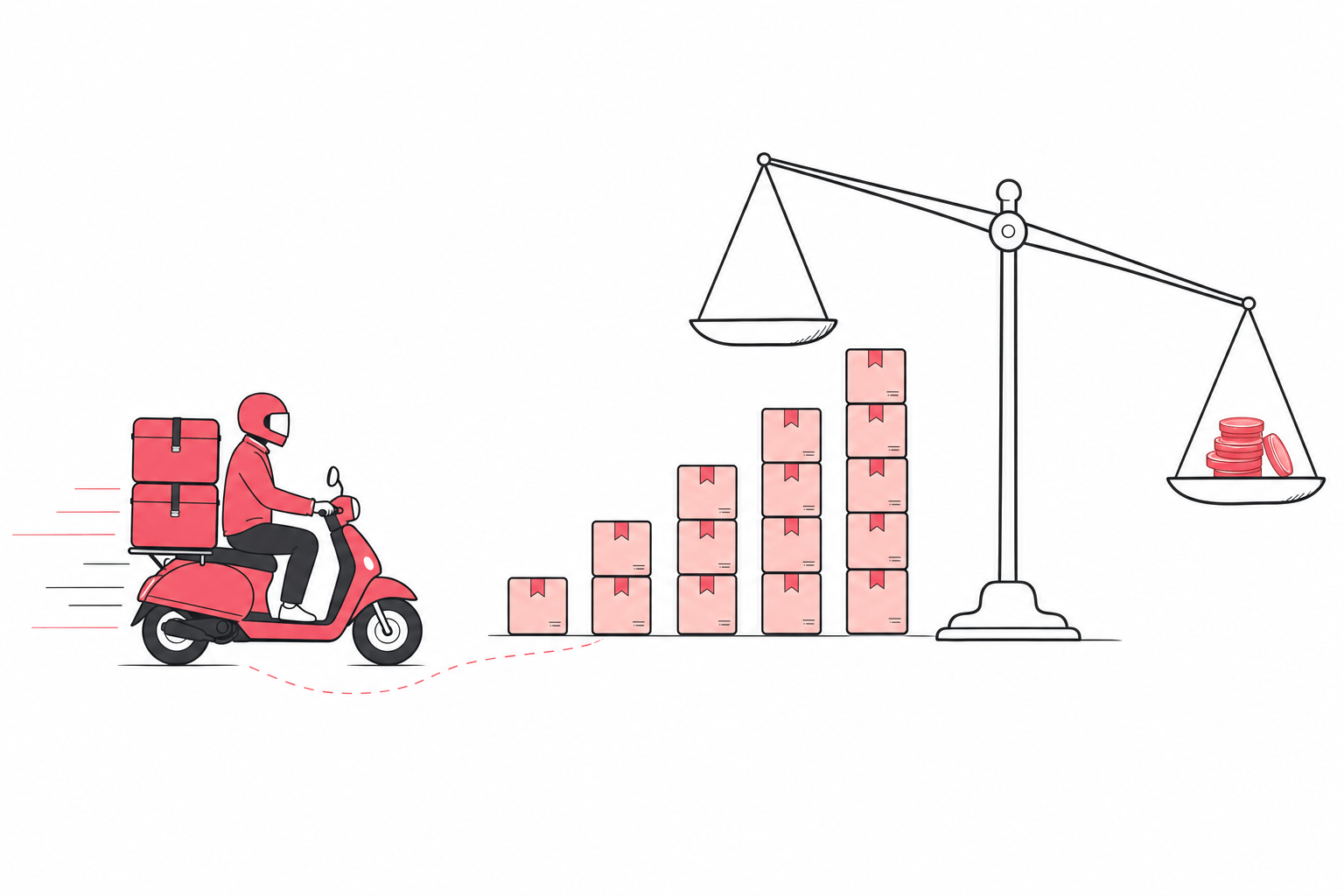
Your order count is climbing. Revenue on the dashboard looks like the best month you have had. The bank balance disagrees, and the gap is getting wider every week.
That is the standard shape of a cash on delivery business, and it comes up constantly among sellers running COD in India, Pakistan, the Gulf and South East Asia. One thread asking COD sellers where to look first when revenue rises and profit does not listed the usual suspects: refused and undelivered orders where you paid shipping out and back, courier COD fees and slow remittance, ad spend judged against every order placed rather than the ones that were delivered and paid for, and the hours spent calling customers to confirm orders that almost nobody prices.
In these markets COD is the default rather than one option among several. A seller who spent seven months building a supplier network in Jordan put it plainly: people there rarely buy through a website checkout with a card, so almost every sale closes in a DM with cash on delivery. India works the same way at scale, which means the cost structure below is the business rather than an edge case.
This article is about the COD payment model specifically. For the general margin calculation, read dropshipping profit margins. For reading a competitor's costs from outside their store, read Shopify store revenue vs profit. What follows is the arithmetic that only applies when the customer pays the courier instead of paying you.
Table of contents
- The one number that fixes the reporting
- What the Indian RTO data actually says
- A worked example in rupees
- The cash gap between dispatch and payout
- Prepaid versus COD: run the switch point
- Check the category before you commit to a COD product
- How to cut your RTO rate
- Run the category check on one product this week
The one number that fixes the reporting
Cost per order and cost per delivered order are different numbers, and on COD the second one is the only one that pays your bills. A seller asking how to decide when it is safe to scale a COD product described the trap exactly: the return data lags, so the ad looks profitable on day three, the budget gets tripled, and the refusals start landing on day twelve against a budget three times the size.
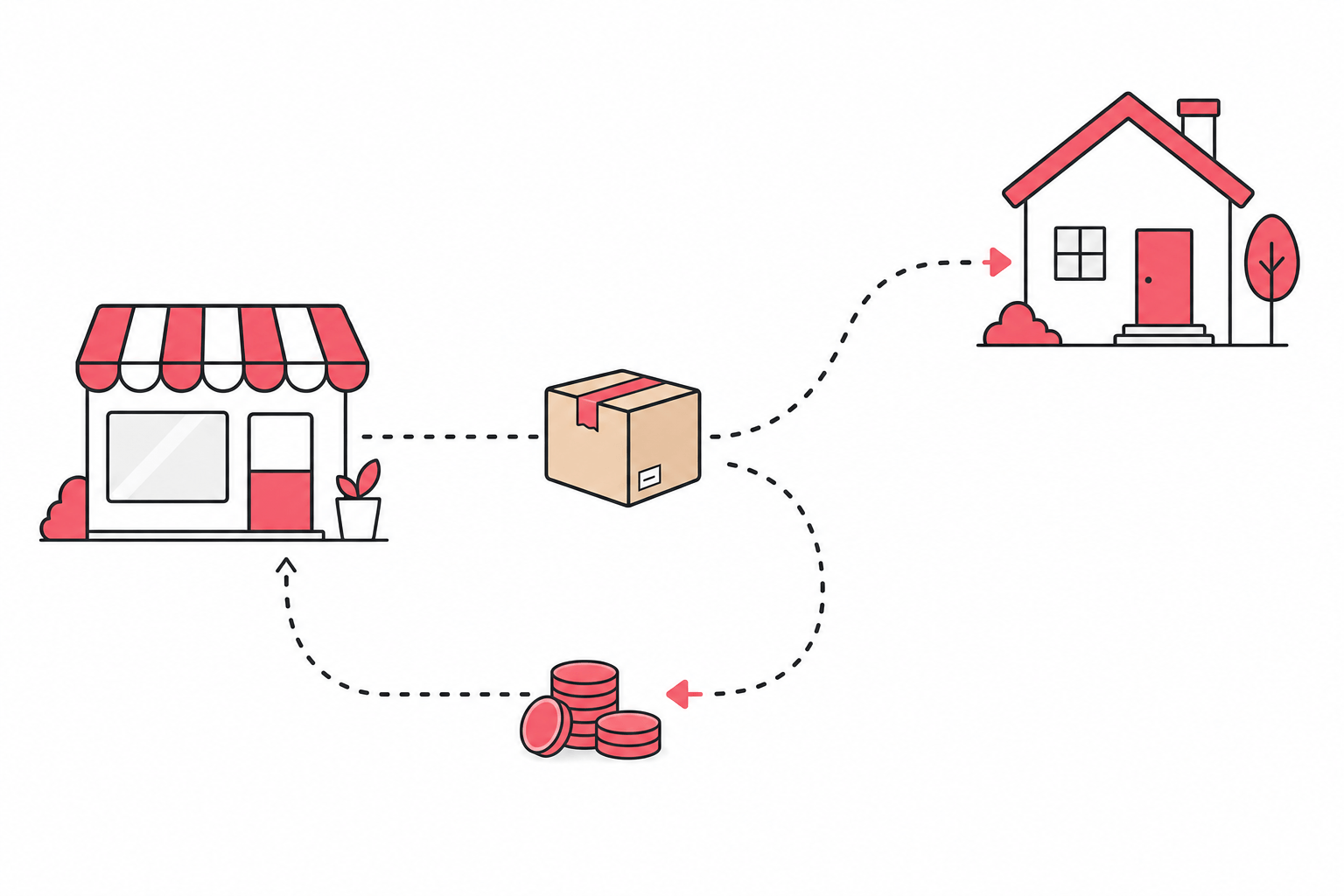
Everything else in this article is downstream of that single swap. Your ads manager counts orders placed. Your courier decides which of them became money. Until your reporting uses the second number, every optimisation you make is tuned to the wrong signal.
What the Indian RTO data actually says
RTO stands for return to origin: an order you shipped that never reached the customer, usually through refusal at the door, a bad address or a failed delivery attempt. It is the single largest leak in Indian COD, and there is real published data on its size.
Shipway, a logistics platform owned by Unicommerce, analysed millions of D2C shipments processed through its network in FY25 and published the result as its ShipNotes report. The headline finding: less than 2% of prepaid orders are returned, while nearly 26% of non-prepaid orders come back. That is the number to hold in your head. Roughly one in four COD parcels earns nothing and still costs you freight in both directions.
The breakdowns are where it gets useful, because they tell you which COD orders are worth shipping.
Delivery speed. Orders attempted within one to two days recorded a 22% RTO rate. That rose to 27% when the attempt came in three to five days, and to 35% beyond five days.
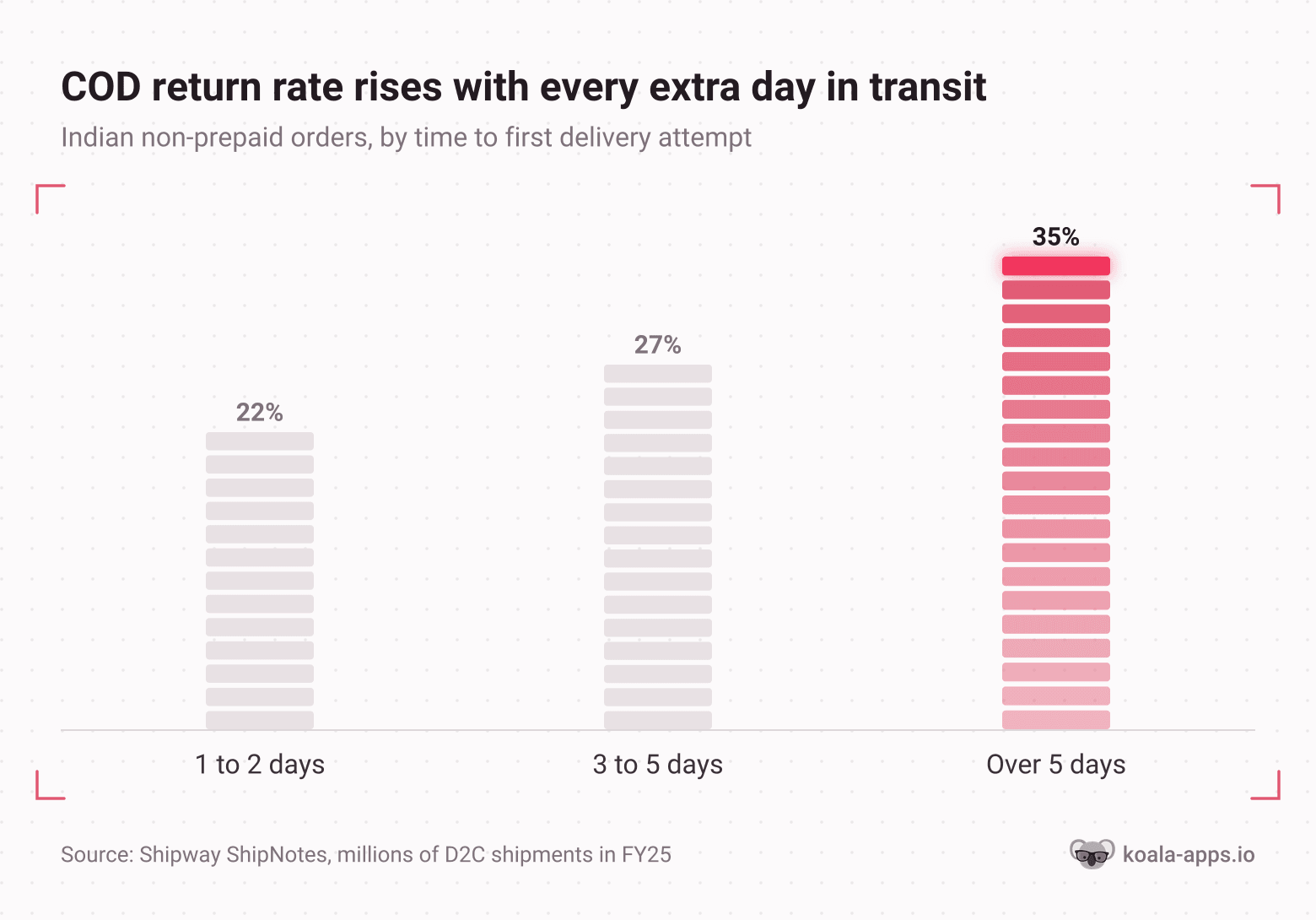
On COD, transit time works as a refund mechanism. The buyer's enthusiasm has a shelf life, and every extra day in transit spends some of it.
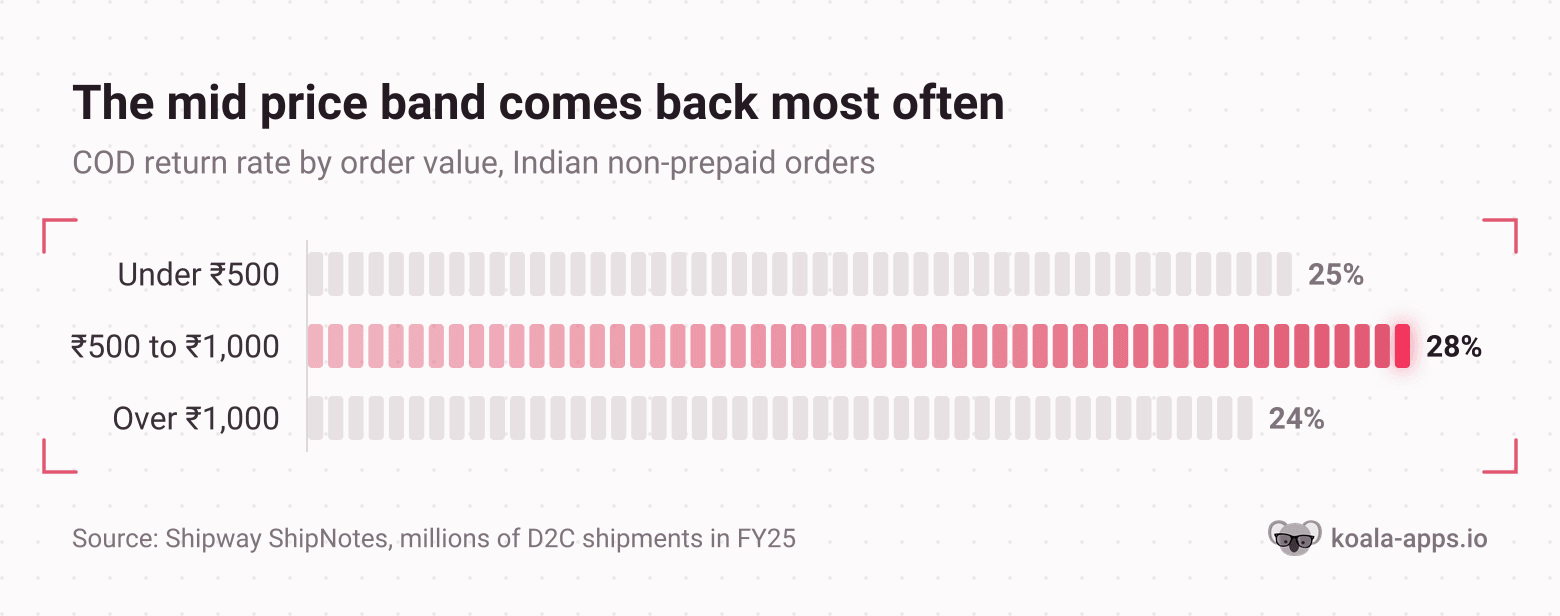
Order value. Orders between ₹500 and ₹1,000 recorded the highest return rate at 28%. Orders under ₹500 came back at 25% and orders above ₹1,000 at 24%. The mid band is where impulse buying and second thoughts meet, which is precisely the price point most new COD stores pick.
Distance. Intra-city shipments returned at 20%, metro to metro at 22%, intra-state at 23%, inter-state non-metro at 27%, and special zones covering the North East and Jammu and Kashmir at 28%.
City. Vadodara recorded the lowest rate at 18%, Patna the highest at 35%. Thrissur, Mumbai, Kolkata, Chandigarh and Ahmedabad joined Vadodara at the good end; Srinagar, Jaipur, Varanasi, Ranchi and Jammu joined Patna at the other.
Read those four cuts together and a serviceable rule falls out. A ₹699 impulse product, shipped inter-state to a tier-three pin code with a five-day delivery promise, is sitting at the intersection of every bad number in the study. The same product sold intra-city at ₹1,200 with a two-day attempt is a different business.
A worked example in rupees
Numbers make this concrete. Take a product selling at ₹899 with a landed cost of ₹350, and run 100 placed orders at the 26% national COD return rate.
For freight, Shiprocket's India pricing page listed an average shipment cost of ₹45 on its free Lite plan when we read it on 18 November 2026, falling to ₹41 on the ₹199 Business plan, ₹39 on the ₹499 Advanced plan and ₹36 on the ₹799 Pro plan. Courier rates move, so check yours. We will use ₹45 each way. The COD collection fee is the one line you have to fill in yourself: XpressBees states that COD charges vary by order value, pin code and your agreement, so take it off your own rate card. The example assumes ₹30 per collected order, ₹15 of packaging per parcel and ₹250 of ad spend per placed order.
100 placed orders, 74 delivered, 26 returned:
| Line | Amount |
|---|---|
| Revenue collected (74 × ₹899) | ₹66,526 |
| Product cost on delivered orders (74 × ₹350) | ₹25,900 |
| Forward freight on all 100 parcels | ₹4,500 |
| Return freight on 26 parcels | ₹1,170 |
| COD collection fee on 74 orders | ₹2,220 |
| Packaging on 100 parcels | ₹1,500 |
| Ad spend (100 × ₹250) | ₹25,000 |
| Profit | ₹6,236 |
That is ₹62 per placed order and a 9.4% net margin on collected revenue. Workable, and nothing like what the dashboard showed you.
Here is what the dashboard showed you. At 100 placed orders the revenue figure reads ₹89,900 and the return on ad spend reads 3.6. Against money that actually arrived, the same campaign returns 2.66. And your real acquisition cost is not ₹250: dividing ₹25,000 of spend by 74 delivered orders gives ₹338 per delivered order.
Now move one variable. Hold everything else and let the return rate go to 35%, the figure the study records for deliveries attempted after more than five days:
- 65 delivered orders, 35 returned
- Revenue collected: ₹58,435
- Total costs: ₹57,275
- Profit: ₹1,160
Nine extra percentage points of RTO removed 81% of the profit. The same thing happens from the other direction: keep the 26% rate and push acquisition from ₹250 to ₹300 per placed order, and profit lands at ₹1,236. Either move, on its own, takes this product from a real business to a rounding error.
Here is the structural fact about COD, stated bluntly. A delivered order has to carry its own costs plus a share of every failure, so the gross margin per order has to be a multiple of the freight, not a near match for it. If one order's gross margin is smaller than two round trips of freight plus packaging, the product cannot absorb a normal Indian return rate, and no creative test or audience change will rescue it.
The cash gap between dispatch and payout
Even a profitable COD product can starve you, because the money arrives long after it was spent.
Shiprocket's own documentation sets out the timeline: COD processing is D+8, meaning eight working days from the date of delivery, remittance is credited three times a week on Mondays, Wednesdays and Fridays, and you should expect the payment in your bank account within ten working days of delivery. Their Early COD option compresses that to as soon as two days after delivery.
Add transit time to that and roughly three weeks passes between the parcel leaving your hands and the cash entering your account. Meanwhile the product cost, both freight legs, the packaging and the entire ad bill are already paid.
On the 100-order example, the outflow per cycle is about ₹58,000 and it leaves immediately. At a steady hundred orders a month with a three-week collection lag, roughly ₹40,000 of your own money is permanently parked in parcels and ad invoices. That figure is your actual cost of entry, and it scales with order count. Doubling your orders doubles the float before it doubles the profit, which is why COD stores so often hit a wall at exactly the moment they start working.
Two consequences follow. Early remittance is worth paying for whenever its fee is lower than what the delayed cash costs you in lost ad days. And your growth ceiling is set by working capital rather than by demand, so calculate the float before you raise the budget.
Prepaid versus COD: run the switch point
The cleanest fix for RTO is to stop offering COD, and the published gap is dramatic: under 2% returns on prepaid against 26% on non-prepaid. The cost is order volume, because in these markets a prepaid-only checkout turns away buyers who would have bought.
So the question is arithmetic rather than principle. How many prepaid orders does your ad budget need to buy before prepaid-only beats COD?
Run it on the same product. On the same India rates read on 18 November 2026, a prepaid order at ₹899 keeps ₹899 minus ₹350 of product, ₹45 of freight, ₹15 of packaging and roughly ₹18 of gateway fee at an assumed 2%, which leaves ₹471 with no COD collection fee and effectively no return cost. The COD version produced ₹31,236 of contribution before ads across 100 placed orders.
₹31,236 divided by ₹471 is 66. If the same ad spend that bought 100 placed COD orders buys more than 66 prepaid orders, prepaid-only is the better business. Below that, COD is carrying you.
Measure your own ratio rather than guessing it. Run prepaid-only on one product for a fortnight, count the orders, and compare. The threshold will differ with your price point and your gateway rate, but the calculation is always the same two lines.
Partial prepaid sits between the two and is worth testing on the same basis: a small advance at checkout filters the buyers who were never going to accept the parcel while keeping the COD promise on the balance.
Check the category before you commit to a COD product
Everything above says a thin-margin product dies on COD. The practical question is what to sell instead, and that is answered by looking at the stores already winning the category you are considering, before you buy inventory or spend on ads.
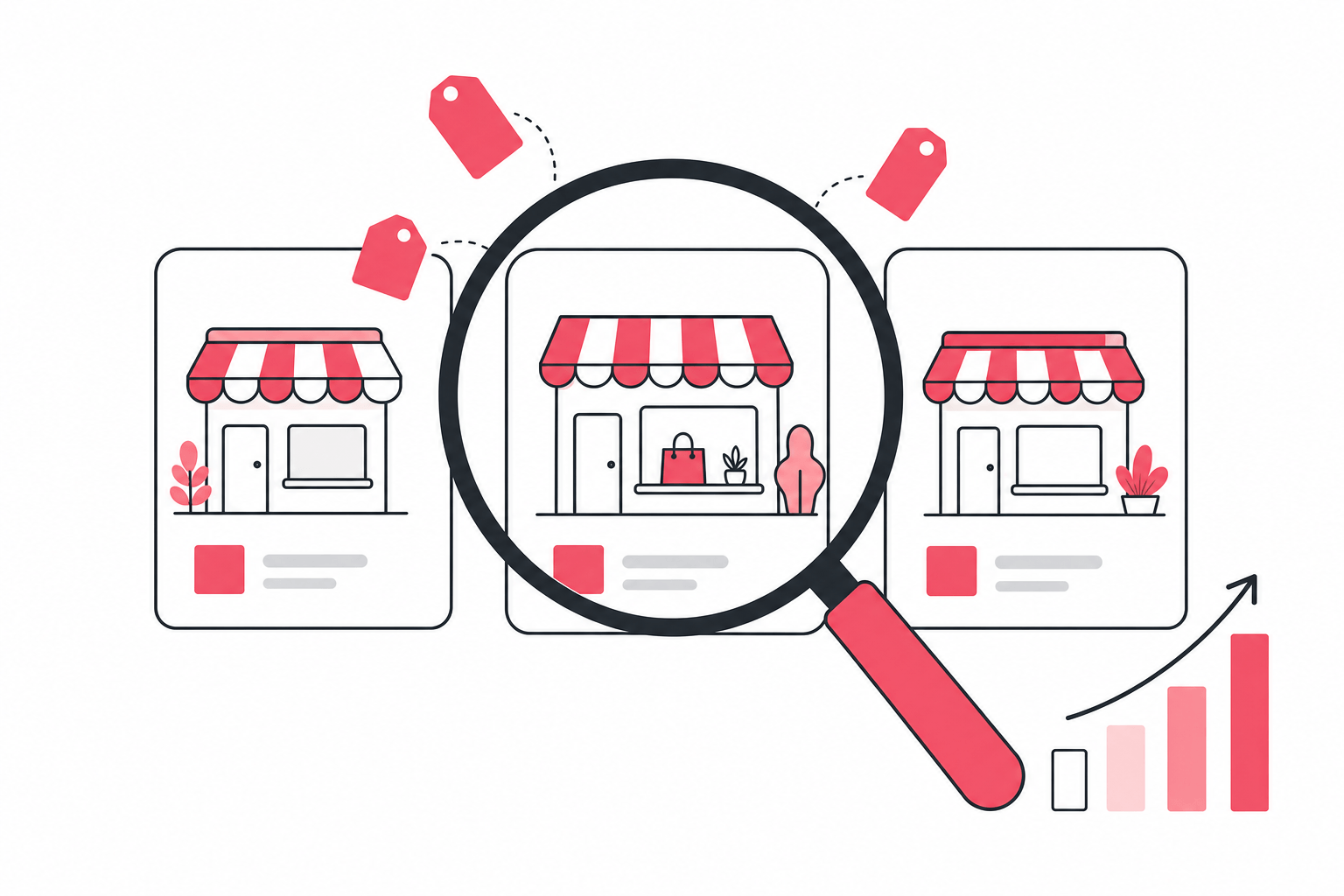
Two things decide whether a category can carry a 26% return rate, and both are readable from outside a store.
Is the category drawing enough traffic to carry the failures? A category where the serious stores are quiet is a category where you will be buying every visitor at auction price and then losing a quarter of the resulting orders at the door. Take home and garden as a worked example. In Koala's data on 18 November 2026, the ranked home and garden storefronts carry a median of about 2.8 million estimated monthly visits each, and the busiest sits above 14 million. That is a category with demand in it. Coverage note: this describes the Shopify stores Koala tracks rather than a census of the platform, and traffic figures are modelled estimates, so use them to compare stores and spot trends.
What do those stores sell, and at what price? This is the decisive read for COD, because it tells you whether the category's economics leave room for returns. Of the ranked home and garden stores Koala tracks, 40 carry a readable monthly app bill and the median is about $17,297 a month, on a median of 14 installed apps. A category whose working stores sustain that kind of software commitment is a category with gross margin in it.
Then open the price points. rugsusa.com, one of the tracked stores at roughly 3.3 million estimated monthly visits with 14 apps installed, published prices from $29 to $579 when we read its storefront on 18 November 2026, clustering at $49, $79, $90 and $99. Those are considered purchases at considered prices. The stores that make home decor work do it at a price point where one delivered order absorbs two legs of freight and a share of the refusals.
Put the two reads side by side and the decision makes itself. Busy category, healthy price points, and your product priced to match: COD is survivable. Busy category, healthy price points, and your product at a third of them: you are competing on a cost structure the category does not support. Quiet category: the return rate is the least of your problems.
The same read tells you where the price ceiling is. If every working store in the category sells above a level you assumed was impossible, your margin problem may be a pricing problem, and the ₹500 to ₹1,000 band carrying the worst return rate in the study is an argument for pricing up rather than down.
How to cut your RTO rate
The data points at three levers, and sellers running COD argue about them constantly.
Confirm the order before it ships. This is the standard move, and the standard objection is that calls annoy people. A thread asking whether COD sellers call to confirm found the split clearly: some sellers say a quick call catches most of the impulse orders, others say customers miss the call, get irritated, or cancel because it feels like extra friction. A message rather than a call is the usual compromise, and the honest version of the rule is that unconfirmed orders are held, not shipped and hoped for.
Screen on address and history before dispatch. The signals sellers name in a thread on what makes them cancel a COD order before it ships are a phone number that does not connect, an address with an area name and no house number, the same number or address repeating across several orders in a short window, a customer who refused a previous delivery, and unusually large quantities on a first order. None of these is conclusive on its own. Together they are the cheapest filter you have, because the most expensive order is the one that never should have shipped.
Take a partial advance on the risky ones. A small prepaid component on borderline orders, high-value orders or regions where your own data shows a bad rate converts a refusal from a loss into a nuisance. It also gives you a per-region test: compare the return rate on partially prepaid orders against the full COD baseline in the same pin codes.
Two more levers come straight out of the study. Buy the faster delivery option where you can, since the gap between a one to two day attempt and a five day attempt is 13 percentage points of RTO. And track your rate by city and by zone rather than as one company number, because a 26% average can easily be 18% in your best market and 35% in your worst, which are two different decisions.
The bill on a single refused parcel is specific. One seller trying to put a realistic figure on fake and changed-mind COD orders listed the full bill on a refused parcel: outbound shipping, return shipping, packaging, product stuck in transit, ad spend that converted into nothing, and the time spent chasing the customer. On a low-ticket product, one refused parcel wipes out the profit from several good orders.
Run the category check on one product this week
The research half of this article is free to do, and it is the step that stops you committing ad budget to a product that cannot carry a normal return rate.
That is what Shop analysis, the Explorer dashboard in Koala Inspector, is for. Open any public Shopify store and the extension gives you the store's category, its total product count, its creation date and last update, its active theme, and its localisation including currency, country and language, with previews of the installed apps, the traffic, the best-sellers, the ad campaigns and the trends. Browsing the catalog and filtering to best-sellers is free too, and the stats header gives the store's product count and its price range high to low, which is the exact read the section above describes.
All of that costs no tokens at all, on the free plan, with no card. Here is the loop:
- Pick the category you are considering and open three stores in it that are clearly busy.
- Read each store's category, product count and theme from the Explorer dashboard to confirm it is a real operation rather than an abandoned storefront.
- Open the catalog, filter to best-sellers, and write down the price range. This is your category price point.
- Compare your intended price against it. If you are at a third of the category's typical price, your margin cannot absorb a 26% return rate.
- Price one delivered order properly. Selling price minus product cost minus two legs of freight minus packaging minus the COD collection fee from your own rate card.
- Divide the failures in. Multiply your freight-and-packaging cost by your expected return rate and subtract that too. What is left is the ceiling on your cost per delivered order.
- Only then set an ad budget, judged on cost per delivered order rather than cost per order.
The free plan includes 15 tokens a month for the deeper screens, which is enough for several Site Traffic reads if you want the traffic volume, sources and geography behind a category rather than only its catalog and prices.
Install Koala Inspector free and run steps one to three on the category you are about to commit to. It takes about twenty minutes and it is the cheapest due diligence available on a payment model that returns one parcel in four.
Cash on delivery dropshipping: FAQ
The questions COD sellers ask once the dashboard and the bank balance stop agreeing.
What is a good RTO rate for cash on delivery dropshipping?+
Judge yourself against roughly 26 percent, which is the share of non-prepaid orders returned across millions of Indian D2C shipments in FY25 according to Shipway's ShipNotes report. Under 20 percent is good, because the best city in that study was Vadodara at 18 percent. Above 30 percent you are close to the worst conditions the data records, which were Patna at 35 percent and any order whose first delivery attempt came after more than five days.
Why does revenue rise while COD profit falls?+
Because the order dashboard counts placed orders and your bank account only receives delivered ones. A returned COD parcel costs you outbound freight, return freight, packaging and the ad spend that bought it, and none of that appears on the day the order lands. Switch every calculation from cost per order to cost per delivered order and the gap closes.
How long does COD money take to reach your bank account in India?+
On Shiprocket the processing time is eight working days from the date of delivery, remittance runs three times a week on Mondays, Wednesdays and Fridays, and the money is expected in your account within ten working days of delivery. Their Early COD option pays out as soon as two days after delivery. Add transit time and roughly three weeks passes between dispatch and cash.
Can a thin-margin product work on cash on delivery?+
Rarely. At a 26 percent return rate, roughly one in four parcels earns nothing and still costs freight both ways, so every delivered order has to carry its own cost plus a share of the failures. If the gross margin on one order is smaller than two round trips of freight plus packaging, the product cannot absorb a normal Indian COD return rate and no amount of ad optimisation fixes it.
Should I offer prepaid only instead of COD?+
Run the switch point rather than the argument. Prepaid orders are returned at under 2 percent against 26 percent for non-prepaid, so prepaid keeps more per order. In the worked example in this article the same ad budget needs about 66 prepaid orders to beat 100 placed COD orders. Measure how many prepaid orders your current spend actually buys, then compare.
Which products survive best on COD in India?+
Products priced where one delivered order carries two legs of freight, packaging, the collection fee and a share of a 26 percent failure rate. The Shipway data also points away from the 500 to 1,000 rupee band, which recorded the highest return rate at 28 percent, and toward faster delivery and shorter distances, since intra-city shipments returned at 20 percent against 27 percent inter-state to non-metro pin codes.
Sources
- MediaBrief, Shipway's ShipNotes report on RTO across Indian e-commerce - the 26% non-prepaid versus under 2% prepaid return rates, the 22/27/35% split by delivery attempt speed, the 25/28/24% split by order value band, the 20% to 28% range by zone, and Vadodara at 18% against Patna at 35%. Based on millions of D2C shipments processed through Shipway in FY25.
- Shiprocket, how soon COD amounts reach a seller's bank account - D+8 working days processing, remittance on Mondays, Wednesdays and Fridays, within ten working days of delivery, and Early COD at two days. Read 18 November 2026.
- Shiprocket, shipping plans and pricing - the ₹45, ₹41, ₹39 and ₹36 average shipment costs across the Lite, Business, Advanced and Pro plans. Read 18 November 2026.
- XpressBees, cash on delivery and digital payment options - COD charges varying by order value, pin code and seller agreement. Read 18 November 2026.
- Reddit, r/smallbusiness on COD sellers whose revenue rises while profit does not - refused orders, courier fees and slow remittance, ad spend judged on placed orders, and the cost of confirmation calls.
- Reddit, r/dropshipping on checking RTO before scaling ad spend - the lag between a promising day-three ROAS and returns landing on day twelve.
- Reddit, r/dropshipping on what fake COD orders actually cost - the full bill on a refused parcel and one refusal wiping out several good orders.
- Reddit, r/dropshipping on what makes a seller cancel a COD order before dispatch - the screening signals, from unreachable numbers to repeat addresses.
- Reddit, r/smallbusiness on whether COD sellers call to confirm orders - the split between sellers who say calls catch impulse orders and those who say they cost conversions.
- Reddit, r/dropshipping on building a COD and DM-driven store in Jordan - card checkouts being rare and almost every sale closing in a DM with cash on delivery.
- Rugs USA, storefront price range - published prices from $29 to $579 clustering at $49, $79, $90 and $99. Read 18 November 2026.
- Koala Inspector store data, 18 November 2026 - the ranked home and garden storefronts at a median of about 2.8 million estimated monthly visits, the 14-app median, the $17,297 median readable monthly app bill across the 40 of those stores carrying one, and rugsusa.com at roughly 3.3 million estimated monthly visits with 14 apps. These cover the Shopify stores Koala tracks rather than the whole platform, and traffic figures are modelled estimates.
November 18, 2026
Cash on Delivery Dropshipping: Where the Profit Actually Goes
Order count climbs, the bank balance does not. Here is the COD arithmetic in rupees: returns to origin, double freight, remittance delay, and the category check to run before you ship.

November 16, 2026
Home Decor Dropshipping Products: Work Backwards From Stores That Already Sell Them
Skip the guessed product lists. Start from the home and garden stores pulling real traffic in Koala's data, read what they sell, and learn the margin and shipping traps unique to home decor.
November 12, 2026
Dropshipping as a Digital Nomad: How to Run Your Shopify Business From Anywhere
Dropshipping is the ecommerce model that travels best, because nothing you sell passes through your hands. Here is what actually changes when you run a Shopify store from another country: connection speeds, visa limits, time zones, and the parts that get harder rather than easier.
November 11, 2026
Print on Demand With No Upfront Inventory: What You Pay Instead, and When
Print on demand removes the inventory bet. Here is what you actually pay before a first sale, what each order costs, how long production and shipping really take, and how to check demand for a design before you commit.
November 9, 2026
Shopify Store Revenue vs Profit: Read a Rival's Real Costs
A competitor's revenue estimate proves demand exists. Here are the three cost lines you can read off any Shopify store before you copy its offer, its stack or its ad strategy.
November 5, 2026
Dropshipping Suppliers With Local Warehouses: The 6-Question Checklist
Where your stock physically sits decides your delivery promise, your duty bill and what a return costs you. Six questions to put to a supplier this week, with the good answer and the red flag for each.
October 27, 2026
ClickFunnels Shopify Integration: How to Connect Them (Classic vs 2.0)
The native ClickFunnels Shopify integration lives in ClickFunnels Classic and handles one job: handing a funnel order to Shopify for shipping. Here are the official setup steps, the Zapier and API routes for ClickFunnels 2.0, and the limits worth knowing before you build.
October 14, 2026
Printful vs Printify vs Gelato: Which One to Commit Your Catalogue To
Printful runs on 24,729 of the Shopify stores Koala tracks, Printify on 13,852 and Gelato on 4,601. Here is what that gap is made of, plan by plan and country by country, and how to check demand before you build a catalogue on any of them.
October 8, 2026
How to Choose a Print on Demand Supplier: Judge Them on What Live Stores Keep Running
Roundups rank print on demand suppliers by catalogue size. Here is a selection method built on four things you can actually test: turnaround, print quality, catalogue fit, and margin after Shopify's monthly bill.

September 22, 2026
How to Test a Dropshipping Product: 5 Free Checks First
Five free checks that say whether a dropshipping product is worth testing, each with a pass or fail rule, plus the sample size and the number that kills it.

September 18, 2026
Best Selling Products on Shopify Right Now (September 2026)
Ten products actually moving on live Shopify stores in September 2026, the store each was observed on, the five traits they share, and the weekly routine that finds the next one.

September 10, 2026
How to Vet a Dropshipping Supplier Before Your First Order
You have a supplier name and a quote that looks good. Here is the eight-point check that tells you whether the company, the photos and the lead times are real, before any money moves.

July 15, 2026
Beauty Dropshipping Winning Products (How to Copy Proven Winners) in 2026
The beauty and personal-care products that sell, and how to find a winner by copying proven stores' best-sellers, apps, and ad angles with the free Koala Inspector.

July 10, 2026
Footwear Dropshipping Winning Products: How to Spot Shoes That Actually Sell
The footwear sub-niches that sell, the margin and sizing traps unique to shoes, and a step-by-step way to confirm a winning shoe by checking real competitor stores.

July 10, 2026
Jewelry Dropshipping Winning Products (and How to Validate Them) in 2026
The jewelry sub-niches that sell, the margin and quality-control realities, and how to validate a pick by reading competitor stores with Koala Inspector.

June 29, 2026
Skincare Dropshipping Products That Actually Sell in 2026
Find winning skincare dropshipping products with margin, repeat-purchase, and competitor signals. See how to copy proven stores with Koala Inspector.
June 22, 2026
Print on Demand Product Research: Find Proven Winners Before You Design
A step-by-step print on demand product research method: study the stores already selling, read their best-sellers and pricing, and validate demand before you create a single design.
June 16, 2026
How to Spot Fake Shopify Sales and Earnings Screenshots
A buyer's guide to telling whether another store's sales claims and earnings screenshots are real before you trust a course, a winning-product claim, or a store-for-sale listing.
September 26, 2025
ShopHunter Alternatives: The Best Free Pick for Dropshippers
ShopHunter starts at $50/month. Koala Inspector is the best free ShopHunter alternative for Shopify store analysis, product research, and competitor tracking.
August 13, 2025
How To Find Dropshipping Suppliers: Best Methods & Platforms. (And How To Spot A Fake)
Explore our ultimate guide to finding the perfect dropshipping supplier. Get insights on product selection, pricing, and best platforms and how to spot a fake.
August 13, 2025
How to Find a Dropshipping Business For Sale
Compare the top 10 marketplaces to buy a dropshipping store, know what red flags to check, and use Koala Inspector to vet any store before you buy.
July 22, 2025
What is the Best Dropshipping Platform for 2026: Top 12 Platforms Analyzed
Compare the 12 best dropshipping platforms for 2026. Honest look at features, pricing, pros, and cons of Shopify, WooCommerce, Spocket, DSers, and more.

July 22, 2025
USAdrop - Everything You Need To Know
USAdrop review for Shopify dropshippers. US warehouse, 1-5 day shipping, product sourcing from China and the USA, pricing, plans, and honest limitations.
June 23, 2025
Dropshipping vs Reselling: Which Is Better?
Compare dropshipping vs reselling on startup costs, margins, control, and risk so you can pick the right model for where you are right now.
June 16, 2025
Is Dropshipping Saturated in 2026? An In-Depth Market Analysis
Is dropshipping too saturated to be worth starting in 2026? We break down the real data, the niches that are actually crowded, and how to find gaps.
June 13, 2025
Automated Dropshipping: The 5 Layers, What Each Costs, and What to Automate First
Automated dropshipping is five separate jobs, not one switch. The apps that run each layer, how common each is across the stores Koala tracks, entry prices, and the order to set them up in.
June 6, 2025
Dropshipping Budget: What 90 Days of a Shopify Store Actually Costs
A worked dropshipping budget for your first ninety days, every fixed figure carrying a link to the company that charges it, plus Koala's own data on the app stack that quietly becomes the biggest line.
June 6, 2025
Dropshipping Success Rate (How To Improve Yours)
Only 10-20% of dropshipping stores reach consistent profit. See why most fail and the 7 concrete steps that move you into the successful minority.
May 30, 2025
How to Start Dropshipping in 2026
A practical guide to starting a dropshipping business in 2026: niche research, real costs, supplier vetting, and how Koala Inspector helps you find winning products.
May 23, 2025
Is Dropshipping Dead? A 2026 Market Analysis
Is dropshipping dead in 2026? We dig into real market data, actual failure rates, and what separates stores still growing from ones that flopped.

May 23, 2025
How To Use Google Trends For Dropshipping: Expert & Advanced Tips
Learn how to use Google Trends for dropshipping product research, niche validation, and keyword timing. Practical tips with real examples.
May 23, 2025
Dropshipping Side Hustle: Turn Your Free Time Into Profit
Is dropshipping a good side hustle? Real numbers on startup costs, time investment, income potential, and what separates stores that stick from ones that fold.
May 23, 2025
Understanding Dropshipping Profit Margins: Tips & Profit Hacks
Essential tips and hacks to increase your dropshipping profit margins, including negotiation with suppliers, pricing strategies, and automation.
May 23, 2025
Dropshipping vs Wholesale: Choosing the Right Model for Your Online Business
Dropshipping and wholesale both have real tradeoffs. Here is a clear breakdown of startup costs, margins, inventory, and which model fits your situation.

May 23, 2025
Reverse Dropshipping Complete Guide & Market Analysis
A complete guide to reverse dropshipping: how it works, the best products to sell, how to find suppliers, and the real pros and cons of targeting emerging markets.
May 23, 2025
How To Make Passive Income With Dropshipping
How to turn a dropshipping store into passive income: automate order fulfillment, build SEO traffic, and reduce daily hands-on work.
May 23, 2025
7 Reasons Why Dropshipping is Hard in 2026
Is dropshipping hard? An honest yes, plus the real hard parts in 2026 (winners, ads, margins) and how to shortcut each one.
May 23, 2025
How to Fulfill Dropshipping Orders on Shopify
Learn how dropshipping fulfillment works on Shopify, compare manual vs automatic vs third-party methods, and find the best apps for 2026.
May 23, 2025
Are Pre-Built Dropshipping Stores Worth It
Pre-built dropshipping stores cost $50 to $5,000+. We break down what you actually get, the hidden costs, and the 10 best places to buy one in 2026.
May 14, 2025
Dropshipping Vs Ecommerce: What's The Difference?
Dropshipping vs traditional ecommerce compared on startup costs, margins, inventory, branding, and risk. Find out which model fits your goals.

May 14, 2025
How to Start Dropshipping for Free
Can you start dropshipping with no money? Yes. Here's a practical 9-step guide to free platforms, free tools, and zero-cost marketing that actually works.
May 14, 2025
13 Common Risks of Dropshipping & How to Avoid Them (2026)
The real dropshipping risks that kill stores in 2026, from unreliable suppliers and thin margins to legal and chargeback exposure, plus how to de-risk each one.
May 14, 2025
Digital Dropshipping: Is It Worth It In 2026?
Learn what digital dropshipping is, how to start, the best products to sell, and which platforms to use. A practical 2026 guide with real pros and cons.
May 9, 2025
Guide to High-Ticket Dropshipping: A Market Analysis & How To Get Started in 2026
How to start high-ticket dropshipping in 2026: best niches, supplier vetting, profit math, and 6 steps to your first premium sale.
April 11, 2025
5 Best Dropship.io Alternatives
Compare the 5 best Dropship.io alternatives for 2026. Koala Inspector is the free way to research winning products and competitor stores. See pricing and best fit.
March 21, 2025
What Is Dropshipping & How Does It Work: The Ultimate Guide (2026)
A plain-English guide to how dropshipping works: the order flow, business models, real profit ranges, and what you actually need to start in 2026.
January 13, 2025
Shopify Product Research: How to Do It + 8 Best Tools (2026)
How to do product research for Shopify dropshipping, step by step, plus the 8 best product research tools for 2026 compared and a quick FAQ.
January 13, 2025
Guide to Finding Profitable Dropshipping Niches in 2026
The 20 most profitable dropshipping niches in 2026, methods to identify them, niches to steer clear of, and strategies to analyze your competition.
January 13, 2025
How to Find Winning Products for Dropshipping in 2026
Learn how to find winning dropshipping products using competitor research, trend signals, and tools like Koala Inspector. Real methods, no guesswork.
January 13, 2025
How To Find Dropshipping Products: 11 Tried & Tested Methods
11 proven methods to find winning dropshipping products in 2026: spy tools, trend research, supplier directories, and real validation tactics.
January 13, 2025
What Is The Cost To Start a Dropshipping Business (2026 Guide)
Real numbers on what dropshipping costs to start in 2026. Breakdown of store setup, legal, marketing, apps, and hidden fees with a full cost table.
April 25, 2024
AI Dropshipping in 2026: How AI Finds Winning Products (and How to Validate Them)
What AI dropshipping actually means in 2026, how AI finds winning products, where it still needs a human, and how to validate an AI pick against real competitor signals.
March 20, 2024
Dropshipping Marketing: 12 Strategies to Market Your Dropshipping Store
12 real dropshipping marketing strategies that drive traffic and sales: paid ads, SEO, email, influencers, retargeting, and more. Practical steps for each.
January 19, 2024
Dropshipping on Facebook: How to Use the Facebook Marketplace
Learn how to start dropshipping on Facebook Marketplace. Covers setup, fees, product research, listing tips, and what to avoid so you don't get banned.

September 19, 2023
Speedee Delivery - Everything You Need To Know
Speedee Delivery is a Midwest regional carrier handling 70,000+ orders daily. Learn what it costs, how long shipping takes, and how to connect it to Shopify.
September 12, 2023
Printify POD
Printify POD explained: how print-on-demand works, what products you can sell, how to connect to Etsy and Shopify, and what to watch for on margins.
July 25, 2023
Dropshipping Reddit for E-commerce Success
How to use Reddit for dropshipping: best subreddits, practical tips, and real marketing tactics that work without getting banned.
June 6, 2023
The Ultimate Guide To Dropshipping On TikTok
A practical guide to TikTok dropshipping: finding winning products, organic vs. paid strategy, dos and don'ts, and how to use competitor research tools.
May 9, 2023
Que es Dropshipping?
¿Qué es dropshipping? Cómo funciona, ventajas, desventajas y cómo crear tu tienda en Shopify. Guía práctica para empezar desde cero.
March 21, 2023
How To Find Best Pet Dropshipping Suppliers
A practical guide to the top US pet dropshipping suppliers, what products to focus on, and how to pick a niche that actually sells.
Written by
Ana Gelevska
eCommerce Content Writer
Ana Gelevska is a content writer with more than five years of experience creating content for eCommerce brands and global clients. She digs into each topic and the people it is for, then turns it into clear, useful articles that Shopify sellers and dropshippers can act on.
Connect on LinkedIn