What Is The Cost To Start a Dropshipping Business (2026 Guide)
 By Ana GelevskaJanuary 13, 2025 · Updated June 4, 2026
Starting a dropshipping business does cost money. The good news is that the starting number is low compared to almost any other retail business, but the full picture is more nuanced than the "$100 to start" claims you see in most YouTube thumbnails.
Most beginners spend between $300 and $1,000 in their first few months. If you include a real marketing budget to test ads and find a winning product, plan on $1,500 to $2,500. This guide breaks down every line item so you can budget accurately before you open your store, not after you've run out of cash.
You can start dropshipping for free if you genuinely want to test an idea first. But if you're building something you expect to generate revenue, the numbers below are more realistic.
How Much Does It Cost To Start Dropshipping
The range is wide because it depends on a few real decisions: which platform you use, whether you run paid ads, and how many products you test before finding one that sells.
A stripped-back store with a free theme, one sourcing tool, and organic social media as your only traffic channel can be set up for under $300 in the first month. A store with a realistic paid-ads testing budget to find a winning product costs $1,500 to $2,000. The global dropshipping market was valued at $365.67 billion in 2024 and is projected to reach $1.25 trillion by 2030, a CAGR of about 22%, so the model itself is not the bottleneck for most starters. Budget clarity is.
Here is the full breakdown.
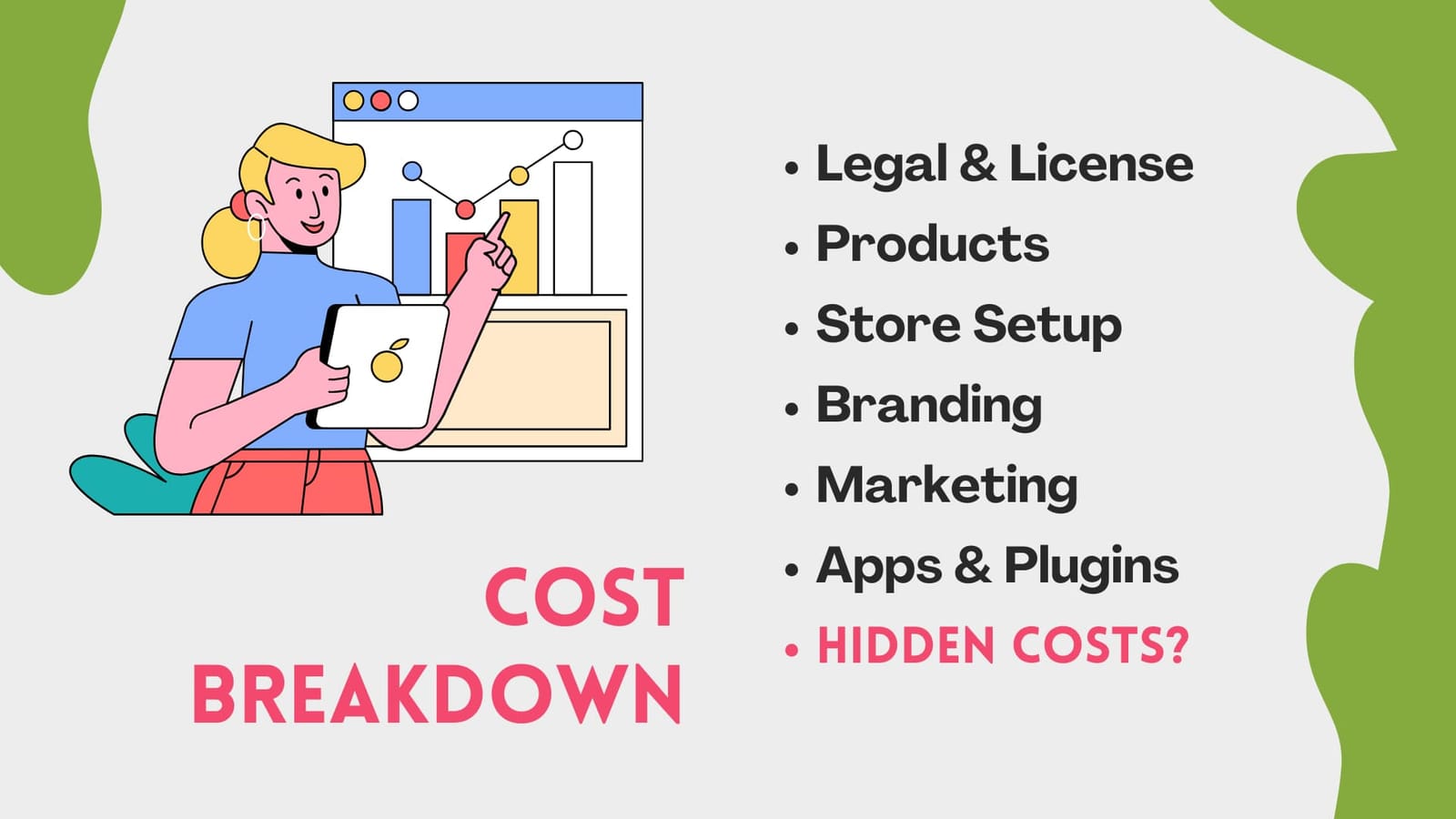
Cost To Start Dropshipping Breakdown
Legal & License Expenses
Requirements vary by state, but here are the standard line items for a US-based dropshipping business:
- Business registration: Filing as an LLC or sole proprietor costs $50 to $500 depending on the state. Delaware and Wyoming are popular choices for lower fees and flexible structures.
- Sales tax permit: Some states require a permit to collect sales tax; many charge nothing for the permit itself. Check your state's revenue department directly.
- EIN (Employer Identification Number): Free from the IRS. You'll need one to open a business bank account.
- Business licenses: Varies by city, county, and product type. A general business license in most US cities runs $50 to $150.
Average cost: $200 to $1,000
Product Cost
You don't pay for inventory upfront in dropshipping, but spending $50 to $150 on product samples before you launch is a hard-won lesson most sellers learn the expensive way. Ordering five to ten samples lets you check quality, measure actual delivery times, and photograph the product yourself, which converts better than supplier stock photos.
Most dropshipping stores source through Alibaba, AliExpress, or platforms like Spocket and SaleHoo. Use the Koala Inspector to spot what products and suppliers successful stores in your niche are already using. That cuts a lot of guesswork out of the sourcing process.
Recommended sample budget: $100 to $150
Cost Of Store Setup
Shopify is the default platform for dropshipping, and for good reason: the app ecosystem, payment processing, and built-in shipping tools are hard to match. Here are the current plan costs billed monthly:
Shopify Basic
$39 per month. Covers unlimited products, 24/7 support, two staff accounts, and access to Shopify Payments (2.9% + $0.30 per transaction). This is where nearly every new dropshipper starts.
Shopify
$105 per month. Adds five staff accounts, professional reports, and slightly lower transaction fees (2.6% + $0.30). Useful once you're generating consistent revenue and need reporting.
Advanced Shopify
$399 per month. Built for high-volume stores with complex shipping and reporting needs. Not relevant until you're well past the startup phase.
One note on payment processing: Shopify Payments charges 2.9% + $0.30 per transaction. If you use a third-party payment processor like Stripe or PayPal instead, Shopify adds an extra 0.5% to 2% on top of that. On international orders, cross-border fees can push total per-transaction costs to 4% to 6%.
For themes, start with a free Shopify theme. Use the Koala Inspector browser extension to inspect what themes competitors in your niche are running, which gives you a shortlist to evaluate without paying for anything upfront.
Average cost: $468 a year (Shopify Basic, billed monthly)
Branding
A logo and some basic visual assets don't need to cost much, but they do need to look credible. Canva handles most of what a new dropshipping store needs:
- Canva Free: $0 (covers basic logo creation, social graphics, and marketing materials)
- Canva Pro: $120/year per user (removes the stock photo watermarks and unlocks resize tools)
- Canva for Teams: $300/year for five users
If you want a custom logo beyond what Canva templates offer, Fiverr designers charge $30 to $100 for a simple brand mark. Skip the expensive branding packages at launch. Customers buy based on product and trust signals, not logo originality.
Realistic branding cost at launch: $0 to $120
Marketing Costs
This is where most starters underestimate badly. Organic traffic takes months to build. Paid ads generate sales faster, but you are paying to learn what works before you find a winning product-audience fit.
A few real numbers from the corpus: the average cost per click on Facebook across all industries runs around $1.72. With a typical ecommerce conversion rate of around 3%, that means roughly $57 in ad spend to generate one sale. For a product with a $30 margin, you're not making money yet. You're buying data.
On Google Ads, average cost per lead varies widely by category but can run $50 or more. A realistic ad testing budget to find a winning product and validate your store is $500 to $1,000. Some sellers spend more. A Reddit thread on r/dropshipping noted that a store doing $10k in monthly revenue had almost $900 disappear before the owner could touch it, split across processing fees, platform fees, and a couple of chargebacks.
Budget for this realistically. Most successful first stores don't find their first winning product immediately.
Recommended marketing budget: $500 to $1,000 minimum
Dropshipping Apps & Plugins
You don't need every app in the Shopify store. A lean setup for a new dropshipping store looks like this:
- SEO Image optimizer: Adds alt tags and image filenames automatically so your product images show up in image search and support your page rankings. The Beginner plan runs $9.99/month ($119.88/year).
- Frequently Bought Together: Shows complementary product bundles on product pages, which increases average order value. Flat $9.99/month ($119.88/year).
- Judge.me: Collects and displays product reviews with automated follow-up emails. Reviews are one of the strongest conversion signals for a store without an established brand. The Awesome plan is $15/month ($180/year).
The Yearly Costs
| App | Monthly | Annual |
|---|---|---|
| SEO Image Optimizer (Beginner) | $9.99 | $119.88 |
| Frequently Bought Together | $9.99 | $119.88 |
| Judge.me (Awesome) | $15.00 | $180.00 |
| Total | $419.76 |
The Total Cost of Starting a Dropshipping Business
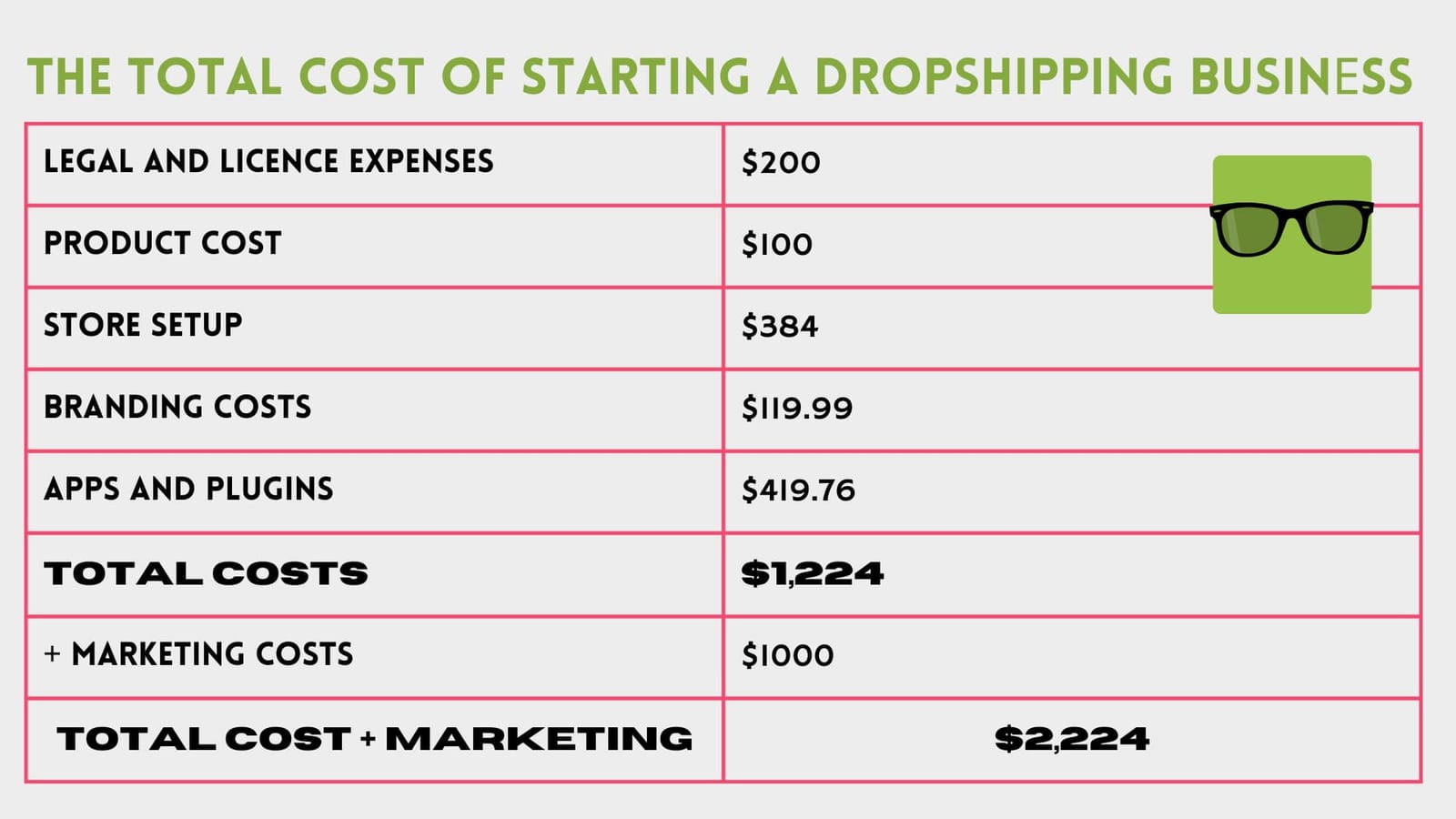
Here is a full rollup of the line items above:
| Item | Cost |
|---|---|
| Legal and Licence Expenses | $200 |
| Product Samples | $100 |
| Store Setup (Shopify Basic, year 1) | $468 |
| Branding Costs | $120 |
| Apps and Plugins | $420 |
| Subtotal (before marketing) | $1,308 |
| Marketing Budget | $1,000 |
| Total with Marketing | $2,308 |
You can run leaner than this. If you skip apps, use a free Canva account, and rely on social media instead of paid ads, you can get a store live for under $400. But the table above is what a realistic first-year cost looks like for someone actually trying to make sales.
6 Hidden Costs Of Dropshipping
Before finding a product that sells consistently, many dropshippers spend more than the startup budget above. These are the costs that don't show up in the headline numbers.
1. Supplier Fees
Dropshipping suppliers and wholesale platforms typically charge monthly subscription fees, transaction fees, or both. Basic plans for sourcing apps start around $20 to $30 per month. As your order volume grows, those fees can climb to $80 to $100 per month. Some suppliers also charge per-order processing fees that run 5% to 10% of the order value.
2. Shipping Costs
Shipping is included in the product price you set, but the actual cost varies in ways that affect your margin:
- Product size and weight: Heavier or bulkier products cost more to ship and more to return.
- Origin and destination: International shipments cost more and take longer than domestic ones.
- Carrier: Different carriers have meaningfully different rates for the same package. Shopping among FedEx, UPS, USPS, and regional alternatives saves money at volume.
3. Return and Refund Costs
Refund handling is one of the costs beginners underestimate most. Options include replacing the product without requiring the customer to return it (cheaper if the product is low-cost), having the customer return to the supplier directly, or absorbing the cost yourself. None of these are free. Build a margin cushion for returns before you set your prices.
4. Currency Conversion Fees
US-based sellers using Shopify Payments are charged around 1.5% for currency conversion on international orders. When you add foreign transaction fees, cross-border Shopify sales can cost 4% to 6% per transaction according to data from Airwallex. On a $50 sale, that is $2 to $3 that doesn't show up obviously on the order page.
5. Storage and Handling Fees
Standard dropshipping means you never touch inventory. But some suppliers charge fees for inventory management, priority handling, or large-volume orders. These are not universal, but they appear frequently enough in supplier contracts to warrant checking before you sign up.
6. Customer Service Costs
Customer service costs are often zero at launch, because you handle everything yourself. Once you start scaling, that changes. Outsourced customer service typically costs $300 to $1,500 per month depending on volume and the platform you use. If you hire someone in-house to handle support part-time, factor that into your cost model before you scale ad spend.
Dropshipping has a genuine low cost-to-start advantage over most retail businesses. But "low cost" is not the same as "free," and the realistic budget for a first year that includes finding a winning product and generating real revenue is closer to $2,000 to $3,000 than the $100 figure that circulates online.
Use the Koala Inspector to skip the guesswork on product research. Seeing what competitors are already selling, what apps they use, and which suppliers they source from saves real money on testing costs.
Written by
Ana Gelevska
eCommerce Content Writer
Ana Gelevska is a content writer with more than five years of experience creating content for eCommerce brands and global clients. She digs into each topic and the people it is for, then turns it into clear, useful articles that Shopify sellers and dropshippers can act on.
Connect on LinkedIn