How to Start Dropshipping for Free
 By Ana GelevskaMay 14, 2025 · Updated June 4, 2026
Starting a dropshipping business with no money is genuinely possible in 2026. The setup costs can be zero if you pick the right combination of free tools and free trials. What costs you something is time: researching niches, building a store, creating content, and handling orders manually until you can afford to automate. That tradeoff is worth understanding before you start, because the people who succeed at free dropshipping treat it as a learning phase, not a permanent business model.
This guide covers the actual steps, the tools that are free (and their real limitations), and what you will eventually need to pay for to grow.
Can You Start Dropshipping With No Money in 2026?
Yes, technically. Shopify offers a 3-day free trial, then $1 per month for the first three months. DSers and Spocket have free tiers. TikTok and Instagram are free to post on. You can string these together and open a live store without spending a dollar.
The honest part: free plans are limited. DSers' free tier caps you at three stores and 3,000 products. Spocket's free plan doesn't let you import products at all, only browse. Shopify's trial ends and the billing starts. None of this is disqualifying, but it means "free" has a shelf life. About 10-20% of dropshipping businesses reach sustained profitability, and the ones that do typically invest in tools and ads once they've validated a product.
The value of starting free is not that it stays free. It's that you can test a niche, figure out the workflow, and find out if there's demand before putting real money in. You can even build a successful online side gig while keeping the day job. Once you see what works, spending on paid ads or a better supplier app is a calculated decision rather than a guess.
9-Step Guide to Start Dropshipping For Free
Here's a practical walkthrough of each step, with specific free tools and what they actually do. 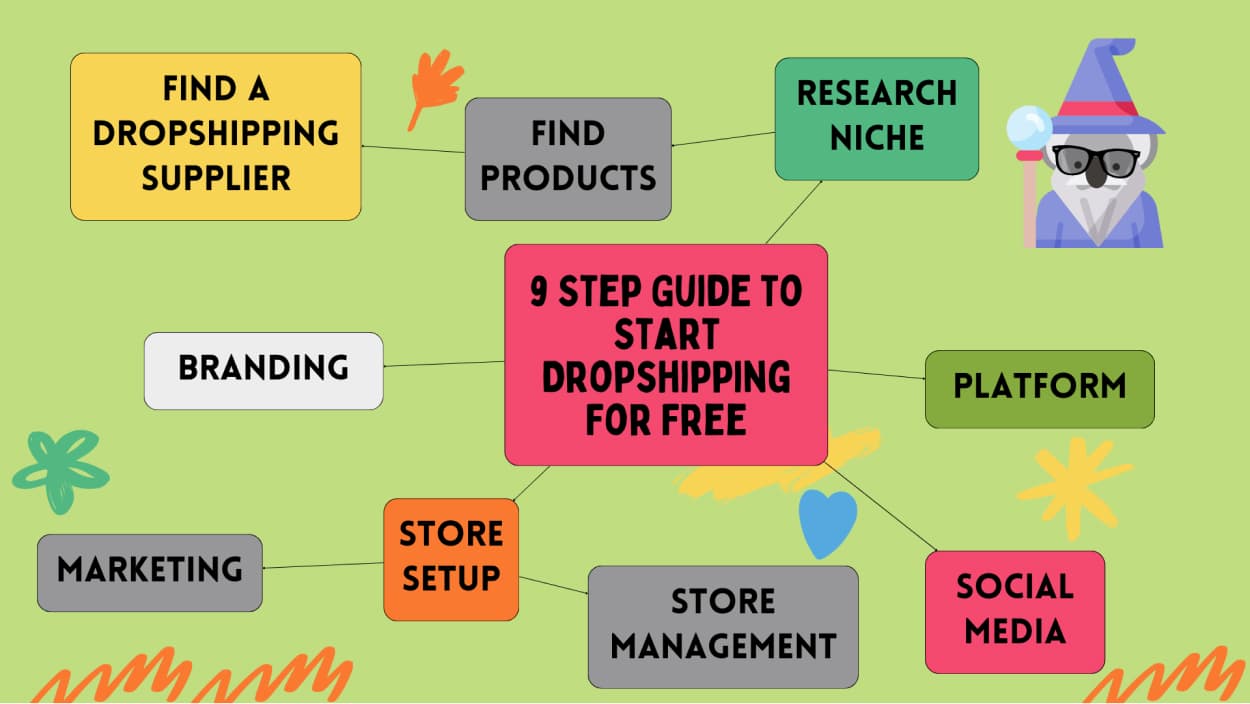
1. Pick a Free Platform
You have two real options:
Free-tier apps like DSers (free up to 3 stores / 3,000 products) let you connect to AliExpress and import products without paying. Spocket's free plan lets you browse but not import. Modalyst has a free plan limited to 25 products. Etsy charges $0.20 per listing but no monthly fee, which makes it viable for small catalogs.
Free trials on paid platforms give you full functionality for a limited time. Shopify's current offer is 3 free days, then $1/month for the next 3 months. Zendrop offers 30 free days on its paid tiers. This is better for testing a complete store setup than a stripped-down free plan.
The practical approach: start with Shopify's trial, connect DSers' free tier, and import products from AliExpress. You get a real store with real functionality for roughly 3 months at $1/month, which is enough time to find out if the niche works.
Social media storefronts (selling directly through TikTok Shop or Instagram Shopping) are technically free but require meeting follower thresholds, which takes time.
2. Research and Find a Profitable Niche
The most common mistake here is picking a niche based on what sounds exciting rather than what has actual search demand. A better method: go to Google Trends and look for queries with steady or rising interest over 12 months, not just a spike. Spikes usually mean a trend is already fading.
Narrow the niche down to where you can say something specific. "Pet supplies" is too broad. "Slow feeders for dogs" is a product category where you can speak to a specific problem and find a specific buyer.
If you want competitive intelligence beyond Google Trends, Koala Inspector can show you what other Shopify stores are actually selling and how their inventories are structured. Seeing what a similar store has as its top sellers is more useful than guessing from category data.
3. Find Products That Sell
Sellable products share some characteristics: they solve a specific problem, they're hard to find locally, and they have a clear "why buy this" that fits in a short caption or product title. Finding winning products requires checking demand before committing to a niche.
Koala Inspector lets you see the full inventory of any Shopify store, their newest additions, bestsellers, and pricing. If a competitor added a product two weeks ago and already has it listed prominently, that's a signal. You're looking for patterns, not copying individual products.
On the supplier side, AliExpress shows order volumes per product. High order counts with good reviews are a baseline signal. The caveat: high volumes on AliExpress often mean high competition. Look for products with solid order history but not the generic versions everyone sells.
4. Find a Dropshipping Supplier With No or Low Upfront Cost
The main no-upfront-cost suppliers for beginners:
- AliExpress - the most accessible, no minimum order, ships worldwide. Shipping times to the US average 15-30 days unless you choose AliExpress Premium Shipping (faster but costs more).
- CJDropshipping - free account, faster shipping options than standard AliExpress, quality control service available for an extra fee.
- Alibaba - mostly bulk orders, but some suppliers on Alibaba accept single-unit orders for sampling.
- HyperSKU - focused on quality control and faster shipping, free to join.
- Crov - US-based supplier catalog, faster domestic shipping.
When evaluating any supplier, look at four things:
- Order fulfillment time - how quickly they mark an order as shipped after you place it. Anything over 3 business days is a customer service problem waiting to happen.
- Review patterns - read the negative reviews specifically. If multiple buyers report items arriving broken or different from the listing photos, move on.
- Shipping options - whether they offer tracked shipping and what the tracking update frequency looks like. Customers expect to see movement on their orders.
- Communication response time - message the supplier before placing any orders. How fast and how clearly they respond tells you a lot about what support will be like if something goes wrong.
You don't have to use offshore suppliers. Trade shows and local business networks can connect you with domestic suppliers, and the product quality and shipping times are generally better. Vintage and secondhand sourcing is another route if you're comfortable with variable inventory.
5. Decide on Branding
Branding at the free stage means making decisions, not spending money. Pick a store name, a color palette, and a tone of voice before you build anything. Write it down. This saves you from redesigning everything later.
For the logo, Canva's free tier is sufficient for most dropshipping stores. Use a simple wordmark or icon that reproduces clearly at small sizes (favicon, product images). Avoid complicated designs that look unprofessional when scaled down.
For email, Zoho Mail's free plan includes one custom domain email address. Having an email address at your store's domain rather than a Gmail address makes the store look legitimate without costing anything.
Extend the same visual treatment to product images. If you're using supplier photos, add consistent overlays, backgrounds, or text treatments so all your product images read as one store rather than a collection of sourced images.
6. Set Up Your Store
The store setup itself is straightforward with Shopify's onboarding. The parts that matter more than the platform are:
- Product descriptions that aren't the supplier's copy. Most AliExpress product descriptions are machine-translated and generic. Rewriting them to speak to a specific buyer (their problem, their situation, why this product helps) differentiates you from every other dropshipper selling the same item.
- Product images that aren't just the main supplier photo. Use multiple angles. If you can order a sample and photograph it yourself, that's the best outcome for conversion.
- A clear return/refund policy. This is the most common question new buyers have. A visible, specific policy (how long they have, how to request a return) reduces hesitation.
Use a free Shopify theme. Dawn is the default and it's well-built. Don't spend time on theme customization until you've validated the niche.
7. Set Up Social Media
Pick two platforms based on where your target buyer actually spends time, not where you're most comfortable. For most product categories, that's TikTok and Instagram. For older demographics or community-oriented niches, Facebook Groups can be more effective than broadcast content.
Set the same username across all platforms. This sounds minor but it matters when someone sees your content on TikTok and tries to find you on Instagram.
The content that works on TikTok is not the content that works on Instagram. TikTok rewards videos that hook in the first 1-2 seconds and feel native to the platform (not produced). Instagram rewards visual consistency in the feed. Plan for this distinction rather than reposting the same content everywhere.
Using trending hashtags increases the chance of your posts appearing on recommendation pages, but it's not a substitute for consistent posting. Posting 3-4 times per week consistently outperforms sporadic high-effort posts.
8. Promote Your Store Using Free Marketing Strategies
Paid ads are where most beginners spend first and get the least out of. Before paying for a single ad, exhaust the free channels:
- Email marketing - Mailchimp's free plan covers up to 500 contacts and 1,000 emails per month. That's enough for early-stage stores. Build the list from day one, even before you have much to say. A simple welcome sequence (what the store sells, what to expect) is worth the setup time.
- Organic social - Consistent posting builds an audience. The compounding effect takes months, not days. The stores that skip paid ads entirely and grow through organic content typically focus on a specific community or interest rather than trying to appeal broadly.
- SEO - Product pages and category pages optimized for specific search terms drive purchase-intent traffic. This is slower than social but produces buyers rather than browsers. Start with your product titles and descriptions. Use the phrases buyers actually search for, not the language suppliers use.
- Competitor research - Before building out any marketing, look at what competitors are doing. Koala Inspector shows the marketing apps a Shopify store has installed, which tells you what channels they're investing in. Seeing a store running a loyalty program and SMS marketing suggests those channels are working for that niche.
9. Monitor and Manage Your Store
The stores that don't make it usually stop looking at the data. The stores that grow use data to figure out what to fix next.
The free tools that matter most:
- Google Analytics 4 - tracks who visits, where they came from, what pages they look at, and where they leave. The most useful early metric is which products get clicks but no purchases. That gap is usually a product description, price, or trust issue.
- Google Search Console - shows what search queries lead to your site, your ranking position for each, and any indexing problems. For a new store, this primarily helps you find keywords that are almost converting (ranking 10-20) that you can improve with better content.
- Hotjar (free tier) - creates heatmaps showing where users click and session recordings showing how they navigate. For a dropshipping store, the product page recording is usually the most revealing: you can see exactly where buyers drop off.
Check these at least weekly in the first three months. When something changes (traffic drops, conversion rate shifts), you want to catch it quickly.
Pros and Cons of Dropshipping For Free
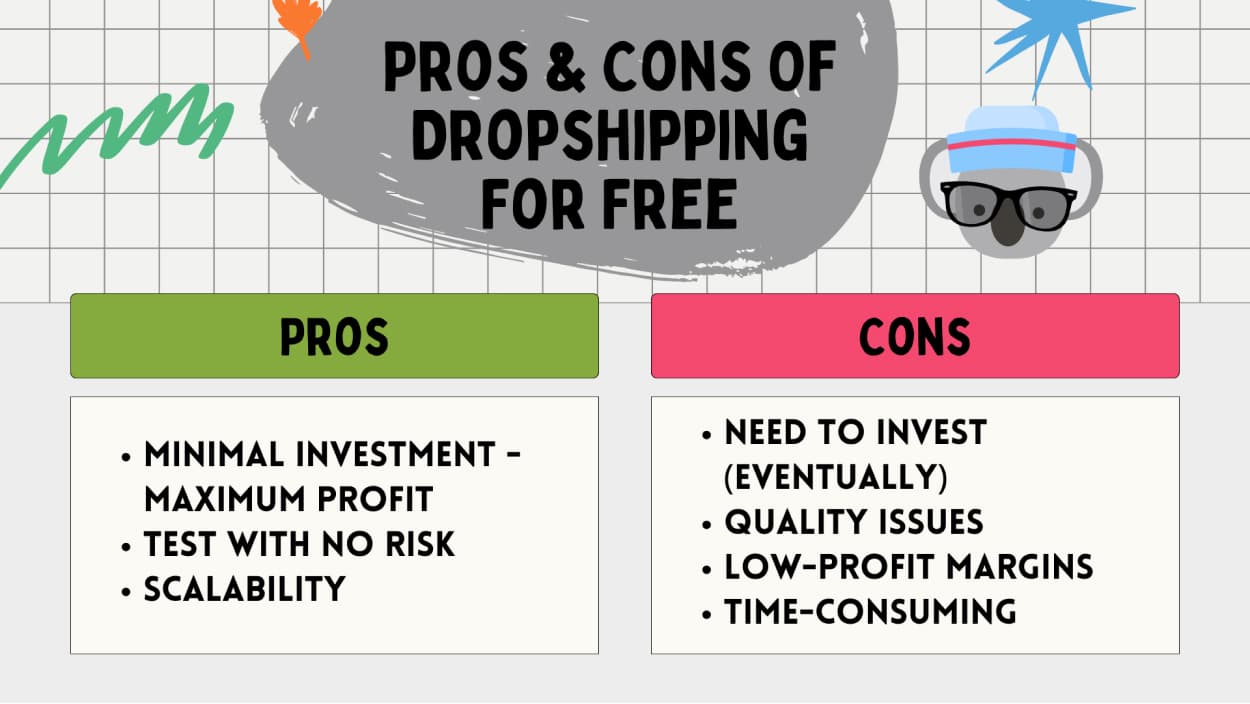
Starting free is genuinely useful for learning. But it comes with real constraints that are worth knowing upfront.
Pros
You can test without losing money. If a niche doesn't work, you close the store and the only cost is time. This is the main reason to start free: it removes the financial pressure that causes beginners to make bad product decisions (holding on to a failing product because they already paid for ads, for example).
The tools are enough to get started. Free tiers of DSers, Canva, Mailchimp, and Google Analytics cover the core functions of a dropshipping business. You're not missing critical capabilities at the start.
You learn the workflow before the stakes are high. Processing your first 20-30 orders manually, handling the first few customer complaints, figuring out how to communicate with suppliers when something goes wrong - all of this is much cheaper to learn when it's not costing you ad spend.
Cons
Free trials end, and free tiers are limited. Shopify's $1/month trial lasts three months. After that, you're on a paid plan or you're not running a store. DSers' free tier works for small stores but has limits that become restrictive as inventory grows.
Organic reach is slow. Building an audience on social media through posting alone takes months. Most successful dropshipping stores that grew without paid ads started with a very specific niche community and became a genuine resource for that community, not just a product feed.
Manual operations take hours. Without paid tools to automate order fulfillment, inventory sync, and customer emails, you're doing everything by hand. That's viable at 5-10 orders per day. At 50, it becomes a second full-time job.
Profit margins are thin by default. When you're dropshipping generic products from AliExpress without any brand differentiation, you're competing on price against sellers who've optimized their supply chains for years. Investing in branding, product photography, and customer experience is what changes the margin picture - and those investments cost money or time.
The honest conclusion: free dropshipping is a legitimate starting point, not a business model you can scale on. The goal is to use the free phase to validate a niche and learn the basics, then invest deliberately in the things that produce returns.
Good Alternatives to Dropshipping With No Money
Free business models that are genuinely viable alongside dropshipping: 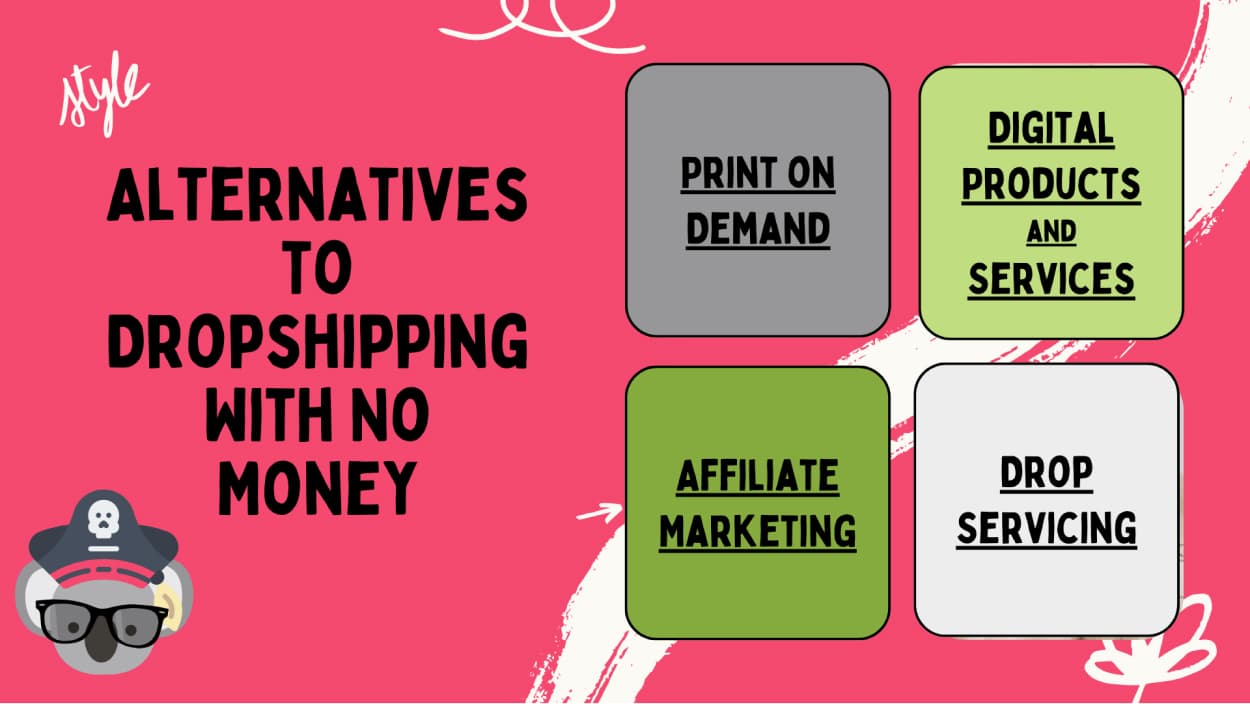
Print on Demand
Print on demand works on the same fulfillment model as dropshipping: you don't hold inventory, products are made and shipped by a third party after each sale. Platforms like Printful and Printify integrate directly with Shopify and Etsy.
The difference is that the product itself carries your design, which creates brand differentiation that generic dropshipping usually lacks. The downside: margins are thinner than standard dropshipping because production costs per unit are higher than bulk manufacturing.
Products available: t-shirts, hoodies, mugs, phone cases, tote bags, stickers, hats, and more.
Digital Products and Services
Digital products (ebooks, courses, templates, presets, tools) have no inventory cost and no shipping complexity. If you have specific knowledge or skills that are useful to others, a digital product is often a higher-margin option than dropshipping physical goods.
This works best when you already have an audience or can build one around a specific topic. Selling a course on "how to set up Shopify" to someone already engaged with your dropshipping content is a natural extension.
Affiliate Marketing
Affiliate marketing means promoting other companies' products and earning a commission on sales you refer. You can include affiliate links in blog posts, social media content, or a dedicated review site. No inventory, no fulfillment, no customer service.
The tradeoff: you need an audience for this to generate meaningful income, and building that audience from zero takes time. The commissions are also smaller than your cut on a direct sale. But it works well alongside a content strategy you're already building for your store's SEO.
Drop Servicing
Drop servicing means selling a service (content writing, video editing, SEO, graphic design) and fulfilling it by hiring a freelancer at a lower rate. You manage the client relationship and quality control; the freelancer does the work.
This requires no upfront product cost and can be profitable faster than physical goods dropshipping if you can source reliable freelancers and price the work correctly. The main risk: delivering poor-quality work damages your reputation permanently.
Starting Your Free Dropshipping Business
The free phase of dropshipping is most useful when you treat it as a structured test. Pick a niche, set up a store, create content, and track what happens. You're looking for early signals: which products get clicks, what content gets engagement, whether there's any organic search traffic.
If those signals are positive after 60-90 days, you have a case for investing in paid tools and ads. If they're not, you've learned something without losing money - which is the actual value of starting free.
The mechanics above work. What makes the difference is how honestly you interpret what the data is telling you and how quickly you act on it.
Written by
Ana Gelevska
eCommerce Content Writer
Ana Gelevska is a content writer with more than five years of experience creating content for eCommerce brands and global clients. She digs into each topic and the people it is for, then turns it into clear, useful articles that Shopify sellers and dropshippers can act on.
Connect on LinkedIn