13 Common Risks of Dropshipping & How to Avoid Them (2026)
 By Ana GelevskaMay 14, 2025 · Updated July 22, 2026
Only 10-20% of dropshipping stores are actually successful. The failure rate isn't because the model is broken, it's because most sellers start without knowing what they're signing up for. The risks are real but they're also predictable. Understand them upfront and you can build a store that survives them.
Is dropshipping risky? The short answer
Yes, dropshipping carries real risk, but almost all of it is predictable and preventable. The model is still legal and active in 2026, and Shopify itself publishes guidance on running it within the rules. Stores don't usually fail because dropshipping is broken, they fail because of a few specific traps the seller never checked for.
Here are the risks that do the most damage, and the fastest way to de-risk each:
- Unreliable suppliers - order samples, keep a backup supplier per category, and study which suppliers proven stores already rely on before you commit.
- Thin profit margins - price at 3x your landed cost, track profit per product, and add upsells to raise order value.
- Market saturation - check the ad and search landscape first, and enter niches that still have room instead of commodity price wars.
- Chargebacks and disputes - set honest shipping expectations, send tracking on every order, and make refunds easy so buyers don't dispute.
- Long shipping times - be transparent on the product page and favor suppliers with US or EU warehouses where margins allow.
- Legal and compliance exposure - avoid branded or unsafe goods, keep a clear returns policy, and get basic GDPR coverage for EU buyers.
- Payment account freezes - use Shopify Payments where available and keep chargeback rates under 1%.
- Weak product and niche research - validate demand and competition with real data before you spend, not after.
The single highest-leverage move behind most of these is competitor research: studying proven Shopify stores shows you which suppliers, apps, and offers already work in your niche, so you skip the traps others paid to learn. Below is the full list of 13 risks with the detail behind each fix.
13 Common Dropshipping Risks
1. Supplier Reliability
Every order you take depends on someone you've never met. If your supplier ships late, runs out of stock during a campaign, or sends products that look nothing like the photos, it's your store's name on the complaint.
A common real-world scenario: you run paid ads and generate 80 orders in a week. Your supplier has a stockout you didn't know about. Now you're manually emailing customers while your refund rate climbs and your ad account's payment reserve gets hit.
What to do:
- Order samples from any supplier before committing. Check the packaging, actual shipping time, and whether the product matches the listing.
- Keep at least one backup supplier per category. When your primary goes down, you need somewhere to route orders without a gap.
- Use Koala Inspector to analyze which suppliers competing stores are using. This is a faster way to vet who's actually reliable versus who looks good on a listing page.
More detail on finding vetted suppliers: finding reliable suppliers.
2. Product Quality Control
You don't handle the product, which means you find out about quality problems after a customer does. High return rates, public negative reviews, and disputes with PayPal or Stripe are all downstream effects of inconsistent quality.
What to do:
- Order samples on a regular schedule, not just at onboarding. Suppliers change manufacturers and material sources without notice.
- Watch your return reason data closely. "Item not as described" and "defective product" reasons from multiple orders in the same category signal a supplier problem, not an isolated incident.
- Put your quality expectations in writing with the supplier before you start selling. It won't prevent all problems, but it gives you something to point to when you need to escalate or switch.
3. Low Profit Margins
The math gets uncomfortable fast once you account for product cost, shipping, platform fees, payment processing, and ads. A product you buy for $8 and sell for $28 might net $4 per order after Shopify's cut, PayPal fees, and a $12 cost-per-acquisition on Facebook.
Sellers on Reddit who hit $1 million in revenue frequently note their net profit was around 25% under good conditions. For most stores, it's lower.
What to do:
- Target products with enough margin to survive a bad ad week. A general rule: your selling price should be at least 3x your landed cost (product plus shipping from supplier to customer).
- Add upsells, bundles, or related products to raise average order value without raising your ad spend proportionally.
- Avoid competing on price in crowded commodity categories. If everyone sells the same phone case, the only way to win on price is to lose on margin.
4. Market Saturation
Some dropshipping niches are so crowded that you're competing against dozens of stores selling identical products with identical ad creative. Car accessories, phone cases, and cheap LED lighting are examples where margins have been driven to near zero by volume competition.
Saturated niches also tend to attract sellers who will undercut your price to win the next sale, which pulls everyone down.
What to do:
- Research the SERP and paid ad landscape before choosing a product category. If the top Google Shopping results are all identical products at near-identical prices, you're entering a price war.
- Look for products where you can add real differentiation: better photos, a specific use-case angle, a bundle that solves a broader problem, or better post-purchase support.
- Use Koala Inspector to spot trending products before they hit peak saturation. The goal is to find a niche that has demand but hasn't been commodity-ized yet.
5. Choosing the Wrong Niche
Too competitive and you can't get traffic at a viable cost. Too obscure and there's no search volume or buying intent to capture. Most first-time dropshippers pick one or the other and waste months on it.
What to do:
- Check Google Trends for actual demand patterns before committing. A niche with steady, year-round interest is less risky than one tied to a seasonal spike or a social media moment that's already peaking.
- Run small test campaigns ($50-100) to measure real click and conversion data before building out a full store in a category.
- Pick a niche where you understand the customer. You'll write better product descriptions, spot supplier problems faster, and respond to customer questions without having to Google everything.
6. Online Scammers (Suppliers and Customers)
Fraud comes from both sides of the transaction. Some suppliers operate through legitimate-looking listings but deliver counterfeit goods, substitute cheaper versions of what you ordered, or simply disappear after you've paid for inventory. On the customer side, chargeback fraud is a recurring problem in dropshipping because of long shipping times. A customer receives the product but disputes the charge, claiming it never arrived.
What to do:
- Verify any new supplier by placing a small test order before listing their products. Check the tracking, packaging, and product quality yourself.
- Use platforms like Koala Inspector to cross-reference which suppliers established stores rely on.
- For customer-side fraud: require tracking on every order, send confirmation emails with tracking numbers as soon as the order ships, and document your shipping carrier records. These records are your defense in a chargeback dispute.
- Watch for suspicious order patterns: extremely large first orders, orders to high-risk regions, or multiple orders to the same address with different payment methods.
7. Financial Risks
Dropshipping feels low-cost to start, but the expenses stack up. Shopify subscription, domain, apps, paid themes, ad spend, payment processing fees (typically 2.9% plus $0.30 per Stripe transaction), and returns. A month of heavy testing on Facebook Ads can wipe out two months of margin gains.
Seller interviews consistently show the same problem: store owners feel profitable because revenue is coming in, but they haven't accounted for all per-order costs. A product with a $12 gross margin and $8 in fees, shipping, and returns generates $4. Multiply that by a 20% return rate and you're at break-even or worse.
What to do:
- Calculate your actual cost-per-order before you start selling a product at scale, including your average ad CPA, not just the supplier cost.
- Track profit at the product level, not just at the store level. A losing product hidden in a profitable store will eventually surface as a cash flow problem.
- Build a cash buffer before scaling. A supplier price increase or a bad week of ads shouldn't threaten the business.
8. Choosing the Wrong Platform
Not all e-commerce platforms are built for dropshipping. Some have high transaction fees that chip away at already thin margins. Others lack supplier integrations, making order routing manual and error-prone.
What to do:
- Shopify is the practical default for most dropshipping stores. It has the best supplier app ecosystem (DSers for AliExpress, Spocket, CJdropshipping, AutoDS) and handles high order volume without needing much technical work.
- Check all-in cost before picking a platform: subscription fee, payment processing, and any additional app costs. A platform with a lower monthly fee but 2% transaction fees on a $50k/month store costs more than Shopify Basic at $39/month with no extra transaction fee if you use Shopify Payments.
- Confirm the platform can handle your eventual scale. Rebuilding a store on a new platform later is expensive.
9. Customer Service
Because you don't control fulfillment, customer service is reactive by default. Shipping delays, wrong items, lost packages, and returns all come back to your inbox, and the supplier is rarely the one handling it with you.
Poor customer service is one of the most direct drivers of bad reviews and chargebacks. The global average cart abandonment rate is around 70%, and post-purchase support quality directly affects whether one-time buyers become repeat customers.
What to do:
- Set up clear shipping time expectations on product pages, not buried in a policy page. If your supplier ships from China with 2-3 week delivery, say that clearly. Customers who know what to expect complain less.
- Create templated responses for your most common support scenarios (delayed shipments, wrong items, return requests). This keeps response time consistent even when volume spikes.
- Have a clear, easy-to-find return and refund policy. Vague policies generate disputes; clear ones generate refund requests you can process cleanly.
10. Building a Brand
Stores that focus purely on product listings with no brand identity are interchangeable. A customer who bought from you once has no reason to come back, and no reason to trust you over the next Shopify store they find.
This matters for long-term profitability. Paid acquisition costs money on every order. If your repeat purchase rate is near zero, you're paying acquisition cost forever.
What to do:
- Pick a coherent store identity: name, visual style, and a clear customer segment. "General store selling everything" is not a brand.
- Build post-purchase touchpoints: confirmation email, shipping update, and a follow-up after delivery. These cost almost nothing and build customer familiarity.
- Use social media to show the products in context. User-generated content and real use-case photos outperform generic product images in both ads and organic reach.
11. Shipping and Fulfillment
Shipping from overseas suppliers (particularly China-based AliExpress sellers) typically takes 2-4 weeks. That's a long time relative to what customers now expect from Amazon Prime. Late deliveries, lost packages, and customs holds all generate customer complaints you didn't cause but have to resolve.
Cross-border shipping is also getting more complicated. The US ended its duty-free de minimis treatment for low-value imports, so shipments that used to enter duty-free now face customs duties. The EU is removing its 150 EUR duty-free threshold as well. These regulatory changes affect landed costs and delivery timelines, so budget for them.
What to do:
- Be transparent about shipping times on your product and checkout pages. Customers who know what to expect complain less.
- Where margins allow, consider suppliers with US or EU warehouses for faster delivery. Spocket, for example, focuses on US and EU-based suppliers.
- Offer tracking on every order. A customer who can see their package moving is far less likely to dispute the charge than one who's waiting without visibility.
12. Legal and Compliance Risks
Dropshipping carries real legal exposure most sellers don't take seriously until there's a problem. This includes selling counterfeit or brand-infringing products (which can result in account termination and legal claims), non-compliance with consumer protection law (return windows, refund obligations, disclosure requirements), and data privacy regulations like GDPR for EU customers.
Product safety is a genuine concern too: regulators across the EU regularly find that a large share of goods sold through international marketplaces fail local safety rules. Selling one of them puts the liability on you, not your supplier.
What to do:
- Avoid selling branded goods (apparel with recognizable logos, electronics with brand names) without explicit authorization. The supplier listing something doesn't mean you have the right to resell it.
- Make your return and refund policy visible and specific. In many countries, sellers are legally required to accept returns within a defined window regardless of what your policy says.
- If you sell to EU customers, get basic GDPR compliance in place: a privacy policy, cookie consent, and clear data handling practices. An app like Consentmo handles the hard part for you, serving a geo-targeted cookie banner, automating data-subject requests, and keeping your tracking scripts compliant across GDPR, CCPA, and similar rules.
13. Payment Gateways and Processing
Some payment processors flag dropshipping businesses as high-risk, particularly if you have high chargeback rates or ship from international suppliers. Account freezes and fund holds can interrupt operations at the worst possible moment.
Chargeback rates above 1% can trigger reviews or terminations from Stripe and PayPal. Dropshipping stores, especially those with long shipping times, are particularly vulnerable to disputes.
What to do:
- Use Shopify Payments if available in your country. It's integrated, has transparent rates, and doesn't add transaction fees on top of Shopify's subscription.
- Keep chargeback rates low by being transparent about shipping times, sending tracking updates proactively, and making it easy to request a refund rather than dispute a charge.
- If you're flagged as high-risk, there are payment processors that specialize in this category (Payoneer, 2Checkout/Verifone). The rates are higher, but they're built for stores with longer fulfillment timelines.
De-Risk Faster by Studying Proven Stores
Most of the risks above share one root cause: guessing. You guess a supplier is reliable, guess a niche isn't saturated, guess an offer will convert, then pay real money to find out you were wrong. Competitor research replaces the guess with evidence, and it's the single cheapest way to skip the traps that sink first-time stores.
The idea is simple. Somewhere in your niche, there are stores already selling the product you want to sell, already profitable, already through the mistakes you're about to make. Everything you can read from their public storefront is a shortcut. Koala Inspector is a free Chrome extension that reads it for you: open any Shopify store and it pulls the store's products, likely best-sellers, installed apps, active theme, and estimated traffic and sales, all from signals any visitor's browser can already see.
Here's how that maps directly onto the risks:
- Supplier and quality risk. The extension's Find Retailers feature takes a product and surfaces other stores and suppliers selling the same item, with a Search in AliExpress shortcut. If a "winning product" turns up under a dozen resellers, you learn it's already widely sourced before you build a store around it. It also points you toward the suppliers proven stores actually use.
- Saturation risk. Before you enter a niche, check the ads and offers real competitors are running. Koala Inspector's Ad Campaigns view shows the Google and Facebook or Instagram ads a store has live, so you can read the current creative and offer landscape instead of walking blind into a price war. Its Product Trends view flags what's gaining momentum so you catch a wave earlier, not at peak saturation.
- Margin and offer risk. Studying a proven competitor's catalog, price points, and bundles shows you the average order value math that already works in the niche, which is far safer than pricing from a spreadsheet guess.
- Platform and app risk. The free App Detector lists every app a store runs, grouped by type. That's a ready-made map of the upsell, reviews, shipping, and support stack a successful store in your category relies on, so you don't over-buy apps or miss a critical one.
- Demand risk. Its Site Traffic view estimates a store's monthly visits, sources, and top keywords, so you can gauge whether a niche has real, durable demand before you commit ad budget to it.
None of this comes from a store's private dashboard. It's modeled from public signals and sampled over time, so treat the numbers as directional rather than exact. Used that way, a few minutes of competitor research turns most of the 13 risks from expensive surprises into things you saw coming. For a deeper walkthrough, see how to find winning products and how to spot fake Shopify sales numbers.
The Market Isn't the Risk
It's worth putting the risk in context. The dropshipping model keeps growing, and demand for the products behind it is not disappearing.
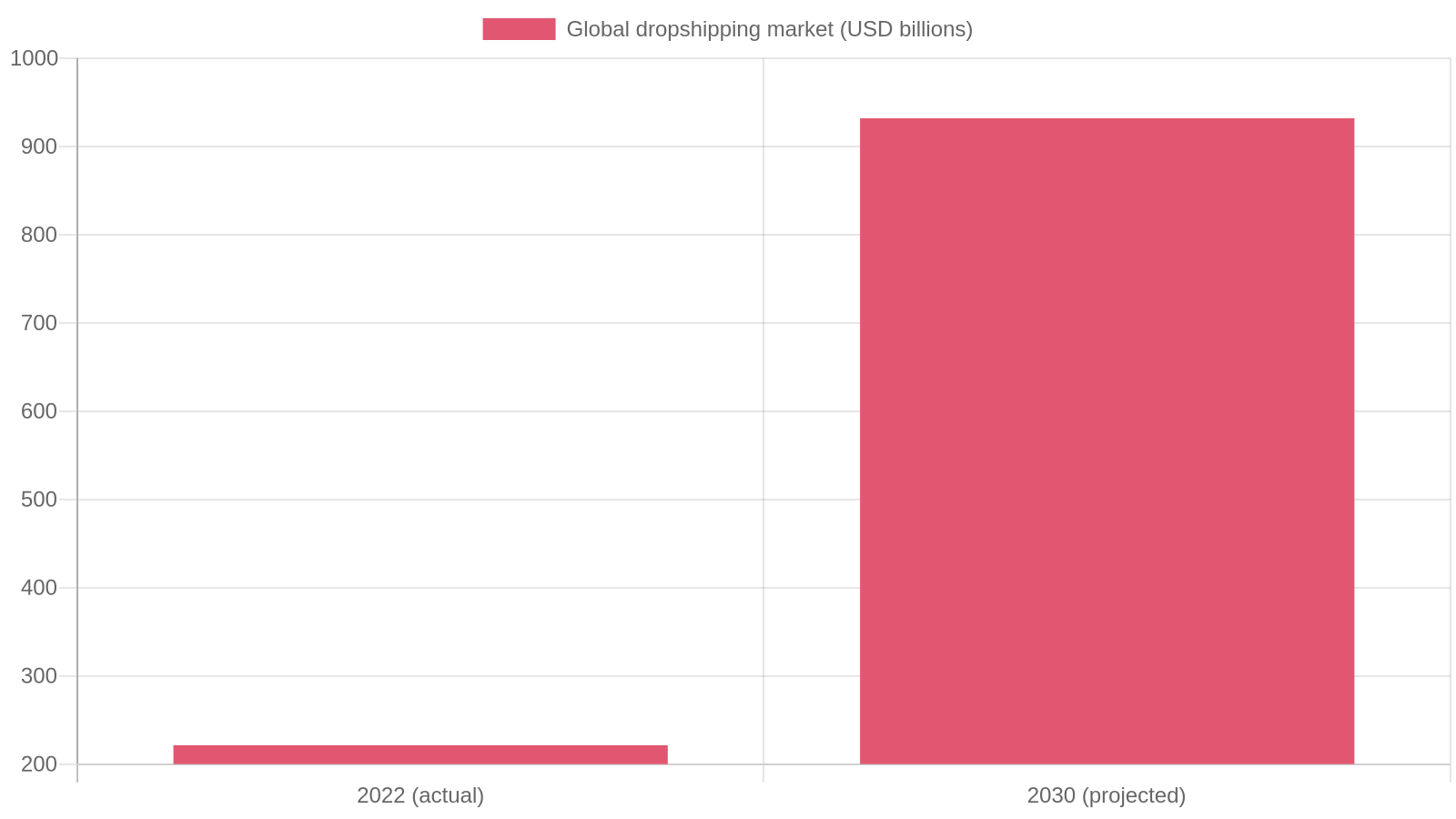
The global dropshipping market was valued at around $221 billion in 2022 and is projected to reach roughly $932 billion by 2030, a compound annual growth rate near 23% (Dropship.io). A growing market doesn't make any single store safe, but it does confirm the risks in this guide are execution risks, not a dying-model risk. The opportunity is real; the discipline is what's optional, and skipping it is what fails stores.
Frequently Asked Questions
Dropshipping Risk FAQ
Straight answers to the questions new sellers ask most about whether dropshipping is worth the risk.
Can I make $10,000 per month dropshipping?+
It is possible but not typical, and it takes time. Most beginners see $0 to $1,000 a month in their first few months, intermediate sellers reach $500 to $5,000, and hitting $10,000 usually means 6 to 12 months of consistent work with high order volume, a healthy average order value, and margins in the 30 to 40% range. The risks in this guide are what stall that climb, so de-risking suppliers, margins, and chargebacks early is what shortens the path.
Can you start dropshipping with no money?+
Almost, but not truly for free. You can research products, study competitors with a free tool like Koala Inspector, and set up a store on a free trial without spending on inventory. What you cannot skip is ad testing budget: reaching real buyers takes money, and starting with too little cash is one of the most common financial risks, because one bad week of ads can wipe out your runway before a product proves itself.
CJdropshipping vs DSers: which one is better for you?+
DSers is the better fit if you source from AliExpress and want fast, bulk order processing straight into Shopify. CJdropshipping fits better when you want sourcing, warehousing, and print-on-demand under one roof, often with US or EU warehouse options for faster delivery. Neither removes supplier risk on its own, so order samples and check real shipping times before you scale on either.
Does dropshipping still work?+
Yes. Dropshipping is still an active, legal model in 2026 and the global market keeps growing. What has changed is the bar to win: sharper product research, faster shipping, honest unit economics, and a store that reads as a real brand instead of a generic template. The sellers who fail usually hit one of the risks in this guide, not a broken model.
Does dropshipping work?+
It works when the fundamentals are right: a reliable supplier, a product with enough margin to survive a bad ad week, a niche that has demand without brutal saturation, and clear shipping expectations. Only an estimated 10 to 20% of stores succeed, and the gap is almost always research and execution rather than the model itself.
Does Shopify automatically fulfill orders for dropshipping?+
Not on its own. Shopify handles the storefront, checkout, and order records, but fulfillment happens through a supplier app you connect, such as DSers, Spocket, CJdropshipping, or AutoDS. Those apps can route orders to your supplier automatically, though you still confirm and monitor them. Shopify does not stock or ship products for you.
The Short Version
Dropshipping risks are real but manageable. The stores that fail usually do so because of one or more of these: a bad supplier they never tested, margins they never properly calculated, or a saturated niche they entered without competitive research.
The stores that last pick reliable suppliers, keep honest track of their unit economics, and build something that gives customers a reason to buy from them specifically rather than from whoever else is running the same product.
Koala Inspector can help with the supplier and product research side, turning most of these risks into things you can see before they cost you. Beyond that, the work is in the details you control.
Written by
Ana Gelevska
eCommerce Content Writer
Ana Gelevska is a content writer with more than five years of experience creating content for eCommerce brands and global clients. She digs into each topic and the people it is for, then turns it into clear, useful articles that Shopify sellers and dropshippers can act on.
Connect on LinkedIn