How To Find Dropshipping Suppliers: Best Methods & Platforms. (And How To Spot A Fake)
 By Ana GelevskaAugust 13, 2025 · Updated July 15, 2026
Finding the right supplier is the single variable that determines whether a dropshipping store succeeds or stalls. The global dropshipping market was valued at $365.67 billion in 2024 and is projected to reach $1.25 trillion by 2030, yet most new stores never make it. A large share of that failure traces back to bad supplier choices: late shipments, quality inconsistencies, poor communication, and outright scams.
This guide covers where to find suppliers, how to vet them before you commit, the main platforms worth considering, and the red flags that signal you're looking at a fake.
How To Find Reliable Dropshipping Suppliers (Quick Answer)
To find a reliable dropshipping supplier, don't take any claim on faith. Vet every candidate against the same short checklist before you list a single product:
- Order a sample and buy it like a customer. Check that the product matches the photos, the packaging protects it, and the tracking updates in real time.
- Measure the real, end-to-end delivery time, not the quoted window. Time it from order to doorstep, including the days it sits before anyone processes it.
- Confirm the full landed cost still leaves a margin. Add product price, shipping, and any platform fees, then check it against your intended retail price.
- Test their support before you sign up. Send a pre-sale question and note how fast and how clearly they reply.
- Verify the business is real. Search the company name with "review", "scam", and "complaint", and look for verifiable registration and a physical address.
- Check what proven competitors already use. The safest supplier is one a successful store in your niche already trusts, and you can check that instead of guessing (more on this below).
Anything that fails a hard check, a refusal to send a sample, a demand for wire transfer or crypto, or prices far below market, is a reason to walk away, not negotiate.
What Suppliers Actually Handle in Dropshipping
Before searching, it helps to be clear about what you're relying on a supplier to do. In a dropshipping setup, the supplier holds the inventory, picks and packs each order, ships it to your customer, and manages restocking. You handle the storefront and customer relationships. That division only works if the supplier holds up their end consistently.
Here are the six functions that matter most:
1. Product Inventory Management
Suppliers should maintain real-time stock counts that feed into your store. If their system runs on manual updates or weekly exports, you will sell out-of-stock items and have to cancel orders, which damages your store's reputation fast.
2. Pricing
Your margin comes from the gap between what the supplier charges you and what customers pay. Suppliers with competitive wholesale pricing let you price attractively while staying profitable. Be skeptical of prices that are far below market rate. In practice, those "deals" usually come with quality that doesn't match the product photos.
3. Shipping Speed and Tracking
Slow shipping is one of the most common reasons customers dispute orders or leave negative reviews. Look for suppliers who provide real tracking numbers (not just a carrier reference) and can ship within the delivery windows you promise.
4. Communication
When a shipment goes wrong or a customer has an urgent question, you need a supplier who responds the same day, not after 72 hours. Multiple contact channels (email, live chat) and a defined response time are worth confirming before you sign up.
5. Quality Control
Returns and refunds eat into margins. Suppliers who run quality checks and match outgoing products to approved samples save you from a steady drip of disputes. Ask specifically about their QC process before you start selling their products.
6. Returns and Refunds
No matter how well you vet products, returns happen. A supplier with a clear return and refund process, one you can explain directly to customers, removes a significant operational headache.
What to Have Ready Before You Start Contacting Suppliers
Reaching out to suppliers without a clear business profile wastes time and often results in worse terms. Before you start, cover these four areas:
1. Pick a Niche
Suppliers specialize. A supplier with strong performance in fitness accessories will have worse lead times, selection, and quality control in home decor. Narrow your focus to a specific category before searching, so you can find suppliers whose core business matches what you want to sell.
2. Understand Who You're Selling To
Supplier requirements vary by customer segment. A store targeting EU customers has different shipping and compliance needs than one targeting domestic US buyers. Know your audience's geography, typical order size, and quality expectations before you start vetting.
3. Set Concrete Requirements
Write down your non-negotiables before talking to anyone: maximum acceptable shipping time, minimum acceptable product quality, whether you need custom packaging, and minimum order quantity tolerance. Having these written down makes supplier comparisons straightforward rather than impressionistic.
4. Know Your Price Range
A supplier's pricing determines your margins. If you're running a high-volume, low-margin model, you need very competitive pricing and bulk discounts. If you're in a premium niche, you can accept higher supplier costs in exchange for better quality and branding options.
4 Types of Dropshipping Suppliers
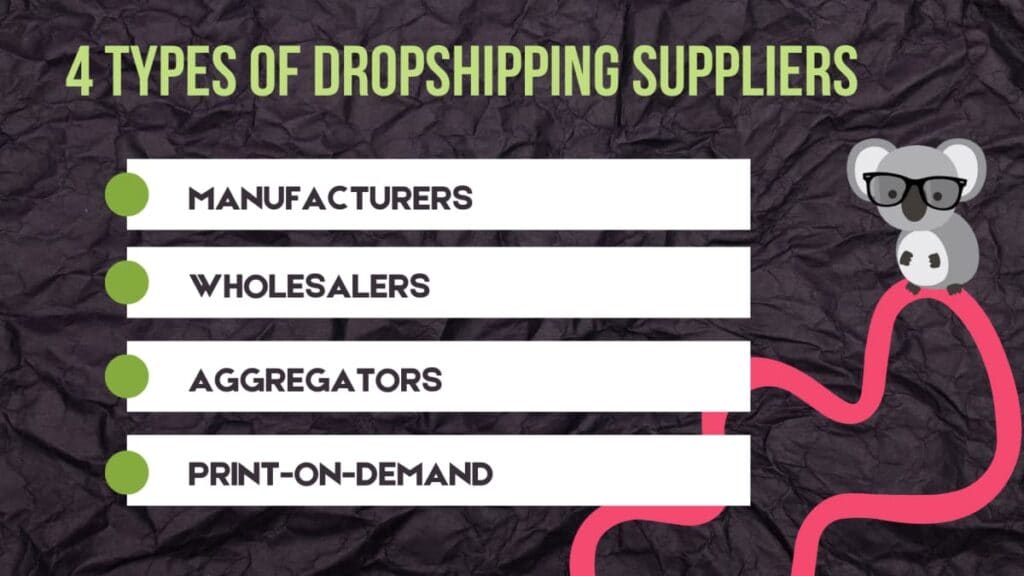
Each supplier type offers different trade-offs between cost, flexibility, and operational complexity. Here is how they compare at a glance:
| Supplier type | Typical cost | Minimum order | Shipping speed | Best for |
|---|---|---|---|---|
| Manufacturers | Lowest per unit | High | Slower | Established stores wanting branding and control |
| Wholesalers | Moderate | Lower | Faster | New stores wanting simplicity over rock-bottom cost |
| Aggregators (marketplaces) | Higher (platform margin) | Very low | Varies widely | Fast product discovery and Shopify integration |
| Print-on-demand | Highest per unit | None (made to order) | Slower | Custom, branded, no-inventory products |
Manufacturers
Manufacturers produce goods directly. Buying from them cuts out middlemen, which can reduce costs significantly, and gives you more influence over product specifications and branding. The trade-offs are real though: minimum order requirements tend to be higher, lead times are longer, and they typically expect a more established business relationship before offering favorable terms.
Wholesalers
Wholesalers buy in bulk from manufacturers and resell to businesses at a markup. Their minimums are lower than manufacturers, and they usually ship faster because inventory is already on hand. Margins are thinner than buying direct from a manufacturer, but the reduced complexity often makes wholesalers a better fit when starting out.
Aggregators (Dropshipping Marketplaces)
Platforms like AliExpress aggregate products from thousands of manufacturers and wholesalers into a single catalog. They make supplier discovery easy and typically offer direct integration with Shopify. The trade-off is cost: you pay a platform margin on top of the supplier's price, which compresses your margins. Product quality across a large catalog also varies more than it does with a vetted direct supplier.
Print-on-Demand Suppliers
Print-on-demand suppliers produce items (clothing, mugs, posters, phone cases) only when an order comes in, applying your design at fulfillment time. There's no inventory risk, and you can offer a wide range of designs without committing to stock. Shipping times run longer, and per-unit costs are higher than wholesale, so they work best for stores built around custom or branded products. Printful and Printify are the most widely used.
5 Methods for Finding Dropshipping Suppliers
1. Competitor Research (Verify Before You Trust)
The single fastest way to find a reliable supplier is to copy the homework of a store that already proved the supplier works. Before you trust any supplier, check what successful competitor stores in your niche actually run.
For Shopify stores, the free Koala Inspector Chrome extension does this from your browser. Open a competitor's store and it shows you, in seconds and at no cost:
- Every app the store runs, grouped by type, so you can see the fulfillment, sourcing, and shipping-tracking tools a working store relies on.
- The exact theme the store uses, with a link to it.
- The store's catalog and likely best-sellers, with prices, so you know which products are actually moving.
From there, the Find Retailers action takes any product and surfaces other stores, marketplaces, and suppliers selling the same item, with their links, prices, and ratings, plus a shortcut to search it on AliExpress. That turns "who supplies this winning product?" into something you can check instead of guess. You can also add a store to Shop Tracking to watch how its apps, products, and prices change over time. Pair it with our database of top Shopify stores to pick which competitors to inspect first. Suppliers that proven stores rely on have already passed a real reliability test.
2. Trade Shows and Industry Events
Trade shows let you see products in person, ask questions directly, and build a relationship before you commit to anything. Suppliers you meet at trade shows have already passed a basic credibility check just by showing up. You can also spot product quality issues or inconsistencies that don't come through in catalog photos.
3. Networking and Referrals
Other dropshippers who've been through the process of vetting suppliers are a genuinely useful resource. Entrepreneur communities on Reddit and Facebook groups dedicated to dropshipping often have threads about reliable suppliers in specific niches. A referral from someone who has actually used a supplier is worth more than any directory listing.
4. Direct Outreach to Manufacturers
Contacting manufacturers directly bypasses intermediary markups and gives you more control over product specs. Start by building a list using ThomasNet, Alibaba, or trade show directories. Search for terms like "wholesale [your product] manufacturer" to find leads. When you reach out, be specific about your order volumes and requirements. Many manufacturers who don't advertise dropshipping are willing to discuss it if you approach them professionally.
5. Supplier Directories and Databases
Directories like SaleHoo, Worldwide Brands, and Doba pre-vet suppliers and provide reviews from other sellers. Most charge a membership fee. The value is mainly in reducing the research time and screening out obvious scams, not in finding suppliers you couldn't find elsewhere. Always do your own vetting even after finding a supplier through a directory.
5 Dropshipping Supplier Platforms Worth Knowing
1. AliExpress
AliExpress connects directly with thousands of suppliers, mainly based in China, and integrates with Shopify through tools like DSers. The catalog is enormous and the prices are competitive. Shipping times from Chinese warehouses to US or EU customers are the main limitation, often 2-4 weeks without expedited options. Quality varies significantly by supplier. Order samples from multiple suppliers before picking one for a product you plan to scale.
2. WeFulfil
WeFulfil is an Australian fulfillment service that handles inventory storage, packing, and shipping. It's different from a marketplace, you send inventory to their warehouse rather than sourcing directly from suppliers. That model gives you more control over quality and packaging, at the cost of added upfront complexity. Better suited to stores that have already validated products and need more reliable fulfillment.
3. Spocket
Spocket focuses specifically on US and EU-based suppliers, which addresses the shipping time problem that makes AliExpress difficult for some markets. Products from Spocket suppliers typically arrive in 2-7 days domestically. The catalog is smaller than AliExpress, but the quality floor is higher because suppliers are vetted. Integrates with Shopify, WooCommerce, and Wix.
4. Modalyst
Modalyst connects you with suppliers in the EU and US, with a particular focus on brand-name and premium products. If you're building a store around recognizable brands or higher price points, Modalyst gives access to inventory that general platforms don't carry. The platform handles product importing and provides real-time inventory updates.
5. Doba
Doba aggregates millions of products from thousands of suppliers into a single catalog. It integrates with major e-commerce platforms and marketplaces including Amazon and eBay. It's best known for the breadth of its catalog and the market research tools it offers alongside supplier access.
How to Find Private Suppliers
AliExpress and large aggregator platforms are easy to get started with, but everyone else is using them too. Private suppliers, smaller manufacturers or regional wholesalers who aren't listed on the major platforms, give you product exclusivity that's hard to compete against.
To find them, look at trade shows and industry directories that serve your niche specifically. Smaller manufacturers exhibiting at niche trade shows often have no existing dropshipping setup. If you approach them with clear volume expectations and professional materials, many will agree to a direct arrangement.
Also watch emerging markets and independent craftspeople who produce high-quality goods in limited quantities. These relationships take longer to establish but produce the kind of product differentiation that's genuinely hard to copy.
5 Steps for Evaluating a Supplier Before You Commit
1. Order Samples
Order samples from any supplier you're seriously considering. Check that the product matches the photos and description, assess packaging quality, and note actual shipping time versus what was quoted. Do this before listing a product, not after.
2. Test Shipping Speed and Tracking
Place a sample order as if you were a customer. Check whether tracking updates in real time, whether the delivery window matches what was stated, and whether the packaging protects the product adequately. This tells you more than any supplier's self-reported shipping estimate.
3. Compare Pricing Carefully
Get the full landed cost: product price plus shipping plus any platform fees. Compare it to market rates for similar products. Build out your actual margin at your intended retail price. A competitive supplier price doesn't help if shipping fees eliminate the margin.
4. Test Their Customer Support
Contact them with a product question before you sign up. Note how quickly they respond, whether the answer is clear and specific, and whether they have multiple channels available. You will need fast responses when real problems come up.
5. Verify Their Legitimacy
Search for the supplier's business name alongside terms like "review," "scam," and "complaint." Look for forum discussions from other dropshippers. Check for verifiable business registration. A supplier that has been operating for years with consistent reviews is a meaningfully lower risk than one with a thin online footprint.
How to Spot Fake Dropshipping Suppliers
Fraud in dropshipping is more common than new sellers expect, and a fake supplier costs you more than the order value alone once chargebacks, lost inventory, and shipping pile on. Identifying a fake supplier before you wire them money is far cheaper than trying to recover afterward. Sellers who share what actually worked after months of testing consistently land on the same lesson: the difference between a store that clicks and one that burns cash often comes down to who you trust to fulfill orders. Here are the main warning signs:
1. No Verifiable Business Registration
Legitimate suppliers have verifiable legal identities. Cross-check company names against official government business registries. If a supplier can't provide a registered business name, a physical address you can verify on maps, and a valid tax ID, treat that as a hard stop.
2. Unusually Low Prices
Prices significantly below what other suppliers charge for the same product category are a classic warning sign. They signal either counterfeit goods, bait-and-switch quality, or a setup designed to collect upfront payments and disappear. Real margins in dropshipping are tight. Suppliers who claim to offer prices that make your margins look easy are almost always not offering what they claim.
3. Requests for Wire Transfer or Crypto Payment
Legitimate supplier platforms process payments through traceable channels with buyer protections. A supplier who insists on wire transfer or cryptocurrency is eliminating your ability to recover funds if they don't deliver. Fake suppliers often build apparent legitimacy over weeks or months before requesting a large advance payment via untraceable methods.
4. Slow or Vague Responses
If a supplier takes more than a business day to respond to a product inquiry, or gives answers that don't actually address your question, that pattern will only get worse once you're relying on them for order fulfillment. Evasive communication about shipping timelines or return policies is particularly telling.
5. No Sample Policy or Refund Process for Defectives
A supplier who won't let you order samples or who has no defined process for defective products is a supplier you can't hold accountable. Legitimate suppliers understand that buyers need to verify quality before committing.
6. Outdated or Thin Product Catalog
An outdated catalog, missing product specifications, no material details, or photos that look lifted from other sites suggests a listing rather than an actual operation. Real suppliers keep their catalogs current because their business depends on it.
7. Negative Patterns in Reviews
A few bad reviews are normal. A pattern of complaints about the same issues, products that don't match photos, shipments that never arrived, refund requests ignored, is a reliable signal. Look beyond the platform's own review system to independent forums and communities.
8. Unprofessional Website or Broken Contact Details
A supplier's website reflects how they operate. Broken links, spelling errors throughout, missing contact information, or a site that looks like it was built in an afternoon are worth noting. While a polished website doesn't guarantee legitimacy, an obviously unprofessional one is a flag.
9. Promises That Don't Match How Dropshipping Works
Any supplier promising guaranteed profits, overnight success, or prices so low that your margins would be exceptionally high is telling you something. Dropshipping margins are typically 10-25%. Suppliers who promise much more than that are either uninformed about their own market or aren't being straight with you about what they're actually selling.
Frequently Asked Questions
How do you vet a dropshipping supplier before you commit?
Order a sample and place it as a real customer would, then check that the product matches the photos, the packaging protects it, and the tracking updates in real time. Confirm the full landed cost (product plus shipping plus fees) still leaves a margin at your retail price. Test their support with a pre-sale question and note the response time. Finally, verify the business exists: search the company name with "review", "scam", and "complaint", and look for verifiable registration and a physical address.
What supplier do most dropshippers use?
AliExpress is the most common starting point because it carries a huge catalog at competitive prices and integrates with Shopify. Sellers who need faster domestic delivery often move to vetted marketplaces like Spocket or Modalyst, which focus on US and EU suppliers. The most reliable choice for any given niche is the supplier your successful competitors already use, which you can check rather than guess.
How can you tell if a dropshipping supplier is fake or a scam?
Warning signs include no verifiable business registration, prices far below market rate, requests for wire transfer or crypto payment, slow or evasive replies, no sample or refund policy, a thin or outdated catalog with borrowed photos, repeated complaints about the same problems in reviews, and promises of guaranteed profits. Any single hard flag, like refusing a sample or demanding an untraceable advance payment, is enough to walk away.
Where do successful competitor stores source their products?
You do not have to guess. Open a competitor's Shopify store with the free Koala Inspector Chrome extension to see its active theme, every app it runs, and its likely best-sellers. Then use Find Retailers on a product to surface other stores, marketplaces, and suppliers selling that same item. Suppliers that proven stores rely on have already passed a real reliability test.
How do you verify a supplier's real processing and shipping time?
Do not trust a quoted shipping window on its own. Place a sample order yourself and measure the full timeline: how long the order sits before processing, how long picking and packing take, and how long the carrier leg actually runs. That real, end-to-end number is what your customers will experience, and it is almost always longer than the headline estimate.
Where can you find vetted, reliable dropshipping suppliers?
Vetted suppliers come from a few reliable places: marketplaces that pre-screen suppliers such as Spocket, Modalyst and Doba; paid directories like SaleHoo and Worldwide Brands that filter out obvious scams; niche trade shows where you can inspect products in person; and referrals from other sellers in dropshipping communities. Always run your own sample-and-support check even after finding a supplier this way.
Written by
Ana Gelevska
eCommerce Content Writer
Ana Gelevska is a content writer with more than five years of experience creating content for eCommerce brands and global clients. She digs into each topic and the people it is for, then turns it into clear, useful articles that Shopify sellers and dropshippers can act on.
Connect on LinkedIn