Dropshipping Vs Ecommerce: What's The Difference?
 By Assaf ShalinMay 14, 2025 · Updated June 4, 2026
Selling online is one thing. Figuring out how to sell online is another. Most people starting an online business face a choice early on: should you stock your own products or find a supplier who ships directly to your customers? That question is what separates traditional ecommerce from dropshipping, and it shapes everything from your startup costs to how much control you have over the customer experience. This guide breaks down both models side by side so you can make the call with your eyes open.
What is Dropshipping?
Dropshipping is a type of ecommerce, but with a specific fulfillment arrangement. You run a store, take orders, and collect payment. The difference is you never hold the products yourself. Instead, you forward each order to a supplier, who picks, packs, and ships directly to your customer.
Your job is to handle the marketing, pricing, and customer service. The supplier handles the physical side. The customer receives a package, often without knowing it came from a third party.
The model has grown fast. The global dropshipping market was valued at $365.67 billion in 2024 and is projected to reach $1.25 trillion by 2030, a CAGR of about 22%. That growth is partly because the startup costs are low and the mechanics are straightforward enough for a first-time seller to figure out.
What is Traditional Ecommerce?
Traditional ecommerce means you buy inventory upfront, store it (yourself or in a third-party warehouse), and fulfill orders from your own stock. This is how most branded online retailers operate. You control what's on the shelf, how it's packaged, and how fast it ships.
With 2.64 billion people buying online in 2023 and global ecommerce revenue at $3.09 trillion that year, the market is enormous. The question is not whether ecommerce works. It is which operating model fits the resources and goals you are starting with.
How Ecommerce Fulfillment Works
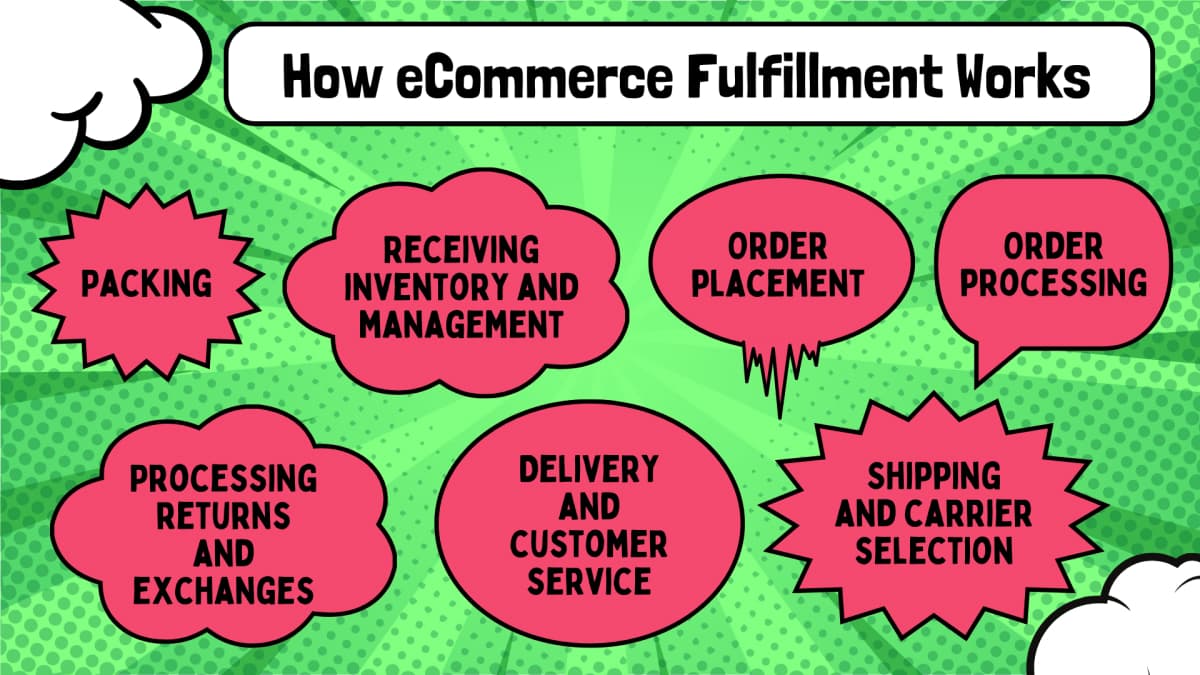
Ecommerce fulfillment is the process of getting an order from your warehouse to your customer's door. The main steps are:
- Receiving inventory from your supplier and logging it into your system
- Processing the order when a customer buys
- Picking and packing the item
- Choosing a carrier and generating a shipping label
- Handing the parcel to the carrier
- Handling any returns or exchanges
Every step is something you own. That is both the strength and the operational burden of the traditional model.
How Dropshipping and Traditional Ecommerce Overlap
The two models share more than people expect:
- Both sell through an online store. Neither requires a physical retail space.
- Both depend on a working relationship with suppliers. No reliable supplier means no inventory and no orders shipped.
- Both reach customers anywhere in the world from a single storefront.
- Both use the same payment processors and platform infrastructure. Shopify, WooCommerce, and similar platforms support both without modification.
The differences live in what happens after a customer clicks "buy."
Dropshipping vs. Ecommerce: The Differences
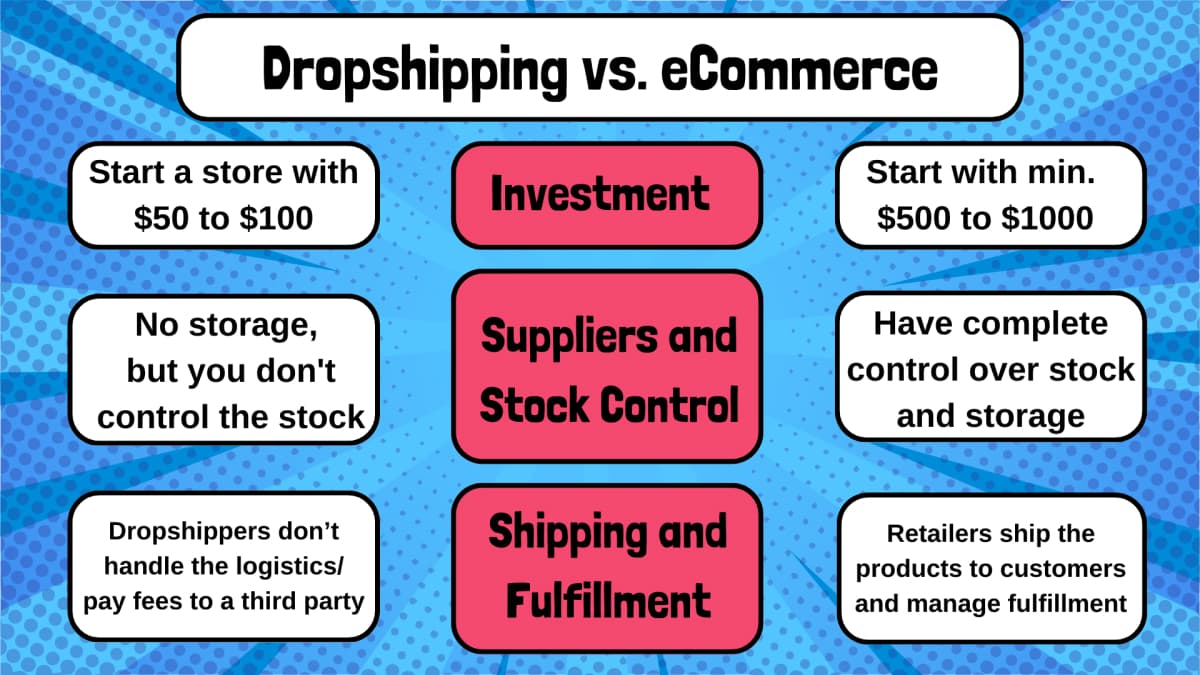
The clearest way to see the difference is to compare the two models on the factors that matter most when you are deciding how to build a store.
Startup Costs
Dropshipping has a much lower barrier to entry. Most beginners spend $300 to $1,000 to get a dropshipping store running, covering a Shopify plan ($39/month on the Basic tier), a domain, and some initial ad spend. You can even set up a dropshipping store for free in the early stages to test a niche before committing.
Traditional ecommerce requires buying stock before you make a single sale. Minimum order quantities, storage space, and the risk of unsold inventory push the realistic starting budget much higher. For a modest inventory-based store, a few thousand dollars is a reasonable floor, and a serious product launch with warehousing can easily run $10,000 or more.
Inventory and Stock Control
In dropshipping, you have no direct visibility into your supplier's stock levels. If a supplier runs out of a product, you may not find out until a customer places an order that cannot be fulfilled. You cannot pre-stage inventory for a sale campaign or guarantee availability during peak periods.
Traditional ecommerce flips this completely. You know exactly what you have on hand, you can reorder before running out, and you can plan promotions around confirmed stock. That control has a price: the cash tied up in inventory and the cost of space to store it.
Shipping and Fulfillment
With dropshipping, the supplier ships directly to your customer. Shipping times and costs vary by supplier location. US and EU-based suppliers typically deliver in 2-7 days. Suppliers shipping from China or other distant warehouses often take 14-45 days, which creates real customer service headaches.
With traditional ecommerce, you control shipping entirely. You choose the carrier, set the handling time, and can offer predictable delivery windows. The tradeoff is that packaging, labeling, and carrier management are all your operational responsibility.
Profit Margins
Margins are one of the sharpest differences between the two models. Traditional dropshipping stores typically see net margins of 10-30% after product costs, platform fees, and ad spend. Branded ecommerce businesses that own their supply chain can achieve 40-60% margins because they buy in volume and control pricing more directly.
This does not mean dropshipping is unprofitable. It means margin management matters more, and a $25 sale with $7-8 in product cost after fees and ad spend is a realistic outcome to plan around, not a disappointment.
Risk Profile
Both models carry real risks, just different ones.
Dropshipping risks center on your supplier. Poor product quality, slow shipping, or a stockout during a campaign can damage your reviews and eat into margins before you can react. The lower barrier to entry also means high competition in popular niches, which compresses prices and makes it harder to stand out.
Traditional ecommerce risks center on capital. Overbuying inventory, picking a product that does not sell, or facing a sudden return spike can lock up cash and hurt profitability. Fulfillment errors, shipping delays, and returns management add operational complexity that scales with order volume.
Branding and Customer Experience
This is where the gap is most visible in practice. A traditional ecommerce seller controls every touchpoint: the packaging, the insert card, the unboxing experience. That is how brands get built and how customers come back for a second order.
Dropshipping limits what you can control. Most suppliers ship in their own packaging with no customization options. Some offer private-label or white-label arrangements, but those typically require minimum order commitments. If branding matters to your strategy from day one, traditional ecommerce is the stronger foundation.
Scalability
Dropshipping scales fast because you are not limited by warehouse capacity or upfront inventory cost. Adding new products means finding a supplier, not buying stock. You can test 50 products in the time it would take to plan a purchase order for five.
Traditional ecommerce scales eventually, but growth requires infrastructure. More sales means more storage space, more staff for picking and packing, and more systems to manage it. The capital requirements grow with the business.
Long-term Sustainability
Dropshipping is a viable long-term business, but the path to sustainability requires solving problems that the model does not solve on its own. Supplier dependence, lack of brand control, and thin margins mean that stores built purely on the dropshipping model often hit a ceiling. The sellers who build durable dropshipping businesses usually develop strong relationships with a small set of vetted suppliers or gradually shift to private-label arrangements as volume grows.
Traditional ecommerce has a clearer long-term brand story, but requires more capital to get there and more discipline to manage inventory profitably.
How to Choose the Right Model
Neither model is universally better. The right call depends on where you are starting from.
Start with dropshipping if:
- You want to test a product or niche without committing capital to inventory
- Your starting budget is under $1,000
- You want to launch fast and iterate based on real sales data
- You are comfortable managing supplier relationships and customer service
Start with traditional ecommerce if:
- You have a specific product or brand in mind and the capital to back it
- Control over quality, packaging, and delivery time is central to your customer promise
- You are planning for repeat purchase rates and brand loyalty from the start
- You can absorb the upfront inventory cost and the risk of unsold stock
A lot of successful ecommerce businesses started as dropshipping stores, used that revenue to validate demand, then moved to owning inventory for their best-selling products. The models are not mutually exclusive. Many operators run both at once, dropshipping new products while stocking proven ones.
Before you commit, be honest about your budget, your tolerance for operational complexity, and how much the unboxing experience matters to the customers you are trying to win.
Written by
Assaf Shalin
Co-founder & Developer, Koala Apps
Assaf Shalin is a co-founder of Koala Apps and one of the developers behind Koala Inspector. He builds the tools that let Shopify sellers see what is actually working in other stores, from installed apps and themes to best-selling products. On the blog he covers the technical side of store research: how competitor research really works, what public store signals can and cannot tell you, and how to turn them into decisions.
Connect on LinkedIn