Shopify Product Research: How to Do It + 8 Best Tools (2026)
 By Ana GelevskaJanuary 13, 2025 · Updated September 4, 2026
Product research for Shopify dropshipping means finding products with proven demand, healthy margins, and reliable supply before you spend a dollar on ads. The fastest way to do it: study Shopify stores that are already winning, see which of their products are selling, confirm the margin holds with real shipping costs, and only then test it. Most stores that fail skipped that validation and picked on gut instinct.
This guide walks the exact process step by step, shows you what to look for in a product, and compares eight tools worth your time in 2026. Jump to the step-by-step method if you want the playbook first.
How to Do Product Research for Shopify Dropshipping (Step by Step)
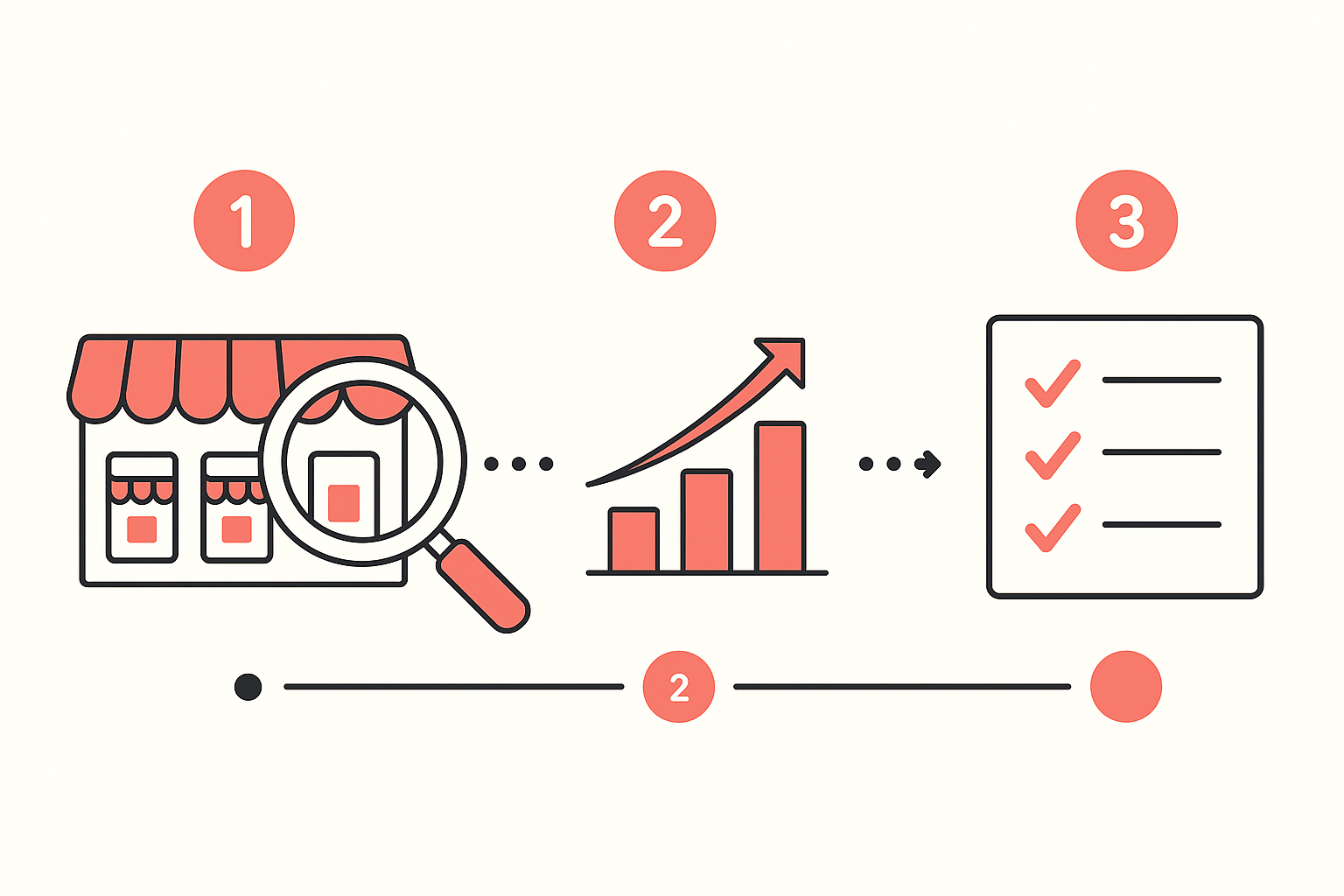
You do not need ten tools to start. The highest-signal method is to reverse-engineer Shopify stores that are already selling, because their winners are products real buyers have already paid for. Here is the process, in order.
Step 1: Find stores that are already winning in your niche
Pick a niche you understand, then build a short list of active Shopify stores in it. You can find them from the ads in your own feed, from a Google search for the niche plus "shop," or by following the brands competitors are clearly copying. The goal is a handful of stores that look like they are spending money and making sales, not hobby shops.
Step 2: Read their best-sellers, not their homepage
A store's bestseller list is the single most honest signal in product research. It tells you which products buyers actually chose with their wallets. Install Koala Inspector, the free Chrome extension, open it on any Shopify store, and the Products screen lets you filter the full catalog to likely best-sellers, with each product's image, price, and variants. Favorite the ones that keep showing up across multiple stores. A product that ranks high in three competitor catalogs at once is a far stronger candidate than anything on a "hot products" feed.
Step 3: Confirm there is active demand, not a dead listing
A product can sit in a catalog without selling. Cross-check the candidates against live demand: open the store's Ad Campaigns view in Koala Inspector to see the Google and Facebook/Instagram creatives it is running, and check the Facebook Ad Library for how long similar ads have been live. An ad that has run for six months or more is almost certainly profitable, because nobody funds a losing campaign that long. Koala Inspector's Product Trends view also surfaces what is gaining momentum right now.
Step 4: Size the opportunity with traffic data
Knowing a product sells is not the same as knowing how big the prize is. Koala Inspector's Site Traffic view gives a store's average monthly visits, the month-over-month change, traffic sources, top keywords, and visitor geography. A store pulling steady search and social traffic to a product you are eyeing is proof the audience exists and is reachable. Thin or collapsing traffic is a warning.
Step 5: Check the margin with real numbers
Use the Find Retailers button on a product to surface other sellers, marketplaces, and suppliers carrying the same item, with their prices, so you can sanity-check sourcing cost and see how widely the product is already resold. Then build the real margin: sale price minus product cost, shipping to your target country, a returns allowance, Shopify fees, and your estimated ad cost per sale. If the math is negative at a realistic conversion rate, drop it now, not after your first ad spend.
Step 6: Track the store and move first
Add the strongest competitors to Shop Tracking. Koala Inspector re-scans tracked stores and logs changes to a per-shop feed: products added or removed, price moves, theme and app changes, and more. When a competitor quietly adds a new product or drops its price, you see it early and can react before the rest of the market. This turns one-off research into an ongoing edge.
For a deeper dive into picking the single best item from your shortlist, read our companion guide on how to find winning products for dropshipping. For a full framework on reading a rival's whole operation, see our Shopify competitor analysis guide.
Why Product Research Makes or Breaks Dropshipping
The math is unforgiving. A product needs to sell at a price high enough to cover the item cost, shipping, ad spend, platform fees, and return rate, with something left over. If you pick wrong, no amount of good copy or slick design fixes it. Yet the most common failure mode is not poor ads -- it is launching a product with no validated demand, or one where the real shipping cost wipes out the margin.
Real pain points from sellers who have been through this process:
- Trending products spike and then crash before you can scale. Arriving two to three weeks late to a viral item is worse than not testing it at all, because you pay the elevated ad CPMs and get the tail end of demand.
- Thin margins collapse when actual costs hit. A product that looks like 50% gross margin can become 10% when you factor in real shipping quotes (not the low-ball estimates suppliers show upfront), chargeback rates, and Shopify fees.
- Competition undercuts you on price. If the product is on AliExpress at $3 and anyone can source it, the only barrier is ad spend -- and that is a race to the bottom.
Good product research identifies problems before they cost you money.
What to Look for When Researching Dropshipping Products
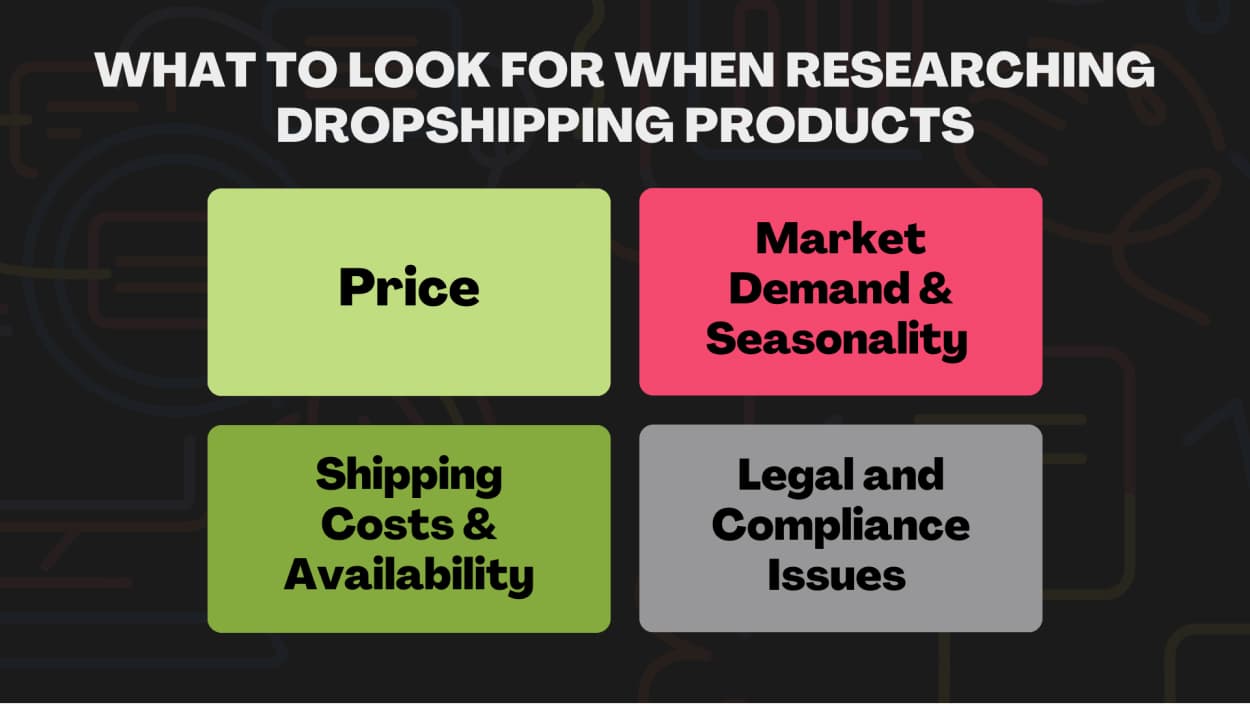
Not every popular product is a good dropshipping product. Here are the filters that separate viable from attractive-looking-but-doomed.
Price and Margin
A common rule among experienced dropshippers is to only test products where you can price above $100 at roughly 50-60% gross margin. That threshold exists because paid ads -- Facebook, TikTok, Meta -- are the primary traffic driver, and the cost to acquire a customer rarely drops below $20-30 for a cold-traffic campaign. Thin-margin, low-ticket products require volume that is hard to achieve without massive ad budgets.
To validate margin before you test:
- Get a real shipping quote from your supplier for your target country, not the cheapest untracked option. On CJ Dropshipping to the US, actual shipping for a mid-weight product often runs $15-25, not $3-8.
- Build a simple calculator: sale price minus product cost, shipping, returns allowance (3-5%), platform fees, and estimated ad cost per conversion. If the number is negative at realistic conversion rates, move on.
- Check what the product sells for on Amazon and domestic retailers. If you cannot price at a reasonable premium over those channels, cold-traffic ads will not convert.
Demand Signals That Are Actually Useful
You need evidence that people are already buying this product, not just that they might. A few reliable signals:
- A competitor has been running the same ad for six or more months. Ads that run that long are almost certainly profitable. Nobody sustains a losing campaign for six months. The Facebook Ad Library and TikTok Creative Center both show when an ad started running -- check there before you invest in creative.
- The product ranks well on Amazon Movers and Shakers. Amazon updates this list hourly based on the largest sales-rank improvements over the previous 24 hours. A product climbing fast there has real purchase intent behind it.
- Google Trends shows sustained or rising interest, not a spike. A spike that already peaked is a product you are too late on. Flat or slowly rising trends indicate steady demand. For seasonal products, confirm the pattern repeats year over year rather than being a one-off.
Shipping Realities
Long shipping times are the fastest way to lose customers. Most buyers in the US, UK, and Australia have been trained by Amazon to expect delivery in two to five days. A two-to-four-week AliExpress shipping window generates refund requests before the product even arrives.
When evaluating a supplier:
- Prioritize suppliers with a three-to-five-day processing time and tracked shipping options to your target market.
- Check whether the supplier ships from a local warehouse (common for popular items at agents like CJ or USAdrop). Local warehouse stock ships in days, not weeks.
- Get lead time commitments in writing. Suppliers often give optimistic estimates that slip during peak seasons.
Legal and Compliance Issues
Some products that sell well are genuinely difficult to dropship at scale:
- Products with safety certifications required (electronics, children's items, health devices) need documentation you may not be able to get from a third-party supplier.
- Branded or trademarked items are a fast way to get your Shopify store and ad accounts shut down.
- Restricted items vary by market. What ships freely to one country may be banned or heavily regulated in another.
Before you build a store around a product, spend fifteen minutes confirming it does not fall into any of these categories for your target market.
3 Ways to Do Dropshipping Product Research
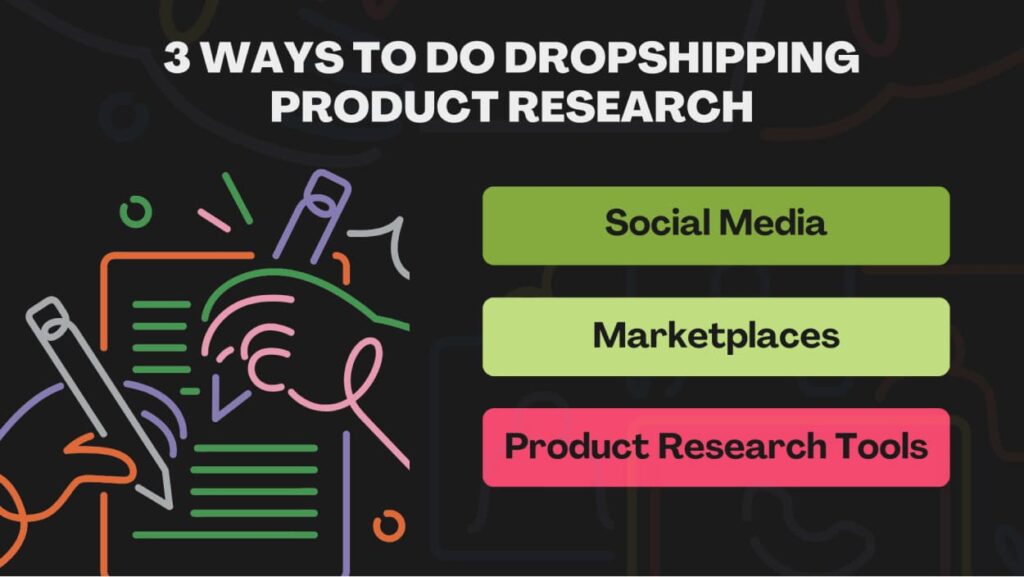
Study Competitor Ads
The fastest shortcut to finding products people are actually buying is to look at what competitors are spending money to advertise. A business only runs ads at scale if those ads are producing revenue. The tools for this:
- Facebook Ad Library: Free, no account required. Search by advertiser or keyword. Filter by "active" ads and look at the start date. Ads running consistently for six or more months are almost certainly profitable.
- TikTok Creative Center: Shows top-performing ads by category, engagement rate, and region. Useful for identifying products getting traction on short-form video before they saturate.
- Koala Inspector: Install the Chrome extension, visit any Shopify store, and see their best-selling products, estimated traffic, and active marketing campaigns. This is competitor research done in two minutes instead of two hours -- more on this below.
When you find an ad that has been running for months, the product has validated demand. Your job then is to find the supplier, price it right, and build a better funnel than whoever is already running it.
Use Search and Marketplace Signals
Search volume and marketplace rankings tell you about the size of an existing audience:
- Google Trends: Compare multiple products or variations. Look for consistently high interest, not just a recent spike. The comparison feature is particularly useful -- it shows you whether interest in "ice nugget makers" is rising while "ice machine" stays flat, for instance.
- Amazon Movers and Shakers: Updated hourly, shows products with the largest sales rank improvement in the past 24 hours. Items that appear here repeatedly over several days have genuine purchase momentum.
- AliExpress bestsellers: Sort by orders and look at reviews carefully. High order counts indicate consistent demand. Recent reviews mentioning shipping speed and quality give you supplier reliability signals.
The limitation of marketplace research is that it shows what is already popular, not what is about to trend. Pair it with ad library research for a fuller picture.
Use a Dedicated Product Research Tool
Manually tracking ads and marketplaces works, but it is slow. Dedicated tools aggregate signals across platforms and surface patterns faster:
- They track which products are getting new ads created and scaled, which indicates early traction.
- They show estimated revenue from competitor stores, which lets you size the opportunity before you commit.
- Some include supplier matching, which saves time once you have identified a product worth testing.
The tradeoff is cost. Most decent tools run $30-50/month. If you are validating your first product on a tight budget, start with free methods. Once you are generating revenue, a research tool pays for itself quickly in time saved. We cover the best options below.
For advanced tactics using search data specifically, see our full guide on Google Trends for dropshipping.
8 Best Dropshipping Product Research Tools
Koala Inspector
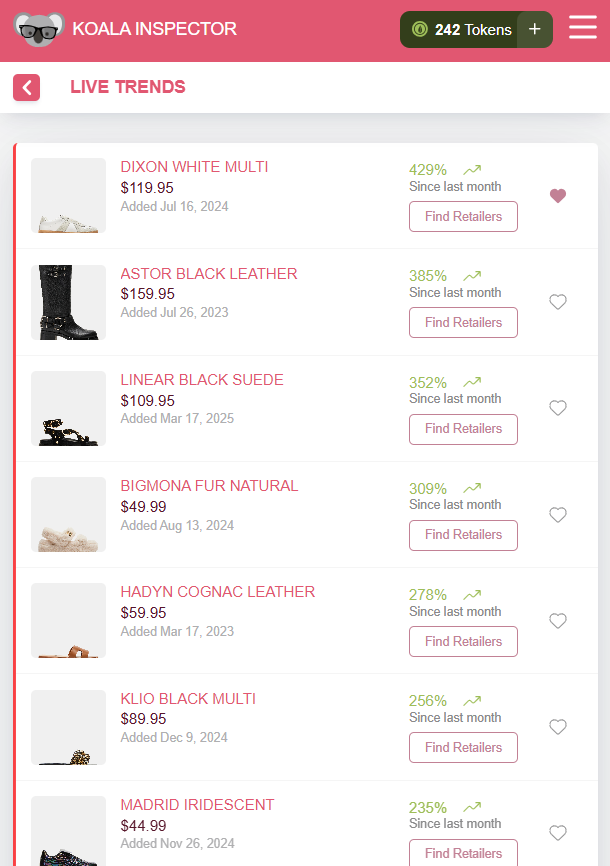 We're biased, but with over 250,000 users, Koala Inspector earns its place as the go-to competitor intelligence tool for dropshippers. Install the Chrome extension, visit any Shopify store, and within seconds you see their best-selling products, top-performing ad campaigns, supplier details, Shopify theme, traffic estimates, and more.
This is particularly useful for the ad-led research method described above. You spot an interesting ad, click through to the store, activate Koala Inspector, and immediately know what their bestsellers are -- without guessing. It cuts the "reverse-engineering a competitor" process from hours to minutes.
The free version covers basic functionality with 15 tokens per month, including product statistics, store structure, and bestseller and new-product views. The Premium plan is $22/month and includes 220 tokens, tracking for up to 50 shops, and VIP support. One-time token top-ups are available and never expire: 10 tokens for $3.99, 25 for $6.99, or 100 for $11.99 (best value).
Features:
- Product performance and dropshipping analytics.
- Supplier reliability data.
- Competitor store bestseller and inventory tracking.
- Monthly visitor estimates.
- Product title and description generator.
- Automatic orders.
Pros:
- Turns competitor research into a two-minute task.
- Supplier data alongside product data in one view.
- Consistent updates based on user feedback.
Cons:
- Free plan is limited to 15 tokens per month.
- Premium plan may be more than a beginner wants to spend before their first sale.
SaleHoo
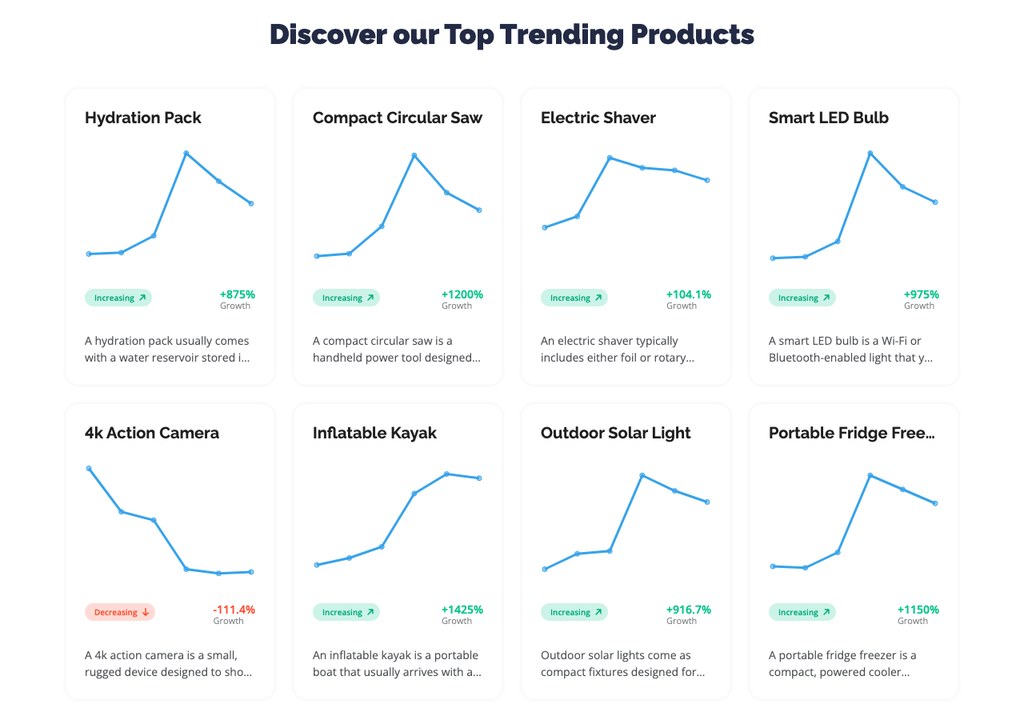 SaleHoo runs product research and supplier sourcing off the same subscription. Market Insights tracks demand, competition, and pricing across platforms, so you can weigh sell rate, average price, and trend direction before you commit to a niche. Behind it sits a directory of 8,000+ hand-checked global suppliers, filterable by product type, price range, and supplier type, which closes the gap between a product that looks good and a supplier who can actually ship it. One-click import then moves the winner into your Shopify store.
Plans: Starter at $9/month and Pro at $49/month, both billed annually (or $299 and $1,699 as one-time payments); Enterprise at $499/month. All plans carry a 60-day money-back guarantee.
Features:
- Product research with demand, competition, and pricing trend data.
- Directory of 8,000+ vetted global suppliers, filterable by product type, price range, and supplier type.
- One-click product import to Shopify.
- Built-in profit calculator and supplier outreach templates.
Pros:
- Product validation and supplier sourcing sit in the same platform, so a shortlisted product comes with somewhere to buy it.
- Every supplier is hand-checked, which takes the scam risk out of cold sourcing.
- Lowest paid entry price on this list at $9/month.
- 60-day money-back guarantee.
Cons:
- Paid plans are billed annually, so there is no month-to-month option.
- Built for sourcing and validation rather than competitor research, so it will not tell you what a specific Shopify store is selling.
- The smoothest workflows, one-click import and store connections included, assume you are on Shopify.
DSers
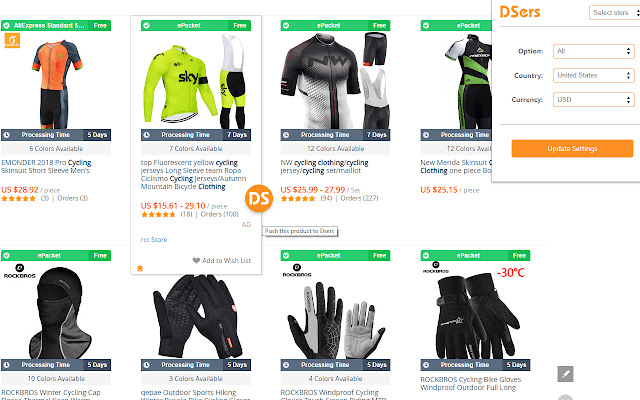 DSers is built primarily for AliExpress-based dropshipping and handles the order management side well. Its strength is bulk order processing -- you can fulfill hundreds of orders to AliExpress suppliers in a fraction of the time it would take manually. It supports multiple suppliers for the same product, so you have a backup if your primary supplier runs out of stock.
Plans: free basic plan; paid plans start at $19.90/month (Advanced), $49.90/month (Pro), and $499/month (Enterprise).
Features:
- Bulk order processing.
- Multi-supplier management.
- Order tracking and fulfillment.
Pros:
- Handles high order volume efficiently.
- Multi-supplier support reduces stockout risk.
- Competitive pricing at the entry tier.
- Clean, straightforward UI.
Cons:
- Certain features locked behind paid tiers.
- Can feel overwhelming for first-time users.
Niche Scraper
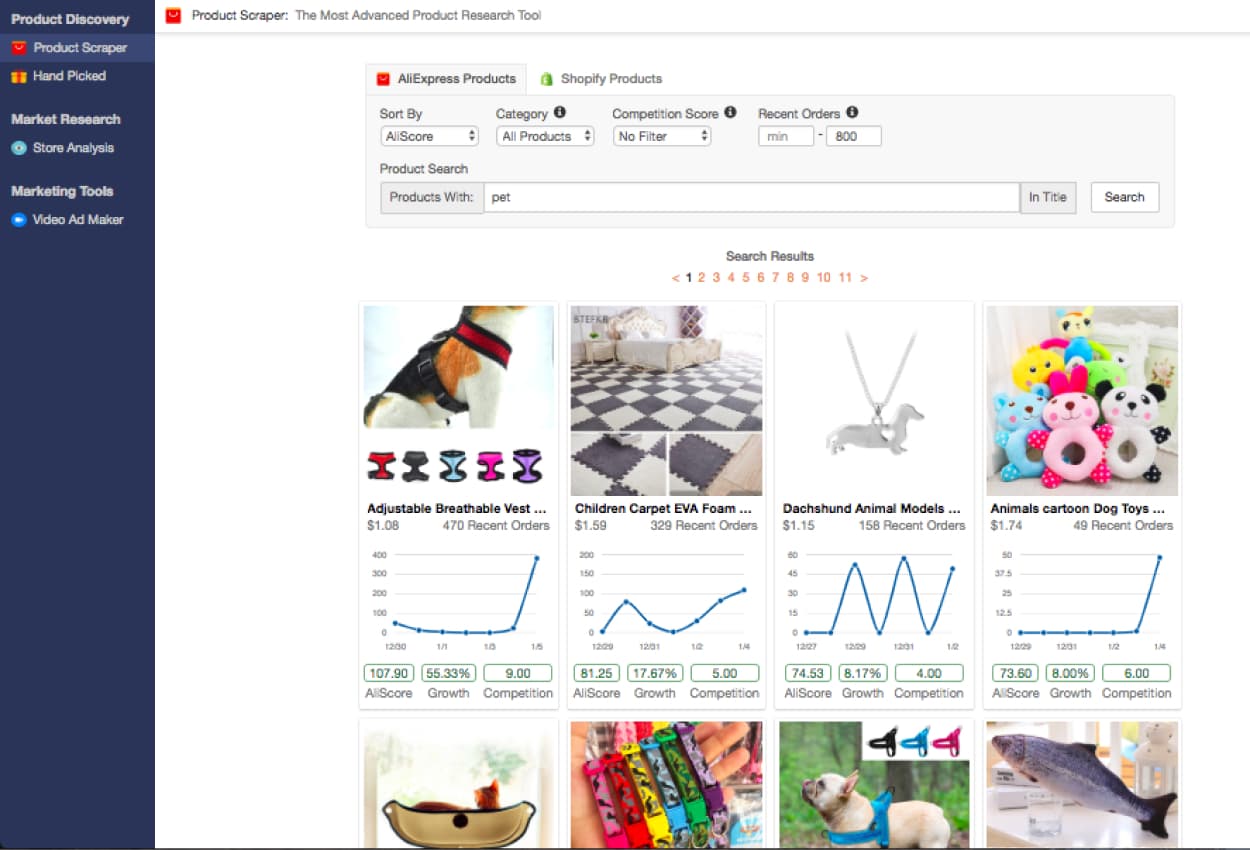 Niche Scraper identifies trending products by analyzing sales velocity across AliExpress and Shopify stores. It also gives you data on social media engagement, which is useful for assessing whether a product has viral potential on TikTok or Instagram. The "scrape" feature lets you pull top-selling products from any Shopify store and see estimated revenue.
Plans: free tier with limited access; $49.95/month or $199/year for Pro. The annual plan works out to about $16.50/month.
Features:
- Trending product identification with sales data.
- Social media engagement analysis.
- Competitor store scraping.
Pros:
- Useful combination of marketplace and social signals.
- Product recommendations updated regularly.
- Dashboard is easy to navigate.
Cons:
- Monthly plan is priced high relative to what you get at the free tier.
- Store scraping data can lag behind real-time trends by a few days.
Sell The Trend
Sell The Trend combines product research with a store builder, which is useful if you want to go from "product found" to "store live" quickly. It pulls trend data from AliExpress, Amazon, and Shopify, tracks Facebook ad activity, and includes a video ad creator. The research side covers market saturation estimates and profit margin calculators.
Plans: 7-day free trial; $39.97/month or $32.97/month annually.
Features:
- Multi-source trend tracking (AliExpress, Amazon, Shopify).
- Facebook ad analysis.
- Built-in store builder.
- Profit margin calculator.
Pros:
- Combines research and store building in one tool.
- Facebook ad data alongside product data.
- Profitability metrics built in.
- Clean UI.
Cons:
- More expensive than most standalone research tools.
- Takes time to learn all the features.
Jungle Scout
Jungle Scout was built for Amazon sellers and remains strongest there, but the underlying product demand data applies to dropshipping too. If you find a product with strong Amazon demand and limited competition, that is a signal worth acting on. Its keyword research and sales estimate tools help size the market before you commit.
Plans: Basic at $29/month (browser extension + product research); Suite at $49/month (add keyword tracking and store management); Professional at $84/month (advanced features for high-volume sellers).
Features:
- Product demand and sales trend data.
- Competitor tracking.
- Profitability calculators.
Pros:
- Well-established, reliable data.
- Strong Amazon market coverage.
- Intuitive interface.
- Solid customer support.
Cons:
- Monthly cost adds up.
- Best value for Amazon-focused sellers; less tailored for pure dropshipping.
Ecomhunt
Ecomhunt curates a daily list of products its team believes have winning potential, alongside Facebook ad examples, targeting suggestions, and AliExpress supplier links. It is more hands-off than a raw data tool -- you are trusting their curation rather than running your own analysis. That can save time, but it also means you are looking at the same products as every other Ecomhunt subscriber.
Plans: Free (limited to 3 product tracker sessions, 10 live trending products, basic database access); Basic at $23/month; Pro at $39/month; Suite at $49/month.
Features:
- Curated winning product lists with Facebook ad examples.
- Targeting suggestions per product.
- Market saturation estimates.
Pros:
- Product lists updated daily.
- Facebook ad data included.
- Affordable entry price.
Cons:
- Shared product lists mean higher competition risk.
- Lower tiers have limited database access.
Dropship Spy
Dropship Spy focuses on products that have already demonstrated sales traction -- only items that pass internal testing criteria appear on the platform. That means less data to sift through, but the products shown are more reliably validated. Alongside each product, you get Facebook ad data, supplier details, audience targeting, and engagement metrics.
Plans: $39/month or $119/year (annual works out to about $10/month, a significant saving).
Features:
- Validated winning product lists.
- Facebook ad analytics.
- Supplier and targeting data.
Pros:
- Pre-vetted products reduce false positives.
- Facebook ad examples with engagement data.
- Annual plan is reasonably priced.
- Product database updated regularly.
Cons:
- Smaller product catalog than broader tools.
- Less useful if you want to discover products before they appear on curated lists.
How to Validate a Product Before You Spend on Ads
Finding a product that looks good in a tool is step one. Before you build a store and run ads, run through this quick checklist:
Competitor ad longevity. Go to the Facebook Ad Library or TikTok Creative Center. Find ads for this product. Are any of them six months or older? If yes, that is a strong signal someone is profitable with it. If every ad is less than four weeks old, wait and watch.
Margin with real shipping costs. Get an actual shipping quote for your target country. Build the P&L: if you cannot price at 3x or more of landed cost (product plus shipping to customer), the paid-ads math rarely works.
Supplier reliability. On AliExpress, filter by orders and read the most recent 20 reviews. If reviews mention late shipping, wrong items, or poor quality, find a different supplier before you test -- not after your first batch of refund requests. You can also check supplier reviews and alternatives directly in Koala Inspector when you are researching competitor stores.
Google Trends check. Paste the product name or category into Google Trends. Is demand stable or rising? A downward-sloping trend means you are testing a product that has already peaked.
If a product clears all four of these, it is worth a small test. If it clears none, move on -- there are more products than there is time to test them.
Shopify Product Research FAQ
What is Shopify product research?
Shopify product research is the process of finding products with proven demand, workable margins, and reliable supply before you list them or run ads. For dropshippers it usually means studying what is already selling on competitor Shopify stores, validating the demand with ad and traffic signals, and confirming the numbers work with real shipping costs.
How do you do product research for Shopify?
Start from stores that are already winning rather than a blank page. Build a short list of active Shopify stores in your niche, read their best-sellers with Koala Inspector, confirm the products have live ads and steady traffic, check the margin with a real shipping quote, then track the strongest stores so you spot new winners early. The step-by-step method above walks through each stage.
Is there a free way to do Shopify product research?
Yes. The Facebook Ad Library, TikTok Creative Center, Google Trends, and Amazon Movers and Shakers are all free. Koala Inspector's free plan adds the piece those miss: it lets you open any Shopify store and see its catalog, likely best-sellers, theme, and installed apps without paying, with 15 tokens a month for the deeper traffic and ad views.
How long does product research take?
Reverse-engineering one competitor store by hand can eat an afternoon. With a tool that reads a store's best-sellers, ads, and traffic in one view, the same check takes a couple of minutes, so you can vet a dozen stores in the time it used to take to vet one. Research is also ongoing, not a one-time task, because winners saturate and markets shift.
How many products should I research before testing one?
There is no magic number, but vet enough that you can reject most of them. A useful habit is to shortlist products that appear as best-sellers across several competitor stores, then run each survivor through the margin and supplier checks below. Quality of filtering matters far more than the size of your list.
Wrapping Up
Good product research is not a one-time event. Markets shift, ad costs change, and products that work this quarter may saturate by next quarter. The dropshippers who build lasting businesses treat research as an ongoing process rather than a launch task.
Start with competitor research to find what is already converting. Read winning stores' best-sellers with Koala Inspector, validate with real margin math and supplier checks, and track the strongest competitors so new winners surface early. When a product clears every check, test it quickly, because the window on a trending product is often shorter than you think. From here, narrow your shortlist with our guide on finding winning products, or go wider on a single rival with our Shopify competitor analysis walkthrough.
Written by
Ana Gelevska
eCommerce Content Writer
Ana Gelevska is a content writer with more than five years of experience creating content for eCommerce brands and global clients. She digs into each topic and the people it is for, then turns it into clear, useful articles that Shopify sellers and dropshippers can act on.
Connect on LinkedIn