How to Find a Dropshipping Business For Sale
 By Ana GelevskaAugust 13, 2025 · Updated June 4, 2026
Starting a dropshipping store from zero takes months before you see a single sale. You have to pick a niche, find suppliers, build a site, load products, write copy, run test ads, and repeat all of that until something sticks. Buying an existing dropshipping business skips most of that. The store is already live, the products are already listed, and in the case of an established store, there is already a sales history to look at.
That said, buying a store is not automatically safer than building one. A bad purchase can cost more than starting fresh would have. This guide covers what types of stores are available, what to check before you pay, and which marketplaces are worth your time in 2026.
Why Buy a Dropshipping Store?
The main reason is time. Building a new store and waiting for it to gain traction typically takes six months to a year before consistent revenue shows up. A store that is already generating orders hands you that runway instantly.
The other reason is that dropshipping businesses can carry real value. Profitable stores typically sell for 20x to 40x their monthly net profit, according to data from business brokers like Empire Flippers and Spocket. A store making $3,000 per month in profit could sell for $60,000 to $120,000. That also means if you buy smart and grow the store, you have an asset you can resell at a multiple later.
Dropshipping also has a structural advantage over inventory-based businesses: no warehouse, no stock risk, and margins that improve as you optimize pricing and find better suppliers. Those traits make the model attractive to both buyers and sellers.
Types of Dropshipping Stores You Can Buy
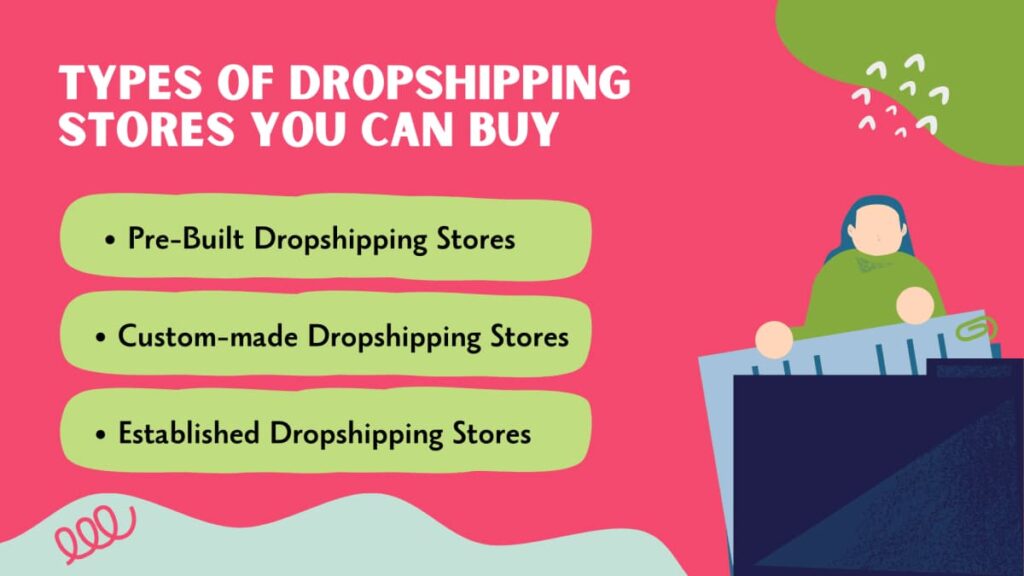
Not every listing is the same. There are three main categories you will encounter.
Pre-Built Dropshipping Stores
Pre-built dropshipping stores are ready-to-launch templates with a niche, products, and design already in place. The word "built" is doing some heavy lifting here. Many of these are essentially clones: the same AliExpress products, the same Shopify theme, and the same generic copy used across dozens of identical stores sold by the same provider.
Pre-built stores are the cheapest option and the easiest to spin up, but they have no sales history, no traffic, and no supplier relationships. You are paying for setup time saved, not for a running business.
Custom-Made Dropshipping Stores
A custom store is built to your specifications by a service or developer. You describe the niche, preferred suppliers, branding direction, and layout, and they build it out. This costs more than a pre-built option and takes longer, but you get something that is actually differentiated.
Custom stores make the most sense if you have a specific niche in mind that the pre-built services do not cover, or if you want branding that does not look like every other store running the same Shopify theme.
Established Dropshipping Stores
An established store is an operating business with a traffic and revenue history. This is the only category where you are buying something with a proven track record. It typically includes a supplier base, customer email list, existing SEO presence, and documented financials.
These listings cost significantly more than pre-built or custom stores, because you are paying for proof. Buyers who want profit margins of at least 15-30% (a common threshold cited by brokers) tend to find them only in established listings. Stores that have been operating for 18 months or more with stable income also tend to sell at better multiples than younger stores.
If you want the full benefit of skipping the build phase and getting a store with real momentum, an established listing is the only option that delivers that.
What to Look for Before You Buy
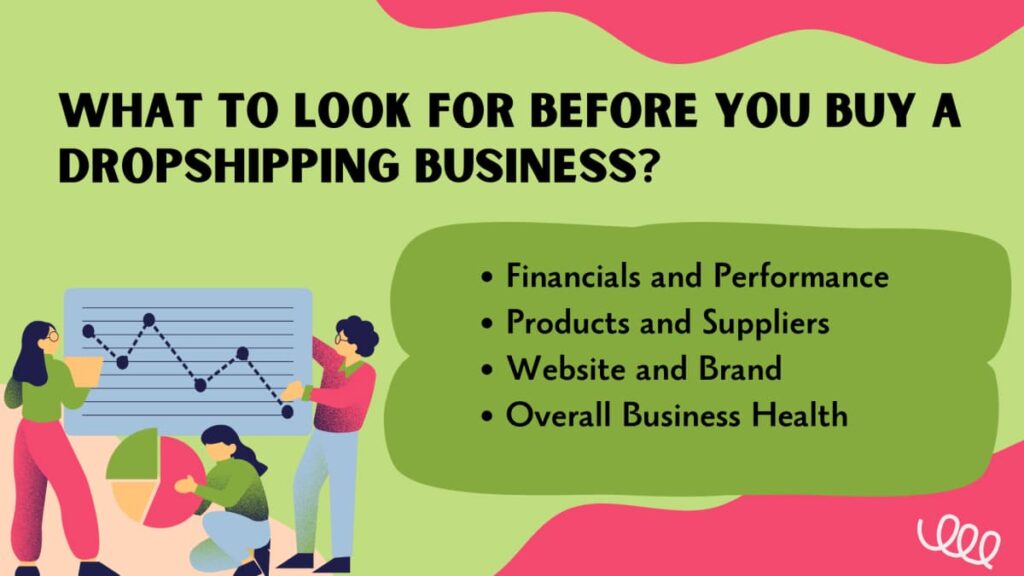
Due diligence on a dropshipping purchase is not complicated, but it does take time. These are the things that matter most.
Financials and Performance
Ask for at least 12 months of revenue and profit records. Monthly snapshots are not enough. You want to see Shopify or payment processor reports directly, not screenshots that could be edited. Look for whether revenue is trending up, flat, or declining, and ask about any spikes. A single viral month can inflate average numbers significantly.
Traffic sources matter as much as revenue. A store that gets all its customers from paid ads has a very different risk profile from one with organic search traffic or a returning customer base.
Products and Suppliers
Find out who the suppliers are and whether the relationship is transferable. Some stores rely on a supplier the seller has a personal relationship with. That relationship may not carry over to you.
Check product reviews on the supplier side and look at what customers are saying publicly. Slow shipping times and quality complaints are the most common reasons dropshipping stores lose customers and revenue.
Website and Brand
For established stores, look at the brand's public presence. Check the social accounts, the reviews on Google or Trustpilot if they exist, and any mentions in forums. A brand with a bad reputation in its niche is hard to rehabilitate.
Also check the site technically: page speed, mobile experience, checkout conversion rate if the seller will share it. A poorly built Shopify store with a slow theme and broken checkout will need investment to fix before it can perform.
Overall Business Health
The most important question to ask any seller is why they are selling. Common honest reasons include wanting to focus on other projects, needing liquidity, or the business having hit a ceiling the seller does not know how to break through. Vague answers, inconsistent financial numbers, or reluctance to share Shopify admin access for verification are red flags.
Also check whether the business has any active disputes, chargebacks above industry average (typically around 0.5%), or supplier contracts with minimum order requirements that could create problems after the handover.
10 Marketplaces to Buy Dropshipping Stores in 2026
Flippa
Flippa is one of the largest online business marketplaces. It covers websites, apps, and e-commerce stores across a wide range of sizes and prices. The breadth of listings is useful if you are still figuring out what you want, but the same openness that creates volume also creates risk.
Advantages of Flippa
- Dashboard integrations with Google Analytics and Semrush let you see traffic and keyword data directly inside a listing
- Extensive filters make it possible to narrow by revenue, profit, age, niche, and business model
- Large number of active listings at any given time
Disadvantages of Flippa
- Low barrier to listing means a higher proportion of questionable or misrepresented stores compared to vetted platforms
- Third-party escrow adds fees to transactions
- No migration support after purchase
Pricing
Flippa listings span a huge range. You can find stores listed below $10,000 and high-revenue businesses listed above $1 million. Seller listing packages run from $29 (Entry) to $199 (Premium).
Empire Flippers
Empire Flippers focuses on established, profitable online businesses. Every listing goes through a vetting process before it appears on the marketplace, which removes most of the low-quality or fraudulent listings that show up on open platforms.
In one documented sale, a content site sold through Empire Flippers for $76,121 at a 33x monthly profit multiple, going under offer within 48 minutes of going live. That is a real benchmark for what a well-performing listing looks like on their platform.
Advantages of Empire Flippers
- Thorough vetting means listings include verified financials and traffic data
- First-time sellers pay a $297 upfront listing fee, with the platform taking 15% on a successful sale
- Migration support and legal assistance are available for buyers and sellers
Disadvantages of Empire Flippers
- Listings skew toward higher price points; the most affordable options typically start above $25,000
- Weekly listing updates rather than continuous new listings
- Higher fees relative to open marketplaces
Pricing
Empire Flippers is best suited for buyers with at least $25,000-$30,000 to spend. Most listings with consistent revenue are priced well above that, with larger operations listed in the hundreds of thousands.
AliDropship
AliDropship is both a plugin for building AliExpress-based dropshipping stores and a marketplace for buying pre-built stores. Unlike pure brokerage platforms, it is also a direct service provider.
Advantages of AliDropship
- Full ownership of any business you build or purchase through their platform
- Personal manager assistance during the build process
- Automation tools for order management and product imports
Disadvantages of AliDropship
- Many useful features are behind paid plugin upgrades
- One-click import works only in Chrome
- Theme customization is limited by locked layout and menu options
Pricing
The pre-built store option is free for the first 14 days, then $39 per month. Their core plugin requires a one-time purchase of $89.
Brandafy
Brandafy focuses on turnkey stores with a fast turnaround. Average delivery time runs between one and three days, and each store comes with supplier integrations and an advertising strategy outline built in.
Advantages of Brandafy
- Fast store delivery
- Included ad strategy and supplier integration
- Lifetime support on purchased stores
Disadvantages of Brandafy
- Customer support response times have been inconsistent based on user reports
- Design quality can be uneven
- Product categorization errors reported in some stores
Pricing
Brandafy offers a free pre-built store option, an advanced store package starting at $17, and a managed store service at $1,297 per month.
StartStorez
StartStorez prices its stores based on the number of products you want listed, rather than the store's age or history. That model makes costs predictable if you know roughly how large you want your catalog to be.
Advantages of StartStorez
- Basic plan includes automation tools, social media integration, and 24/7 support
- Easy to add products post-purchase
- Straightforward pricing structure
Disadvantages of StartStorez
- Comparable options exist at lower price points on other platforms
- Copyright complaints related to design assets have been reported
- No trial option before committing
Pricing
A one-product store costs $65 per month. The 12-product tier is $99 per month, and the 30-product tier is $129 per month.
Acquire
Acquire has a broad range of listings, similar to Flippa, but with more detailed financial reporting per listing. Each listing includes over 20 financial metrics. The platform also has a financing partnership with Clearco, which lets qualified buyers spread payments rather than paying everything upfront.
Advantages of Acquire
- Detailed per-listing financial reports
- Financing option via Clearco partnership
- Clean, easy-to-use interface
Disadvantages of Acquire
- Buyer access requires an annual subscription ($390 or $780 depending on tier)
- Canceling the subscription requires contacting support
- Some user reports of AI-generated startup listings with inflated claims
Pricing
The free tier lets you browse listings. Premium access is $390 per year; Platinum is $780 per year with additional features.
Dropbuild
Dropbuild builds stores that include video ad creative and ad copy as part of the package. That makes it a reasonable option for buyers who want to start running ads immediately after purchase without sourcing their own creative.
Advantages of Dropbuild
- Video ad creative and ad copy included in packages
- Designs built for conversion
- Lifetime support
Disadvantages of Dropbuild
- Some users have reported long shipping times on products
- Operational guidance has occasionally been described as generic
- No pre-made stores; everything is built to order
Pricing
Dropbuild charges a one-time fee: $449 for a one-product store or $599 for a niche store, both with lifetime support included.
DropCommerce
DropCommerce is a supplier network that also offers pre-built stores. It is particularly well integrated with platforms like BigCommerce and Shoplazza, and its supplier base skews toward North American and North American-made products.
Advantages of DropCommerce
- Product and supplier quality is consistently higher than many AliExpress-based alternatives
- Clean integration with several major e-commerce platforms
- Fast shipping on most products due to domestic supplier base
Disadvantages of DropCommerce
- Products are priced higher than AliExpress equivalents
- Coverage is primarily North American
- No budget tier for buyers just starting out
Pricing
Free to browse. Paid tiers start at $19 per month and go up to $149 per month. Pre-built stores are available starting at $249 and up to $999.
Ecommerceify
Ecommerceify is a smaller service that builds and sells custom dropshipping stores with post-purchase support included. Their delivery times are fast, and they are responsive to custom instructions during the build process.
Advantages of Ecommerceify
- Fast turnaround on store delivery
- Full ownership after purchase
- Ongoing product recommendation support
Disadvantages of Ecommerceify
- Higher price point relative to similar services
- Full support is only available on higher-tier packages
- Custom stores are not eligible for promotional pricing
Pricing
Custom store packages are $199 and $349. Pre-built packages are $149 and $299.
DropshipForSale
DropshipForSale covers a wide range of niches, including more niche-specific categories that larger marketplaces often overlook. Post-purchase support is a consistent strength.
Advantages of DropshipForSale
- Extensive niche coverage
- Post-purchase support and store customization tools
- Diverse product categories
Disadvantages of DropshipForSale
- Inventory management interface has a learning curve
- Some buyers have reported receiving stores that did not match their expectations
- Store transfer process has caused problems for some users
Pricing
A basic website build starts at $20. Pre-built store purchases range from $399 to $1,250 depending on niche and scope.
Should You Buy or Build Your First Dropshipping Store?
This is worth thinking through before you commit to either path.
Buying a Dropshipping Store: Pros and Cons
Buying saves time and, for established listings, gives you immediate revenue and an existing customer base. The trade-off is cost and lock-in. Established stores are expensive, and if the store has built brand recognition in a particular niche, changing direction later comes with real costs. Pre-built stores avoid the lock-in problem but also deliver little actual head start.
Building Your Own Store: Pros and Cons
Building gives you complete control over niche selection, branding, suppliers, and structure. The cost to start is lower. The drawback is that everything takes time: building, testing products, finding suppliers that perform, and building traffic from scratch. Most stores take six months to a year before they are consistently profitable.
If you are new to dropshipping and want to learn the mechanics, building your own store teaches you more. If you want to skip the learning curve and have the budget, buying an established store with a verified track record is the faster route.
Doing Your Due Diligence: Use Koala Inspector Before You Buy
You would not buy a car without at least checking the service history. The same logic applies to an online store. A marketplace listing gives you what the seller wants you to see. What you actually need is an independent view of how the store operates.
Koala Inspector is a Chrome extension built for exactly this. It lets you see the apps a Shopify store is running, the products it stocks, its estimated traffic, and the tools and strategies it is using. More than 95,000 dropshipping sellers use it to research competitor stores and validate their own product strategies.
Before buying any dropshipping business, use Koala Inspector to see what is actually running under the hood. Check the apps to understand the tech stack and ongoing costs. Look at the product catalog to see whether it is genuinely differentiated or just a generic AliExpress feed. Compare what the seller claims to what the store actually shows.
The tool is free to start and takes about two minutes to set up.
Final Thoughts
Buying a dropshipping business can be a smart shortcut, but only if you know what you are buying. The marketplace you use matters, the type of listing matters, and the due diligence you do before signing matters most of all.
Focus on established stores if you want something with real traction. Vet financials thoroughly, ask hard questions about why the business is for sale, and verify traffic sources independently. Use Koala Inspector to audit the store itself before any money changes hands.
The upside of getting this right is a business that already works. The downside of getting it wrong is an expensive mistake with no easy exit.
Written by
Ana Gelevska
eCommerce Content Writer
Ana Gelevska is a content writer with more than five years of experience creating content for eCommerce brands and global clients. She digs into each topic and the people it is for, then turns it into clear, useful articles that Shopify sellers and dropshippers can act on.
Connect on LinkedIn