Dropshipping Suppliers With Local Warehouses: The 6-Question Checklist
 By Ana GelevskaNovember 5, 2026
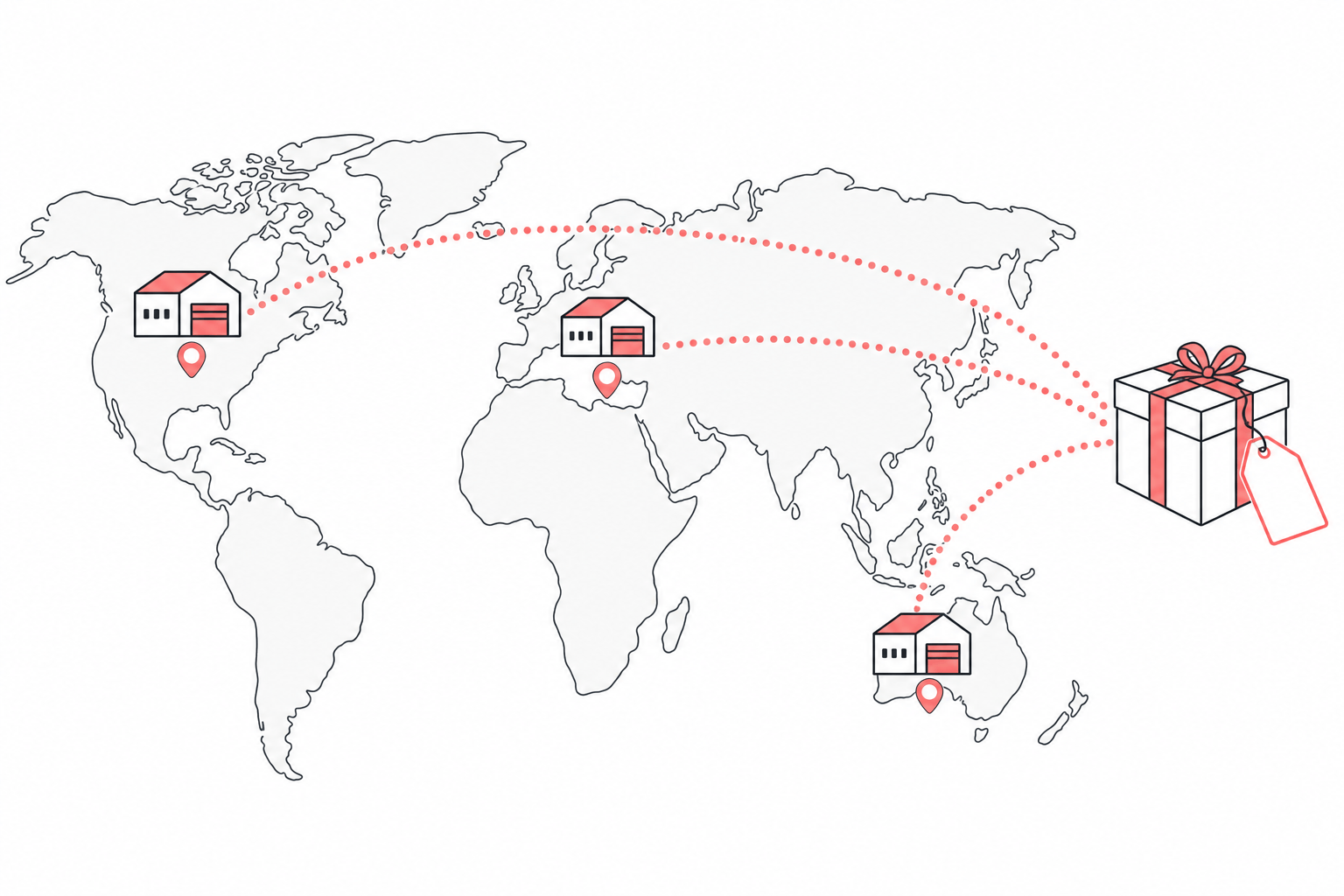
A supplier's warehouse location is what decides your delivery promise and your customs exposure. The catalogue tells you what you can list; the warehouse tells you what you can honestly say on the product page and what a border will cost you. Most supplier pitches are loud about the first and vague about the second, so the questions below are the ones that close the gap.
This is the check that got urgent in 2026. The EU has changed how low-value parcels are charged and what data has to travel with them, and merchants are asking about it in public: a thread on r/ecommerce from October 2026 about the new identifier requirement drew 24 replies from sellers working out what it meant for their catalogues. A supplier with stock already inside your customer's market sidesteps most of that. A supplier shipping everything from one origin passes all of it to you.
Table of contents
- The six questions
- What changed in the EU, and what is still moving
- Read the stores that already sell it
- Trace the product back to its supplier
- FAQ
The six questions
Run these in order. Each one is a message you can send today, a good answer you can recognise, and a red flag that should end the conversation or at least stop you scaling behind that supplier.
1. Which country does each SKU ship from?
Ask: "For each of these SKUs, which country does the parcel physically leave from?" Put the SKU list in the message so the answer has to be per line rather than per company.
A good answer names a country per SKU, says which of them are stocked locally and which are shipped from the main facility, and volunteers the difference in transit time between the two. Suppliers who genuinely run regional stock talk about it in this shape without being pushed, because it is their selling point.
The red flag is an answer about where the company is registered. "We are a US company" and "this SKU ships from a US warehouse" are different statements, and only the second one changes what your customer experiences. A registered office in your market with every parcel still leaving one origin gives you a local-sounding brand and the same transit time you had before.
2. Will you send a tracked sample to my own address?
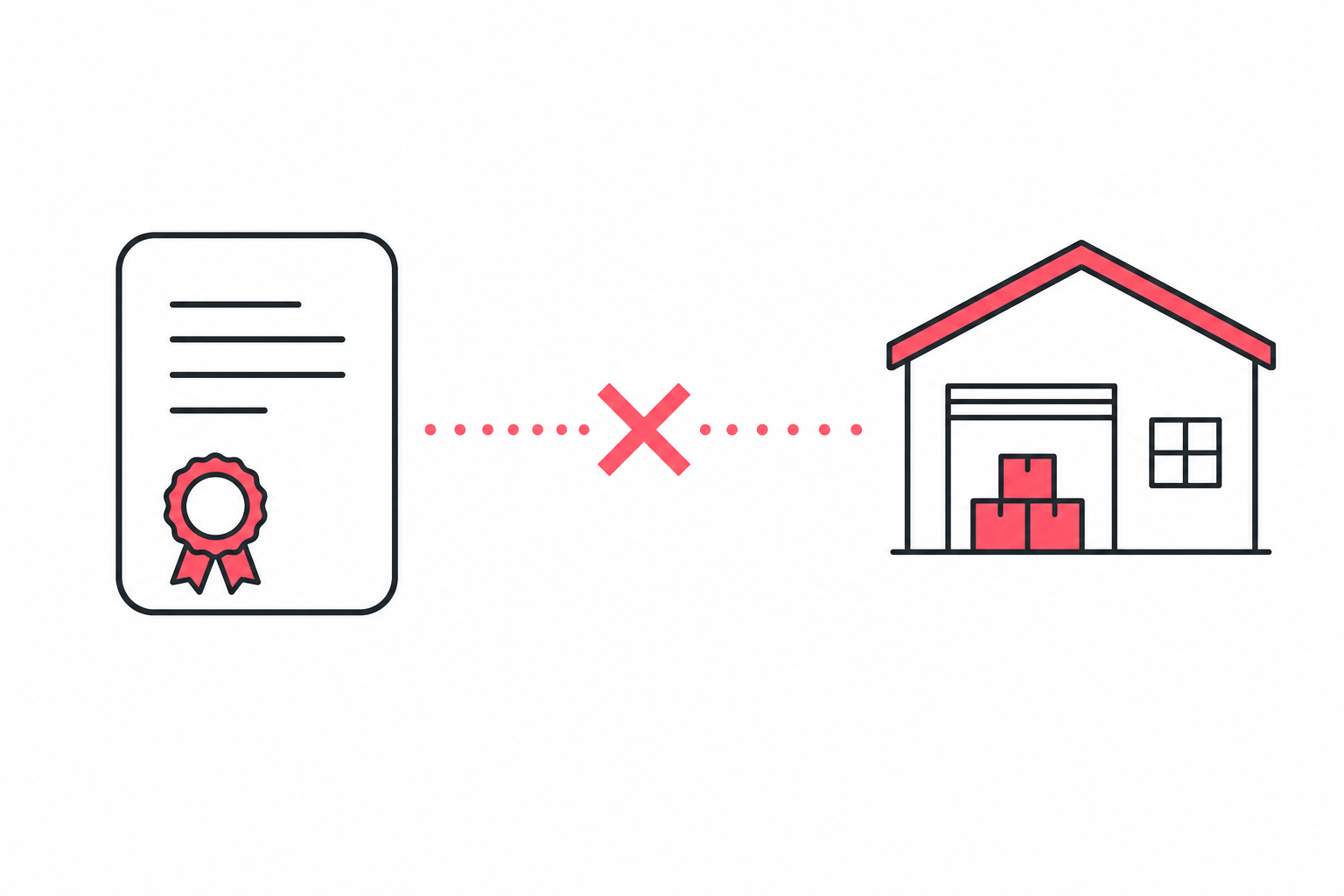
Ask: for one unit, at full price, shipped by the method your customers will actually get, with tracking, to the address a customer would use. Do not flag it as a test.
A good answer is yes, with a tracking number that starts scanning within a day or two. Then you time it yourself: order date to doorstep, in days, as one number. That number is your delivery promise. Everything else is a quote.
The red flag is a refusal, a sample sent by a faster service than customers get, or tracking that goes quiet for a week and then reappears near the destination. A parcel that disappears from tracking in the middle has usually been consolidated and re-shipped, which means your customer's parcel will do the same thing and your support inbox will hear about it. Our guide to faster dropshipping delivery covers what to do with the number once you have it.
3. Does an order ever get split across origins?
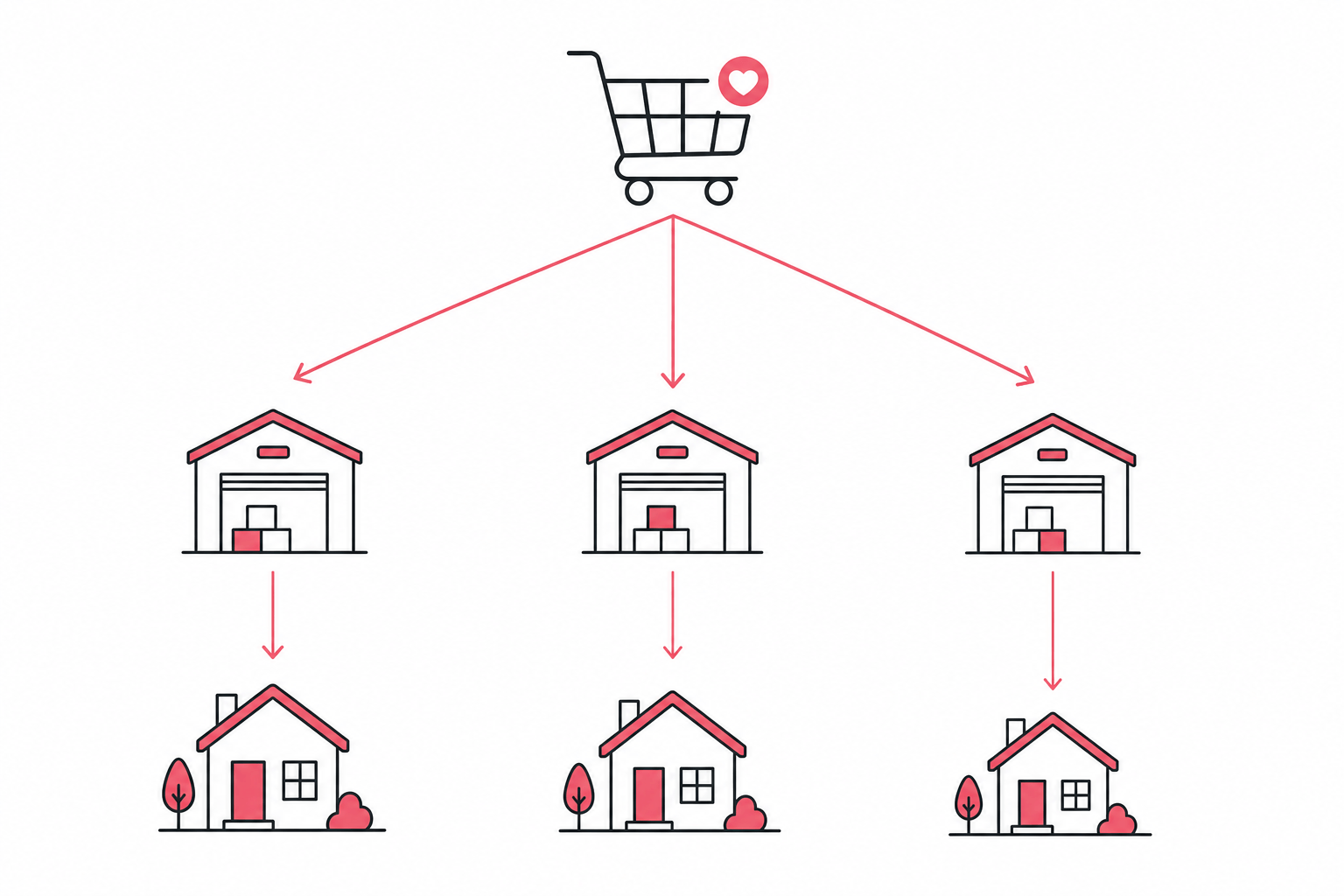
Ask: "If a customer buys three different SKUs in one order, do they arrive as one parcel or several, and do they leave from the same country?"
A good answer is specific about both. Either the supplier consolidates before despatch, or it tells you plainly that items ship separately from whichever facility holds them. Both are workable once you know which one you have.
The red flag is a supplier who has not thought about it. A split order is three delivery experiences, three tracking numbers your customer has to reconcile, and on a cross-border route it can mean the charges apply more than once, because they are applied per customs declaration line rather than per basket. It also quietly breaks any free-shipping threshold you set on the assumption that one order equals one parcel.
4. Who is named on the customs declaration, and who pays the duty?
Ask: "On a cross-border order, who is the declarant on the customs paperwork, and is duty paid before delivery or billed to my customer on arrival?"
A good answer names a party and a method. A supplier shipping delivered-duty-paid is telling you the charge is inside the price you were quoted. A supplier shipping with duty due on arrival is telling you your customer gets an invoice at the door, which is the single most common cause of a refused delivery.
The red flag is "the customer handles it", delivered with a shrug. For sales into the EU the Commission is explicit that responsibility for customs formalities and duty payment on distance sales sits with the platforms, sellers or carriers rather than with the consumer, with online platforms treated as the importer for distance sales (EU Customs Reform, read 5 November 2026). A supplier who cannot say who is declaring your goods has not told you that the obligation disappears. It has told you it has landed on you.
5. Where is the returns address?
Ask: "When a customer in [your main market] returns an item, what address does it go back to, and who pays the return leg?"
A good answer is a returns address inside your customer's region, with a stated process for what happens to the stock once it arrives.
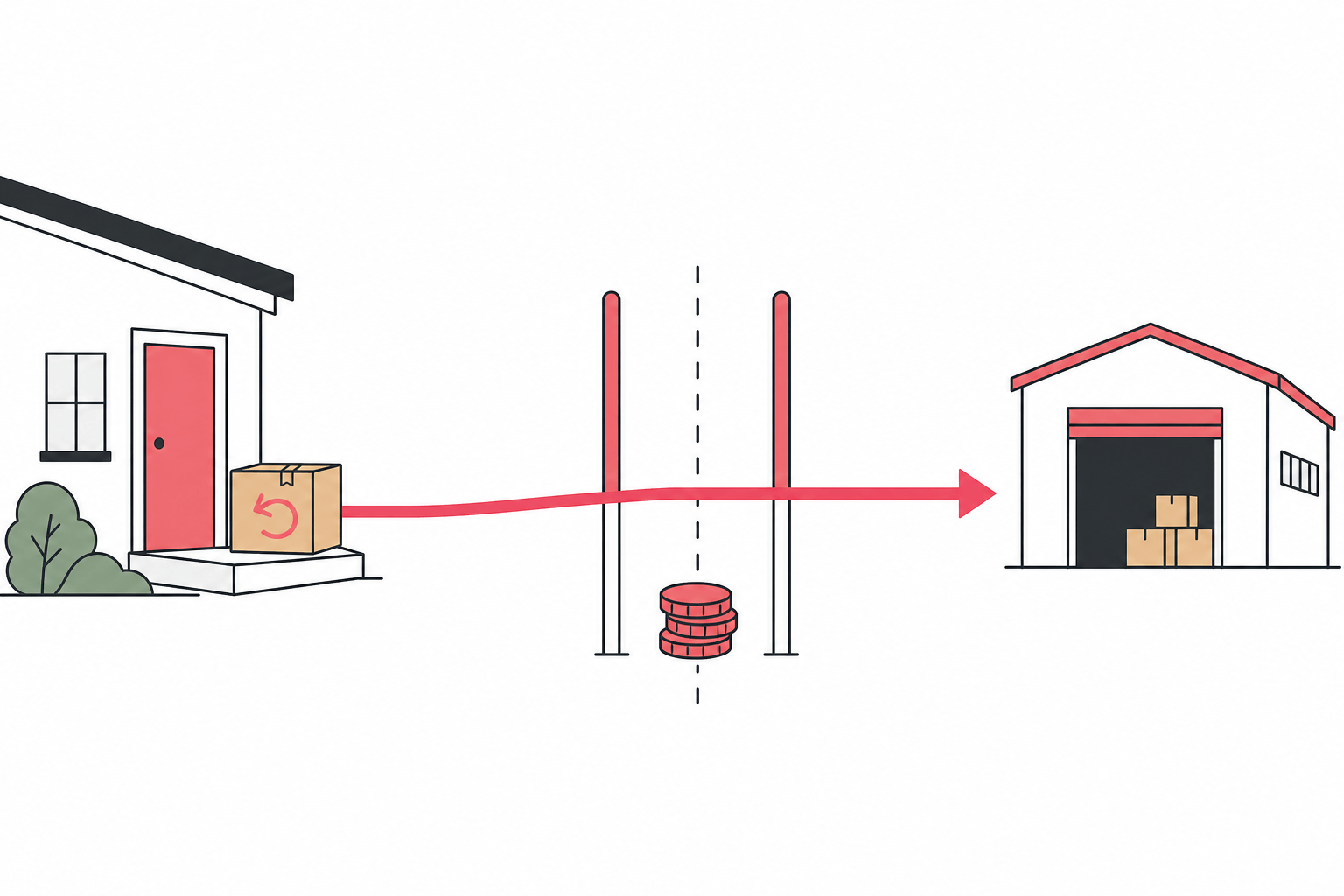
The red flag is a returns address in the origin country. A return shipped back across a border routinely costs more than the item, and the charges on the original import do not come back with it. The European Commission's own guidance is blunt on this: where goods sold in distance sales in a consignment of an intrinsic value not exceeding EUR 150 are returned after release, operators may no longer request invalidation of the customs declaration, so the temporary EUR 3 customs duty paid on them cannot be reimbursed through that route, and the Union handling fee is non-refundable from the moment the declaration is accepted (Commission guidance, version of 5 October 2026, read 5 November 2026). Read that as a straightforward operational cost: on cross-border stock, a return is the item, both freight legs and the charges, with nothing recovered. Budget your return rate against that number before you price the product.
6. What happens to stock already in transit if a rule changes?
Ask: "If a customs requirement changes while a shipment is on the water, who absorbs it, and have you had to deal with that this year?"
A good answer describes a real instance. Any supplier moving volume into the EU has had to handle the 2026 changes, and one that can tell you how it handled them is one that will tell you about the next change before it reaches your customers.
The red flag is a blank. Rules apply at the moment a declaration is lodged, not at the moment you placed the order, so stock that left before a change still meets the new requirement when it arrives. A supplier with no answer is one you will find out from through a stuck parcel.
What changed in the EU, and what is still moving
Everything in this section comes from pages published by the European Commission, read on 5 November 2026. Figures and dates move, so check the source pages before you make a commercial decision on them.
Settled. The EU removed the EUR 150 customs duty exemption for low-value consignments and replaced it with a temporary customs duty of EUR 3 per item, applying from 1 July 2026 to 1 July 2028, by Council Regulation (EU) 2026/382 (Access2Markets, published 30 June 2026). The word "item" has a technical meaning worth knowing, because it is what makes a mixed basket expensive: it covers one or more goods in a consignment sharing the same tariff classification, description and, where applicable, origin, and the charge is applied per declaration line regardless of how many units sit on that line. Three of the same t-shirt is one line. A t-shirt, a watch and a pair of socks is three.
Settled. Product identifiers became mandatory on 1 November 2026 for goods sold in distance sales to buyers in the EU. Three are in scope: the merchant's own product reference, the manufacturer's own model or part number, and a standardised code such as an EAN, UPC or ISBN where one exists, with an exemption code used where it does not. Operators could provide them voluntarily from 1 July 2026 with no penalty during that window, and enforcement started on 1 November (Taxation and Customs Union, published 3 November 2026). This is the one that lands on your supplier rather than on you: the manufacturer's code is a number only the manufacturer holds.
Less settled than the headlines suggest. The Union handling fee of EUR 2 per item is described by the Commission's reform page as applying from 1 November 2026. The Commission's own explanatory guidance, in its version of 5 October 2026, was more careful: it said the fee applies from the tenth day after the entry into force of the delegated act fixing it, that the act was still under scrutiny, and that the fee was therefore expected to apply from 1 November 2026. If you are modelling the per-parcel cost, treat the EUR 2 as live and confirm the date with your carrier rather than with a blog.
Not yet. The permanent arrangement depends on the EU Customs Data Hub, which the Commission's reform page dates to 2028 for e-commerce operators, with the temporary EUR 3 duty running until that point. Anything you read about what happens after that is a forecast.
None of this is legal or customs advice, and none of it is a substitute for asking your own carrier or broker. It is here because it changes which supplier you should pick: every one of these charges and data requirements applies at a border, and stock that is already inside your customer's market does not cross one.
Read the stores that already sell it
Before you commit to a supplier, look at what the stores already selling that product do. Their operational choices are visible on their own storefront, and they have paid for the lessons you are about to pay for.
Koala Inspector's data across the Shopify stores it tracks shows where that money goes. Order tracking is the single most-installed category of fulfilment app in that data: four separate order-tracking apps sit on more stores than any sourcing app does, led by CWILL Order Tracking on 31,447 stores and 17TRACK Order Tracking on 28,516, compared with 15,345 for DSers and 6,255 for CJdropshipping (Koala Inspector store data, read 5 November 2026). Those numbers describe the stores Koala tracks rather than all of Shopify, so read them as a pattern and not as a census.
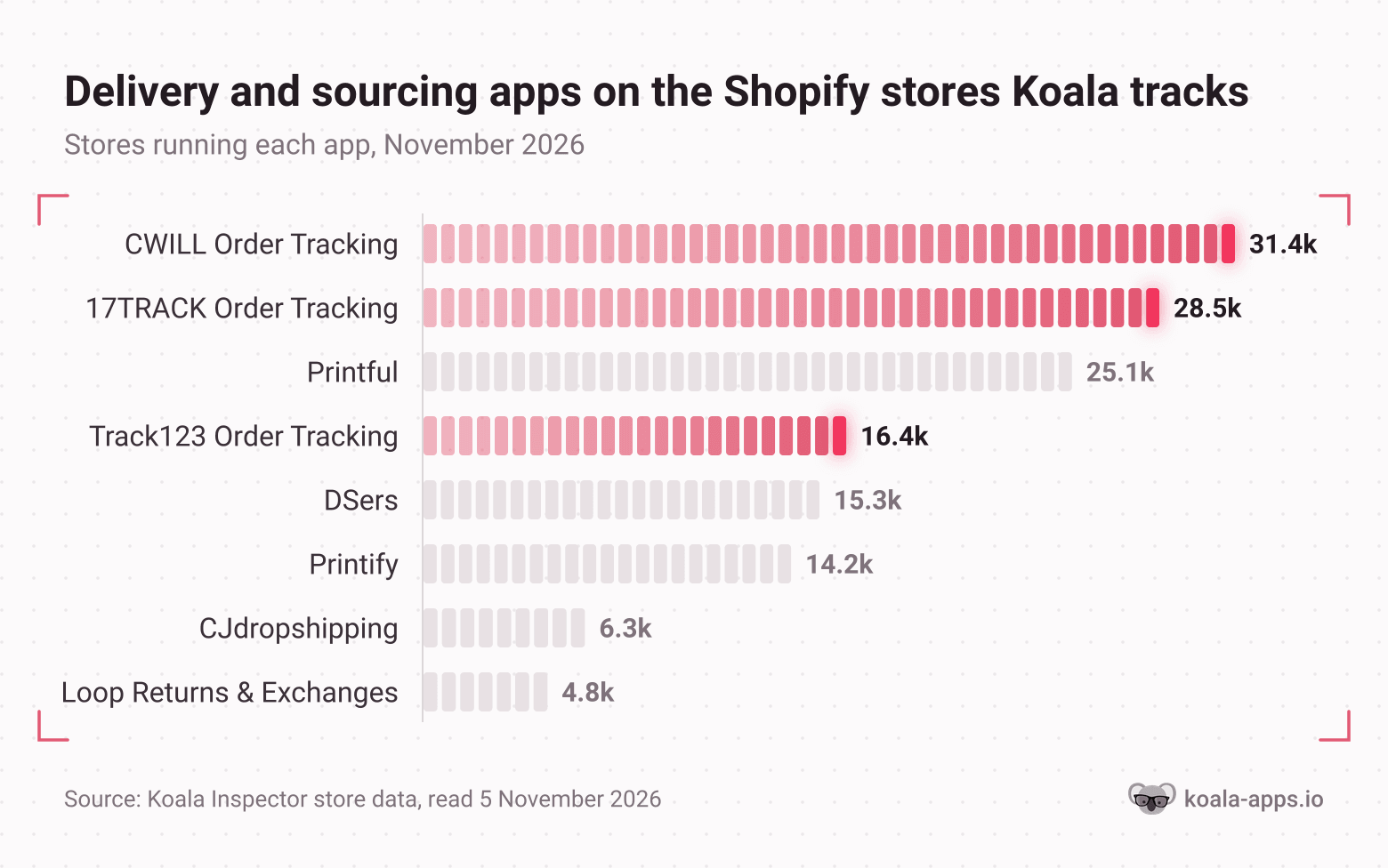
The pattern is worth sitting with. Stores invest in telling the customer where the parcel is, at a scale that dwarfs their investment in sourcing tooling, which is what an industry does when delivery time is long and uncertain. A supplier with regional stock reduces the problem those apps exist to manage.
Two reads are free in the extension and worth doing on every competitor you find. Open a store in your category and you can see which apps it runs, which tells you whether it is on a print-on-demand stack, an AliExpress-style sourcing stack, or its own fulfilment. Then open Product research and best-sellers to browse that store's full catalogue or filter to its best-selling products, with image, price, variations and a stats header giving total product count, price range and the first-published date. A store whose best sellers are concentrated in a handful of SKUs is usually holding stock on those SKUs, and that is the shape you want to copy.
What sellers say about Koala Inspector
Verified reviews from the Chrome Web Store.
“Great tool for competitor research and customer support is really quick!”
 Aiswarya S
“great app for ecommerce, there are a lot of useful information. Friendly customer service!”
 Lavender Yuzu
“Excellent tool for Shopify research! simple, accurate, and packed with insights. Highly recommend it.”
 Data Analysis
Trace the product back to its supplier
The checklist above assumes you already have a supplier to interrogate. When you have a product instead, Koala Inspector closes that gap directly. Find Suppliers takes a product and returns the suppliers selling that same item, from Alibaba, AliExpress and CJ Dropshipping to Amazon, Walmart, eBay and Etsy, split into exact matches and similar products so you are comparing like for like.
For the warehouse question specifically, two things on that screen do the work. You pick a Ship to country from 29 destinations, and shipping, import duty, delivery time and market price are then estimated for that country rather than in the abstract. Each supplier card shows an estimated delivery time in days alongside a cost breakdown of item price, shipping estimate and import tariffs, totalling to a landed cost per unit. A supplier claiming local stock and a supplier shipping from one origin stop looking alike the moment the delivery estimate for your actual market sits on the card.
It runs from a button on every product in the extension's product view, and from the browser's right-click menu on any product image on any website, which means you can run it on a competitor's product page or on a photo in a supplier's catalogue. It costs 2 tokens, refunded automatically if the search returns nothing, and changing the destination country, the selling price, the view, the filters or the sort afterwards is free.
Treat the output as a shortlist rather than an answer. The delivery times and duty figures are estimates for screening, and the six questions above are what turn a promising card into a supplier you can build a delivery promise on. Our guides to finding dropshipping suppliers and vetting one before your first order cover the rest of the shortlist, and how to find a competitor's supplier covers the same trace run from a store rather than from a product.
Start where your stock actually is
Pick the product you are closest to committing on. Install Koala Inspector free, run Find Suppliers on it with your main market set as the destination, and read the delivery estimates before you send a single message. Then send the six questions to whoever is left.
The free plan gives you 15 tokens a month with no card, which covers seven supplier traces at 2 tokens each, and the app read, theme read, catalogue and best-seller views stay free forever. Premium is $22 a month with 220 renewing tokens if you are sourcing at volume. Plans and token costs are current as of November 2026; the pricing page has the live figures.
Find out where the stock sits first. Everything else in sourcing is downstream of that one fact.
Local warehouses and suppliers: FAQ
What sellers ask when they start checking where a supplier's stock actually sits.
Does anyone else find it difficult to know what to fix first in dropshipping?+
Almost everyone does, and there is an order that works: fix the thing your customer actually experiences. Delivery time and delivery certainty come first, because they drive refunds, chargebacks and the reviews that decide whether your ad spend compounds or leaks. Product choice comes second, ad creative third, and store design last. A useful test is to ask which problem a customer could describe out loud. Nobody emails you about your hero image. They email you about a parcel that has not moved in eleven days.
Does dropshipping work?+
Yes, with a tighter supply chain than the model needed a few years ago. The stores that survive now treat the supplier as the product: they know which country each SKU ships from, they have timed a real parcel to a real address, and they have a returns route that does not cross a border. Stores that pick a supplier on catalogue size and price alone are the ones that end up refunding customers for parcels they cannot track. The business model is sound and the sourcing standard has risen.
Do I actually need a brand new phone for organic dropshipping?+
No. A new handset changes nothing about how a short-form video performs, and buying one is a way of feeling productive without doing the work. What moves organic reach is posting volume, a hook in the first second, and a product people can see being used. Any phone from the last few years shoots well enough for that. Spend the money on a tracked sample from your supplier instead, so the product in your videos is the product your customer receives.
How are you guys avoiding crazy customs delays with dropshipping to the US?+
Three things, in order. First, establish the real shipping origin per SKU rather than the supplier's registered address, because a parcel's origin is what sets its route. Second, make sure the supplier can supply complete, accurate product data for the declaration, since incomplete data is what parks a parcel rather than distance. Third, prefer a supplier holding stock inside your customer's market for your best sellers and accept the higher unit cost, because a domestic parcel never meets a border. Time a tracked sample to your own address before you promise a delivery window on your product page.
How can a beginner start dropshipping?+
Pick one product category you can describe in a sentence, find the stores already selling into it, and read how they operate before you build anything. Then source: shortlist suppliers, run the warehouse-location questions in this guide, and order one tracked sample at full price. Only then build the store, write the delivery promise from your measured sample time, and start with a small ad budget you can afford to lose while you learn what the real cost per order is. Our guide to starting a dropshipping business walks the setup end to end.
How does dropshipping work?+
You list a product without holding stock. A customer orders from you, you pay your supplier, and the supplier picks, packs and ships the item straight to that customer. Your margin is the gap between your retail price and the full landed cost of product, shipping, duty and fees. Because the supplier holds the stock, the supplier controls how fast it arrives, what condition it arrives in, and where it has to be sent back to. That is why the warehouse question matters more than the catalogue.
New to the model itself? Start with how to start a dropshipping business, then come back to this checklist before you place a first order.
Sources
- European Commission, Access2Markets: EU applies EUR 3 customs duty per item on low-value e-commerce consignments - published 30 June 2026, read 5 November 2026. The EUR 150 exemption, the temporary duty, the definition of "item" and the 1 July 2026 to 1 July 2028 window.
- European Commission, Taxation and Customs Union: Product identifiers for e-commerce imports mandatory from 1 November 2026 - published 3 November 2026, read 5 November 2026. The three identifiers, the voluntary period from 1 July 2026, and enforcement from 1 November 2026.
- European Commission, Taxation and Customs Union: EU Customs Reform - read 5 November 2026. Who is responsible for customs formalities and duty on distance sales, the Union handling fee date, and the Customs Data Hub timeline.
- European Commission, DG TAXUD: The temporary EUR 3 customs duty and the Union handling fee - explanatory guidance, version of 5 October 2026, read 5 November 2026. Returns and invalidation, non-refundability of the handling fee, per-declaration-line application, and the fee's dependence on a delegated act then under scrutiny.
- Reddit, r/ecommerce: sellers working out the new EU product identifier requirement - October 2026, 24 replies. Where the merchant-side worry is coming from.
- App install counts are Koala Inspector's own store data, read on 5 November 2026, covering the Shopify stores Koala tracks.
- Koala Inspector feature and token details are from the product's current plans and pricing, November 2026.
Written by
Ana Gelevska
eCommerce Content Writer
Ana Gelevska is a content writer with more than five years of experience creating content for eCommerce brands and global clients. She digs into each topic and the people it is for, then turns it into clear, useful articles that Shopify sellers and dropshippers can act on.
Connect on LinkedIn