Home Decor Dropshipping Products: Work Backwards From Stores That Already Sell Them
 By Ana GelevskaNovember 16, 2026

Search for home decor dropshipping products and page one hands you supplier directories and lists of fifteen things somebody decided were trending. None of them tell you whether a single real store is selling those products at volume right now.
So flip the order. Instead of starting with a product list, start with the home and garden stores that are already pulling serious traffic, read what they actually sell, and build your shortlist out of that. Below is what that looks like using Koala's own store data: which home sub-categories run deepest, which product types the busy stores build their catalogs around, what each type costs you in shipping and breakage, and how to tell whether a product is already picked over.
Start with the stores, then read the products
Across the home and garden stores Koala Inspector tracks, the category splits into clear sub-categories, and three of them run deeper than the rest. Kitchen and dining is the deepest with seven tracked stores, interior decor follows with six, and rugs and carpets with five. Bed and bath carries four. The stores inside those four groups average between 2.7 and 4.8 million estimated monthly visits each.
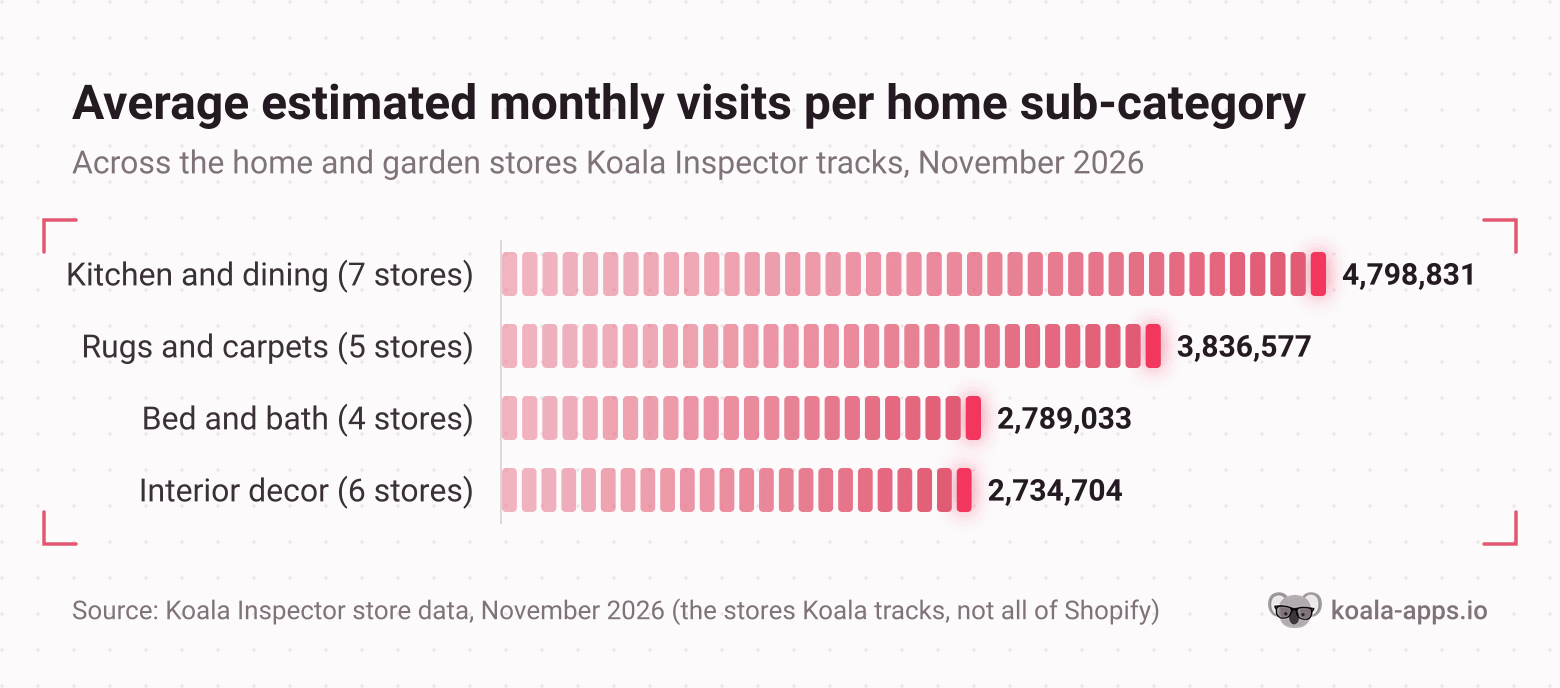
Two things matter about those numbers. They cover the stores Koala tracks rather than every store on Shopify, so read them as a sample of the busy end of the category rather than a census. And the gap between the top and the bottom of that chart is small. Every one of those four sub-categories sustains stores at millions of visits a month, which means none of them is a dead end for a new seller.
The depth at the top is bigger than the averages suggest. The largest home and garden store in Koala's data, stanley1913.com, shows 18.5 million estimated monthly visits and runs 20 Shopify apps at roughly 4,799 dollars of monthly app spend. That last figure is the useful one. App spend is a store telling you, in money, how seriously it takes the category. The average tracked home store runs 16 apps. When you open a competitor and find a thin stack of two or three, you are looking at a store that is coasting, and its best-seller list carries less weight.
You can browse the current rankings on the home decor leaderboard, with kitchen and furniture as separate lists.
The five product groups those stores actually sell

Read the catalogs of the stores above and the same five groups come back. Here is what each one gives you and what it costs you.
Rugs and washable rugs
Rugs and carpets is one of the deepest home sub-categories Koala tracks, and the stores in it average 3.8 million estimated monthly visits. The modern washable rug format is what made the category workable online: a thin cover that ships rolled and flat, over a pad the customer buys once. That split is the whole trick, because it turns a heavy furniture item into a textile parcel.
Margin reality. Rugs carry high average order values, often well into three figures, so a single sale covers more ad spend than almost anything else in the home category. The catch is that size variants multiply your landed cost. A 2x3 runner and an 8x10 room rug are not the same product economically, and a supplier price that looks fine on the small size can be underwater on the large one.
Shipping problem. Flat and rolled is manageable; pile-backed traditional rugs are not. Check the shipped weight on every size before you list it, because the biggest variant is the one customers want and the one that eats your margin.
Saturation check. Pattern-led rugs saturate fast because the same designs circulate between suppliers. Run the exact design through a supplier search and count the exact matches before you commit to it.
Cookware and drinkware
Kitchen and dining is the deepest sub-category of all, with seven tracked stores, and it holds the single biggest store in Koala's home data. Drinkware in particular is the category's gateway product: insulated tumblers, bottles and travel mugs sell on a lifestyle promise, photograph well, and are small enough to post cheaply.
Margin reality. Drinkware margins are solid at the mid price points and brutal at the bottom. Cookware is the opposite shape: higher ticket, slower consideration, more questions before purchase, and a buyer who reads reviews carefully.
Shipping problem. Drinkware is the easiest shipping job in the whole home category. Cookware is one of the hardest, because a cast-iron pan or a glass lid is heavy, breakable, or both.
Saturation check. This is the group where saturation bites hardest, since every seller who wants an easy win lands on tumblers. Treat a long list of exact-match suppliers at near-identical delivered prices as a signal to find a sharper angle, like a specific use case or a colourway nobody is running.
Wall and interior decor
Interior decor is the second-deepest sub-category with six tracked stores. Wall art, prints, mirrors, vases, candles and small sculptural objects sit here, and the print-led half of it is the friendliest entry point in the entire home niche.
Margin reality. Prints and posters cost little to produce and sell on taste, so the margin is good and the inventory risk is close to zero when you work with a print supplier. Ceramics, glass and mirrors reverse that: higher ticket, higher breakage, slower resolution when something goes wrong.
Shipping problem. Flat prints post for very little. Anything ceramic or glass needs real packaging, and a seller who skips that pays for it in replacements rather than returns, because the customer does not send back a broken vase, they ask for a new one.
Saturation check. Design-led decor has a short shelf life. The same arch mirror or ribbed vase appears everywhere for six months and then dies. Check how many of the busy stores in your category already list a near-identical item, and treat two out of five as early and five out of five as late.
Bedding and bath
Bed and bath carries four tracked stores averaging 2.8 million estimated monthly visits. Sheet sets, duvet covers, weighted and cooling blankets, towels and bath mats are the staples.
Margin reality. Textiles have the best weight-to-price ratio in the home category after prints, and bedding sells on a sleep benefit, which is a far easier ad angle than a decorative one. Sizing is the quiet cost: a UK double is not a US full, and a mismatch is a guaranteed return.
Shipping problem. Compressible and unbreakable, so the physical risk is low. The real risk is colour. A grey that photographs blue is one of the most common reasons bedding comes back, so order a sample and shoot it yourself.
Saturation check. Basic white sheet sets are commodity goods and you will not win on them. The live ground is the specific claim, like a cooling weave or a specific fibre, and that is worth checking against what the busy stores are pushing on their homepages right now.
Seasonal decor
Wreaths, string lights, table settings, ornaments and holiday textiles. Seasonal decor is the one group where you can concentrate an entire year's ad spend into eight weeks.
Margin reality. Seasonal items carry gift-buying urgency, which supports better prices than the same item would get in March. The trade is that the window closes hard, and stock you are still holding in January is worth very little.
Shipping problem. You have to be live and tested before the season opens, so your supplier's delivery time becomes the whole plan. A fifteen-day delivery estimate kills a December product in November.
Saturation check. Seasonal saturation is a timing question. The same ornament that was fresh in September is everywhere by November, so the test is not whether other stores carry it, but when they started.
The shipping problem is the home niche in one sentence

Everything above comes back to one constraint: home goods are large, fragile, or both, and that is what separates this niche from selling phone cases.
A seller on r/ecommerce laid out the maths plainly while trying to make a furniture business work in Australia. The product cost around 90 Australian dollars a unit to manufacture and ship in. Domestic delivery to the customer added another 60 to 90 dollars because the item was bulky. Before marketing, packaging, fees, returns or damages, the cost was already over 150 dollars a unit, against a target retail price of 160. The honest conclusion in that thread is that the numbers were impossible, and they were impossible before a single ad ran.
That is the trap in home decor, and the way out is to pick on physics first and taste second:
- Flat beats bulky. Washable rug covers, prints, textiles and bath mats all ship as parcels. Furniture, large mirrors and ceramics ship as freight or as breakage.
- Unbreakable beats fragile. A blanket cannot arrive in pieces. A vase can, and your supplier will not always cover it.
- Price your landed cost per unit, not the product cost. The figure that decides whether a home product works is item price plus shipping plus import duty, per unit, to the country you sell into. Koala Inspector's Find Suppliers screen breaks a product down exactly that way, including an estimated delivery time per supplier, which is the number that kills most seasonal picks.
- Budget for breakage as a line item. In fragile sub-groups, treat replacements as a cost of doing business and price them in from the first order rather than discovering them at month three.
How to tell a product is already picked over
Saturation is the second thing that sinks home stores, and it is easier to measure than most sellers assume. The question people keep asking in the communities, as in this r/dropshipping thread on finding winning products, is how to tell demand from noise. For a physical home product there are two concrete readings.
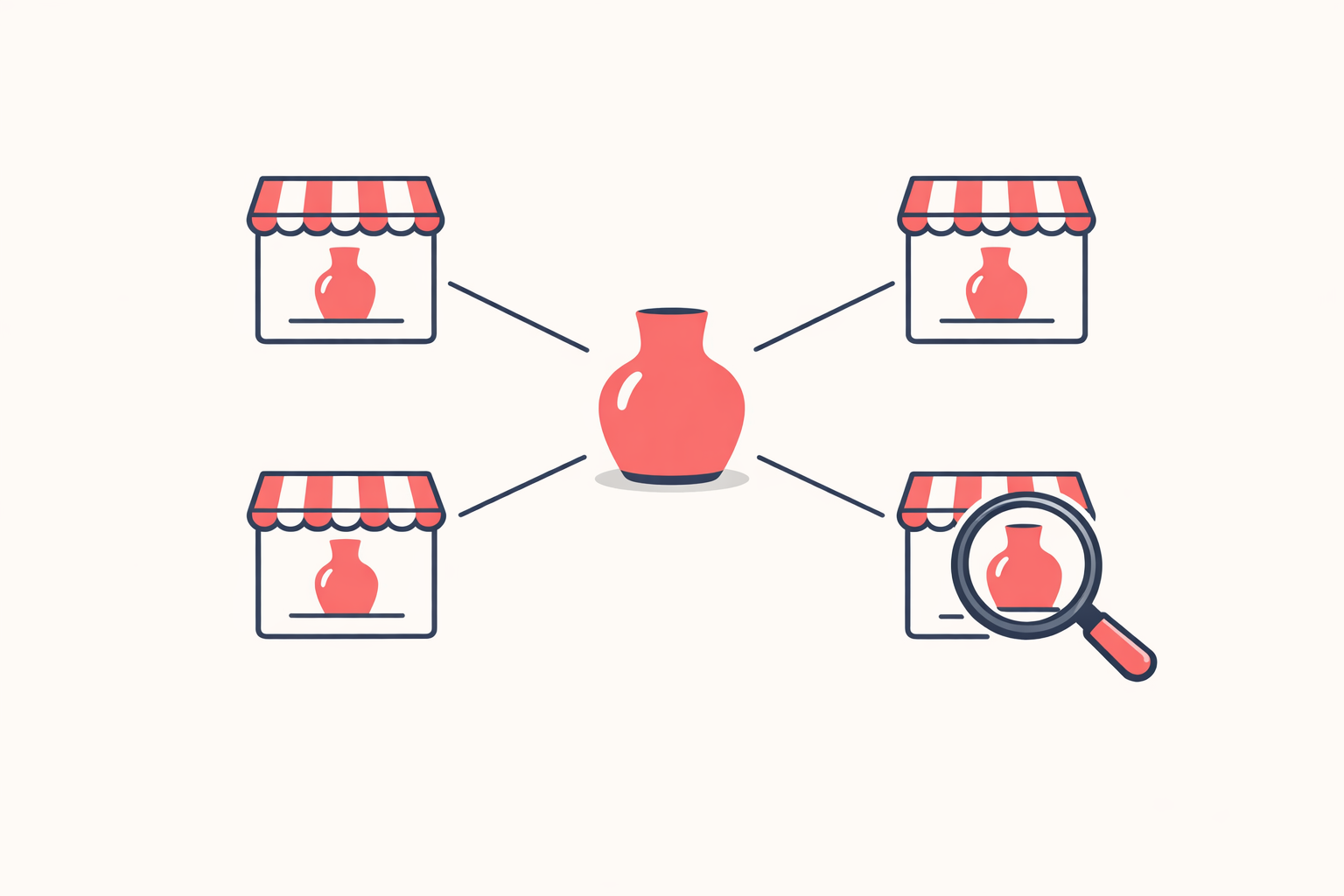
Read the supplier spread. Open the product in Find Suppliers and look at the split between exact matches and similar products. A long list of exact matches, all at tightly bunched delivered prices, means the product is everywhere and the price has already been competed down to the floor. A short list with wide price spread means there is still room to work with. The screen also shows your estimated profit and margin per unit at your chosen selling price, which is the fastest sanity check available on a home product with heavy shipping.
Read the catalogs. Open four or five of the busy stores in your sub-category and check how many list the same product or a near twin. Two out of five is a product with proven demand and room left. Five out of five means you are entering a price fight against stores with more traffic, better reviews and a deeper app stack than you have on day one. Our guide to whether a dropshipping product is saturated goes further on reading that signal across niches.
The thing neither reading gives you on its own is direction. A product can be in two catalogs and falling, or in four and still climbing. That is what Koala Inspector's Product Trends screen is for: live trending products with sales signals and trend indicators, so you can see momentum rather than a snapshot. In a category where a vase shape has a six-month life and a seasonal item has eight weeks, knowing which way a product is moving is worth more than knowing that it sold last quarter.
The workflow, start to finish
Here is the whole thing as a repeatable loop. It takes about twenty minutes per candidate and most of it costs nothing.
- Pick a tracked store in your sub-category. Start from the home decor leaderboard or any busy home store you already know, and open it with the free Koala Inspector extension. The store overview gives you the category, the product count, the active theme and the localization in one screen, at no token cost.
- Check the store is worth copying. The free app detector lists every Shopify app the store runs. A home store running a review app, an email tool and an upsell app on a paid theme is spending real money, and its catalog decisions are worth taking seriously. A store with three apps is not a reference.
- Read its best-sellers. Browse the catalog and filter to best-selling products, with prices, variants and the first-published date. This is free as well, and it is the step that replaces a guessed product list with a real one.
- Check how crowded the product already is. Run your shortlist through Find Suppliers and read the exact-match count, the delivered price spread and your landed cost per unit. Then open three more stores in the same sub-category and see how many carry it.
- Check which way it is moving. Product Trends shows you whether the product has momentum behind it or has already peaked. For seasonal and design-led home items, this is the difference between a profitable eight weeks and a warehouse of unsold wreaths.
- Then, and only then, spend on ads. By this point you know real stores sell it, what it costs you delivered, how many suppliers list it, and whether it is rising.
The first three steps are free and unlimited, so you can run them on every candidate you have. Install Koala Inspector free from the Chrome Web Store, open a busy home store, and read its best-sellers in the next five minutes.
Where home decor sits against other niches
The physics of this niche make it harder than beauty and easier than furniture. If you are still choosing, our niche guides cover the three closest comparisons: beauty dropshipping winning products for a category with no shipping problem at all, footwear winning products for one where sizing drives returns the way breakage does here, and jewelry dropshipping winning products for the smallest, lightest end of the physical spectrum. The full list of options is in our guide to the best dropshipping niches.
Home decor dropshipping: FAQ
The questions sellers ask before committing to this niche.
How do I find winning dropshipping products?+
Work backwards from stores that already sell them. Pick a store in your niche that is clearly pulling traffic, open its catalog and filter to best-sellers, then check how many other suppliers already list the same product. A product that several busy stores sell and keep advertising has had its demand proven with somebody else's ad budget. Koala Inspector reads a store's catalog, best-sellers, apps and theme for free, and its Product Trends screen shows live trending products with sales signals and trend indicators so you can tell a product on the way up from one that already peaked.
What home decor products sell best for dropshipping?+
The product groups that busy home stores actually build catalogs around are rugs and washable rugs, cookware and drinkware, wall and interior decor, bedding and bath, and seasonal decor. Across the home and garden stores Koala Inspector tracks, the deepest sub-categories are kitchen and dining, interior decor, and rugs and carpets, and the stores in them average between 2.7 and 4.8 million estimated monthly visits each.
Is home decor a good niche for dropshipping?+
Yes, with one condition: you have to solve shipping before you solve marketing. Home decor buyers spend readily and repeat, and the category carries strong average order values. The difficulty is physical. Large items cost a fortune to deliver and fragile ones arrive broken, so the sub-niches that work for a small seller are the light, flat, hard-to-break ones such as washable rug covers, wall art, textiles and drinkware.
How do I know if a home decor product is already saturated?+
Count the stores and the suppliers carrying it. Open the product in Koala Inspector's Find Suppliers screen and look at the split between exact matches and similar products: a long list of exact matches at tightly bunched delivered prices means the product is widely sold and the margin is already competed away. Then check whether the busy stores in your category list it. A product in every catalog you open is late; a product in two of five is early.
How much margin do home decor products need?+
Enough to cover delivery, breakage and returns before ad spend, which is a higher bar than most categories. Price your landed cost per unit including shipping and import duty, then add a realistic allowance for items that arrive damaged. Koala Inspector's Find Suppliers cost breakdown shows item price, shipping estimate, import tariffs and total landed cost per unit, so you can see what is left before you commit.
Sources
- Reddit, r/ecommerce on why a furniture ecommerce business felt impossible - the 90 dollar unit cost, the 60 to 90 dollar domestic shipping and the 150 dollar landed cost against a 160 dollar target price.
- Reddit, r/dropshipping on how people find winning products - the recurring question this guide answers.
- Reddit, r/dropshipping on whether dropshipping is still worth starting in 2026 - finding winning products named as the biggest challenge beginners face.
- Shopify Community, which dropshipping company is best for home decor in the US and Canada - sellers asking the supplier-first version of this question.
- Koala Inspector store data, November 2026 - the seven kitchen and dining stores, six interior decor stores, five rugs and carpets stores and four bed and bath stores, their 2.7 to 4.8 million average estimated monthly visits, the 18.5 million visits and 20 apps at roughly 4,799 dollars of monthly app spend at stanley1913.com, and the 16-app average. These cover the Shopify stores Koala tracks rather than the whole platform.
Written by
Ana Gelevska
eCommerce Content Writer
Ana Gelevska is a content writer with more than five years of experience creating content for eCommerce brands and global clients. She digs into each topic and the people it is for, then turns it into clear, useful articles that Shopify sellers and dropshippers can act on.
Connect on LinkedIn