Printify POD
 By Ana GelevskaSeptember 12, 2023 · Updated June 4, 2026
Printify POD is a print-on-demand platform that handles production and shipping for you. You design a product, list it in your store, and Printify routes each order to one of its print suppliers when a customer buys. No inventory, no upfront stock purchases.
The appeal is straightforward: you only pay for a product after someone orders it. That removes the usual risk of buying 500 units and hoping they sell.
What is Printify POD?
Printify is a print-on-demand and dropshipping platform founded in 2015 and headquartered in Wilmington, Delaware. It connects sellers to a global network of over 80 print providers carrying more than 1,300 product types, from t-shirts and hoodies to mugs, phone cases, posters, and blankets.
When a customer places an order in your Etsy or Shopify store, Printify automatically forwards it to a print supplier, who prints the item and ships it directly to the customer. You never touch the product.
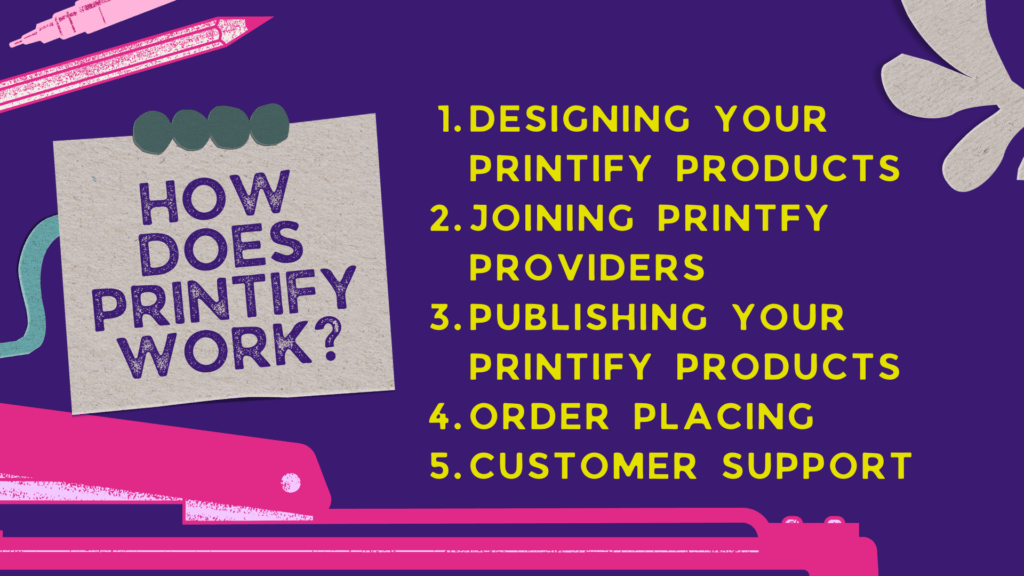
How does Printify POD work?
Here is the full flow from design to delivery.
1. Designing your products
You start in the Printify product catalog by picking a blank item. The catalog covers apparel (t-shirts, hoodies, hats, socks), accessories (phone cases, bags, backpacks), home goods (mugs, pillows, blankets, wall art), and more.
Once you pick a product, you upload your design or use Printify's mockup generator to place artwork on it. You set the size, color, and placement, then configure pricing. Printify shows you the base cost from the supplier and your estimated profit margin so you can set a price that makes sense.
One practical note: extended sizes (4XL, 5XL) cost roughly $5 more to produce at most suppliers, which compresses margins if you're pricing flat across sizes.
2. Choosing a print provider
Printify's core differentiator is its multi-supplier model. For most products you can pick from several print providers, each with different base prices, locations, production speeds, and print methods (direct-to-garment, sublimation, embroidery, screen print).
The tradeoffs are real. A US-based supplier ships faster domestically but may cost more per unit. A European supplier is better for EU buyers. You can see customer reviews and ratings for each provider inside the dashboard before committing.
What the corpus research makes clear: print quality is inconsistent across Printify's provider network. Sellers have reported faded colors, rough textures, and misaligned prints from specific providers. Ordering a sample before you publish a product publicly is worth the cost.
3. Publishing products to your store
After you finalize a design, you publish it directly to your connected store. Printify supports Shopify, Etsy, WooCommerce, Wix, and several other platforms. Each product gets a listing with mockup images, your description, and the pricing you set.
Products sync both ways: order data flows into Printify automatically once a purchase is made, and tracking numbers flow back to your store.
4. Order fulfillment
Once a customer orders, Printify's system selects a supplier based on the product type and the customer's location, sends the print job, and handles production. Most orders go through a 2-5 business day production window before shipping.
The print-on-demand model means items are made individually per order using direct-to-garment (DTG) or other print techniques, rather than pre-printed in bulk. Shipping times depend heavily on which supplier fulfills the order and where the customer is located.
5. Customer support and returns
Printify covers defective or damaged products. If an item arrives with a print error or quality problem, Printify will reprint or refund it. What they do not cover is buyer's remorse or size exchanges, which is standard across POD platforms.
Your store handles first-line customer communication. Printify's support team is reachable via email and live chat for escalated issues.
What custom products can you sell on Printify POD?
Printify's catalog covers a wide range of categories:
- Custom t-shirts and hoodies - the highest-volume category for most sellers
- Custom socks and underwear
- Custom hats and caps
- Custom phone cases
- Custom mugs and drinkware
- Custom backpacks and bags
- Custom stickers and prints
- Custom shoes (via select providers)
- Custom blankets and pillows
- Custom puzzles
- Posters, canvas prints, and wall art
The product range has expanded considerably since Printify launched. Not every product is available from every supplier, so availability depends on which providers stock a given item.
Where is Printify located?
Printify was founded in 2015 and is headquartered in Wilmington, Delaware. Its print provider network spans multiple countries, with suppliers in the US, UK, Europe, Canada, and Australia. For US orders, choosing a US-based provider typically means faster delivery and simpler customs.
How to link Printify to Etsy and Shopify
Connecting Printify to Etsy
Step 1. Create a Printify account at printify.com.
Step 2. In your Printify dashboard, go to "Stores" and click "Connect Your Store," then select Etsy.
Step 3. Authorize the connection. Printify will appear as a connected app in your Etsy account.
Step 4. Browse the Printify catalog, upload designs, and customize your products.
Step 5. When a product is ready, click "Publish to Etsy." It will appear as a new listing in your Etsy shop.
Step 6. Etsy orders sync automatically. Printify receives each order and routes it to the assigned supplier.
One thing Etsy sellers have run into: Printify's default shipping profiles sometimes auto-revert and cause incorrect shipping costs to be charged to buyers. Check your shipping profiles in both Printify and your Etsy shop after connecting.
Connecting Printify to Shopify
Step 1. Create a Printify account.
Step 2. Go to the Shopify App Store and install the Printify app.
Step 3. Open Printify, go to "Stores," and authorize the Shopify connection.
Step 4. Select products from the Printify catalog, add your designs, and set pricing.
Step 5. Publish products to your Shopify store.
Step 6. Set up your Printify billing. You will be charged for each order as it is fulfilled.
Shopify orders sync automatically once the integration is live.
Printify pricing
Printify has a free plan with no monthly fee. You pay the per-product base cost when orders are placed. The Premium plan ($29/month) reduces base costs by up to 20% across most products, which matters once you have enough order volume to offset the subscription.
Comparing landed costs across suppliers matters. Base prices vary meaningfully by provider, and shipping costs vary even more, particularly for international orders. An item that looks cheaper from one supplier may end up more expensive once shipping is included.
What to watch on margins
The core tension with POD is that per-unit costs are higher than bulk manufacturing. That is the trade-off for zero inventory risk.
At a $30 retail price for a basic tee, a typical cost structure looks like: $10-14 in production cost, $4-6 in shipping, and then platform fees (Etsy or Shopify transaction fees, payment processing). That leaves margins in the 30-50% range at most price points, before any ad spend.
Extended sizes, international shipping, and platform fee structures can compress margins further. Build your pricing from actual landed costs for each product and destination, not from assumptions.
How does Printify compare to alternatives?
Printify's main competitors are Printful, Gelato, and SPOD (Spreadshirt).
Printful has historically had more consistent quality because it owns its production facilities rather than routing to third-party suppliers. Its base prices are higher.
Gelato has a global network with strong European coverage and competitive pricing. Its Trustpilot score has slipped recently as it has scaled.
SPOD averages 48-hour production times, the fastest in the industry, but has a smaller product catalog.
Printify's multi-supplier model gives you flexibility and competitive base pricing on many items, but requires more attention to supplier selection. The same product can look quite different depending on which provider fulfills it.
Sum up
Printify is a practical starting point for print-on-demand, especially if you want to sell on Etsy or Shopify without holding inventory. The free plan keeps the entry cost low. The multi-supplier network gives you options, but supplier research and sample orders matter before you publish at scale.
For researching what products are already selling in Printify-based stores on Shopify, Koala Inspector lets you see what any Shopify store is stocking and which apps they are running.
FAQs
Does Printify work with small businesses and individual sellers?
Yes. The free plan has no minimum order requirements and no monthly fee. Many sellers start with a handful of designs on Etsy before scaling.
Can I connect Printify to more than one store?
Yes. You can link Printify to multiple stores across different platforms (Etsy, Shopify, WooCommerce, etc.) from a single Printify account.
How does Printify handle fulfillment?
After a customer orders, Printify forwards the order to the assigned print supplier. The supplier prints the item and ships it directly to the customer. You track the order status in your Printify dashboard.
Is Printify free to use?
Printify is free to join. You pay base costs per product when orders are placed. The Premium plan ($29/month) reduces those base costs by up to 20%.
Do I need to hold inventory?
No. Products are printed per order. You never hold stock or ship anything yourself.
How do I customize products on Printify?
Use Printify's mockup generator to upload artwork and place it on a product. You can adjust placement, pick colors and sizes, and preview how the design looks before publishing.
How does Printify handle defective orders?
If a product arrives damaged or with a print defect, Printify will reprint or issue a refund. Returns due to customer preference (wrong size, changed mind) fall under your own store's return policy.
Can I reach Printify customer support?
Yes, via email and live chat. Response times vary. For complex supplier issues, escalations can take several days.
Is there a minimum order quantity?
No minimum. You can list and sell products one at a time.
Does Printify provide order tracking?
Yes. Tracking information is sent to customers automatically and is visible in your Printify dashboard and your connected store.
Written by
Ana Gelevska
eCommerce Content Writer
Ana Gelevska is a content writer with more than five years of experience creating content for eCommerce brands and global clients. She digs into each topic and the people it is for, then turns it into clear, useful articles that Shopify sellers and dropshippers can act on.
Connect on LinkedIn