Print on Demand With No Upfront Inventory: What You Pay Instead, and When
 By Assaf ShalinNovember 11, 2026
Print on demand removes the inventory bet. You never buy stock, so there is no shelf of unsold hoodies to write off if the design lands badly. Printful states it on its own site: no inventory, no upfront costs, no bulk order minimums, and no monthly fees, because you pay only when you sell (printful.com/how-printful-works, read 11 November 2026). Shopify says the same in plainer terms, that sellers do not need to buy or store inventory ahead of time and primarily incur costs when a customer places an order (shopify.com/print-on-demand, read 11 November 2026).
What you pay instead is a monthly storefront bill, an optional sample, and a per-order production and shipping cost that comes out of money a customer has already handed you. The question sellers ask on r/shopify is exactly this one: do I have to pay the supplier to make the shirt and cover shipping, and does the full Shopify payment land in my account (r/shopify). This post prices all of it, with dates, then shows you how to check that a design is worth listing before you build it.
What you actually pay before a first sale
Three published prices cover almost every new print on demand store, and two of them are zero.
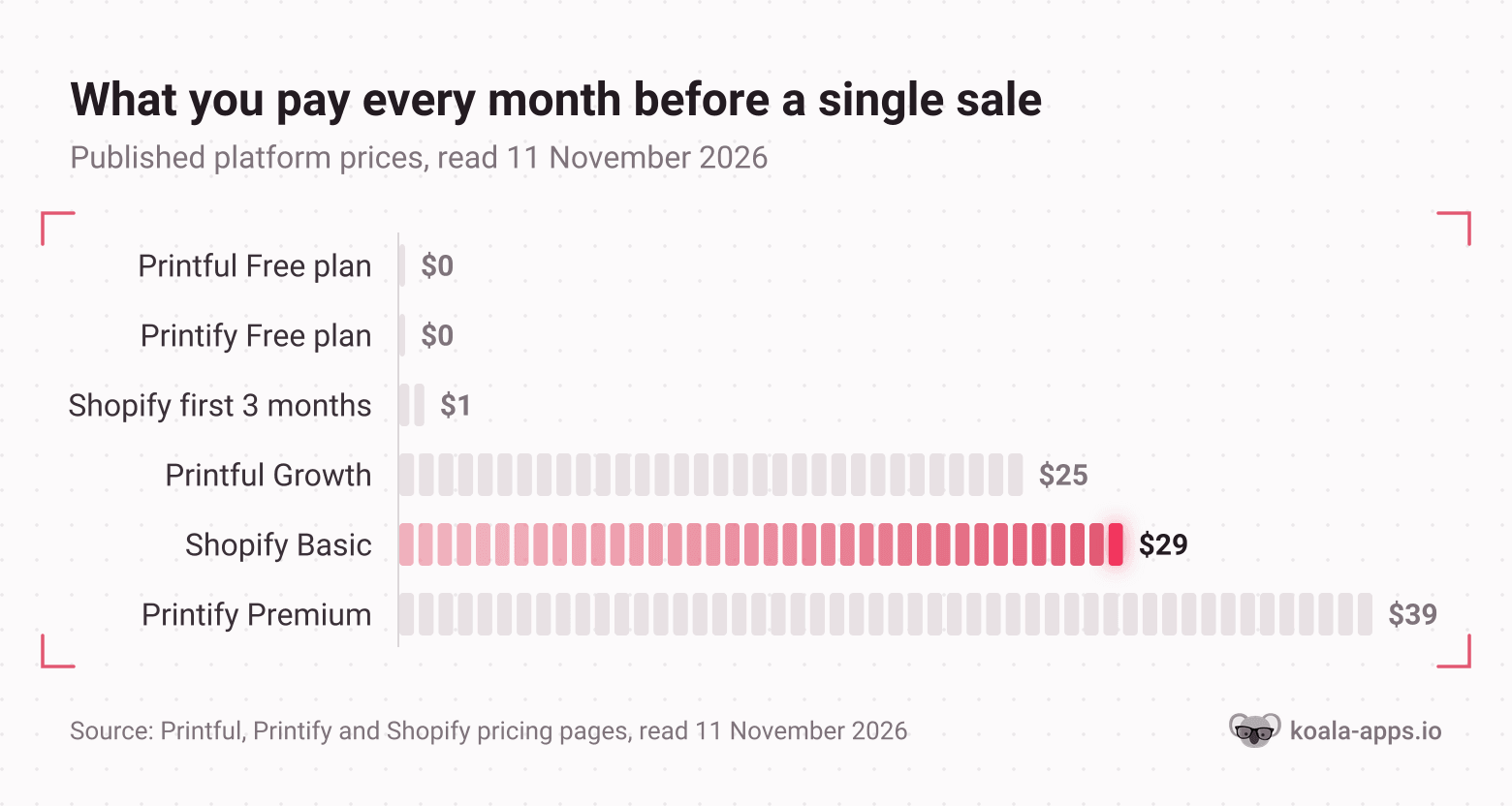
| What | Published price | Source, read 11 November 2026 |
|---|---|---|
| Printful Free plan | $0 a month, 602 customizable products, unlimited stores | printful.com/pricing |
| Printful Growth | $24.99 a month, 14 day trial, free once you reach $12K a year in sales | printful.com/pricing |
| Printify Free plan | $0 a month, 5 stores per account, unlimited product designs | printify.com/pricing |
| Printify Premium | From $39 a month, or from $24.99 a month billed yearly | printify.com/pricing |
| Shopify Basic | $29 a month on the default yearly toggle | shopify.com/pricing |
| Shopify trial | 3 days free, then $1 a month for 3 months | shopify.com/pricing |
Read the table as one sentence: the supplier costs nothing to join, and your storefront is the only thing billing you while you have no sales. Printify puts the upgrade decision well on its own pricing page, telling merchants to start free and upgrade only when the discounts outearn the fee.
So a first month on your own Shopify store, with a free supplier plan, is $1 of subscription plus whatever you spend on a sample and a domain. That is the whole inventory-free starting position, and it is why the model exists.
What each order costs, after the customer pays
Once an order arrives, you pay the supplier for production and shipping, and you keep the difference. Two published vendor examples show the shape of it.
Shopify's own print on demand calculator runs its default on an $8 product cost sold at $20, which at 30 orders a month shows a monthly profit of $360. The footnote matters: those defaults are based on the lowest cost across a subset of US print on demand suppliers as of May 2025, and they exclude shipping fees, taxes and other costs (shopify.com/print-on-demand). Printify's calculator uses a fulfilment cost of $8.77 against a $35 retail price and one sale a day, showing $813.13 of monthly earnings, with the same caveat that shipping, taxes and storefront expenses are excluded (printify.com/how-it-works).
Shipping is the line both calculators leave out, and it is published per product category. Printful's rates for a single t-shirt are $4.95 to the USA, $4.99 to Europe, $4.79 to the UK and $8.59 to Canada, with each additional t-shirt in the same parcel adding $2.20 in the USA. A single hoodie is $8.79 to the USA. There is also a temporary surcharge of $0.40 on all US destination orders from 15 October 2026 to 17 January 2027 (printful.com/shipping, read 11 November 2026).
Price your product with shipping inside the sum, not beside it. A $20 tee at an $8 base cost looks like $12 of margin until $4.95 of postage and the card processing fee come out of it.
Production and shipping timelines, read as two numbers
The second worry after money is time, and most of the confusion comes from treating one published figure as the delivery promise. There are always two windows.
Printful's fulfilment time is 2 to 5 business days to create a product and fulfil an order, and the page says so for all products. Shipping is quoted separately and only starts after fulfilment ends (printful.com/shipping, read 11 November 2026).
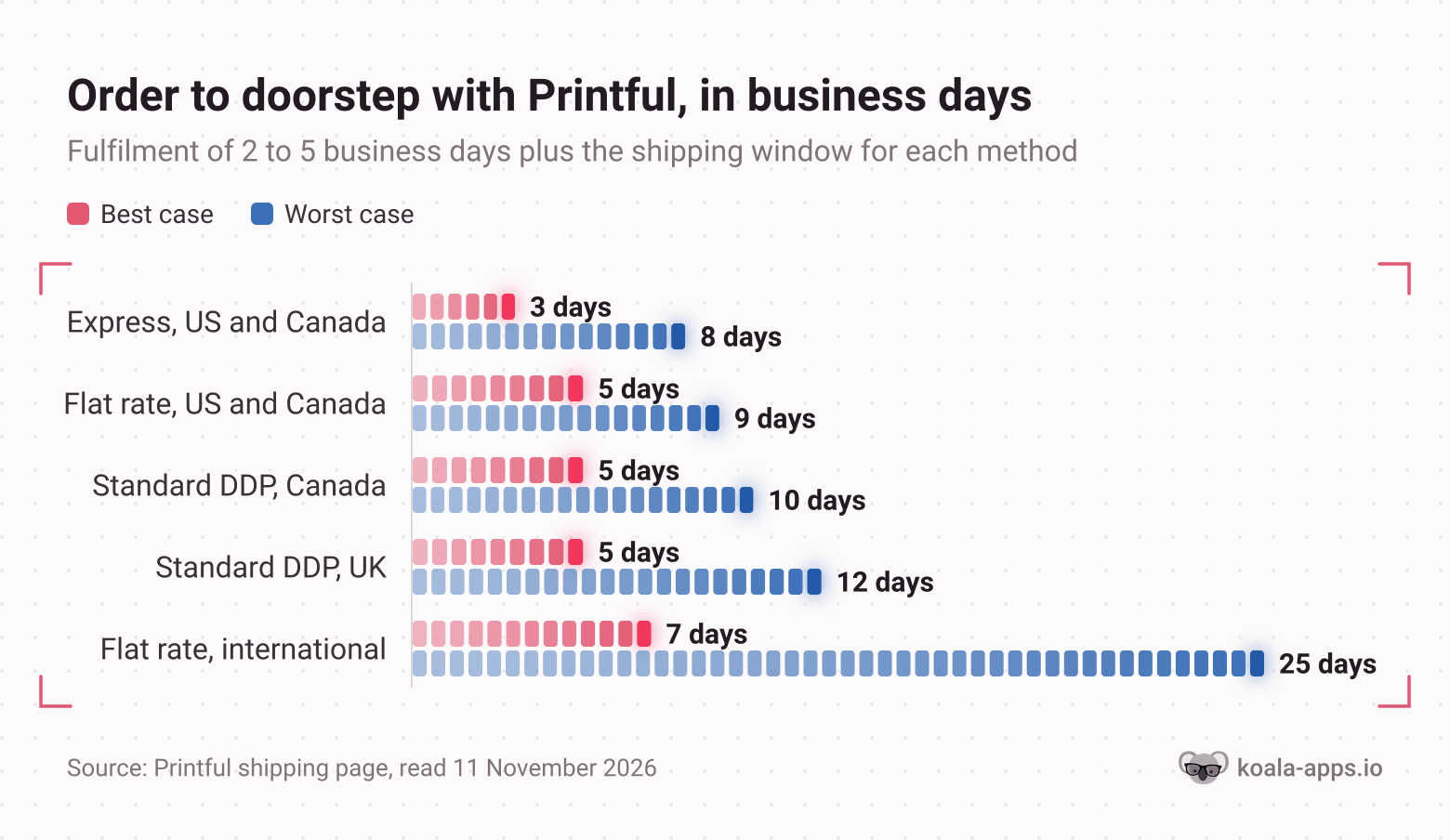
The published shipping windows, added to that 2 to 5 day fulfilment, give the ranges in the chart:
- Express, US and Canada: 1 to 3 business days after fulfilment.
- Flat rate, US and Canada: 3 to 4 business days after fulfilment.
- Standard DDP, Canada: 3 to 5 business days after fulfilment, and up to 12 business days to the Atlantic region.
- Standard DDP, UK: 3 to 7 business days after fulfilment.
- International flat rate: 5 to 20 business days after fulfilment.
Printful also labels the estimated delivery time as the sum of estimated fulfilment and shipping time, and says it is not a guarantee. Put the worst case on your shipping policy page, not the best case. A store promising 3 day delivery on a method whose published range reaches 9 business days is writing its own support tickets, and keeping customers informed about order status is one of the loudest complaints sellers raise about this model.
Two practical moves. Sell to one country first, so you quote one window rather than five. And in October, re-read your supplier's published times before you spend on ads, because peak season is where the long end of every range becomes the normal case.
Print quality, when you cannot see the product
Here is the real tension in an inventory-free launch. The standard advice is to order a sample of everything before you sell it, and the entire point of print on demand is not buying product in advance. Both cannot be true at once.
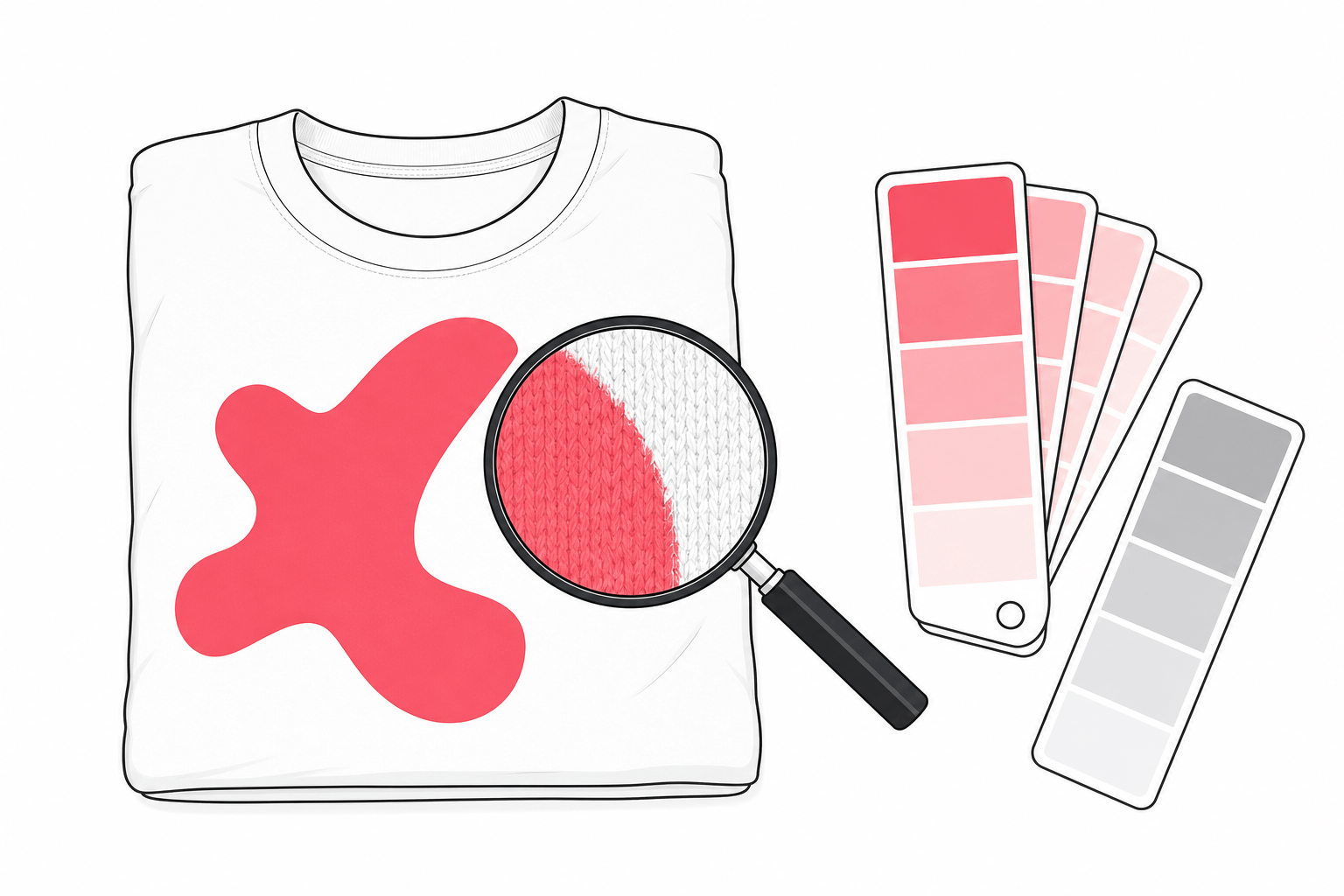
The middle ground is to sample the blank, not the catalogue. You will sell five designs on one or two garments. Order one sample of that garment with one design on it and you learn the four things that generate refunds: the fabric weight and fit, the colour shift between your file and the print, the ink edge after a wash, and what the parcel looks like when it lands on a doorstep. Every other design you list rides on the same blank and the same printer.
The cost of doing that is published. Printful gives 20% off sample orders on the Free plan and 25% off on Growth, and allows one sample order a month with up to three items, with more unlocking as sales volume increases (printful.com/pricing, read 11 November 2026). Three items on one discounted order is enough for a garment in two colours plus a second blank you are considering.
For a sense of the baseline you are checking against, Printful publishes a reshipment rate of 0.24% and says it has fulfilled 149,189,214 items since 2013 (printful.com/how-printful-works, read 11 November 2026). A reprint rate that low does not mean your specific design will print the way you drew it, which is the thing one sample tells you and nothing else does.
Get the misprint and damage policy in writing before you list, too. Sellers on r/printondemand ask who covers the cost of returns and whether a run of them could leave them in debt (r/printondemand), and the answer is specific to your supplier and your product.
Validate the design before you commit: read stores that already sell it
Removing the inventory risk removes the money you can lose on stock. It does not tell you whether anybody wants the product. A seller on r/growmybusiness framed the same gap precisely, asking which signals were strong enough to justify the first order and whether interest ever looked strong while sales never followed (r/growmybusiness).
You can answer that by reading stores that are already selling in your category, before you design anything.
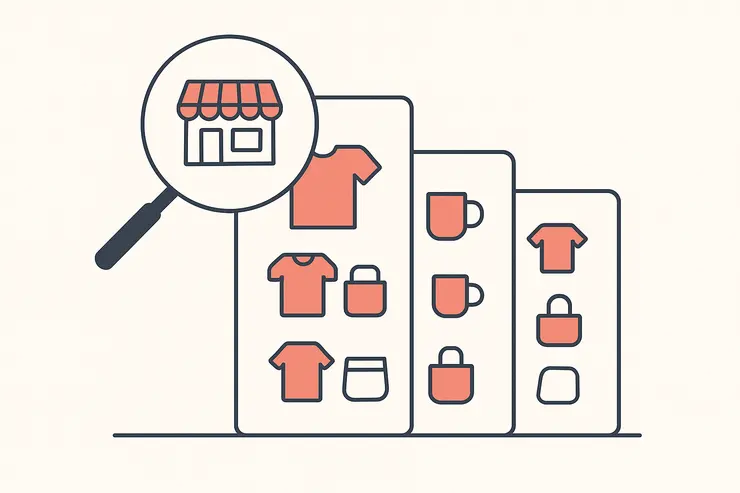
Install Koala Inspector, open a live Shopify store in your niche, and the product research view shows the store's full catalog with a filter for its likely best-sellers. For each product you get the image, the name, the price and the variations, and you can search the catalog, sort it by date added, price or name, and favourite products to keep them across sessions. A stats header gives the total product count, the high and low of the price range, and the date the store first published a product. That is free and costs no tokens.
Run it across six or eight stores in your category and three questions answer themselves:
- Is this product category moving? If the same kind of product sits in the best-sellers view of store after store, there is demand for it beyond your own enthusiasm for the design.
- What does it sell for? The price range in the stats header is your pricing bracket, read off real listings rather than guessed from your cost plus a margin.
- How mature is this store? A first-published date paired with a large catalog tells you whether you are looking at a tested seller or a shop that launched last month.
Scale gives that reading weight. Across the Shopify stores Koala tracks, Printful appears on 25,410 of them, Printify on 14,444, Customily Product Personalizer on 9,349 and Gelato on 4,727, as of 10 November 2026.
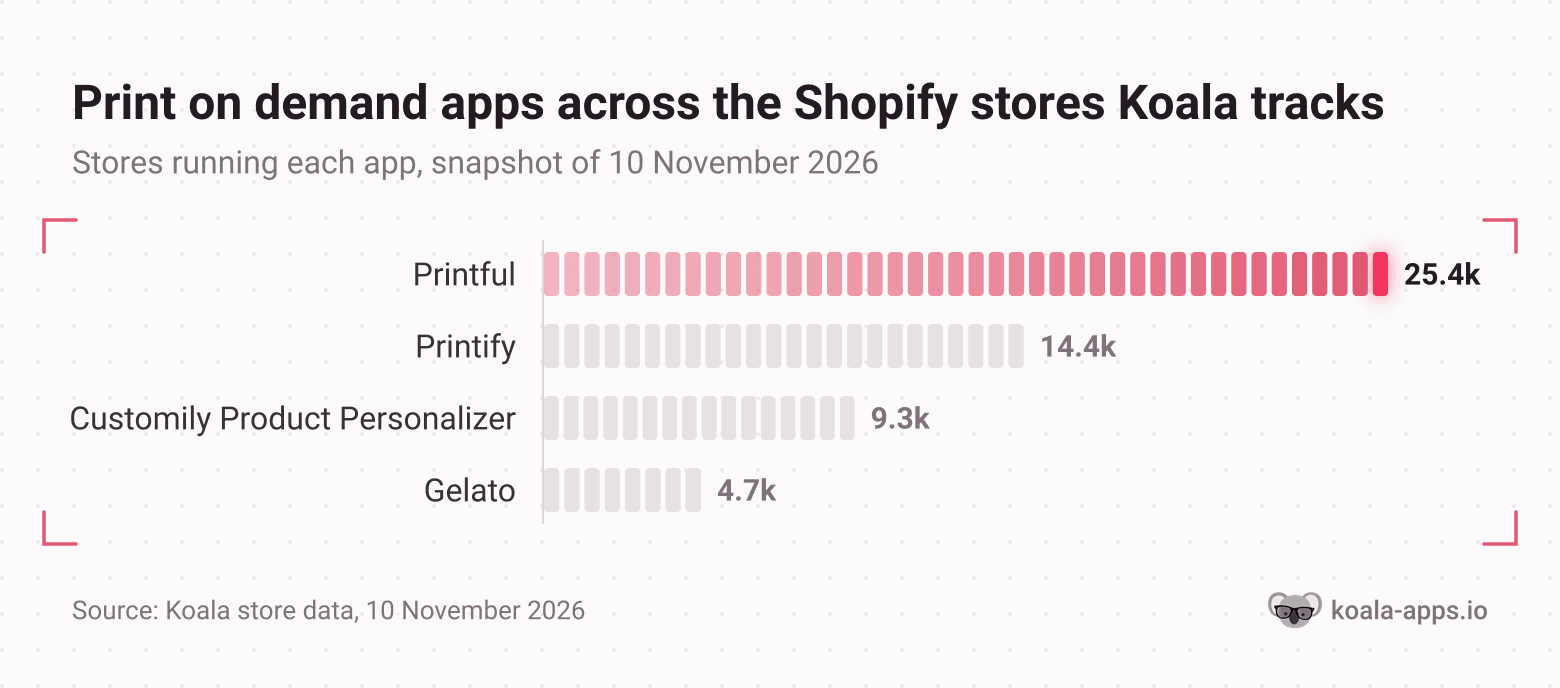
Those counts cover the stores Koala tracks rather than every store on Shopify, so read them as a ranking of how widely each supplier is used, not as a global census. The useful part for a new seller is that there are tens of thousands of live print on demand stores you can open and read before you commit to a single design.
Check demand before you design
Install Koala Inspector, open any Shopify store in your niche, and read its catalog, its likely best-sellers, its price range and its product count. Free, and it costs no tokens.
A checklist you can run this week
- Monday. Pick one country to sell to and one blank to sell on. Write down the supplier's published fulfilment window and the shipping window for that country as two separate numbers.
- Tuesday. Open six to eight live stores in your category with Koala Inspector and record what their best-sellers are, what those products cost, and how big each catalog is. Cut your design ideas to the two that match what is already selling.
- Wednesday. Price one product end to end: base cost, plus shipping to your chosen country, plus payment processing, against the retail price you read off those stores. If the margin is under a third of the retail price, change the blank or the price.
- Thursday. Order one discounted sample of your lead blank with your lead design on it, to your own address, and start the clock.
- Friday. Publish your shipping policy using the worst case of the two windows, and set up your Shopify trial so the subscription clock starts when the store is ready to sell.
- The following week. Judge the sample on fit, colour against your file, ink edge after one wash, and packaging. Then list, and let the first real orders pay for everything that follows.
That sequence costs the price of one t-shirt plus the $1 a month Shopify was charging for its first three months when its pricing page was read on 11 November 2026. The inventory-free model gives you the rest of the risk reduction for free.
What sellers say about Koala Inspector
Verified reviews from the Chrome Web Store.
“great app for ecommerce, there are a lot of useful information. Friendly customer service!”
 Lavender Yuzu
“Excellent tool for Shopify research! simple, accurate, and packed with insights. Highly recommend it.”
 Data Analysis
“The service has been great, very responsive and the most comprehensive spying of global markets Ive seen!”
 Adrienne Greenwood
Keep reading
- How to choose a print on demand supplier is the next decision after this one, with four tests you can run on any supplier.
- Printify POD explained walks through one of the two biggest platforms end to end.
- Print on demand product research covers the design side: finding the artwork and products worth listing.
- How much it costs to start dropshipping prices the wider model, for comparison.
Print on demand without inventory: FAQ
The questions sellers ask before they list a first product.
What is print on demand?+
Print on demand is a business model where products are made only after someone buys them, as Shopify's own print on demand page puts it. You upload a design, list the product in your store, and a production partner prints and ships each item once a customer orders. Shopify's guidance adds that sellers do not need to buy or store inventory ahead of time and primarily incur costs when a customer places an order, which is what makes it a low-risk way to start compared with buying stock in bulk.
Do you need to buy inventory upfront with print on demand?+
No. Printful states plainly on its own site that there are no upfront costs, no bulk order minimums and no monthly fees, and that you pay only when you sell. Printify's platform is free to use on its Free plan at $0 a month with five stores per account. What you still pay before a first sale is anything outside the supplier: a Shopify subscription if you sell on your own store, a domain, and any sample you choose to order. Both pages were read on 11 November 2026.
How long does a print on demand order take to reach the customer?+
Add two windows together. Printful's shipping page, read on 11 November 2026, says it takes 2 to 5 business days to create a product and fulfil an order, then quotes shipping separately: 3 to 4 business days after fulfilment for domestic flat rate in the US and Canada, 1 to 3 business days for express, 3 to 7 business days for standard DDP to the UK, and 5 to 20 business days for international flat rate. So a realistic domestic promise is around 5 to 9 business days, and an international one can run to 25.
Should you order a sample before you start selling?+
Order one sample of the blank you will sell most, rather than a sample of every design. Printful's pricing page, read on 11 November 2026, gives 20% off sample orders on the Free plan and 25% off on the $24.99 a month Growth plan, and allows one sample order a month with up to three items, with more unlocking as sales grow. That single order tells you about the garment, the print quality and the packaging, and it keeps the cost of checking quality to one parcel instead of a shelf full of them.
How much money do you need to start print on demand?+
The floor is close to zero, and the real line item is your storefront. Printful and Printify both publish free plans at $0 a month. Shopify's pricing page, read on 11 November 2026, offers 3 days free then $1 a month for 3 months, with Basic at $29 a month on the default yearly toggle after that. Budget that subscription plus one sample of your lead product, and then every further cost arrives after a customer has already paid you.
Written by
Assaf Shalin
Co-founder & Developer, Koala Apps
Assaf Shalin is a co-founder of Koala Apps and one of the developers behind Koala Inspector. He builds the tools that let Shopify sellers see what is actually working in other stores, from installed apps and themes to best-selling products. On the blog he covers the technical side of store research: how competitor research really works, what public store signals can and cannot tell you, and how to turn them into decisions.
Connect on LinkedIn