Dropshipping as a Digital Nomad: How to Run Your Shopify Business From Anywhere
 By Assaf ShalinNovember 12, 2026
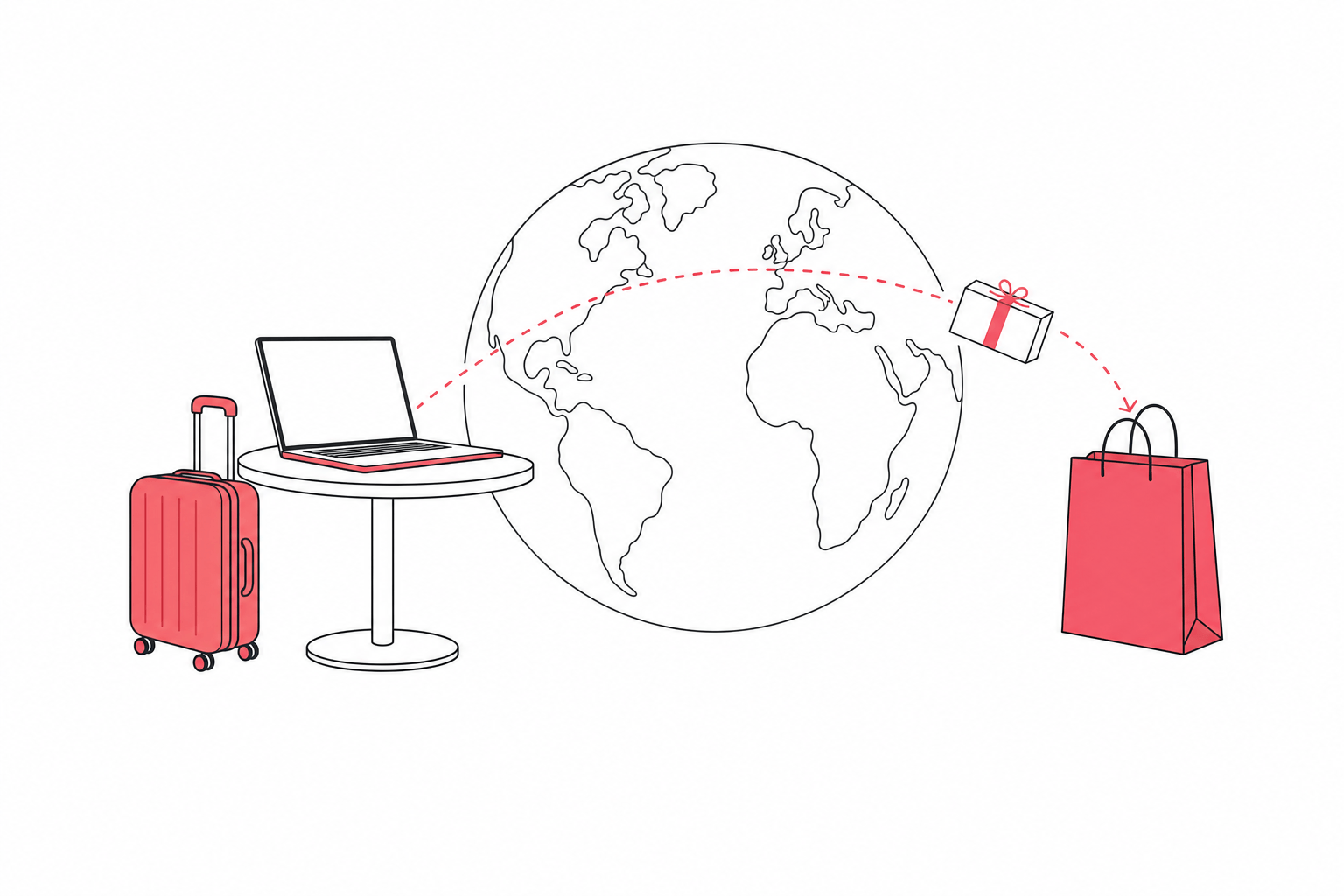
Dropshipping travels better than almost any other retail model, for one structural reason: nothing you sell passes through your hands. The supplier holds the stock and ships the order. What you own is a storefront, a set of supplier relationships and a marketing budget, and all three live in a browser. That is why the model keeps coming up whenever someone asks on r/Entrepreneur which businesses survive a move (r/Entrepreneur).
What changes on the road is reliability and legal standing. Your connection becomes infrastructure, your time zone becomes a support policy, and your visa limits what you are allowed to do at the desk. This post covers all three with figures you can check, then names the parts that get harder rather than easier.
Why dropshipping suits remote work
Strip a dropshipping business down and five jobs remain: find products, build and price listings, buy traffic, answer customers, manage suppliers. None of them needs a room.
Shopify's mobile app page, read on 12 November 2026, covers the back office half: the app manages orders, fulfills shipping requests, updates inventory and tracks visitors, orders and campaigns from anywhere, and its FAQ states the app is included with your Shopify plan with no separate download fee or subscription (shopify.com/mobile). Sidekick, the assistant built into it, can check the day's sales, find a customer's order or update a product price by voice or text.
So the storefront genuinely runs from a phone in an airport. What does not travel quietly is everything built on your identity and address.
What a traveling week actually looks like
The realistic shape is two fixed work blocks a day on your selling market's clock, with the rest of the day free. A seller in r/EntrepreneurRideAlong wrote up exactly that, a normal week doing dropshipping full time as a digital nomad (r/EntrepreneurRideAlong). The rhythm matters more than the hours, because customers judge you on response time and a nine-hour difference attacks that directly.
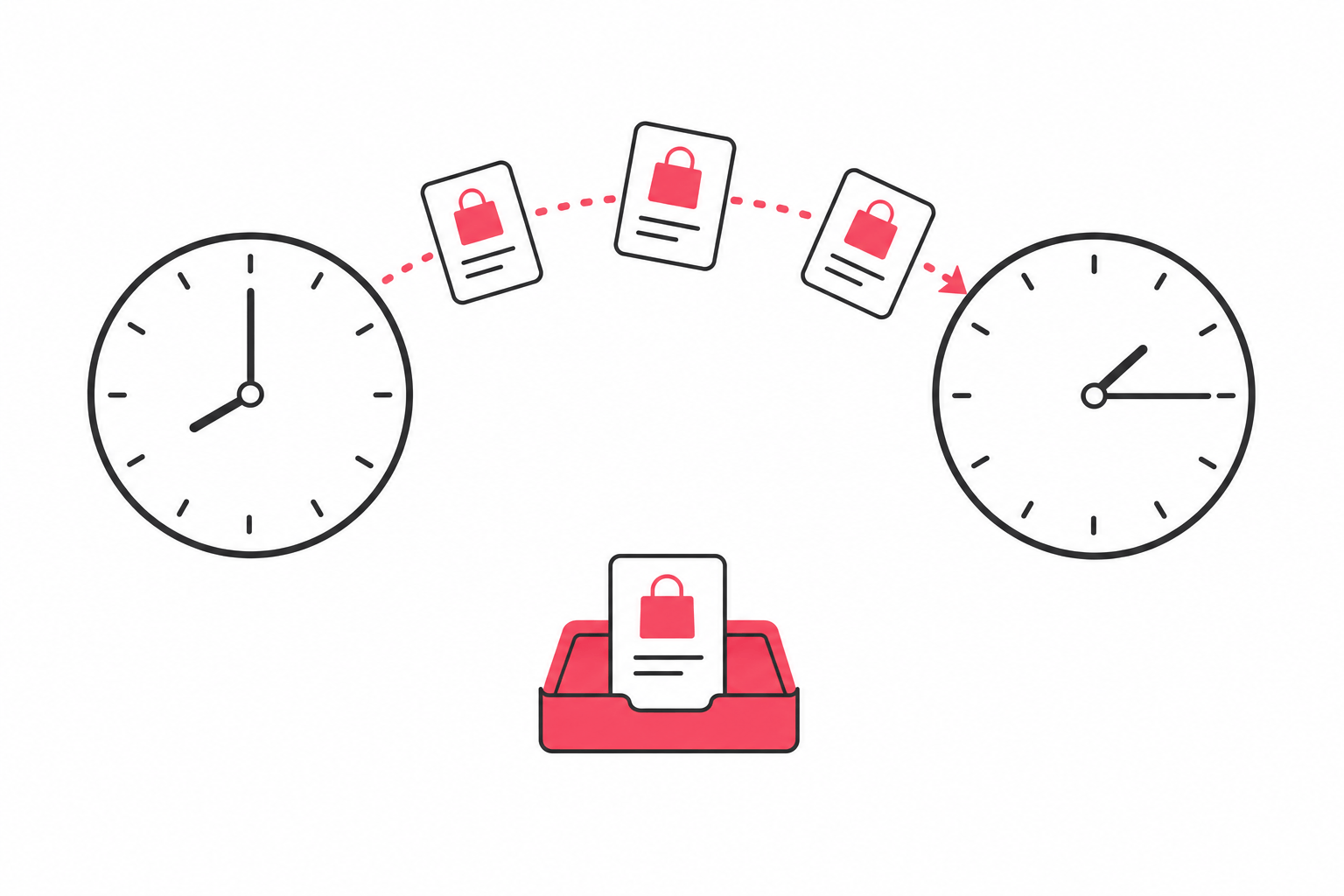
Time zones also quietly distort your own reporting. Merchants have raised end-of-day totals landing on UTC rather than the store's own time zone, which splits a trading day in two on the report you use to make decisions (Shopify Community). Set your store time zone to the market you sell to and leave it there, even as you move. A dashboard that keeps changing shape is a dashboard you stop trusting.
Automate the decisions that should not wait for you
Every hour you are asleep is an hour the store is open. Shopify Flow builds workflows from no-code trigger, condition and action blocks, and the cases it publishes are the ones that otherwise sit in your inbox: hiding products that go out of stock, flagging high-risk orders, and holding or releasing orders for fulfillment on pre-set conditions. Its scheduled automations also let you choose when to pull data and run reports. Shopify states Flow ran 562 million workflows during Black Friday Cyber Monday and automates over a billion decisions a month (shopify.com/flow, read 12 November 2026).
Three rules keep a traveling store sane:
- One market, one clock. Sell into a single country first. One shipping promise, one support window, one set of holidays to plan around.
- Publish a response window you can hit on your worst travel day, not your best one. A stated 24-hour reply that you always make beats a promised two hours you miss on a flight day.
- Write down every manual step you perform twice a week, then automate or template it. That list is your roadmap out of being the bottleneck. Our guide to automated dropshipping breaks the layers down and prices them.
Choosing where to live and work
Pick a base on what is measurable first. The measurable thing that decides your working week is the connection.
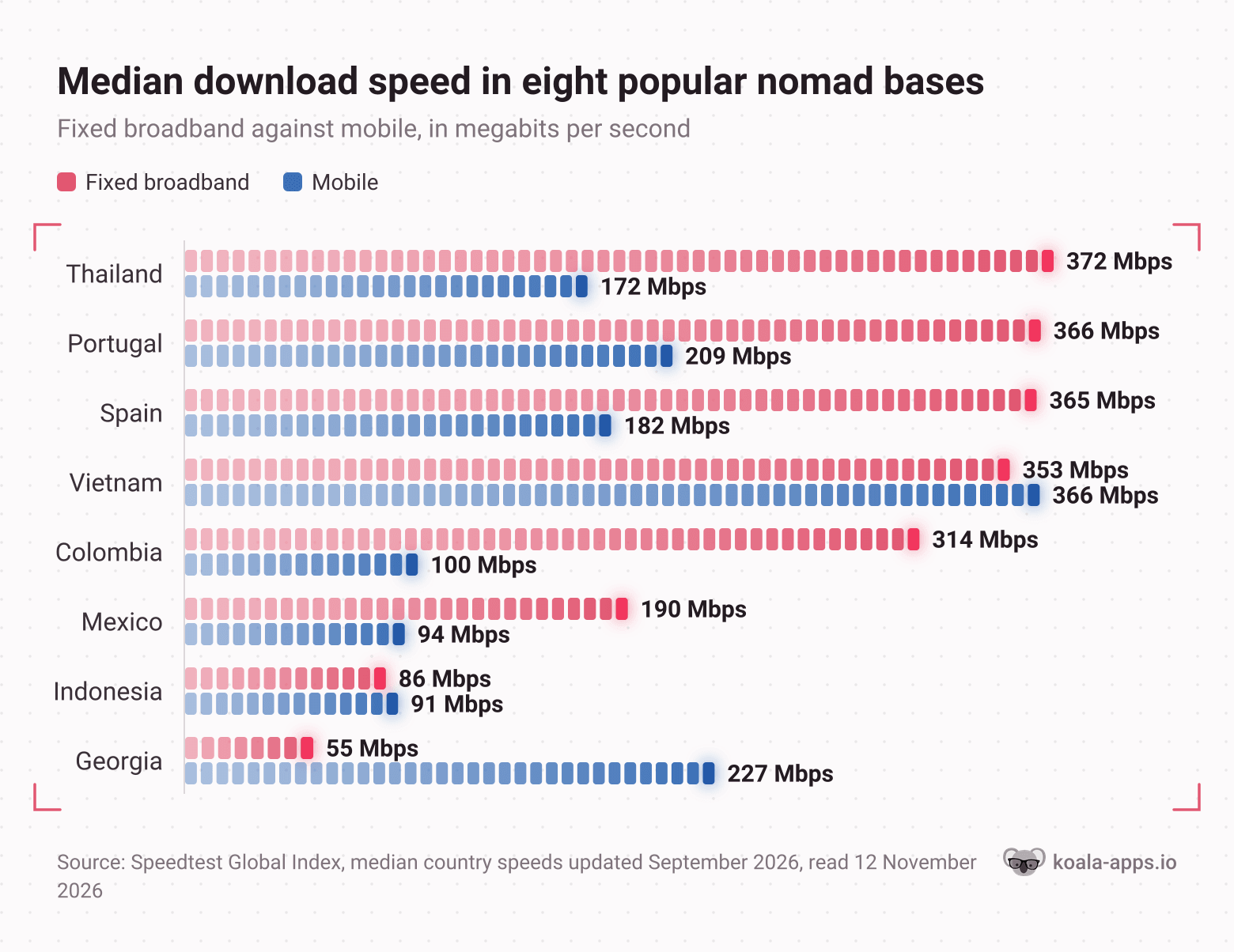
On the Speedtest Global Index, with median country speeds updated September 2026 and read on 12 November 2026, the global median fixed broadband download was 259.98 Mbps and the global median mobile download was 202.96 Mbps (speedtest.net/global-index). Among the eight bases above, read the same day from the same index:
| Country | Median fixed broadband | Median mobile |
|---|---|---|
| Thailand | 371.83 Mbps | 172.28 Mbps |
| Portugal | 366.33 Mbps | 208.67 Mbps |
| Spain | 364.56 Mbps | 182.37 Mbps |
| Vietnam | 353.05 Mbps | 365.87 Mbps |
| Colombia | 314.38 Mbps | 99.64 Mbps |
| Mexico | 189.53 Mbps | 94.04 Mbps |
| Indonesia | 85.95 Mbps | 91.18 Mbps |
| Georgia | 54.89 Mbps | 226.67 Mbps |
Two readings are worth carrying with you. The spread between the top and bottom of that list is roughly sevenfold, so "good internet" is a claim to check per country rather than a background assumption. And in Georgia and Indonesia the median mobile figure matched or beat the fixed one, which makes a local SIM the primary connection in some places and the backup in others. Buy one on arrival either way.
The other factors that decide whether a month works are cost of living against your margins, how long you are legally allowed to stay, and whether there is a coworking space you can reach without an hour of transit.
Finding somewhere to work from
Accommodation is a working decision, because the desk, the chair and the router are part of your office. The practical filters are a separate work surface, a connection you can test on arrival, a location you can leave on foot, and a length of stay that matches how long you can legally be there.
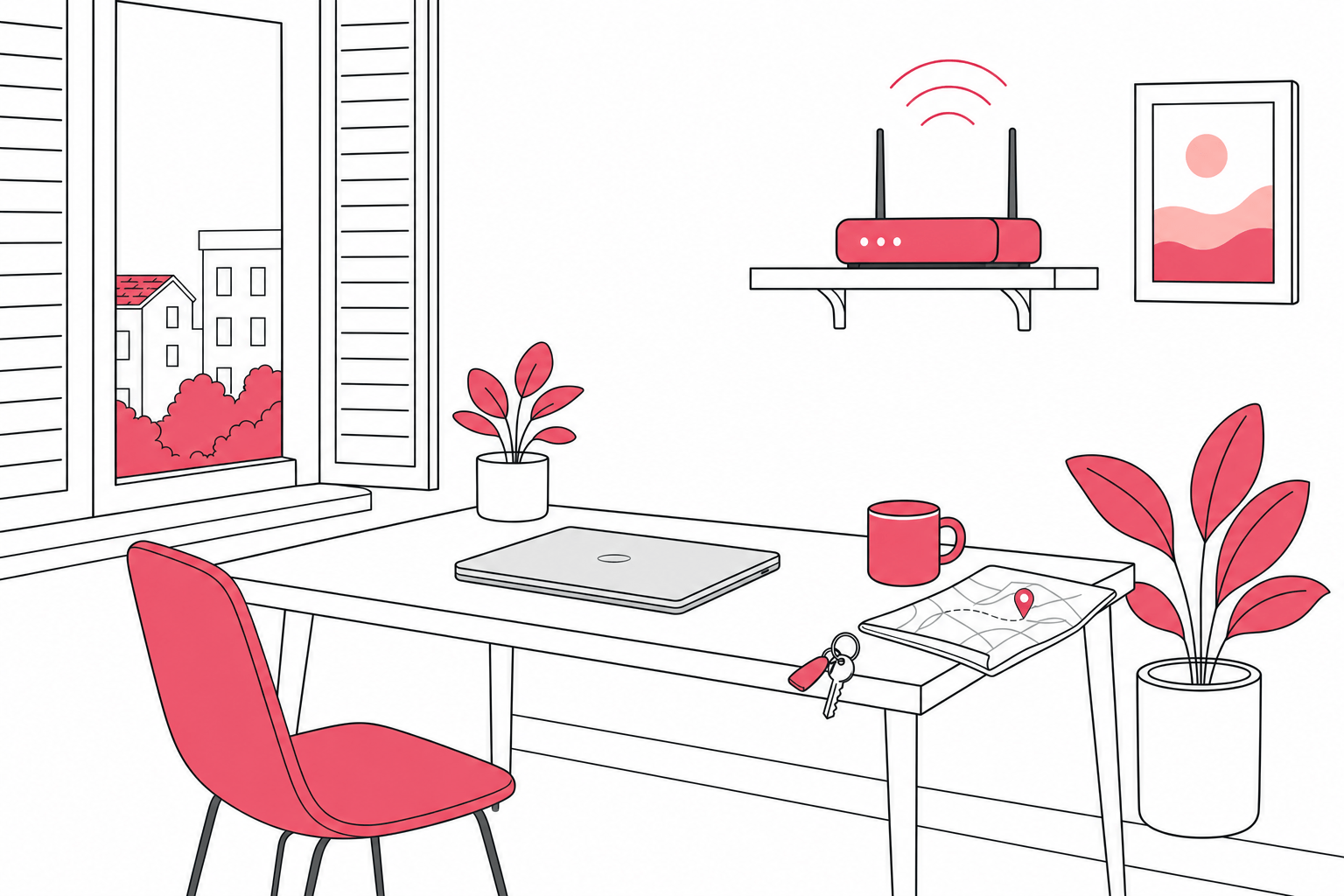
Book short first and extend once you know the place. A week tells you whether the connection holds at the hour you actually work, whether the street is quiet when you need calls, and whether the chair is one you can sit in for three hours. When you move between destinations, platforms like Booking.com let you compare options against those filters before you commit. Its About Booking.com page, read on 12 November 2026, states the platform carries more than 28 million reported accommodation listings, including over 6.6 million homes, apartments and other unique places to stay, in 43 languages. That second figure is the one that matters for a stay longer than a weekend, because an apartment has the desk a hotel room often does not.
Disclosure: the accommodation link above is an affiliate link. If you book through it we may earn a commission, at no extra cost to you. It does not change what we recommend.
The visa question, which sellers underestimate
This is the part that turns a good month into a problem, and the rules are stricter than the lifestyle content suggests.
The UK government's Portugal entry requirements page, read on 12 November 2026, states that you can travel visa free to the Schengen area for up to 90 days in any 180-day period as a tourist, to visit family or friends, to attend business meetings, or for short-term study, and then says directly that the requirements for working in Portugal are different. Visits to other Schengen countries in the 180 days before you travel count towards the same 90 days, and overstaying the limit can mean a ban from Schengen countries of up to three years (gov.uk Portugal entry requirements).
Thailand is tighter again. The same government's Thailand page, read on 12 November 2026, states that from 15 September 2026 visa-exempt entry allows a stay of up to 30 days for tourism only and does not cover business travel including conferences and meetings, with land-border visa-exempt entry normally limited to two entries per calendar year. Overstaying carries a fine of 500 Thai baht a day up to a maximum of 20,000 baht, plus detention, deportation at your own expense and a re-entry ban of up to 10 years (gov.uk Thailand entry requirements).
Those are two destinations and one nationality. Check your own passport against your own destination on the issuing government's page, and look for a dedicated remote-work or long-stay permit where one exists. Tax is the companion question: spend enough days somewhere and you may create obligations there, which is why sellers go hunting for accountants who handle this exact profile (r/smallbusiness).
Keep your supplier research running while you move
Research is the half that quietly stops when you travel, because it has no deadline attached. Nobody emails you about the competitor who just launched the product you were going to launch.
Koala Inspector is a Chrome extension, so it travels with the browser. Open any live Shopify store and the free Explorer view shows its theme, category, product count, creation and last-update dates and its currency, country and language, plus the full catalog with a filter for likely best-sellers. No tokens for any of that.
Two features earn their place specifically on the road:
- Shop Tracking puts a competitor store under ongoing monitoring and records changes to a per-shop feed: apps added or removed, a theme change, products added or removed, price changes and variant changes, with notifications you toggle per shop. It costs 15 tokens per shop, covers up to 50 stores on Premium, and is the one feature disabled entirely on the free plan. That is how you keep watching a market from another time zone without opening twenty tabs each morning.
- Find Suppliers takes a product and returns suppliers with a match score, an estimated delivery time, a cost breakdown of item price, shipping estimate and import tariffs, and the estimated profit per unit at your chosen selling price. Its Ship to selector covers 29 destination countries, so you price for the market you sell to rather than the one you are sitting in. It costs 2 tokens per search, refunded automatically if the search fails. The figures are estimates for comparing suppliers, and they exclude ad spend, payment fees and returns.
Keep an eye on your market from anywhere
Install Koala Inspector, open any Shopify store, and read its catalog, likely best-sellers, apps, theme and price range from the browser you already travel with. Free, with no tokens.
What gets harder, honestly
Four things reliably get worse on the road, and none of them is the part people expect.
Platform verification. Sellers running a US-facing store from abroad describe ad accounts demanding a real address and phone number, with virtual addresses and VoIP numbers rejected, alongside the trust gap of selling into a market you do not live in (r/growmybusiness). Sort your business address, phone and banking before you leave.
Supplier coordination. A supplier in one zone, a customer in another and you in a third turns a single question into a two-day thread. Shorten the chain by picking suppliers with warehouses in your selling market; our checklist for suppliers with local warehouses covers what to ask before you commit.
Cost drift. Flights, deposits, visa fees, coworking and the day lost to each move are business expenses in practice. Price them into your monthly number alongside the subscriptions, starting from what it costs to start dropshipping.
Focus. A store does not reward being half-watched. The weeks you move are the weeks ads go unoptimized and support queues build. Plan a move like a holiday: automate more, launch nothing, and give yourself two settling days before you expect real work.
A routine that survives a move
- Two weeks out. Confirm your legal status for the destination and the length of stay, and book the first week only.
- One week out. Clear the backlog, pause anything you would not want running unattended, and schedule your reports.
- Travel days. Answer customers from your phone in two fixed blocks, and change nothing in ads.
- Arrival week. Test the connection at the hour you actually work, buy a local SIM, and find your second workspace before you need it.
- Settled. Return to your normal blocks on your market's clock, and spend the recovered hour on competitor stores rather than your own dashboard.
Dropshipping genuinely supports a location-independent life, for a structural reason rather than an aspirational one: the inventory is somebody else's problem, so the business fits in a browser. What it does not do is run itself. The sellers who make it work treat the connection, the visa and the time zone as operating constraints they design around, and they keep doing the unglamorous research, pricing and support from wherever the desk happens to be.
What sellers say about Koala Inspector
Verified reviews from the Chrome Web Store.
“I was a bit skeptical about all the hype but gave Koala Inspector a shot. It's user-friendly and provides useful data on what's working for others. The support team is also there when you need them.”
 Martin René
“Great tool for competitor research and customer support is really quick!”
 Aiswarya S
“great app for ecommerce, there are a lot of useful information. Friendly customer service!”
 Lavender Yuzu
Keep reading
- How to start dropshipping in 2026 is the build order if the store does not exist yet.
- Automated dropshipping prices the five layers of automation and says which to do first.
- How to vet a dropshipping supplier before your first order matters more when you cannot meet anyone in person.
- Dropshipping passive income is the honest version of the claim this lifestyle attracts.
Dropshipping as a digital nomad: FAQ
The questions sellers ask before they book the first flight.
Can you run a dropshipping business while traveling?+
Yes, because the physical work sits with your supplier. The jobs that remain are product research, listings, pricing, marketing and customer support, and all of them run from a browser. Shopify's own mobile app page, read on 12 November 2026, describes managing orders, fulfilling shipping requests, updating inventory and tracking visitors, orders and campaigns from a phone, and says the app is included with your Shopify plan with no separate download fee or subscription. What travel changes is reliability and legal standing rather than capability: your connection, your time zone and your visa all become part of the business.
Does a tourist visa let you run an online business abroad?+
Usually not, and this is where sellers get caught. The UK government's Portugal entry requirements page, read on 12 November 2026, states that British travelers can enter the Schengen area visa free for up to 90 days in any 180-day period for tourism, visiting family, business meetings or short-term study, and adds plainly that the requirements for working in Portugal are different. Its Thailand page, read the same day, states that from 15 September 2026 visa-exempt entry allows a stay of up to 30 days for tourism only, and that visa-exempt entry does not cover business travel. Check the rules for your own nationality and destination before you book, and look into a dedicated remote-work or long-stay permit where one exists.
How fast does your internet need to be to run a Shopify store?+
Lower than most people assume for daily order management, and higher than you think for the week you are uploading video creatives or running live calls with a supplier. The useful habit is to check both numbers for a country before you commit to a month there. On the Speedtest Global Index, median country speeds updated September 2026 and read on 12 November 2026, the global median fixed broadband download was 259.98 Mbps and the global median mobile download was 202.96 Mbps. Among popular nomad bases the spread is wide: Thailand's median fixed broadband was 371.83 Mbps and Georgia's was 54.89 Mbps, while Georgia's median mobile download was 226.67 Mbps. In some countries a local SIM is the faster connection.
How do you handle customer support across time zones?+
Pick one selling market and run support on its clock, not yours. Publish a response window you can hit from wherever you are, answer in two fixed blocks a day, and automate the repeatable decisions so nothing waits for you to wake up. Shopify Flow, whose product page was read on 12 November 2026, builds no-code workflows from trigger, condition and action blocks, including holding or releasing orders for fulfillment on pre-set conditions and flagging high-risk orders, and its scheduled automations let you choose when to pull data and run reports.
What is the hardest part of dropshipping while traveling?+
Platform verification and tax, rather than the day-to-day store work. Sellers running US-facing stores from abroad describe ad accounts asking for a real address and phone number and rejecting virtual addresses and VoIP numbers, alongside the trust gap of selling into a market you do not live in. Tax residency is the other one: spending enough days in a country can create obligations there, which is why sellers go looking for accountants who handle this specific situation. Both are worth settling before you move, because neither has a fix you can apply from a hostel lobby.
Written by
Assaf Shalin
Co-founder & Developer, Koala Apps
Assaf Shalin is a co-founder of Koala Apps and one of the developers behind Koala Inspector. He builds the tools that let Shopify sellers see what is actually working in other stores, from installed apps and themes to best-selling products. On the blog he covers the technical side of store research: how competitor research really works, what public store signals can and cannot tell you, and how to turn them into decisions.
Connect on LinkedIn