How To Make Passive Income With Dropshipping
 By Ana GelevskaMay 23, 2025 · Updated June 5, 2026
Dropshipping and passive income get lumped together constantly, but the reality is more specific. A dropshipping store does not run itself from day one. What it can do, once you set up the right systems, is keep generating orders without your constant involvement. This guide covers what that actually requires.
What is dropshipping passive income?
 Dropshipping passive income means the store handles most of its own operations after an upfront setup period. Apps sync inventory, route orders to suppliers, and trigger customer emails automatically. You still need to review performance, refresh ads, and deal with edge cases, but the day-to-day fulfillment loop runs without you.
The key distinction: passive does not mean absent. It means your time input decouples from your revenue output. A store processing 50 orders a day should not require 50x more of your attention than one processing one order a day.
Can dropshipping actually be passive income?
It can, but only once three things are in place: reliable automation for fulfillment, a consistent traffic source that does not require daily babysitting, and a supplier who ships on time without frequent intervention.
Without automation, dropshipping is an active business. You forward orders manually, chase shipping updates, and handle each customer question yourself. That is not passive by any definition.
The path that works: build a store that automates order routing, invest early in SEO or a tested paid-traffic campaign, and use automation tools to handle the repetitive tasks. Once those systems are running and profitable, your required hours drop significantly.
How to actually get there
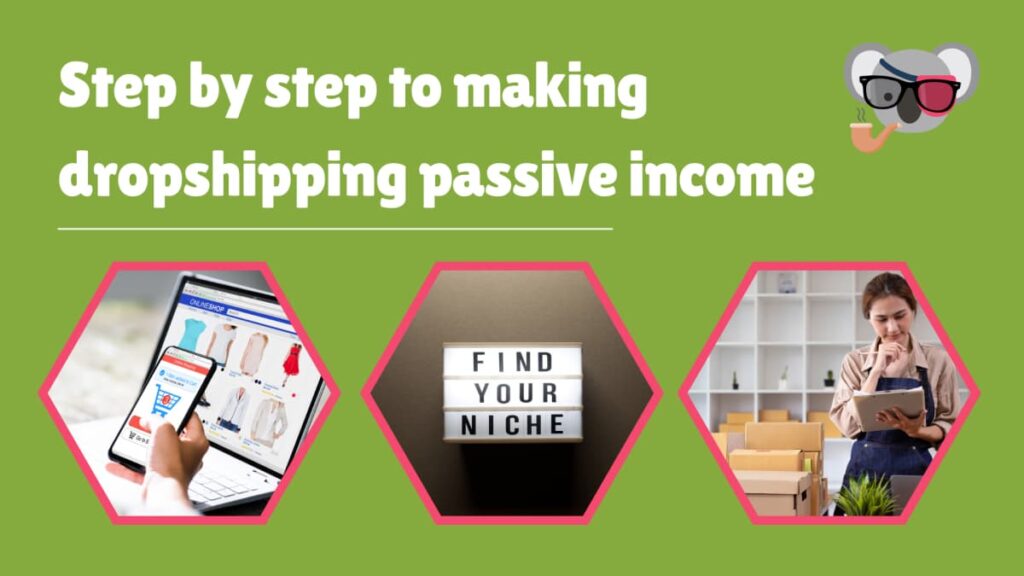 The work splits into roughly five phases, and they are not equal in size. Setup and automation are the heavy lifting. Marketing is the part that stays hands-on longest. Optimization and scaling come later, once there is something running worth refining. They are laid out in order below, but in practice they overlap.
Set Up Your Store
The platform and niche you pick decide how automatable the store can ever become, so these two choices carry more weight than they look like they should. Getting them wrong is expensive to undo later.
Choose Your Platform
Shopify is the practical default for dropshipping automation. Its app marketplace covers every piece of the fulfillment stack, and the built-in payment processing means fewer integrations to maintain. The dashboard puts key metrics in one place, which matters when you are managing by exception rather than watching every order.
Koala Inspector lets you analyze successful Shopify stores in your niche. It shows which themes and apps top-performing competitors use, so you can build on a proven setup rather than testing options from scratch.
Choosing a Profitable Niche
Niche selection has a direct impact on how passive your store can become. A niche with high return rates, complex shipping, or constant trend shifts will always pull you back in.
What to look for: steady, year-round search demand rather than seasonal spikes; product margins above 30% (thin margins force volume, which means more customer service load); and a customer base that buys more than once. Repeat buyers reduce the ongoing cost of customer acquisition.
Koala Inspector is useful here too. It shows which products competitors are actually selling, typical price points, and whether a niche supports multiple active stores. That kind of real data beats guessing.
Finding Reliable Suppliers and Products to Sell
Your supplier determines your default level of involvement. A supplier who ships late, runs out of stock often, or packages carelessly will generate a steady stream of customer complaints that require human responses.
When evaluating suppliers on AliExpress, a positive feedback score above 97% and at least two years of trading history are reasonable baselines. Test their response time before committing. As your order volume grows, dedicated suppliers like CJDropshipping or US-based options reduce shipping times and often come with better API integrations, making automation more reliable.
Finding a supplier you can rely on is consistently the hardest part of building a dropshipping store, and it is exactly what determines whether yours can run without constant oversight. Getting this right early is not optional.
Automate Your Dropshipping Business
This is the phase that decides whether you have a passive income stream or a second job. Everything before it is reversible setup; automation is where the store either starts running without you or doesn't.
Use Dropshipping Apps
A functional automation stack covers three things: product and pricing updates (so listings stay accurate when your supplier changes stock or prices), order routing (so orders go to your supplier the moment a customer buys), and inventory monitoring (so you stop selling items that are out of stock).
Koala Inspector can show you which specific apps successful stores in your niche use. Instead of testing a dozen options, you can implement a stack that competitors have already validated.
Automate Order Fulfillment
Manual order forwarding is the biggest time sink in early-stage dropshipping. Automating it is usually the first thing that makes the business feel less like a full-time job.
Direct API connections between your store and your supplier route orders without any manual steps. For exceptions, such as orders the system cannot automatically match, a part-time virtual assistant can handle the cases that actually need human judgment, while the system takes care of everything else.
Dev Kapoor, a teacher who ran a seasonal outdoor gear store alongside his day job, reported that 91% of his orders were auto-fulfilled without manual input, and he spent roughly 20 minutes per day on customer emails during his busiest weeks.
Automate Customer Service
Most customer questions in dropshipping fall into a small number of categories: where is my order, how do I return this, is this item in stock. A well-built FAQ page and a chatbot configured for those scenarios handle the majority without your involvement.
For the remainder, triggered email sequences that update customers on order status and shipping reduce inbound questions substantially. If your store grows to a point where the remaining inquiries take real time, part-time support staff working from a clear decision tree can handle them without pulling you in.
Automate Inventory Management
Selling out-of-stock items creates problems that take time to resolve: refunds, angry customer emails, bad reviews. Real-time inventory sync with your supplier prevents most of this. Setting automatic product deactivation when stock drops below a threshold protects you further. Many store owners also set a buffer in their inventory settings to account for the gap between a supplier updating their system and that update reaching your store.
Marketing Strategies for Passive Income
Marketing is the piece of dropshipping that takes longest to make passive. Paid ads require active management until you have found a profitable campaign structure. SEO takes months to build. The goal is to move from daily involvement to periodic review.
SEO and Content Marketing
Organic search traffic is as close to genuinely passive as marketing gets. A piece of content that ranks well keeps sending visitors without ongoing spend. Buying guides, product comparisons, and detailed how-to content in your niche are the formats that tend to attract links and rank for purchase-intent queries.
The upfront investment is real, whether you write the content yourself or outsource it. But traffic that arrives six months from now because of something you published today fits the definition of passive in a way that ad campaigns rarely do.
Use Koala Inspector to see which content types competitors are running. Then produce something more thorough on the same topics.
Email Marketing
Automated email sequences generate consistent revenue once they are set up. Welcome flows for new subscribers, abandoned cart recovery, and post-purchase follow-ups run without daily management and compound in value as your list grows. Email marketing returns a strong ROI at scale, with some estimates citing returns around 3,900%, though results vary widely by list quality and niche.
Abandoned cart recovery is worth prioritizing early. Roughly 70% of shopping carts are abandoned before purchase, and an automated sequence targeting those shoppers captures sales that would otherwise be gone.
Koala Apps Skip To Checkout reduces friction at the point of purchase by letting customers bypass the cart page and go straight to checkout. Less friction means fewer abandoned carts to recover in the first place.
Pay-Per-Click Advertising
PPC starts as an active channel and can become semi-passive once you have a campaign that reliably generates profit. The shift happens when you have confirmed positive ROI and can implement automated bid rules and budget thresholds that handle daily adjustments.
Once a campaign is stable and profitable, it can run with weekly rather than daily oversight. At that point, you can hand oversight to a specialist or agency without losing visibility into performance.
Optimising Your Store for Passive Income
 Conversion rate improvements increase profit across every traffic source simultaneously. Small gains here compound.
Improving Website Design and UX
Mobile layout, load speed, and clear navigation are the basics that affect conversion rates across every device. Trust signals positioned near checkout reduce hesitation at the point of purchase.
If you see a store design that converts well, use the free Koala theme detector to identify the theme. That gives you a concrete starting point without expensive trial and error.
Implementing Upselling and Cross-Selling
Post-purchase upsells and "frequently bought together" recommendations increase average order value without requiring your involvement. These run automatically once configured. Higher order value means each customer is worth more, which is one of the cleanest ways to grow passive income without adding traffic volume.
Reducing Cart Abandonment
Exit-intent popups that capture email addresses, simplified checkout flows, and automated cart recovery sequences all reduce the percentage of browsers who leave without buying. Each of these runs without manual effort after setup. Koala Apps Skip To Checkout handles the checkout friction piece directly by removing the extra cart step entirely.
Scaling Your Passive Income Business
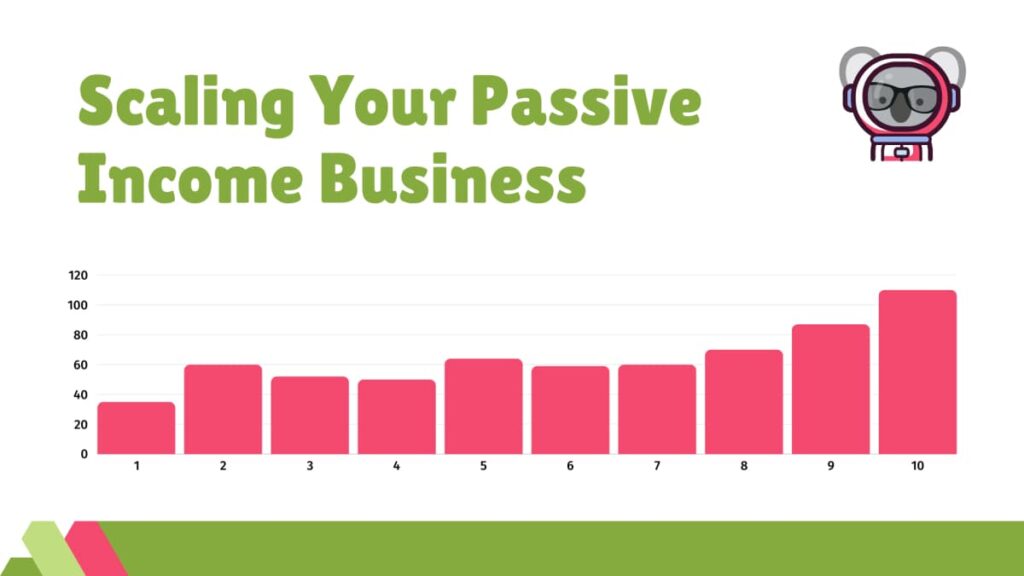 Scaling without proportionally increasing your workload is the point. Your automation infrastructure does the heavy lifting.
Once your systems are stable, expanding your product range based on actual purchase patterns is lower risk than launching cold. Customers who already bought from you tell you what else they want through their behavior. Adjacent niches often transfer with minimal modification to your existing stack.
Automated accounting tools that categorize transactions and generate reports remove the manual bookkeeping work as your volume grows, so your financial picture stays clear without becoming a time sink.
Why the model suits passive income at all
 A few structural traits are what make dropshipping a candidate for passive income in the first place, and they reinforce each other.
The biggest one is that you never buy inventory up front. Traditional retail makes you front capital for stock before you know whether a product sells; dropshipping skips that entirely. Most beginners spend between $300 and $1,000 to start, according to Spocket's analysis of startup costs, with the Shopify Basic plan at $39 per month (or $29 per month if you pay annually) as the main recurring line item. That low entry point is also what limits your downside: with no inventory sitting in a warehouse, a product that stops selling just gets unlisted. There is no unsold stock to write off, and testing a new product costs next to nothing compared with any model that needs an upfront buy.
The other two traits are about your time rather than your money. Because suppliers handle anything that depends on physical presence, packing, holding inventory, the store runs independent of where you are, so you can keep it going while traveling or juggling another job as long as the internet works. And because the work that does exist is mostly automatable, product research, pricing, order routing, inventory sync, and customer messaging all have software that runs without you initiating each step, order volume can climb without your hours climbing alongside it. That last point is the real prize: in most service businesses, more revenue eventually demands more of your personal time, and dropshipping is one of the few models that breaks that link.
How much initial investment is required to make passive income?
 Getting to genuinely passive income requires spending in a few areas: platform and app costs (around $100 per month for a basic Shopify setup with essential tools), initial marketing to build traffic (often a few hundred to a few thousand dollars in ad testing), and automation tools that reduce daily involvement.
If you outsource the remaining manual tasks, expect to pay at least $500 per month depending on scope. The total scales with how fast you want to reach the passive threshold.
You can start with minimal investment by using Shopify's trial period and focusing first on organic traffic. This lets you validate a niche before spending on ads. More resources on low-budget approaches are in our dropshipping guides.
The honest version of this: passive income from dropshipping is not free money. It requires building systems, finding a reliable supplier, and putting in the upfront work to establish traffic. What it offers in return is a business that keeps running and generating revenue after that foundation is set, without requiring your time every day to keep it going.
Written by
Ana Gelevska
eCommerce Content Writer
Ana Gelevska is a content writer with more than five years of experience creating content for eCommerce brands and global clients. She digs into each topic and the people it is for, then turns it into clear, useful articles that Shopify sellers and dropshippers can act on.
Connect on LinkedIn