Printful vs Printify vs Gelato: Which One to Commit Your Catalogue To
 By Assaf ShalinOctober 14, 2026
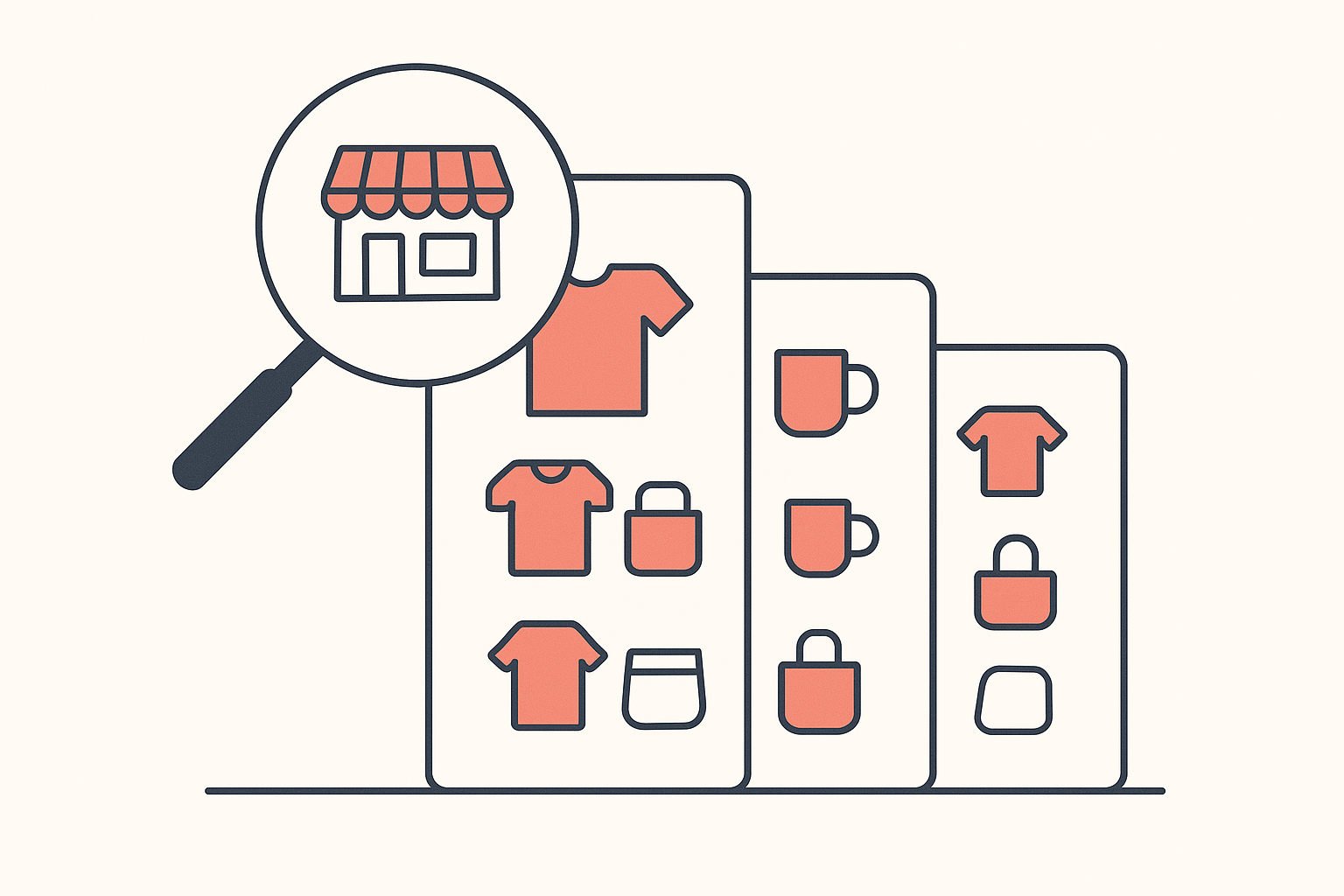
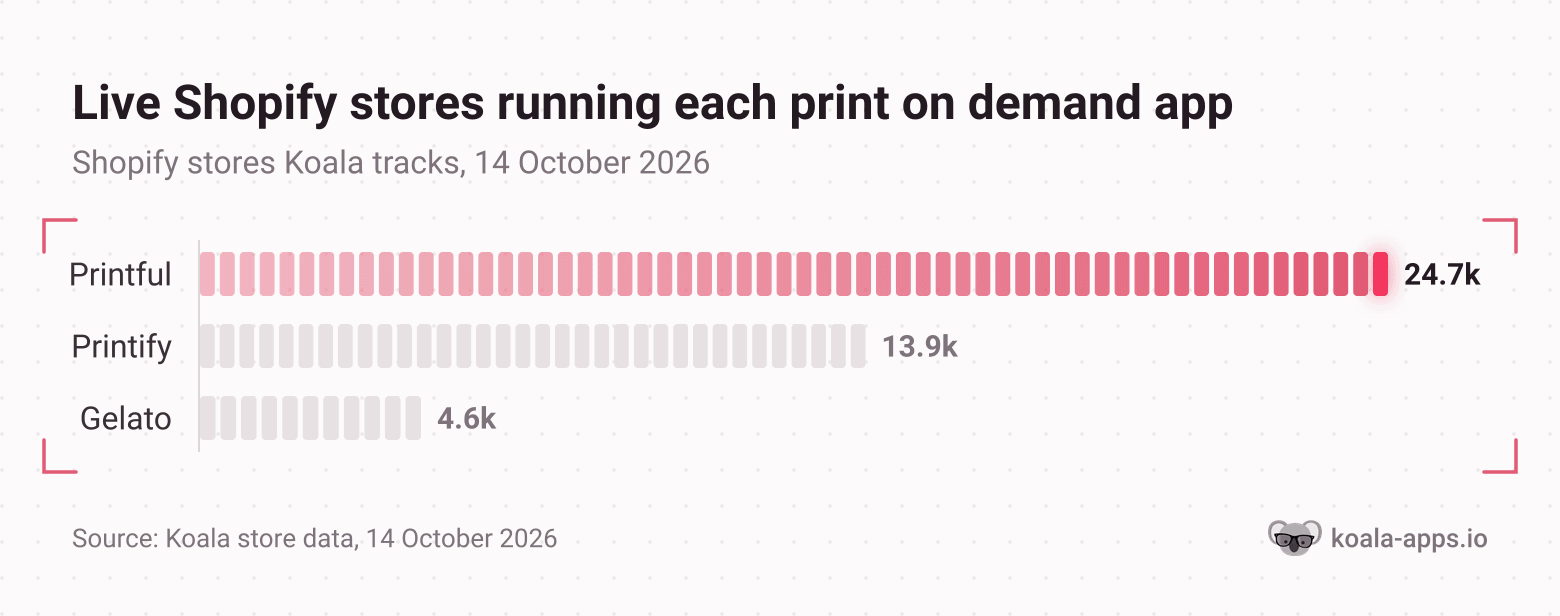
Printful runs on 24,729 of the Shopify stores Koala tracks. Printify runs on 13,852. Gelato runs on 4,601. That is the state of the market on 14 October 2026.
Those numbers cover the stores Koala tracks rather than every store on Shopify, so read them as a strong sample instead of a census. The sample is big enough to settle the question most comparison posts dodge: Printful is the default, by close to two to one.
Popularity is a starting point, not a verdict. The app you pick decides your base cost, your delivery time and how much of your brand survives the parcel, and switching after you have 80 published products is a weekend you will not get back. So here is the comparison on the decisions that actually bite, with every figure read off each vendor's own live pages on 14 October 2026.
Short answer
- Printful if you sell apparel and want one company printing everything. In-house production, private labels and custom packaging on the listing, 579 products, 7 sourcing countries, Growth at $24.99 a month and free once you pass $12K in yearly sales.
- Printify if catalogue breadth and base cost matter most. 2,000+ products through 70+ print providers, 5 stores on the free plan, Premium at $39 a month, and the widest spread of blanks of the three.
- Gelato if your orders land outside North America and Europe. 25 sourcing countries listed, 140+ local production hubs in 32 countries by its own description, Gelato+ at $29.99 a month.
All three install free and charge for production only after a sale, so the subscription is the only thing you risk before your first order.
The comparison table
Everything below was read off the vendor's own pages on 14 October 2026. Figures each vendor does not publish are marked as such rather than estimated.
| Printful | Printify | Gelato | |
|---|---|---|---|
| Catalogue | 579 products | 2,000+ products | "Hundreds of products" (no count published) |
| Who prints | Printful's own in-house facilities | 70+ independent print providers | Local production hubs, 140+ in 32 countries |
| Sourcing countries on the listing | 7 | 8 | 25 |
| Production time | 2 to 5 business days to create and fulfil | Not published on the pages above | Not published on the pages above |
| Free plan | Yes, free to install | Yes, 5 stores | Yes, "Gelato Free" |
| Paid plan | Growth, $24.99 / month | Premium, $39 / month or $299.88 / year | Gelato+, $29.99 / month or $239.88 / year |
| Product discount on the paid plan | Up to 33% | Up to 33% | Up to 33% |
| Branding on the app listing | Private labels, custom packaging, pack-ins | Pack-ins, personalisation | Private labels, custom packaging |
| Samples | 20% discount, free digitization on Growth | Not published on the pages above | Not published on the pages above |
| Shopify App Store rating | 4.8 from 3,900 reviews | 4.7 from 4,319 reviews | 4.8 from 1,018 reviews |
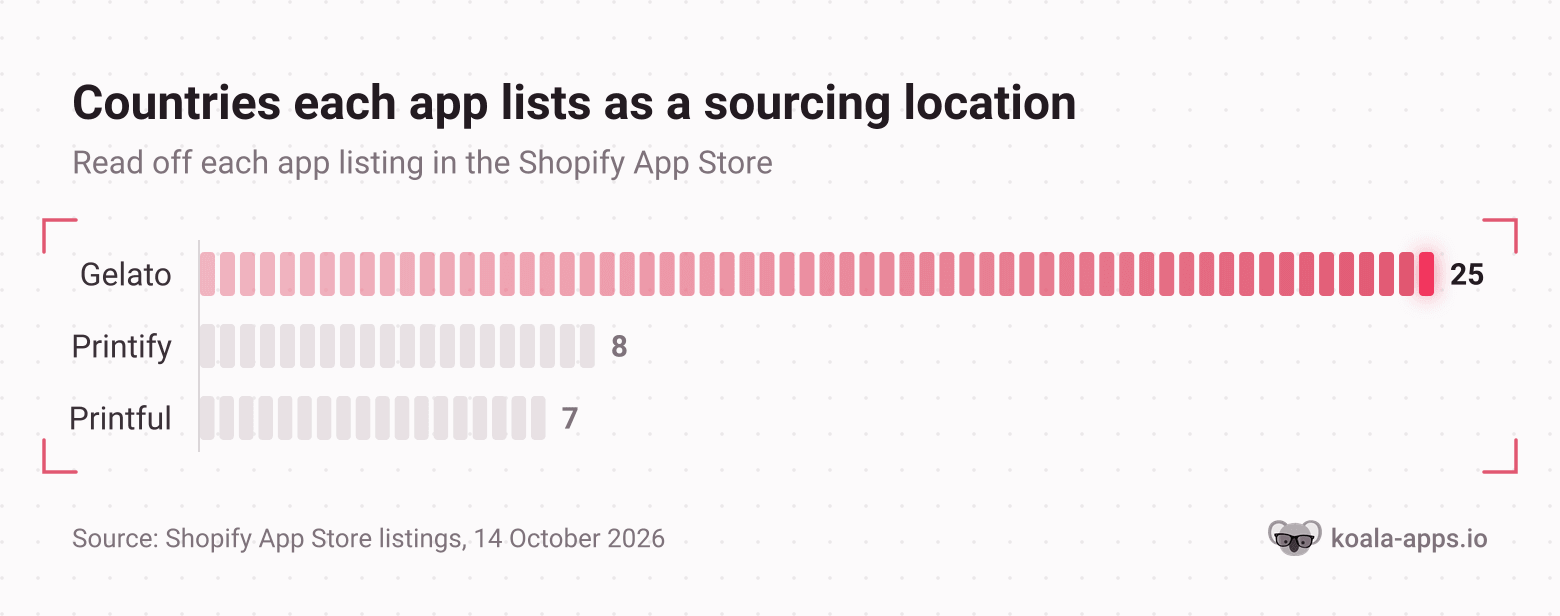
Two honest notes about that table. Printify's own pages disagree with each other on catalogue size: the pricing page says 2,000+ products, the Shopify listing says "over 1,300". And Gelato's listing text claims 32 countries of production while its structured sourcing-location field lists 25, which is the number charted below.
Base cost per product is the one figure worth refusing to take from any blog post, this one included. It moves by provider, by size and by colour, and all three run discounts that change it again. Open the blank in the product creator, put your retail price next to it, and read your own margin.
Printify vs Printful
This is the real fight, and the two store counts above are the first thing to notice: Printful is on nearly twice as many live stores. The decision between them comes down to one structural difference.
Printful prints in its own facilities. Its quality page describes a "completely in-house" partner and its own in-house facilities for apparel packaging, and its shipping page puts creation and fulfilment at 2 to 5 business days. One company, one set of machines, one quality bar. That is why it is the safer pick for apparel where a repeat customer expects the second shirt to match the first.
Printify is a marketplace. Its pricing page describes "2,000+ products, 70+ Print Providers", which buys you reach: more blanks, more price points, and the ability to shop the same t-shirt across providers until the base cost works. It also means the shirt your customer receives depends on which provider filled the order, which is the thing to pin down with a sample before you scale.
On money, Printful's Growth plan is cheaper at $24.99 a month and becomes free once you reach $12K in yearly sales. Printify Premium is $39 a month, or $299.88 a year. Both advertise up to 33% off products on the paid tier.
On branding, the gap is wider than the price gap. Printful's listing carries private labels and custom packaging; Printify's carries pack-ins and personalisation. If the unboxing is part of what you are selling, that single row decides it.
Pros:
- Printful: in-house production, so quality is one company's responsibility
- Printful: private labels and custom packaging on the listing
- Printful: cheaper paid tier, free at $12K yearly sales
- Printify: 2,000+ products against Printful's 579
- Printify: 70+ providers, so you can shop the same blank for base cost
- Printify: 5 connected stores on the free plan
Cons:
- Printful: 579 products is the narrowest catalogue of the three
- Printful: 7 sourcing countries limits non-Western delivery times
- Printify: quality depends on which provider filled the order
- Printify: no private label or custom packaging on its listing
- Printify: $39 a month is the highest paid tier here
Printful vs Gelato
Both run their own printing operation rather than a provider marketplace, so this one is about geography.
Printful lists seven sourcing countries: Australia, Canada, Japan, Latvia, Mexico, Spain and the United States. Gelato lists twenty-five, including Brazil, Chile, China, India, New Zealand, Singapore, South Africa, Türkiye and the United Arab Emirates. For a store selling into Western Europe and North America those lists are close enough that the difference rarely shows. For a store selling into South America, India or the Gulf, Gelato prints in the buyer's country and Printful ships to it.
Printful's counter is in its own numbers: as of 14 October 2026 its pricing page states that 86% of orders are fulfilled in the same region as the customer, and it publishes a production window of 2 to 5 business days. Gelato publishes no equivalent production figure on its listing, which is worth asking support about before you commit a catalogue to it.
Both sell private labels and custom packaging on their listings, so branding does not separate them. Price nearly does: Growth at $24.99 against Gelato+ at $29.99, with the same up-to-33% product discount on each.
Ratings are a tie at 4.8, but the review counts are not close: 3,900 for Printful against 1,018 for Gelato. More reviews is more evidence, and in Koala's data Printful appears on more than five times as many live stores.
Printify vs Gelato
These two are the cheapest and the most expensive monthly plans here, and they are built on opposite models.
Printify spreads across 70+ independent print providers in 8 sourcing countries: Australia, Canada, Czechia, Germany, Latvia, Poland, the United Kingdom and the United States. Gelato spreads across local production hubs in 25 countries by its listing field. So Printify gives you choice of supplier inside a smaller footprint; Gelato gives you a bigger footprint with the supplier chosen for you.
Catalogue goes to Printify without much argument: 2,000+ products published against Gelato's unquantified "hundreds". Branding goes to Gelato, which lists private labels and custom packaging where Printify lists only pack-ins and personalisation. Money goes to Gelato as well, at $29.99 a month against $39, or $239.88 a year against $299.88.
In Koala's data Printify runs on three times as many of the stores we track, which is the tiebreak if you want the option with the larger pool of sellers behind it.
Check demand before you build a catalogue on any of them
The expensive mistake in print on demand is not picking the wrong app. It is picking any app, designing forty products, and finding out afterwards that nobody wanted them. Committing money before you know a product sells is the single most-raised worry in print on demand communities right now, and it has a cheap fix.

Install the free Koala Inspector Chrome extension and spend twenty minutes on stores that already sell what you plan to sell.
- Find three to five live stores in your niche and open each one. The Explorer dashboard gives you the store's theme, category, total product count and creation date in one view, so you can tell a two-year-old business from a store built last weekend.
- Read their best-sellers. The free product research view lets you browse the full catalogue or filter to likely best-sellers, with price and variations on every product. A design that has survived two years in a live catalogue is a design that pays its own rent, and that is a far better brief than your own taste.
- Run the Shopify app detector on each store. It lists every app installed, grouped by type. When three of the five stores already selling your niche run the same print on demand app, you have a real-world answer to the question this whole article is about, drawn from stores whose money is already on the line.
- Favourite the products worth copying the format of, so the shortlist survives the session, then design against that list rather than against a blank canvas.
The app detector and the best-sellers view both cost nothing and need no account setup beyond installing the extension.

Want to see the apps on any Shopify store?
Download for free and start exploring a whole new ecommerce world!

Order a sample before you publish anything
Print quality is where the complaints land, and it is the one thing none of the three can prove to you on a web page.
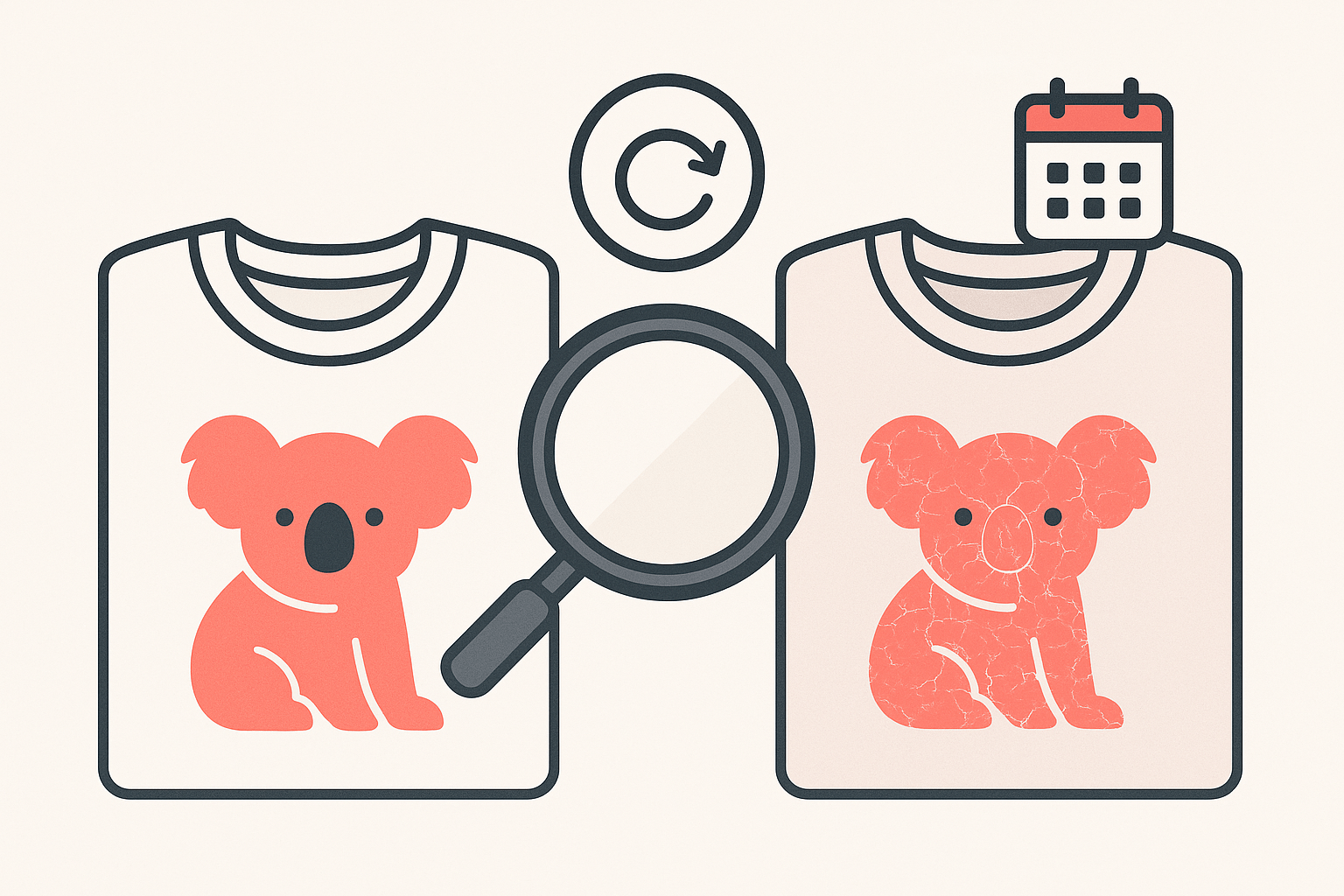
Order the sample from the exact blank and the exact provider you selected. On Printify that matters most, because an order is filled by one of 70+ independent providers and a different provider is a different shirt. Printful sells samples at a 20% discount on every plan and adds free digitization for samples on the Growth plan.
Then do the part most sellers skip: wash it three or four times before you decide. A print that looks perfect out of the parcel and cracks after a few washes produces refund requests weeks later, when the design is already live on forty listings. Photograph the sample in daylight too. One real photo of the garment you received beats the generated mockup every other seller using that blank has.
How to use this comparison
Pick on the constraint that actually binds you.
- Your buyers are in the US, Canada or Western Europe and you sell apparel: Printful, cheapest paid tier of the three and one company answering for quality.
- You need blanks Printful does not carry, or you want to shop base cost across suppliers: Printify, 2,000+ products through 70+ providers.
- A meaningful share of your orders ships outside North America and Europe: Gelato, 25 sourcing countries.
Then validate before you commit. Check what the stores already selling in your niche run, order one sample, wash it, and only then build the catalogue.
Keep reading
- Print on Demand Product Research: Find Proven Winners Before You Design
- Printify POD: what it is and how it works
- How to choose a print on demand supplier
Sources
Store counts come from Koala's own data across the Shopify stores Koala tracks, read on 14 October 2026. Vendor figures were read on the same date from:
- Printful pricing (plans, 579 products, 86% same-region fulfilment)
- Printful shipping (2 to 5 business days to create and fulfil)
- Printful quality (in-house production)
- Printful on the Shopify App Store (plan features, branding, sourcing countries, rating)
- Printify pricing (2,000+ products, 70+ print providers, plans and stores per account)
- Printify on the Shopify App Store (plan features, branding, sourcing countries, rating)
- Gelato on the Shopify App Store (plans, 140+ production hubs in 32 countries, branding, sourcing countries, rating)
Prices and catalogue counts change. Re-check the figure that decides your choice before you commit.
Written by
Assaf Shalin
Co-founder & Developer, Koala Apps
Assaf Shalin is a co-founder of Koala Apps and one of the developers behind Koala Inspector. He builds the tools that let Shopify sellers see what is actually working in other stores, from installed apps and themes to best-selling products. On the blog he covers the technical side of store research: how competitor research really works, what public store signals can and cannot tell you, and how to turn them into decisions.
Connect on LinkedIn