5 Best Dropship.io Alternatives
 By Assaf ShalinApril 11, 2025 · Updated July 20, 2026
Dropship.io is a solid paid product-research tool, but its plans send a lot of sellers looking for something cheaper or broader. Monthly billing starts at $39/month and runs up to $99/month, and its store data covers Shopify and TikTok Shop, so competitors on WooCommerce, BigCommerce, or a custom stack stay invisible. If you're early-stage or your research needs to reach past those platforms, those constraints add up fast.
If price is the sticking point, the fastest fix is Koala Inspector: a free Chrome extension that reads any Shopify store's products, apps, theme, and estimated sales the moment you open it, so you can research winning products and competitor stores without a subscription. Below is a quick verdict on all five picks, then a closer look at each.
Dropship.io Alternatives at a Glance
| Tool | What it does | Best for | Price |
|---|---|---|---|
| Koala Inspector | Reads any Shopify store's products, apps, theme, and estimated sales from your browser | Researching winning products and competitor stores for free | Free, Premium $22/mo |
| Inventory Source | Automates supplier inventory sync and order routing | Established stores automating fulfillment | $99 - $349/mo |
| Shophunter | Estimates revenue and unit sales for Shopify stores | Validating a product with competitor sales data | $50 - $500/mo |
| Minea | Ad research across Facebook, TikTok, Instagram, and more | Finding products through winning ad creative | $49 - $399/mo |
| Sell The Trend | Product research plus a built-in video ad creator | Combining research and video ads in one tool | $37.97 - $99.97/mo |
Each of these solves a different piece of the dropshipping workflow. Koala Inspector is the closest free substitute for Dropship.io's store-spy features, Inventory Source covers fulfillment automation, Shophunter and Minea go deep on product and ad research, and Sell The Trend bundles research with video ad creation.
What Is Dropship.io?
Dropship.io is a product research platform built specifically for dropshipping. It lets you research Shopify stores and TikTok Shop products, track which items are selling, analyze competitors' ad performance, and find trending products before they get saturated.
The core value is the sales data: you can see estimated revenue and unit counts for stores and products, which tells you whether a product is actually converting or just generating ad spend. It also surfaces which ads are running, so you can reverse-engineer a competitor's playbook.
The limitations are real though. Coverage stops at Shopify and TikTok Shop, so any store running on WooCommerce, BigCommerce, or a custom stack is invisible to the tool. And it is subscription-only: monthly plans start at $39/month and reach $99/month for the Premium tier, with the yearly option bringing the entry price down to about $26/month. For a new store validating its first products, that is a real commitment before you have proven anything.
Why People Look for Dropship.io Alternatives
Most people don't abandon Dropship.io, they just hit a specific wall. Here are the ones that come up most often:
Cost at entry level. Monthly billing starts at $39/month. For a new store on a tight budget, that's a hard number to justify before you've validated anything, especially when a free tool can cover the core store research.
Platform coverage. Dropship.io reads Shopify and TikTok Shop, but it can't tell you what's working on WooCommerce stores, Amazon-native brands, or any other non-Shopify competitor. If your market research needs to extend beyond those platforms, you're working blind.
No inventory automation. The tool is research-only. Once you find a product, you still need a separate system to sync inventory and route orders to suppliers. Some sellers want a single platform that handles both research and operations.
Niche data gaps. The platform's product database skews toward high-volume trending products. If you're selling in a tighter niche or a specific geography, the signal-to-noise ratio isn't always great.
Learning time. The full feature set takes time to get comfortable with. For someone who just needs to check a few competitor stores occasionally, the complexity isn't worth it.
The 5 Best Dropship.io Alternatives in 2026
Here's the detail behind the verdict table: what each tool does, what it does well, where it falls short, and who it fits best.
1. Koala Inspector
Koala Inspector is a Chrome extension that gives you real-time data on any Shopify store you visit. Unlike Dropship.io's web dashboard, it works directly in your browser as you browse competitor stores, so there's no separate research workflow to maintain.
Open a Shopify store, click the extension, and you see: which theme they're using, which apps are installed, estimated bestselling products with sales data, and pricing. The data is layered on top of your normal browsing, which makes competitor research feel less like a separate task.
What it does well:
- Shows estimated sales for individual products and best-sellers, not just store-level traffic
- Reveals the exact Shopify apps and theme a competitor is running (useful for spotting tools driving conversions)
- AI Shop Chat and Find Retailers built in, so you can ask questions about a store and locate suppliers for a product without switching tabs
- No setup beyond installing the extension; no learning curve to speak of
What it doesn't do:
- Browser-limited: Chrome only, no Firefox or Safari support
- No inventory management or order routing (research tool only, like Dropship.io)
- Shows the ads a given store is running rather than a searchable cross-store ad library like a dedicated ad-spy tool
Best for: New dropshippers who want Dropship.io-style competitor intelligence at a much lower cost, and anyone who does most of their research by browsing stores directly.
Pricing:
- Free Plan: $0/month. Includes shop structure data, initial product statistics, trending product highlights, CSV export, and 15 tokens/month.
- Premium Plan: $22/month. Everything in free plus 220 monthly tokens, tracking for up to 50 shops, and VIP support.
- Token Packs (one-time, never expire): 10 tokens for $3.99, 25 tokens for $6.99, or 100 tokens for $11.99.
The free plan is enough to evaluate competitors regularly. Premium makes sense once you're tracking a specific set of stores or doing heavier product research.
2. Inventory Source
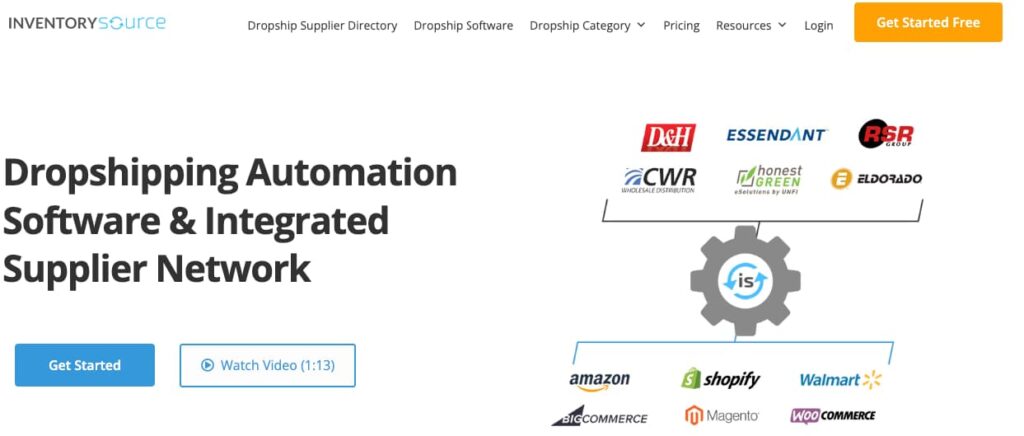
Inventory Source solves a completely different problem than Dropship.io. Instead of helping you find products, it automates the operational side: syncing inventory from suppliers to your store and routing orders automatically when a sale comes in.
If you've found your winning products and suppliers, Inventory Source handles the part that becomes a time sink at volume. You connect your supplier catalog, and the platform pushes product listings to your store, keeps inventory counts current, and sends orders to the right supplier without manual intervention.
What it does well:
- Connects to a large supplier directory, with options across most product categories
- Automates inventory sync so you're not manually checking stock levels
- Order routing removes a step from your fulfillment process
- Free account lets you browse the supplier directory before committing
What it doesn't do:
- No product research or competitor analysis (completely different use case from Dropship.io)
- Setup fees apply to some plans
- The pricing reflects an operations tool, not a research tool
Best for: Established stores with a defined product catalog that need to automate supplier management and fulfillment. Not a fit if you're still in the product-research phase.
Pricing:
Inventory Automation (sync only): Basic $99/month, Plus $149/month, Power Seller $299/month. Full Automation (sync + order routing): Basic $199/month, Plus $249/month, Power Seller $349/month. Free supplier directory access is available on a permanent free tier.
3. Shophunter.io
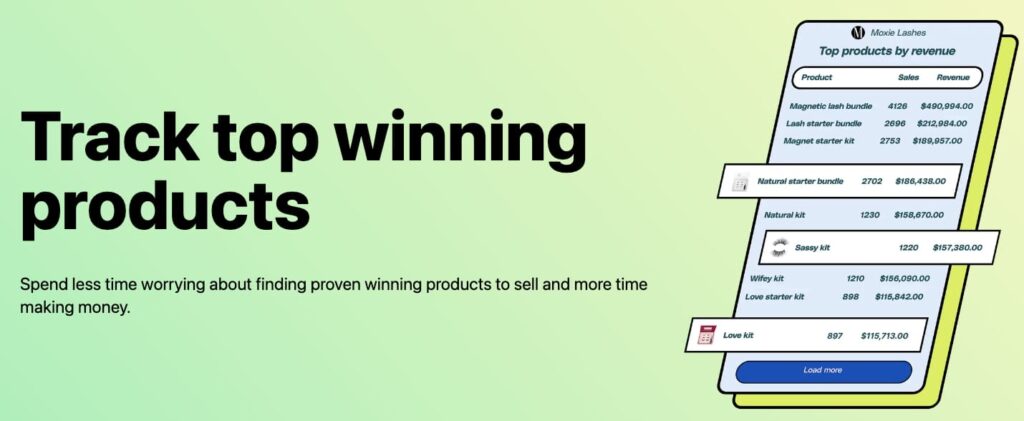
Shophunter focuses on sales validation for Shopify stores. The core promise is the same as Dropship.io's store spy: you can look up any Shopify store and see estimated revenue, unit sales, and top-selling products. Where it differs is in the pricing structure and the emphasis on store-level traffic data.
Shophunter is useful for confirming a product hypothesis. If you've spotted something trending on social media, you can look up stores already selling it and see whether the sales numbers back up the hype or whether the product is mostly ad-driven with weak actual conversion.
What it does well:
- Clear sales estimates for individual Shopify stores
- Trend tracking across stores, not just individual products
- Competitor spying with traffic source data (where a store's visitors are coming from)
- Clean interface, relatively easy to navigate
What it doesn't do:
- Coverage limited to Shopify stores (same limitation as Dropship.io)
- Fewer product sourcing options than full-stack platforms
- The Business and Enterprise tiers are expensive for what you get
Best for: Sellers who want to validate product ideas by looking at competitor sales data, particularly if the goal is identifying which stores to learn from rather than just which products to sell.
Pricing:
First 2 months free, then monthly: Basic $50, Professional $75, Business $250, Enterprise $500.
4. Minea
Minea takes a different approach from the Shopify-store-spy tools above. Its primary focus is ad research across social platforms: Facebook, Instagram, TikTok, Pinterest, and Snapchat. Instead of starting with a store you want to investigate, you start with ads, looking for which creatives are getting real engagement and what products are behind them.
The practical workflow: you filter ads by platform, date range, engagement metrics, and product type. Minea shows you ads that are actually performing, with data on how long they've been running (longer-running ads usually indicate profitability), the audience targeting used, and the Shopify store behind the ad. From there you can drill into the product and import it to your store.
What it does well:
- Broad social platform coverage, more complete than most competitors
- Large product database with current sales data
- Useful for finding products before they show up in store-spy tools (ads often precede sales peaks)
- Affordable Starter plan compared to full-featured competitors
What it doesn't do:
- Very large catalog can be overwhelming to navigate without clear filtering criteria
- Customer support has mixed reviews, particularly for resolving billing issues
- No support for digital products
Best for: Dropshippers who want to find products through ad research rather than store spying, especially if you're targeting social platforms like TikTok or Instagram where ad creative quality matters.
Pricing:
Monthly: Starter $49, Premium $99, Business $399.
5. Sell the Trend
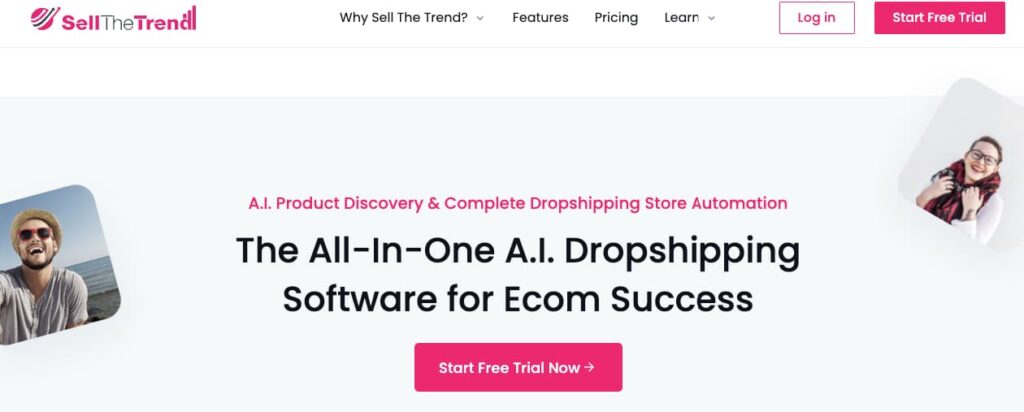
Sell the Trend is the most full-featured platform on this list, aiming to handle product research, supplier connections, and store management in one place. The standout feature that separates it from Dropship.io and the other tools here is the integrated video ad creator, which lets you produce product video ads directly inside the platform.
If you're selling products where video ads drive the most conversions (health, gadgets, pet products, and similar impulse-buy categories), having the ad creator alongside product research removes a workflow step. You find the product, confirm it's trending in the data, and build the ad before leaving the platform.
What it does well:
- Product trend tracking backed by a large dataset of Shopify stores
- Built-in video ad creator (genuinely useful for TikTok and Meta video formats)
- Works across multiple sales platforms, not just Shopify-to-Shopify research
- 24/7 customer support
What it doesn't do:
- No free plan; the Essential tier starts at $37.97/month
- Broader feature set means more to learn; newer users often take time to find the tools they actually need
- Some advanced features take time to master
Best for: Sellers who want to combine product research and video ad creation in a single tool, especially for social commerce channels.
Pricing:
First 2 months free on annual plans. Essential $37.97/month, Pro $99.97/month.
Which Tool Should You Choose?
The right choice depends on what Dropship.io specifically isn't giving you:
- Price is the issue: Start with Koala Inspector's free plan. It covers competitor store analysis, product data, and app/theme detection for $0.
- You need inventory automation: Inventory Source is the only tool here that handles supplier sync and order routing. The research tools above (Dropship.io included) don't do this.
- You want to research through ad data: Minea's ad-first approach covers TikTok and Instagram ads that store-spy tools can miss entirely.
- You want video ads alongside product research: Sell the Trend bundles both into one platform.
- You want comparable store spy features at a lower price: Koala Inspector (Chrome extension, free tier available) or Shophunter.
None of these are direct clones of Dropship.io, which is the point. Each one prioritizes a different part of the dropshipping workflow. Matching the tool to the actual bottleneck in your process will serve you better than picking the one with the longest feature list. If price is the bottleneck, install Koala Inspector and start researching stores for free today.
Dropship.io Alternatives FAQ
Common questions about dropshipping tools, product research, and making the model work.
Can I make $10,000 per month dropshipping?+
It's possible, but it's not typical and it takes time. Real income tracks experience: beginners in their first few months usually see $0 to $1,000 a month, intermediate sellers $500 to $5,000, and sellers past the one-year mark $5,000+ once they scale. Reaching $10,000 means high order volume, a healthy average order value, and margins in the 30 to 40% range, which normally takes 6 to 12 months of consistent work. Solid product research is what shortens that path: validating demand before you spend on ads keeps you from burning budget on products that never convert.
How to use AI for dropshipping?+
AI helps at three points: finding products, writing ad and product copy, and analyzing competitors. Koala Inspector's AI Shop Chat lets you ask plain-language questions about any Shopify store you're viewing, and its Find Retailers feature uses AI to surface other stores and suppliers selling the same product. That turns sourcing and validation into a few clicks instead of an afternoon of manual searching.
What is a dropship extension?+
A dropship extension is a browser add-on, usually for Chrome, that overlays store research data on top of your normal browsing. Instead of switching to a separate dashboard, you open a store, click the icon, and see its products, apps, theme, and estimated sales right there. Koala Inspector is a free example built for Shopify research.
How did you get started with dropshipping?+
Most sellers start by picking a niche they understand, finding a reliable supplier, and validating demand before building a store. The research step is where a tool like Koala Inspector saves the most time: you can study competitors already selling in your niche, see which products move and which apps they run, then model your store on what's working instead of guessing.
What does the Dropship.io extension do?+
Dropship.io's Chrome extension shows sales and revenue estimates for Shopify stores and products as you browse, so you can gauge whether an item is actually converting. It pairs with the Dropship.io web platform for deeper product research and competitor tracking.
Does dropshipping still work?+
Yes. The model is still active in 2026, with the global dropshipping market projected to reach around $537 billion by the end of the year. What's changed is the bar: winning now depends on sharper product research, faster shipping, and a store that reads as a real brand rather than a generic template.
Written by
Assaf Shalin
Co-founder & Developer, Koala Apps
Assaf Shalin is a co-founder of Koala Apps and one of the developers behind Koala Inspector. He builds the tools that let Shopify sellers see what is actually working in other stores, from installed apps and themes to best-selling products. On the blog he covers the technical side of store research: how competitor research really works, what public store signals can and cannot tell you, and how to turn them into decisions.
Connect on LinkedIn