8 Best Dropship Spy Alternatives
 By Assaf ShalinAugust 4, 2026
First, the disambiguation that sends half the people searching this term to the wrong article. Dropship Spy is dropship-spy.com, a credit-based AI tool that finds products, generates video ads and spits out a landing page. Dropship.io is a different company selling monthly subscriptions for Shopify sales tracking. The names are close enough that reviews, YouTube videos and comparison posts routinely mix them up. This post is about the first one. If you came looking for the second, our Dropship.io alternatives roundup is the page you want.
With that out of the way, here is the field.
The short answer
The strongest Dropship Spy alternatives are Koala Inspector for reading live competitor stores free, Dropship.io from $39 a month for Shopify sales tracking, Ecomhunt from $23 a month for a curated winning-product feed, Sell The Trend from $29.97 for research plus fulfilment, Minea from $49 for ad creatives, and Spocket or Zendrop when what you actually need is supplier data.
Dropship Spy alternatives compared
Every price below was read off the vendor's own pricing page. They cover four genuinely different jobs, so the cheapest tool is rarely the right one.
| Tool | What it covers | Free option | Paid from |
|---|---|---|---|
| Dropship Spy (for reference) | AI product research, AI video ads, downloadable landing pages | 1 free credit on signup, no card | $29 one-time for 25 credits |
| Koala Inspector | Live store teardowns: full catalogue and pricing, theme, app stack, the ads a store runs, traffic and sales estimates | Free plan, 15 tokens a month, no card | $22/mo |
| Ecomhunt | Curated winning-product feed with AliExpress performance data and a product tracker | Free tier, 10 live trending products | $23/mo billed yearly |
| Sell The Trend | Product research engine, Facebook and TikTok ad discovery, product import, 1-click fulfilment | 14-day trial | $29.97/mo |
| Dropship.io | Shopify and TikTok Shop sales tracking, product and shop libraries, ad library | Free trial | $39/mo |
| Spocket | Supplier catalogue weighted to US and EU suppliers, branded invoices, supplier chat | 7-day trial | $39.99/mo |
| Minea | Ad creatives across Facebook, TikTok, Pinterest and Snapchat, plus influencer placements | No free plan | $49/mo |
| Zendrop | Supplier sourcing, automated fulfilment, custom product requests, US sourcing | Free plan | $49/mo |
| AdSpy | The largest Meta ad archive here, at 208 million ads from 29.8 million advertisers | No free plan | $149/mo |
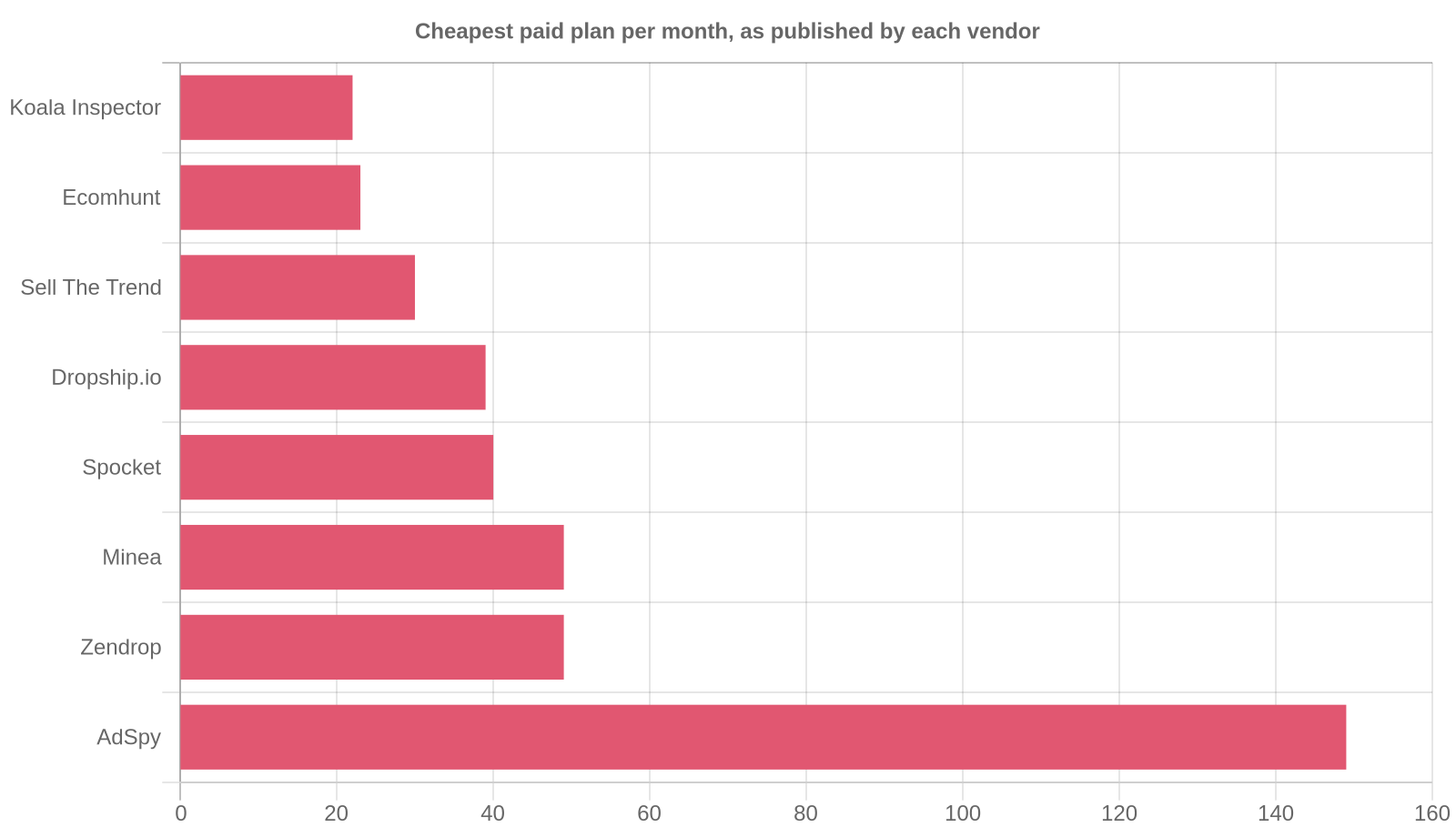
A note on the prices above. Ecomhunt's $23 Basic is its annual rate, billed at $279 a year. Sell The Trend lists Lite at $29.97 against a regular price of $59.97, so treat it as a promotional figure. Spocket's $39.99 Starter climbs steeply through Professional at $59.99, Empire at $99.99 and Unicorn at $299.99. Dropship.io's $39 Basic falls to $26 a month if you pay for the year. AdSpy's single $149 tier is described on its own site as an introductory rate.
What Dropship Spy actually does well
Dropship Spy earns its audience, and the case for it is easy to state.
No subscription. It sells credit packs rather than monthly access: $29 for 25 credits, $59 for 65, $129 for 170, and $249 for 350. The credits never expire. For someone who researches in bursts, that beats paying $39 a month through the three months you do not open the tool.
It goes past research into production. Product research costs 1 credit, an AI video ad costs 1 to 8 credits depending on the engine and length, and a landing-page funnel costs 2. The video side runs on named engines including Google Veo 3.1, Kling and Hailuo, with UGC, cinematic and unboxing styles. Very few research tools will hand you a finished creative and a hostable page at the end.
You can try it for a single credit. New signups get one free credit with no card, which is enough to see the output before committing $29.
It queries live sources. The product research pulls current data rather than serving a monthly hand-picked list, which is a real advantage over the older feed-based tools.
The gap that matters for a Shopify seller
Here is the limit every product-feed tool shares, Dropship Spy included. A curated feed tells you what somebody else picked. Reading a live competitor store tells you what is selling right now, in your niche, at prices you can check.
That difference has a cost. By the time a product is easy to find in a research tool, every other subscriber to that tool has seen it too. A seller who did $100k in 30 days wrote up their approach on r/dropshipping and put it plainly: their best performing products were not the ones showing up on spy tools with piles of sales and engagement. They were products the seller identified themselves by studying the market.
Studying the market means opening the stores that are already winning it and reading how they are built.
Koala Inspector is the free Chrome extension for that second job. Open any Shopify store and it reads the store you are on:
- The full catalogue and its pricing. Every product with images, prices and variations, filterable to likely best-sellers, with the price range across the catalogue and the date the first product went live. That tells you whether the store is a real business or a thin test, and exactly where it sits on price.
- The theme. The active theme by name, paid and custom ones included, with a link straight to it in the Shopify theme store. If the layout you admire is buyable, you can buy it.
- The app stack. Every app installed, grouped by what it does. Those choices took the store owner months to settle on, and you get the shortlist for nothing.
- The ads it runs. The store's Google and Facebook or Instagram campaigns, with the URL, title, description and tags on each card, so you see the offer and the angle before you spend on your own.
Catalogue, pricing, apps and theme come from what the store publishes. Traffic and sales figures are estimates modelled from public signals, useful for comparing stores and spotting momentum rather than for accounting.
What the app stack tells you
App detection is more useful than it sounds, because it only means something against a baseline. Across the Shopify stores Koala tracks, the most common app is Judge.me Product Reviews on 2,376 storefronts, followed by Klaviyo for email and SMS on 1,901, Shopify Inbox on 1,008, Klarna's on-site messaging on 1,003 and PageFly on 848.
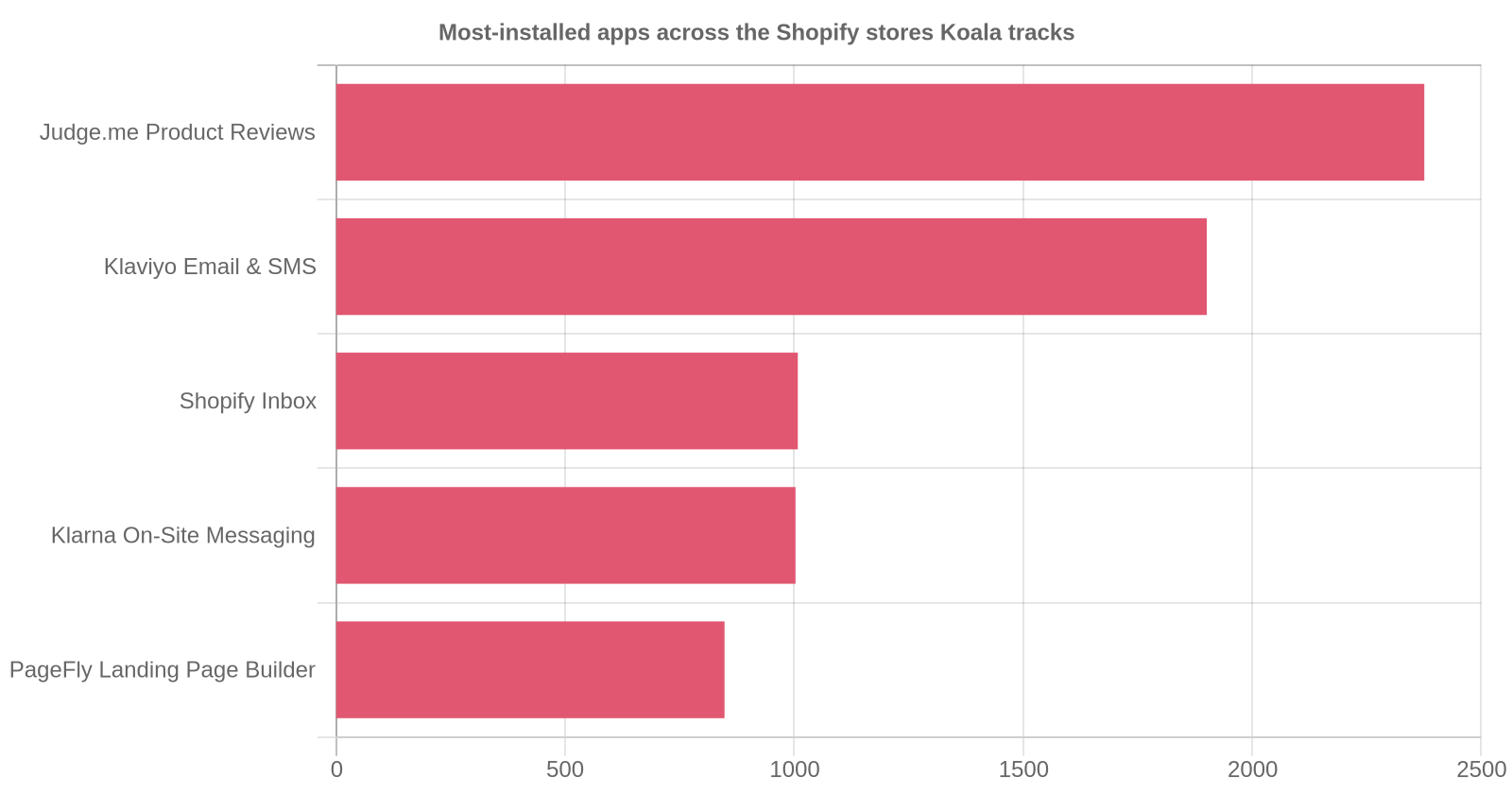
That is the stores Koala tracks rather than all of Shopify, so read it as a picture of what serious stores in this sample rely on. It is still the benchmark you need: once you know the common stack, an unusual app in a competitor's store becomes worth a look, because it is either an edge or a mistake.
Themes work the same way. In the same data, Trademark leads on 904 storefronts, with Dawn on 754 and Horizon on 414. A store on a premium paid theme is telling you it invested in its storefront. A store on the free default is telling you something else.
The first pass costs nothing. Store analysis, app detection, theme detection and product research are free features on the free plan, no credit card, so you can run this across ten competitors in an evening and decide afterwards whether the heavier features are worth $22 a month.
Which one should you pick?
You want a curated winning-product feed. Ecomhunt from $23 a month billed yearly, with a free tier that shows 10 live trending products. Sell The Trend from $29.97 if you want the research engine and fulfilment in the same subscription.
You want ad creatives. Minea from $49 covers Facebook, TikTok, Pinterest and Snapchat plus influencer placements, which is the widest net at that price. AdSpy at $149 has the deepest Meta archive if a niche is too obscure for anything smaller.
You want sales numbers on named competitors. Dropship.io from $39 a month, which also ships a Chrome extension and covers TikTok Shop alongside Shopify.
You want supplier data. Spocket from $39.99 for a catalogue weighted to US and EU suppliers, or Zendrop, which has a genuinely free plan and moves to Pro at $49 and Plus at $79.
You want to know how the stores beating you are built. Koala Inspector, free. It is the one job on this list that a product feed structurally cannot do, and it pairs well with any of the others: find a product anywhere, then open the stores selling it and read them properly. Our guide to dropshipping product research walks through the full workflow, and the product researcher's page covers the features built for it.
What researchers say about Koala Inspector
Verified reviews from the Chrome Web Store.
“I was a bit skeptical about all the hype but gave Koala Inspector a shot. It's user-friendly and provides useful data on what's working for others. The support team is also there when you need them.”
 Martin René
“Great tool for competitor research and customer support is really quick!”
 Aiswarya S
“great app for ecommerce, there are a lot of useful information. Friendly customer service!”
 Lavender Yuzu
Dropship Spy alternatives FAQ
Straight answers to the questions sellers ask alongside this one.
How do I start dropshipping?+
Pick a niche you can actually research, line up a supplier who ships reliably to the market you are selling into, build a simple store, then validate demand with a small ad budget before you scale anything. The research step decides most of the outcome. Open the stores already selling in your niche, read what they charge, how deep their catalogue runs, which apps they use to convert and which theme they sit on, then position against what you find. Koala Inspector does that reading for free on any Shopify store, so the research phase costs you time rather than money.
Is dropshipping worth it?+
It is worth it when the numbers survive contact with reality: a product with enough margin to absorb a losing week of ads, a supplier whose delivery times you have tested yourself, and a store that reads as a brand rather than a template. Sellers who treat it as a research business tend to last. Sellers who buy a curated product list and run ads at it tend to fund everyone else's testing. The cost of entry is low, so the competitive edge has to come from knowing your niche better than the people already in it.
How to find trusted UK-focused dropshipping mentor partners?+
Judge a mentor on a verifiable trading record rather than a course funnel. Ask for live store URLs and check them yourself: a genuinely UK-focused operator can point you at UK storefronts with real catalogues, GBP pricing, UK shipping policies and a mature app stack. Open each one with Koala Inspector and you can see the catalogue depth, price range, installed apps and theme in about a minute, which separates a working business from a screenshot. Cross-check the company on Companies House, and prefer people who are visible and answerable in UK e-commerce communities over anyone selling access through a paid group.
Is DSers good for dropshipping?+
DSers is a strong choice for the fulfilment half of the job. It describes itself as the official AliExpress e-commerce solution and says it is whitelisted by AliExpress, it imports products, places bulk supplier orders in seconds, syncs tracking numbers back to your store, and connects to Shopify, WooCommerce, Wix, eBay, Amazon and Walmart. Its own site puts usage at over 4.5 million dropshipping users and more than 220 million orders. It handles sourcing and order routing, so you still need a separate research tool to work out which competitors are winning and why.
Is it worth going into dropshipping?+
Go in if you can fund several product tests without needing the first one to pay your rent, and if you enjoy the research more than the idea of passive income. Budget for ad testing rather than inventory, expect most products to fail, and plan on months rather than weeks before a store finds a winner. The people who quit early usually started with unrealistic expectations about how fast it pays. If you can only afford one test, spend your time on competitor research first, because it is free and it kills bad ideas before your ad budget does.
Is Dropship.io trustworthy?+
Yes. Dropship.io is an established product-research platform that publishes its plans and prices openly, at $39, $59 and $99 a month on monthly billing, dropping to $26 a month for Basic on annual billing, with free trials available. It tracks Shopify and TikTok Shop sales and ships a Chrome extension. Treat its revenue figures as estimates rather than accounting, which is the right caution for any modelled sales number. Note that Dropship.io and Dropship Spy are two different companies, and we cover the former separately in our Dropship.io alternatives roundup.
Start with the free half
Every paid tool on this list is a bet that someone else's product list is better than your own research. Before you place it, spend an evening reading the stores already winning your niche.
Install Koala Inspector free from the Chrome Web Store, open the last competitor store you looked at, and see its catalogue, pricing, theme and app stack in one click. No card, no trial clock. If you want the traffic profile, ad campaigns and competitor tracking on top, Premium is $22 a month for 220 tokens and up to 50 tracked stores, and one-time token packs start at $3.99. Full details are on the pricing page.
Written by
Assaf Shalin
Co-founder & Developer, Koala Apps
Assaf Shalin is a co-founder of Koala Apps and one of the developers behind Koala Inspector. He builds the tools that let Shopify sellers see what is actually working in other stores, from installed apps and themes to best-selling products. On the blog he covers the technical side of store research: how competitor research really works, what public store signals can and cannot tell you, and how to turn them into decisions.
Connect on LinkedIn