Best Dropispy Alternatives
 By Assaf ShalinJuly 29, 2026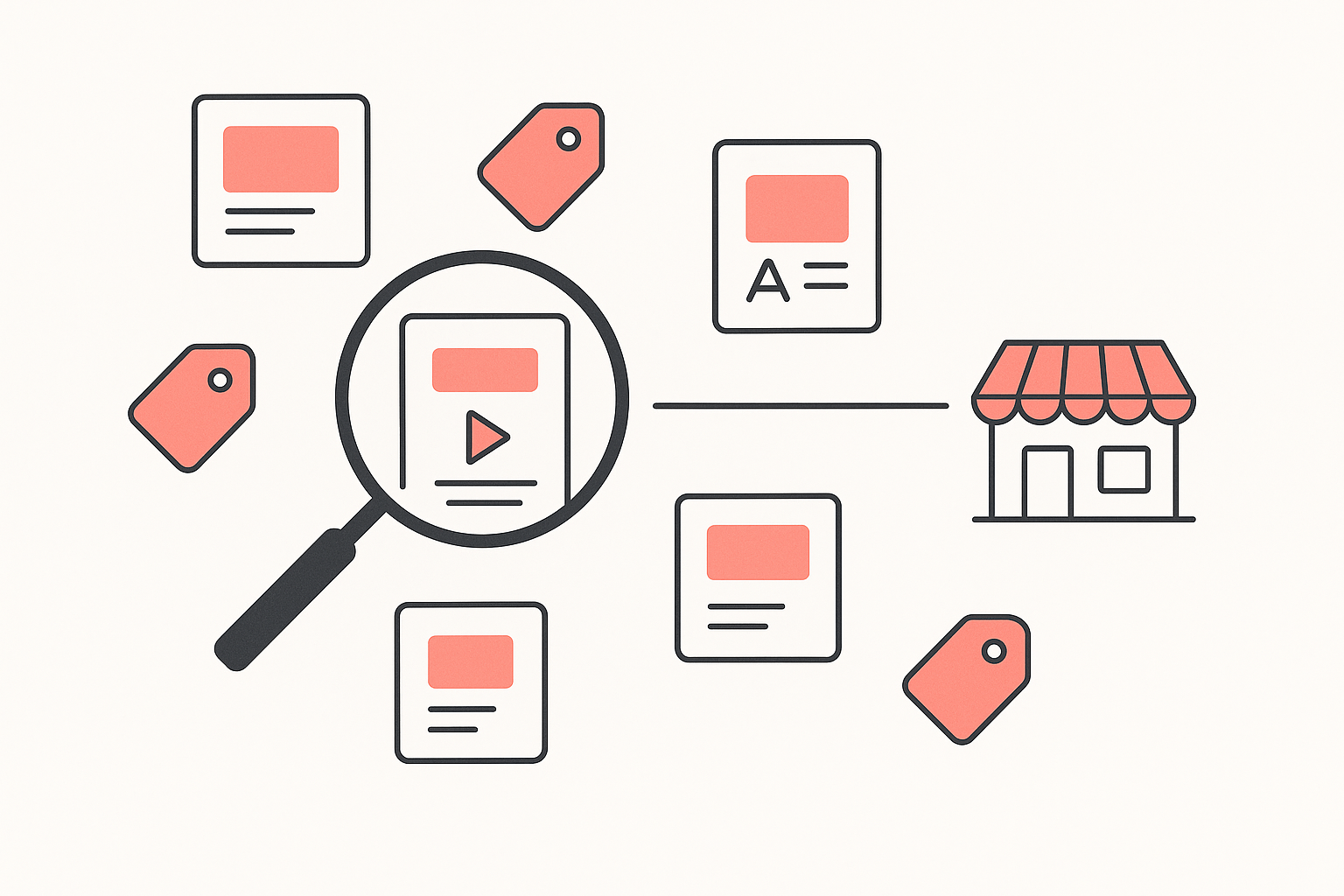
The best Dropispy alternatives at a glance
The best Dropispy alternative for Shopify sellers is Koala Inspector, because it answers the question an ad database cannot: what is the store behind that ad actually running? If you want a bigger creative archive instead of store data, AdSpy holds the largest library on this list at $149 a month, while BigSpy is the only other tool here with a genuinely free tier.
Here is how Dropispy and its eight strongest alternatives compare on what they track, what they cost, and whether they work inside your browser.
| Tool | Ad creatives | Store sales or traffic | Product catalogue | Apps + theme | Free tier | Paid from | Browser extension |
|---|---|---|---|---|---|---|---|
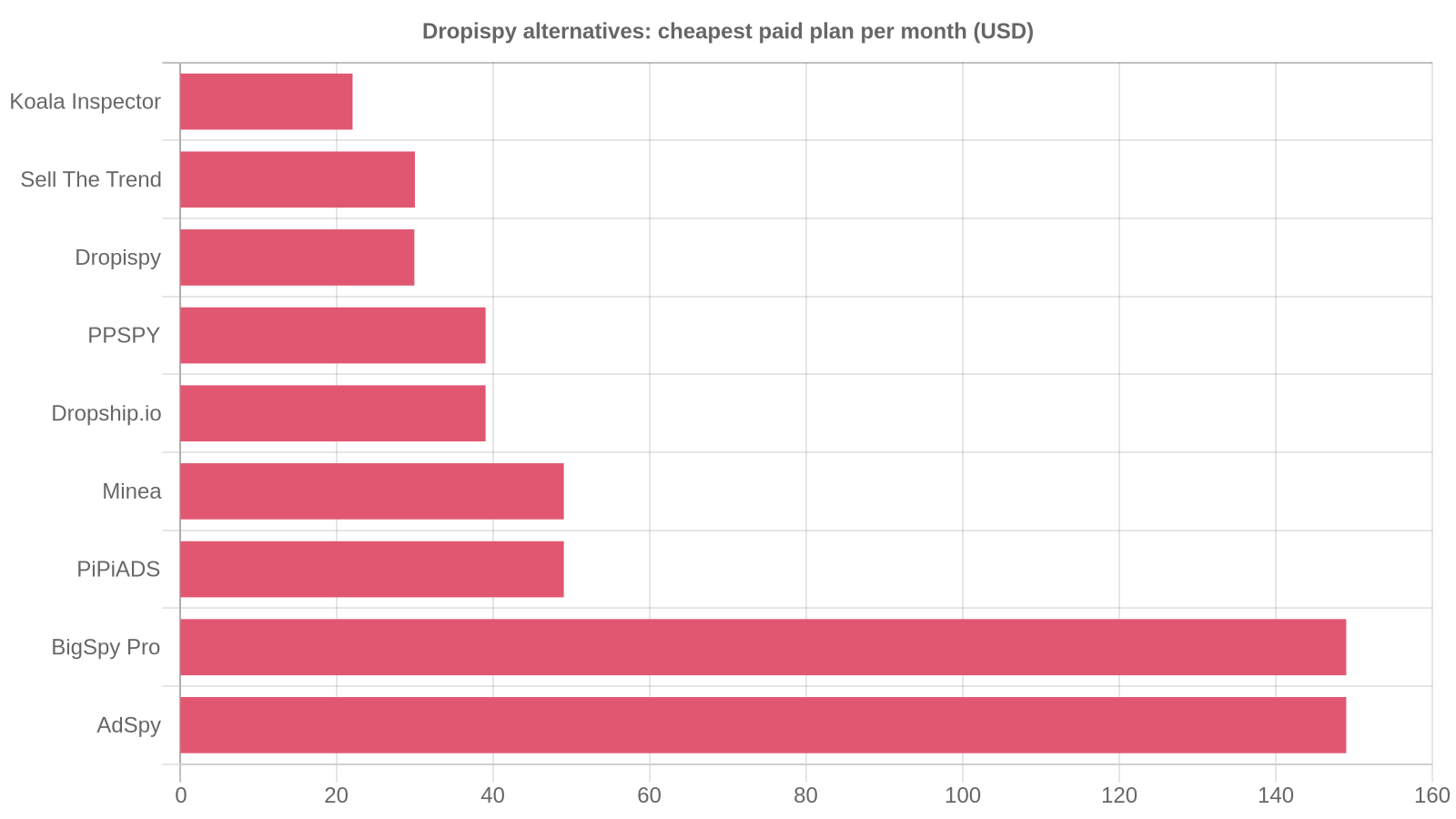
| Koala Inspector | Google + Meta ads for the store you open | Estimated traffic and monthly sales | Full catalogue, best-sellers, price range | Yes | Free plan, 15 tokens/mo | $22/mo | Chrome |
| Dropispy | 50M+ ads, 20k added daily | No | Via Shop Spy, ad-linked | No | Free plan | $29.90/mo | No, web app |
| Sell The Trend | TikTok viral ads finder (Pro) | No | Product database | No | 14-day trial | $29.97/mo | Chrome |
| PPSPY | Ad tracking | Sales tracking on Shopify stores | 200M+ Shopify products | Theme inspiration only | Free trial, no card | $39/mo | Chrome |
| Dropship.io | Ad Library + advertiser tracker | Shop and product sales tracking | Product + Shop libraries | No | Free trial | $39/mo | Chrome |
| Minea | Facebook ads + influencer placements | No | Product research | No | No free plan | $49/mo | Chrome |
| PiPiADS | TikTok, Facebook, Instagram, Threads | No | Product research from ads | No | Trial, 500 credits | $49/mo | No, web app |
| BigSpy | 10 channels, Facebook to Unity | No | No | No | Free tier, 5 searches/day | $149/mo Pro | Chrome, ad saver |
| AdSpy | 207M+ Facebook + Instagram ads | No | No | No | No free plan | $149/mo | No, web app |
Dropispy earned its following honestly. It is one of the cheapest ways into serious Facebook ad research, its pricing page lists a free plan alongside Premium at $29.90 a month, and its own site puts the archive at more than 50 million e-commerce ads with over 20,000 new ones added every day. The interface is clean, the filters are usable on day one, and its Shop Spy tool does classify the stores behind the campaigns.
The limits are just as real. AutoDS, in its own roundup of Dropispy alternatives, lands on the same two: coverage is Facebook-shaped rather than multi-platform, and the product research thins out fast once you step past the ad itself. Dropispy is a web platform at app.dropispy.com with no browser extension, so every question you have about a store means leaving the store and going back to a dashboard.
Why sellers go looking past Dropispy
Three reasons come up again and again.
The platform mix has moved. Dropispy's depth is on Facebook. If your niche now lives on TikTok, or you are buying across Google, YouTube and Pinterest, a Facebook-first archive leaves gaps that a broader tool like BigSpy or PiPiADS fills.
Ad databases age. Everyone researching your niche is looking at the same library, sorted by the same engagement filters. By the time a creative is easy to find, the product behind it has usually been picked over. One seller posting in r/dropshipping described burning roughly 2,800 euros through 2024 chasing products that were already saturated by the time the ads surfaced.
The research stops at the ad. This is the big one. A thread on r/AskMarketing asking which Facebook ad spy tool people actually use put the frustration plainly: the ad library shows what is currently running, which is useful but limited if you are trying to understand strategy. Knowing an ad exists is the start of the job, not the end of it.
That last gap is where a store research tool earns its place, and it is worth being specific about what it means in practice.
The handoff: from an ad to the store behind it
An ad spy tool hands you a creative, a landing page URL, and an engagement count. Then it stops. Everything that decides whether you can actually compete with that store is on the other side of that link.
Install Koala Inspector and the handoff takes about two minutes. Here is the walkthrough.
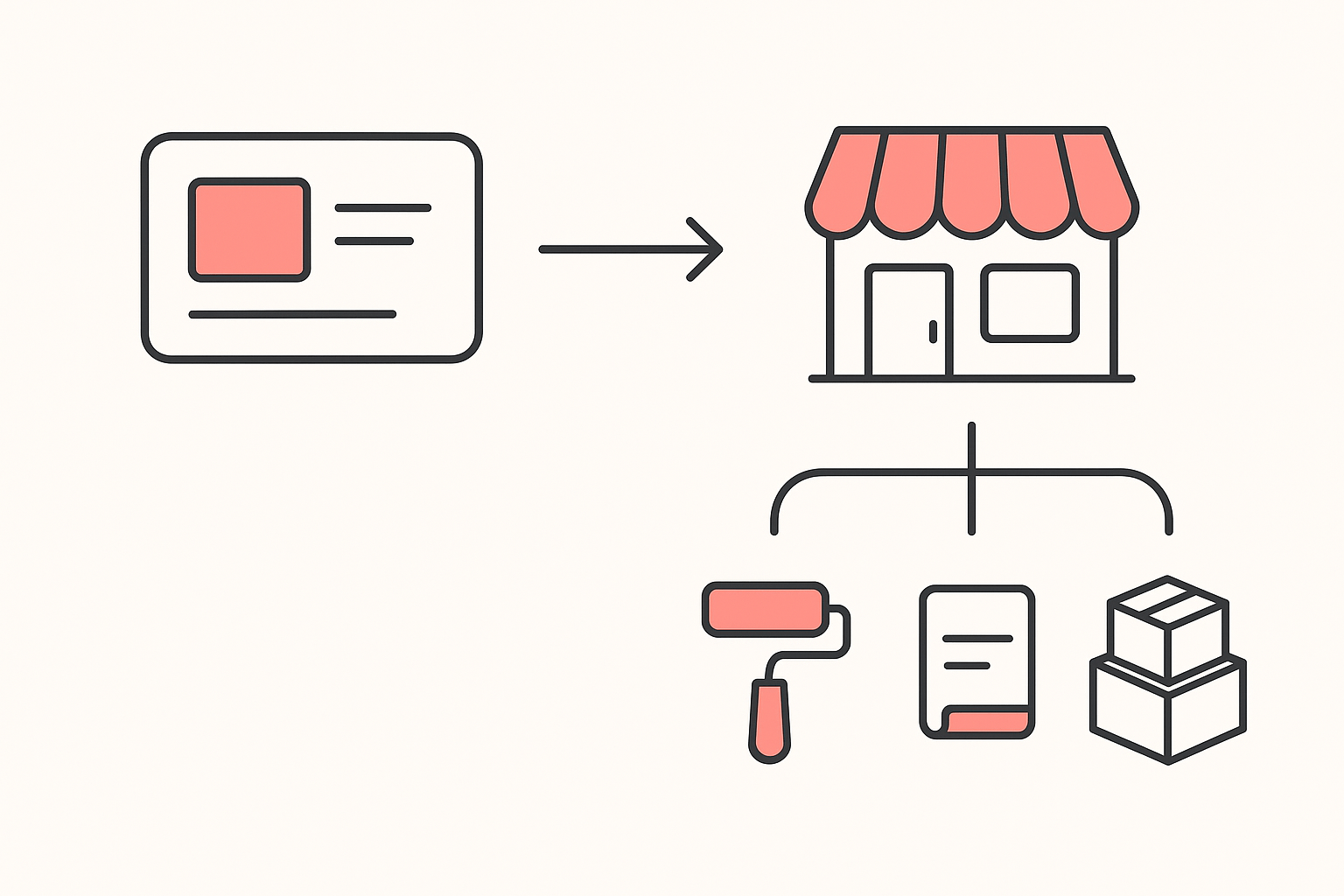
Step 1. Click through to the store. Take the landing page from whichever ad tool surfaced it and open it like a shopper would. Koala Inspector detects Shopify automatically and loads a store dashboard: category, product count, when the store was created, when it was last updated, currency and country.
Step 2. Read the app stack. App detection is free and takes one click. You see every app the store runs, grouped by what it does, which tells you how the store converts: which review app carries the social proof, which email platform runs the flows, which upsell app sits in the cart. Those choices took the store owner months and a fair amount of money to settle on, and you get the shortlist for nothing.
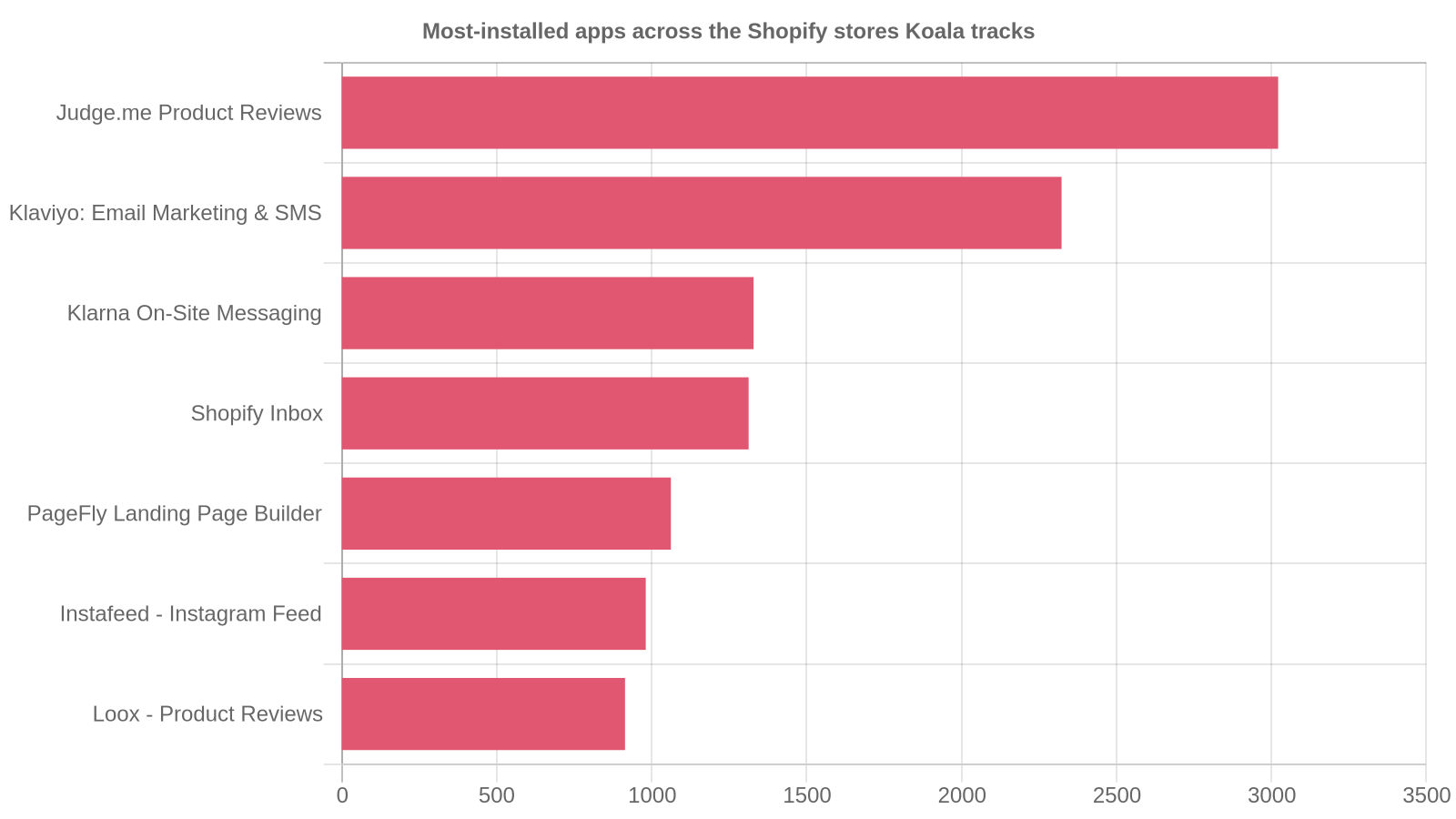
This is also where a benchmark helps. In Koala's own data, across the Shopify stores it tracks, the app that shows up on the most storefronts is Judge.me Product Reviews, on 3,022 of them, followed by Klaviyo for email and SMS on 2,323. Klarna's on-site messaging appears on 1,329, Shopify Inbox on 1,313, and PageFly on 1,062. Those are the stores Koala tracks rather than all of Shopify, so read them as a picture of what serious stores in this sample rely on, not a global census.
Against that backdrop, an unusual app in a competitor's stack becomes interesting. If a store is running something almost nobody else runs, that is either a real edge or a mistake, and it is worth a look either way.
Step 3. Check the theme. Theme detection is free too, and it comes with a link straight to that theme in the Shopify theme store. Across the stores Koala tracks, Trademark leads on 1,160 storefronts, with Dawn on 935 and Horizon on 539. If the store running the ad you liked is on a paid premium theme, you know the layout you are looking at is buyable rather than bespoke.
Step 4. Open the product catalogue. Browse the store's full catalogue or filter straight to likely best-sellers. You get images, prices, variations, the price range across the catalogue, and the date the first product went live. This is where you find out whether the ad was pushing the store's actual hero product or an outlier, and whether the catalogue is deep enough to be a real business or thin enough to be a test.
Step 5. Size the store. Traffic and estimated monthly sales tell you what scale you are up against. A store pulling steady traffic with a clear best-seller is a different opponent from one that just launched and is buying its way to a few orders. Both are worth knowing before you copy anything.
Step 6. Track it. Add the store to Shop Tracking and Koala records what changes: apps added or removed, theme swaps, new products, price moves, variant changes. That turns a one-off look into a running feed of what a competitor is testing.
The whole first pass costs nothing. Store analysis, app detection, theme detection and product research are free features on the free plan, no credit card, so you can run this on ten competitor stores before you decide whether any of it is worth paying for. Install Koala Inspector free and try it on the next ad that catches your eye.
Is there a free Dropispy alternative?
Yes, and there are two honest ones.
Koala Inspector has a free plan: 15 tokens a month, no card. The store research most people actually want costs zero tokens, so the free plan is not a demo, it is the tool. Tokens only come into play for the heavier features (traffic, ad campaigns, product trends, exports, tracking).
BigSpy has a free tier as well, though it is tightly capped: 5 searches and 20 downloads a day, Facebook only, with three industry switches a month. Enough to sanity-check a niche, not enough to research one.
Everything else on this list is a trial rather than a free plan. PPSPY and Dropship.io both let you start without paying, Sell The Trend runs a 14-day trial, and Minea and AdSpy are paid from day one.
The 8 best Dropispy alternatives
1. Koala Inspector
Koala Inspector is a Chrome extension that turns any Shopify store into a research report. Open a store and you get the theme with a link to buy it, the full app stack grouped by category, the product catalogue with likely best-sellers and price range, estimated traffic and monthly sales, and the Google and Meta campaigns tied to that store. Find Suppliers lists suppliers selling the same product, with delivery time, landed cost and your estimated profit per unit, and Shop Tracking watches a competitor for changes so you catch a price drop the week it happens rather than a month later.
Products, prices, apps and themes reflect what the store actually publishes. Traffic and sales are estimates, so use them to compare stores and spot trends rather than as accounting.
Pricing: Free plan with 15 tokens a month and no card. Premium is $22 a month for 220 tokens, tracking up to 50 stores, and priority support. One-time token packs never expire: 10 for $3.99, 25 for $6.99, 100 for $11.99.
Best for: any Shopify seller who wants to know how the stores in their niche are actually built. See the direct comparison in Koala Inspector vs Dropispy.
2. AdSpy
AdSpy is the biggest raw ad library on this list. Its site counts more than 207 million ads from over 29 million advertisers, across 225 countries and 88 languages, covering Facebook and Instagram. If your problem is that Dropispy's archive is not deep enough for an obscure niche, this is the fix.
There is no free plan and no cheap tier: one price, $149 a month, described on the site as an introductory rate. It is a web platform with no official Chrome extension.
Best for: buyers who research at volume and want the largest possible pool of Meta creatives. If you are weighing it up, we cover AdSpy alternatives in detail.
3. Minea
Minea watches Facebook ads and, unusually, influencer product placements, so you catch products being pushed by creators rather than only through paid media. It puts its library at over 10 million ads, and it does ship a Chrome extension, which most ad-only platforms do not.
Pricing runs Starter $49, Premium $99, and Business $199 a month, with no free plan. That makes it a step up in cost from Dropispy, and the influencer angle is the main thing you are paying for.
Best for: sellers in categories where creator placements move more product than paid ads. Compare it against the field in our Minea alternatives roundup.
4. PiPiADS
PiPiADS built its reputation on TikTok and has since widened to Facebook, Instagram, Audience Network, Messenger and Threads. If Dropispy's Facebook focus is what is failing you and your buyers live on TikTok, this is the most direct swap.
Basic is $49 a month with 30,000 credits and 2 ad trackers, Advanced is $99 with 100,000 credits and 10 trackers, and there is a free trial with 500 credits to test the filters. It is credit-based and browser-free, so heavy research months get expensive and every lookup means going back to the dashboard.
Best for: TikTok-first sellers. More options in PiPiADS alternatives.
5. BigSpy
BigSpy trades depth on any one network for breadth across ten: Facebook, Instagram, Google, YouTube, TikTok, Twitter, Yahoo, Pinterest, AdMob and Unity, across 71 countries and 23 languages. It is the widest net here.
The free tier is real but small, capped at 5 searches and 20 downloads a day on Facebook only. Pro is $149 a month for unlimited queries across platforms, plus page tracking and landing page insights. Its Chrome extension saves Facebook and TikTok ads while you browse rather than replacing the dashboard.
Best for: anyone who needs to see a competitor's whole media mix, not just their Meta creatives. See the field in BigSpy alternatives.
6. Dropship.io
Dropship.io is the closest thing on this list to a full research suite. You get a Product Library and a Shop Library, TikTok shop and product trackers, an Ad Library with an advertiser tracker, competitor research, and a Chrome extension included on every plan.
Basic is $39 a month with 10,000 product credits, 5,000 shop credits and 20 competitor searches a day. Standard at $59 lifts searches to unlimited, and Premium at $99 doubles the credit pools again. Free trials are available on all three.
Best for: sellers who want ad data and sales tracking in one subscription instead of two. Read Dropship.io vs Koala Inspector for the head-to-head.
7. PPSPY
PPSPY is Shopify-native in a way Dropispy is not. It tracks competitor sales with 15-day reports, indexes over 200 million Shopify products, surfaces one-product stores, and ships a Chrome extension that works while you browse.
Standard is $39 a month with 30 trackers and 10,000 credits, Pro is $99 with 100 trackers, and Business is $299. You can start a trial without a card. Treat every revenue figure it reports as directional rather than exact, the same caution that applies to any modelled sales number, ours included.
Best for: sellers who mainly want sales tracking on named competitor stores. We compare the field in PPSPY alternatives.
8. Sell The Trend
Sell The Trend is a product research platform first and an ad tool second. Its AI research engine, product database, supplier fulfilment and store builder sit at the centre, with a TikTok viral ads finder arriving on the Pro tier.
Lite is $29.97 a month with 10 daily AI research uses and 5 spy tool uses, Essential is $49.97 with unlimited research, and Pro is $99.97 with the TikTok ads finder and three store connections. A 14-day trial is available, and the Chrome extension is included on every plan.
Best for: beginners who want product ideas and fulfilment in the same place. More in Sell The Trend alternatives.
Still worth keeping: Dropispy on its own free plan
Worth saying plainly: if the archive is what you value and the price is what is pushing you away, Dropispy's own free plan is the cheapest way to keep the ad library and cut the bill. You lose the credit headroom of Premium, but the ad and shop tools stay accessible. Plenty of sellers keep Dropispy for creatives and pair it with a store research tool for everything the ad does not tell them.
How to choose
Start by naming the question you are actually stuck on.
"What creative should I run?" Pick on coverage and budget. AdSpy for the deepest Meta library, PiPiADS for TikTok, BigSpy for the widest platform spread, Minea if creator placements matter in your niche. Dropispy at $29.90 already does this job competently for Facebook, so only pay more if you need a platform it does not reach.
"Is this store actually making money?" PPSPY and Dropship.io both track store and product sales, and Koala Inspector gives you estimated traffic and monthly sales on any Shopify store you open.
"How is this store built, and can I build one like it?" That is store intelligence, and only Koala Inspector on this list answers it: theme, full app stack, complete catalogue with best-sellers, and change tracking over time.
Most sellers who research seriously end up running two tools, one for creatives and one for stores. If you already pay for an ad database, the cheapest upgrade to your workflow is not a bigger ad database. It is closing the gap between the ad you found and the business behind it. Install Koala Inspector free, open the next store an ad sends you to, and see the whole thing in one pass. Then dig deeper with our guides to finding a store's best-sellers, the most popular Shopify apps, and the most-used Shopify themes.
Written by
Assaf Shalin
Co-founder & Developer, Koala Apps
Assaf Shalin is a co-founder of Koala Apps and one of the developers behind Koala Inspector. He builds the tools that let Shopify sellers see what is actually working in other stores, from installed apps and themes to best-selling products. On the blog he covers the technical side of store research: how competitor research really works, what public store signals can and cannot tell you, and how to turn them into decisions.
Connect on LinkedIn