10 Best Sell The Trend Alternatives
 By Assaf ShalinApril 17, 2025 · Updated June 4, 2026
Sell The Trend charges $39.97/month (or $32.97 on an annual plan) and markets itself around its Nexus AI database, which evaluates 26 data points per product across more than 7 million listings and 1,200-plus vetted suppliers. That's a solid pitch. But it's not the right fit for every store owner, and the search for a replacement is one of the more common questions in dropshipping communities.
The reasons vary. Some sellers need deeper Shopify store intelligence. Others want manual human curation rather than algorithm-selected products. A few just find the interface doesn't match how they actually work.
This guide covers ten alternatives that are worth your time, with specific notes on who each one actually suits.

Photo: Kampus Production on Pexels
What to look for when switching tools
Before the list: product research tools differ in meaningful ways, and picking the wrong one wastes real money. Here's what separates them.
Database size and freshness
Sell The Trend's 7 million-plus product database is one of its selling points. Some alternatives go wider across marketplaces; others go narrower but deeper on one source like AliExpress. Update frequency matters more than raw size. A database of 2 million products refreshed daily beats one with 10 million that's stale.
How trends are identified
Sell The Trend uses sales velocity as its primary signal. Other tools pull social engagement data, search volume trends, or manually curate products by hand. None of these methods is universally better, but they serve different decision styles. Data-heavy operators tend to prefer algorithmic tools; sellers who move fast on product launches often prefer curated picks.
Platform coverage
Sell The Trend pulls from AliExpress and Shopify stores primarily. If you source from multiple channels, or if you want to analyze any Shopify store rather than just the ones inside a proprietary database, that coverage gap matters.
Pricing structures
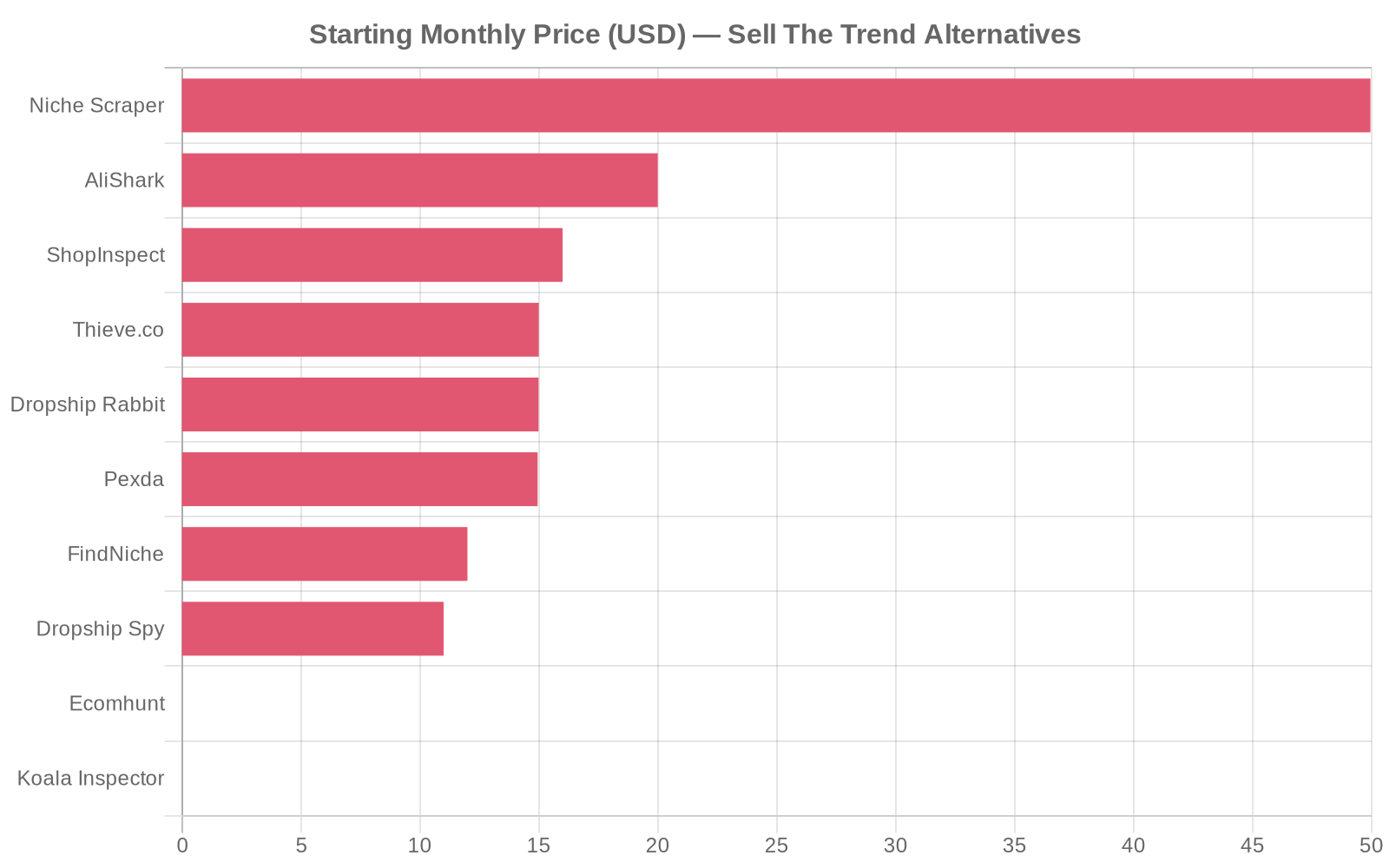
The alternatives below range from $0 to $100 per month. Higher price rarely means better for your specific situation. A $16/month tool that matches your workflow will outperform a $100/month one you use halfway.
10 Best Sell The Trend Alternatives
| Tool | Monthly Pricing |
|---|---|
| Koala Inspector | $0 - $22 (plus optional token packs) |
| eComHunt | $0 - $25 |
| Niche Scraper | $49.95 |
| Alishark | $20 |
| Dropship Spy | $11 - $29 |
| FindNiche | $12 - $99 |
| Thieve co | $15 - $49 |
| Dropship Rabbit | $14.99 - $119.94 |
| Pexdda | $14.95 - $99.95 |
| ShopInspect | $16 - $19 |
1. Koala Inspector
Koala Inspector takes a different approach from Sell The Trend entirely. Instead of a product database you search through, it's a Chrome extension that reveals the inner workings of any live Shopify store, competitor or otherwise.
Open a Shopify store, run Koala Inspector, and you get: the theme, every installed app, estimated traffic sources with geographic breakdowns, active ad campaigns across Facebook, Google, and Instagram, and the store's bestselling products with pricing data. Sell The Trend shows you curated opportunities; Koala Inspector shows you what's actually working in real stores right now.
That distinction matters for your workflow. If you spend time studying competitors directly rather than browsing a database, Koala Inspector fits better. If you need a broad product discovery database, it doesn't replace Sell The Trend on its own.
One practical note: Koala Inspector is Shopify-specific. Non-Shopify platforms are out of scope, and there's no direct product import feature.
Potential limitations: Works only on Chrome. No product importing. Designed for competitive intelligence, not product sourcing. Pairs well with a supplier tool or AliExpress Dropshipping Center rather than replacing them.
Koala Inspector Pros
- Reveals apps, themes, traffic sources, and ad campaigns for any Shopify store
- Free tier includes 15 tokens per month, enough for regular casual use
- More affordable than Sell The Trend at every paid tier
- Geographic traffic data useful for deciding which markets to target
Koala Inspector Cons
- Chrome-only
- No product database or direct importing
- Needs pairing with a supplier/sourcing tool
What is Koala Inspector best for?
- Competitive analysis on Shopify stores
- Finding which themes and apps successful stores use
- Understanding where competitor traffic comes from
- Validating that a product niche has active stores behind it
Koala Inspector Prices:
- Free Plan: $0/Month - Basic shop insights and 15 tokens
- Premium Plan: $22/Month - 220 tokens, tracking for up to 50 shops, VIP support
- Token packs (one-time, never expire): 10 tokens for $3.99, 25 tokens for $6.99, 100 tokens for $11.99 (best value)
2. Ecomhunt - Best for Finding Trending Products
Ecomhunt takes the human-curation approach that Sell The Trend's algorithm-first model doesn't. A team of product researchers manually selects 5-10 products per day based on actual market activity. Each pick comes with supplier links, ad copy angles, audience targeting suggestions, and Facebook engagement data.
The result is a smaller daily selection with more context per product. For sellers who want to spend less time filtering bad data and more time on execution, that trade-off works well. The free tier shows you the products but delays access; paid plans unlock the full research package immediately.
The main constraint is coverage. If you're in a specialized niche, the daily picks may miss your category entirely for weeks. The platform rewards generalist sellers who can move quickly on curated opportunities.
Implementation considerations: The limited daily suggestions (5-10 products) may restrict scaling for larger operations. Sellers in specialized niches might find the curated selection insufficient for their specific market.
Ecomhunt Pros
- Human-curated picks with real editorial judgment behind them
- Each product includes ad angles, descriptions, and targeting suggestions
- Facebook engagement data for social proof
- Free tier available
Ecomhunt Cons
- 5-10 products per day limits volume
- Free tier delays product access by several days
- Niche sellers may find gaps in coverage
What is Ecomhunt best for?
- Sellers who want curated picks, not a database to filter
- Quick product testing with ready-made marketing context
- New dropshippers who want guidance alongside the product data
Ecomhunt Prices:
- Free Plan: $0/Month
- Basic Plan: $15/Month
- Pro Plan: $25/Month
3. Niche Scraper - AI-Powered Product Research Tool
Niche Scraper spans AliExpress, Amazon, eBay, and Shopify simultaneously. That cross-platform coverage is its main advantage over Sell The Trend, which leans primarily on AliExpress and Shopify. Seeing consistent demand across multiple marketplaces is a stronger signal than single-platform performance alone.
The filtering system is more granular than most tools at this price. You can define criteria across multiple dimensions at once, which cuts down the time spent eliminating unsuitable products manually. Profit margin estimates are built into the results.
The tradeoff is complexity. The interface has a steeper learning curve than Sell The Trend, and new dropshippers often find they need time to get value from the advanced filters.
Learning curve consideration: New dropshippers may require more time to become proficient with Niche Scraper's advanced features. This is the main tradeoff for its broader data coverage.
Niche Scraper Pros
- Multi-marketplace coverage (AliExpress, Amazon, eBay, Shopify)
- Strong filtering for precise product criteria
- Built-in profit margin calculations
- Regular database updates
Niche Scraper Cons
- Single price tier with no starter option
- Steeper learning curve for beginners
- $49.95/month is the highest price on this list
What is Niche Scraper best for?
- Sellers who validate products across multiple platforms
- Data-driven researchers who use complex filters regularly
- Margin-focused operations
Niche Scraper Prices:
- Pro Membership: $49.95/Month
4. AliShark - Best for AliExpress Product Analysis
If you source exclusively from AliExpress, AliShark gives you far more depth on that one marketplace than Sell The Trend does. The platform tracks historical performance over time, including sales trends, pricing shifts, and review accumulation. That longitudinal view helps separate products with sustained demand from ones that spiked and faded.
Supplier assessment tools show seller metrics, fulfillment rates, and customer satisfaction scores. For AliExpress-focused sellers, that vetting layer reduces the risk of picking a product only to find the supplier is unreliable.
The scope is the limitation. AliShark does not cover other marketplaces, doesn't have Sell The Trend's store analytics features, and won't work for sellers using multiple supply sources.
Scope limitation: AliShark's specialization is also its constraint. Sellers using multiple supply sources will need supplementary tools.
AliShark Pros
- Deep historical performance data on AliExpress products
- Supplier reliability metrics built in
- Trend tracking over time, not just snapshots
- Affordable at $20/month
AliShark Cons
- AliExpress only
- No store analytics or broader marketplace coverage
- Smaller overall product database than platform-agnostic tools
What is AliShark best for?
- AliExpress-focused dropshippers who want granular historical data
- Sellers who need supplier vetting alongside product research
AliShark Prices:
- Standard Plan: $20/Month
5. Dropship Spy - A Powerful Alternative to Sell The Trend
Dropship Spy bundles product research with marketing assets in a way Sell The Trend doesn't. Each product listing includes pre-written descriptions, ad copy templates, video marketing assets, and audience targeting parameters. For sellers who run Facebook ad campaigns, that package cuts meaningful prep time.
The audience insights go into demographic detail. Buyer personas with targeting recommendations are available for each product. That can reduce wasted ad spend in early campaign stages.
The limitation is customization. The preset materials are generic starting points, not final copy. Established brands with specific voices will need to rewrite most of it. The time saving is real but smaller than it looks at first.
Customization considerations: The preset marketing materials need adaptation for brand consistency. The benefit is front-loaded setup time, not finished assets.
Dropship Spy Pros
- Combines product picks with ready-made ad assets
- Audience targeting data per product
- Lower starting price than Sell The Trend
Dropship Spy Cons
- Smaller product database than broader platforms
- Marketing templates need editing for brand voice
- Limited filtering for custom searches
What is Dropship Spy best for?
- Facebook advertisers who want ad copy and targeting bundled with product picks
- Fast-launch store models where speed to campaign matters
Dropship Spy Prices:
- Standard Plan: $11/Month
- Pro Plan: $29/Month
6. FindNiche - Data-Driven Niche Discovery
FindNiche approaches research from a different angle than Sell The Trend. The focus is niche-level analysis rather than individual product discovery. The platform identifies product categories with growth trajectories, sustainable margins, and quantifiable competition, then connects you to suppliers who specialize in those categories.
That top-down approach suits sellers building cohesive stores around a defined audience. Rather than testing random individual products, you pick a category with a clear demand signal and build from there.
The tool has less value for sellers who operate opportunistically, picking and testing individual trending products without a fixed store identity. FindNiche rewards strategic planning.
Strategic focus requirement: FindNiche works best for sellers building around category identity, not one-off product testing.
FindNiche Pros
- Niche-level analysis with competition scoring
- Supplier directory tied to identified categories
- Visual market mapping
- Affordable entry-level price
FindNiche Cons
- Less suited to individual product discovery
- Smaller user community than major platforms
- Requires a clearer business strategy to use well
What is FindNiche best for?
- Store builders who want to own a niche rather than chase individual trends
- Sellers researching supplier diversity within a category
FindNiche Prices:
- Basic Plan: $12/Month
- Elite Plan: $49/Month
- Premium Plan: $99/Month
7. Thieve.co - A Curated Alternative to Sell The Trend
Thieve.co curates products with quality and aesthetic coherence as the primary filter, not raw sales velocity. The selection team looks for items that photograph well, fit lifestyle categories, and would hold up in a premium-positioned store. The result is a smaller catalog with a higher average quality floor.
Products are organized in thematic collections tied to specific audience interests and aesthetics. For sellers building stores around a distinct visual identity, that organization is genuinely useful. For volume sellers who need breadth, it's too narrow.
Volume limitation: Thieve.co's catalog is smaller than algorithm-driven platforms by design. High-volume testing operations will find it insufficient.
Thieve.co Pros
- Quality-filtered curation, not just sales-velocity sorting
- Thematic collection structure for brand-building
- Supplier information quality-verified
- Emphasis on unique and distinctive products
Thieve.co Cons
- Smaller database than algorithmic platforms
- Limited analytics data per product
- Filtering options are narrower than Sell The Trend
What is Thieve.co best for?
- Brand-focused stores where aesthetic consistency matters
- Lifestyle and premium product niches
- Sellers willing to trade breadth for curation quality
Thieve.co Prices:
- Dropship Plan: $15/Month
- Dropship Pro Plan: $49/Month
8. Dropship Rabbit - A Beginner-Friendly Alternative
Dropship Rabbit is built explicitly for people new to dropshipping who find tools like Niche Scraper or Sell The Trend confusing at first. The search filters are simplified, the interface is clean, and product listings come with step-by-step context about why a product was included and how to test it.
The educational integration is the distinguishing feature. Most tools assume you know what you're looking for. Dropship Rabbit tries to teach you while you use it, with community forums and implementation guides alongside the product data.
The constraint is ceiling. As your dropshipping experience grows, the simplified analytics may stop being enough. It's a strong starting point, but established sellers typically outgrow it.
Scalability considerations: Well-suited to beginners. Experienced sellers may find the analytics too basic for serious scaling decisions.
Dropship Rabbit Pros
- Simplified interface with real usability for beginners
- Educational content built into the product experience
- Community forums for peer learning
- Affordable starting price
Dropship Rabbit Cons
- Limited advanced filtering
- Less data depth than platforms designed for experienced sellers
- Smaller product database than major tools
What is Dropship Rabbit best for?
- First-time dropshippers
- Sellers who want guided learning alongside product data
- Community-oriented store builders
Dropship Rabbit Prices:
- Standard: $14.99/Month
- Premium: around $20/Month
- Standard Plus: $89.94/Year
- Premium Plus: $119.94/Year
9. Pexda - Advanced Product Intelligence Tool
Pexda runs multi-factor product analysis that tracks performance across several marketplaces simultaneously. The platform looks for products with demand patterns that hold up cross-market, which reduces the risk of selecting something that performed well on one platform in isolation but doesn't translate.
The data visualization is more detailed than Sell The Trend, which suits sellers with an analytical background who want to stress-test product choices before committing to ad spend. The advanced plan includes predictive trend signals that go beyond simple sales velocity.
The downside is the interface complexity. If you're not already comfortable interpreting multi-variable data views, the learning curve is real.
Technical complexity: The advanced features take time to learn. Users without an analytics background may find the most valuable data points hard to reach.
Pexda Pros
- Cross-platform validation across multiple marketplaces
- Detailed competition mapping
- Predictive trend signals in higher tiers
- Advanced filtering capabilities
Pexda Cons
- Steeper learning curve than most alternatives
- Premium features locked behind higher-priced plans
- Interface requires familiarity with data analysis
What is Pexda best for?
- Experienced sellers who validate products quantitatively
- Cross-marketplace operations wanting one research hub
- Data-driven operators who need more than sales velocity
Pexda Prices:
- Standard Plan: $14.95/Month
- Premium: $24.95/Month
- Ultimate Plan: $99.95/Month
10. ShopInspect - AI-Driven Product Research
ShopInspect uses machine learning to personalize product recommendations based on store performance history. As the system accumulates data from your store, the suggestions become more relevant to your specific niche and customer profile.
The early trend detection is the main differentiator. The system is designed to surface products before they reach peak saturation, based on pattern recognition across multiple signals. For established stores with real sales history, that personalization compounds over time.
The catch is the cold start. New stores don't have the performance history the system needs, so initial recommendations are generic. The platform earns its value after several months of data accumulation.
Implementation requirement: ShopInspect works best for stores with performance history. New stores will see limited personalization until enough data exists.
ShopInspect Pros
- Recommendations that improve with your store's data
- Early trend detection across multiple signals
- Real-time competitor monitoring
ShopInspect Cons
- Limited value for new stores with no performance history
- Smaller feature set than broader platforms
- Two pricing tiers only
What is ShopInspect best for?
- Established dropshippers who want personalized picks
- Stores in defined niches where pattern recognition is most useful
- Sellers who want trend signals before mainstream saturation
ShopInspect Prices:
- Standard Plan: $16/Month
- Legendary Plan: $19/Month
Which Sell The Trend alternative should you choose?
The short answer depends on where you are in your business.
If you're just starting out: Ecomhunt's free tier gives you real, curated products with marketing context attached. Once you're ready to pay, Dropship Rabbit adds educational depth that makes the learning curve shorter. Both options cost less than Sell The Trend and suit the early-stage research pace.
If you focus on Shopify stores specifically: Koala Inspector gives you visibility into any live Shopify store that Sell The Trend can't match. Combine it with AliShark or the AliExpress Dropshipping Center for sourcing and you have a cheaper, more targeted setup for Shopify-focused operations.
If you're building a branded store with a clear niche: Thieve.co and FindNiche both serve category-level thinking better than Sell The Trend's volume-oriented product database. Neither is cheap on a per-feature basis, but both match the strategic approach better.
If you need broad, data-heavy research: Niche Scraper's multi-marketplace coverage or Pexda's cross-platform validation both go wider than Sell The Trend. Expect a steeper learning curve in exchange.
One practical note that applies across all of these: the dropshipping tools with the best features don't guarantee success. The global dropshipping market is growing fast (projected to reach $1.25 trillion by 2030, per Grand View Research), but finding reliable suppliers remains one of the biggest challenges for most sellers. The tool you pick shapes how you find products. The supplier relationships you build determine whether you can fulfill them.
Most successful operations end up using two or three tools together, not searching for the one perfect all-in-one platform.
Written by
Assaf Shalin
Co-founder & Developer, Koala Apps
Assaf Shalin is a co-founder of Koala Apps and one of the developers behind Koala Inspector. He builds the tools that let Shopify sellers see what is actually working in other stores, from installed apps and themes to best-selling products. On the blog he covers the technical side of store research: how competitor research really works, what public store signals can and cannot tell you, and how to turn them into decisions.
Connect on LinkedIn