The 25 Most Popular Shopify Apps, Ranked by How Many Stores Run Them
 By Ana GelevskaJune 30, 2026 · Updated September 25, 2026
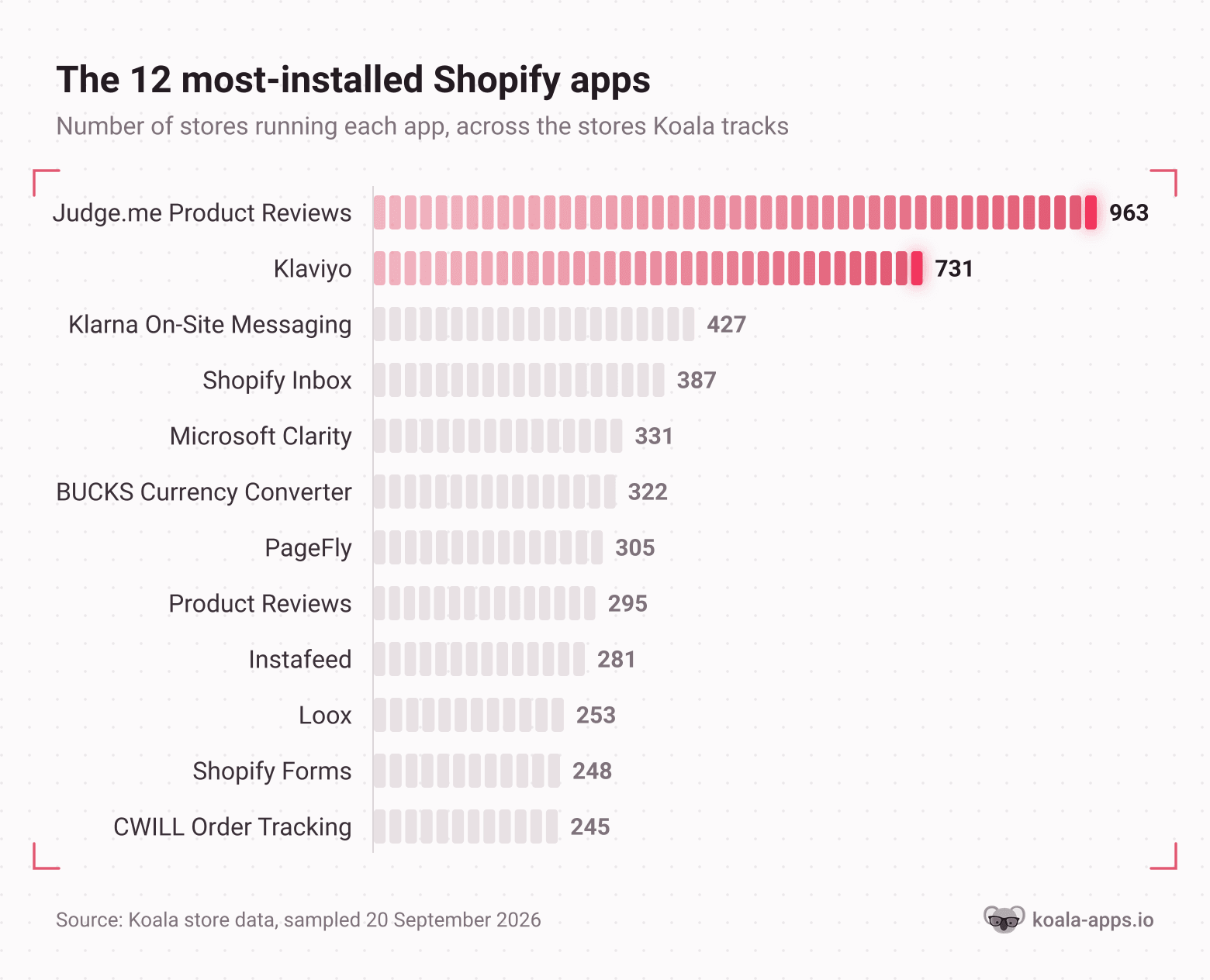
Judge.me Product Reviews is the most widely installed Shopify app in Koala's store data, running on 963 stores, followed by Klaviyo on 731 and Klarna On-Site Messaging on 427. Below is the full top 25 with a real store count beside every app, grouped by the job it does, so you can see which categories the market has already settled and which are still a fight.
The Shopify App Store lists over 16,000 apps, and almost every "best apps" list you will find is a hand-picked opinion dressed up as a ranking. This one is countable. Each number below is the number of stores running that app across the stores Koala tracks, pulled from a sample taken on 20 September 2026 covering 250 apps and 13,732 recorded installs.
Merchants ask for exactly this. One of the most common complaints in Shopify communities is having too many conflicting app recommendations to choose from, with no way to tell an essential tool from a nice-to-have. A store count is the cheapest way to tell them apart.
How to read this ranking
Two things about the numbers, up front.
The source is Koala's own store data. These counts come from the stores Koala tracks, modeled from public signals any visitor's browser can already see and sampled over time. They cover a large, active slice of Shopify rather than the whole platform, so read the ranking as a strong directional signal about what working stores install, never as a global census of every Shopify merchant.
The sample refreshes constantly. Stores enter and leave it, so an individual count moves a little week to week. The ordering, the size of the gaps, and the shape of each category are the parts that stay stable, and they are the parts worth acting on.
The 25 most popular Shopify apps
| # | App | Category | Stores running it |
|---|---|---|---|
| 1 | Judge.me Product Reviews | Reviews | 963 |
| 2 | Klaviyo | Email and SMS | 731 |
| 3 | Klarna On-Site Messaging | Payments and trust | 427 |
| 4 | Shopify Inbox | Chat and support | 387 |
| 5 | Microsoft Clarity | Analytics | 331 |
| 6 | BUCKS Currency Converter PRO++ | Currency and translation | 322 |
| 7 | PageFly | Page building | 305 |
| 8 | Product Reviews | Reviews | 295 |
| 9 | Instafeed | Social proof | 281 |
| 10 | Loox | Reviews | 253 |
| 11 | Shopify Forms | Email and SMS | 248 |
| 12 | CWILL Order Tracking | Order tracking | 245 |
| 13 | iCart Cart Drawer Cart Upsell | Cart and upsell | 195 |
| 14 | Kaching Bundles App & Upsells | Cart and upsell | 195 |
| 15 | 17TRACK Order Tracking | Order tracking | 182 |
| 16 | Mailchimp | Email and SMS | 130 |
| 17 | Brevo PushOwl | Email and SMS | 129 |
| 18 | Track123 Order Tracking | Order tracking | 122 |
| 19 | wetracked.io Connect | Analytics | 122 |
| 20 | Swym Wishlist Plus | Merchandising | 113 |
| 21 | Releasit COD Form & Upsells | Payments and trust | 107 |
| 22 | Omnisend | Email and SMS | 105 |
| 23 | GemPages | Page building | 105 |
| 24 | Ymq Product Options, Variants | Merchandising | 102 |
| 25 | Bundler | Cart and upsell | 97 |
Six categories carry most of that list. Here is what each one tells a store owner, and what it costs to get the call wrong.
Reviews: the closest thing to a mandatory app
Judge.me on 963 stores, Product Reviews on 295, Loox on 253. Reviews is the biggest category in the data by a wide margin, with 1,990 installs across the 16 review apps in the sample.
What the ranking tells you: a review system is the default, not an upgrade. A cold visitor on a product page has one question, and star ratings plus customer photos answer it without sending them to Google. Judge.me leads on breadth and a free tier that carries a store from its first sale onward. Loox trades some of that breadth for photo and video proof, which pulls harder in categories where the product has to be seen on a real person.
What it costs to be wrong: running no reviews at all is the expensive version of this mistake, because you are asking for card details from a stranger with nothing on the page vouching for you. The cheaper mistake is picking a review app that loads badly. Merchants comparing review apps regularly report that some apps slow the store down and do not blend with the store design, which turns a trust asset into a speed tax.

Email and SMS: five of the top 25
Klaviyo on 731, Shopify Forms on 248, Mailchimp on 130, Brevo PushOwl on 129, Omnisend on 105. Email and SMS is the second-biggest category with 1,550 installs across 12 apps, and it is the category with the most entries in the top 25.
What the ranking tells you: owned audience is where the margin is. Paid traffic gets more expensive every year, so the cheapest revenue a store has is the buyer it already paid to acquire. Klaviyo's lead of nearly 3 to 1 over the next name says that stores serious about lifecycle marketing converge on one tool. Seeing Klaviyo on a competitor tells you they invest in keeping customers rather than only chasing new ones.
What it costs to be wrong: picking a light tool because it is cheaper, then rebuilding every flow eighteen months later when segmentation gets real. Migrating an email platform means moving lists, rebuilding automations, and re-warming a sending domain, so this is the app on the list you should over-choose for rather than under-choose.
Page building: the tell that a merchant is testing
PageFly on 305, GemPages on 105, and Replo behind them at 79. Eight page builders share 687 installs.
What the ranking tells you: a page builder on a store means the merchant stopped shipping the theme as it came and started building campaign landing pages and richer product pages. PageFly leads on flexibility and a free plan that lets a store start small. If a competitor in your niche runs one, the pages they built with it are where their offer testing happens, which makes them the most instructive pages on the whole site to study.
What it costs to be wrong: page builders add weight. Building every page in a builder when your theme could already do the job trades load time for convenience, and load time is conversion. Use one where you need a layout the theme cannot give you.
Cart and upsell: average order value, at a price
iCart Cart Drawer on 195, Kaching Bundles on 195, Bundler on 97, Revy on 93, Amp Slide Cart on 85. Cart customization alone spreads 520 installs across 11 apps.
What the ranking tells you: raising average order value is a job almost every store eventually buys a tool for, and no single tool owns it. The leaders here sit at a fifth of Judge.me's count, which means the category is still being decided.
What it costs to be wrong: a cart drawer sits on the single highest-intent moment in your store. An upsell app that adds a slow drawer, or that stacks an offer in front of a buyer who already decided, costs you conversions on the traffic you paid the most for. Test this category against your own checkout rate before you keep it. For a deeper look at the mechanics, see our guide on how to upsell on Shopify.
Order tracking: the post-purchase workload
CWILL Order Tracking on 245, 17TRACK on 182, Track123 on 122. Six tracking apps carry 602 installs, and the top three are unusually close together.
What the ranking tells you: this is a job stores add once volume makes "where is my order" emails painful, rather than on day one. The tight spread across three names says merchants treat tracking apps as broadly interchangeable and pick on price and branding options.
What it costs to be wrong: getting tracking wrong is mostly a support-cost mistake rather than a revenue one, with one exception. If your shipping times are long, a branded tracking page that sets expectations is the difference between a patient customer and a chargeback.
Payments and trust: telling the buyer they can afford it
Klarna On-Site Messaging on 427 and Releasit COD Form on 107. Klarna's number is the third-highest in the whole ranking, and the app does one narrow thing: it tells shoppers on the product and cart pages that they can split the cost or pay later.
What the ranking tells you: buy-now-pay-later has become an expectation at considered price points, and surfacing it early beats burying it at checkout. Spotting it on a competitor usually means they sell at price points where financing changes the buy decision. Releasit's presence signals the other end of the market, cash on delivery, which is standard in several large dropshipping regions.
What it costs to be wrong: messaging a payment option you do not actually offer is a trust break at the worst possible moment. Installing the messaging app without the underlying payment method configured is a real and surprisingly common mistake.

The most interesting number here is the spread
Count the installs and you learn what is popular. Look at the gap between first and second place in each category and you learn something more useful: whether the market has already picked a winner.
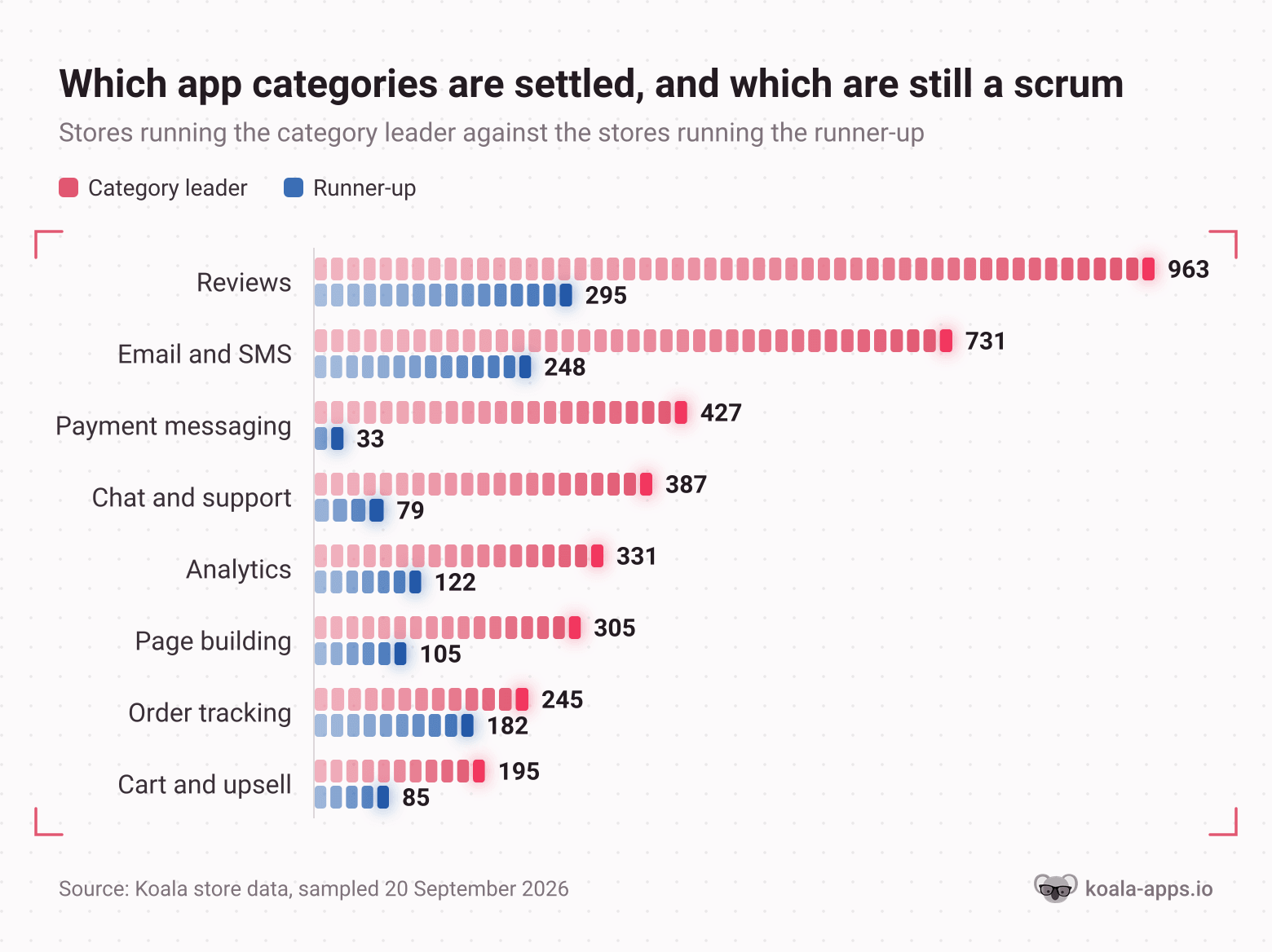
Reviews is the most consolidated category in the data. Judge.me sits on 963 stores while its nearest rival sits on 295, a gap of better than 3 to 1. Payment messaging is even more lopsided: Klarna is on 427 stores and the next banner app in the sample is on 33. Chat looks similar, with Shopify Inbox on 387 against 79 for the next name.
Cart and upsell is the opposite shape. iCart and Kaching are tied on 195, Bundler is on 97, Revy on 93, Amp on 85, and the tail keeps going past that. No app has more than a fifth of the reviews leader's footprint, and a dozen names are still credibly in the race.
That difference changes how you should shop in each category:
- In a consolidated category, follow the leader. When one app has three times the installs of anything else, the integrations, the theme compatibility, the documentation and the answers on forums all cluster around it. Picking the challenger means you are the one filing the support ticket nobody has answered before.
- In a fragmented category, test against your own numbers. Nobody has won cart and upsell, so there is no crowd wisdom to borrow. Install one, measure conversion rate and average order value on your own traffic for a fortnight, and let your store settle it.
- A tight three-way race, like order tracking, means the feature set is commodity. Pick on price and on how the branded tracking page looks, because the underlying carrier data is much the same.
Consolidation also moves. Judge.me's lead is the accumulated result of years of free-tier installs, and the fragmented categories today are the ones where a challenger can still take the crown.
Averages will not tell you what your competitor runs
Everything above describes the market. None of it tells you what the one store beating you in your niche actually chose, and that is usually the question worth answering. A store doing well with a lean five-app stack is a much better model to copy than a list of what 13,732 installs average out to.
You can read any store's stack directly. Koala Inspector is a free-to-start Chrome extension whose Shopify app detector lists every app a store is running, grouped by type, with a link out to each one in the Shopify App Store. It is one of the free features, so it costs nothing to check a store.
Here is the workflow that turns this ranking into a decision:
- Install Koala Inspector from the Chrome Web Store. It runs in your browser with nothing else to set up.
- Open three or four strong competitors in your niche and click the Koala Inspector icon on each. The dashboard loads the store's theme, category, product count, and a preview of its apps for free.
- Open the Apps tab on each one and write the stacks down side by side.
- Look for the overlap. An app that appears on three of four winning stores in your category is a far stronger signal than any roundup, this one included.
- Look for the absences too. If none of your best competitors runs a category you were about to buy into, that is worth a second thought before the subscription starts.
- Track the ones that matter. Shop Tracking records when a store you follow adds or drops an app, changes theme, or moves prices, so you see a competitor's next move rather than reading their last one.
The apps card is free on every store you open, so you can settle a stack decision in an afternoon without spending a token.
What sellers say about Koala Inspector
Verified reviews from the Chrome Web Store.
“The service has been great, very responsive and the most comprehensive spying of global markets Ive seen!”
 Adrienne Greenwood
“Super simple to use and gives tons of detail of other stores. It helped me learn how to improve my store.”
 Jessica Walker
“Awesome customer support. Insights into store AOV, products, traffic and campaign tracking is extremely helpful!”
 Gabe Abramovich
Build the shortest stack that does the job
Read the leaderboard top to bottom and a strategy falls out of it. The apps that win on installs solve a universal job cheaply: proof, repeat sales, support, conversion, testing, insight, and post-purchase. Almost every store needs the first few. Fewer need the last few, and they tend to add those later, once volume makes the pain real.
Every app you add is a recurring bill and a small tax on your store's speed, so fill each job with one lean tool and leave the rest. For the category-level version of this argument, see our deeper look at what apps top Shopify stores actually run and our breakdown of what Shopify apps actually cost.
Install Koala Inspector free and read your closest competitor's app stack in the next ten minutes. The free plan comes with 15 tokens a month and no credit card, and the app detector does not cost any of them.
Popular Shopify apps: FAQ
Straight answers to the questions store owners ask around app stacks and the platform itself.
Are Shopify and Myshopify the same?+
They are two names for the same thing. Shopify is the platform; myshopify.com is the default hostname Shopify hands every store when it is created, as in your-store.myshopify.com. That address stays permanently attached to the store in the admin even after you connect a custom domain, so a myshopify.com URL is a reliable sign that a site is a Shopify store, and every app in this ranking runs on that same platform.
Are Shopify point of sale payments secure?+
Shopify states that it is certified Level 1 PCI DSS compliant and that the certification covers every store on the platform by default, including in-person payments taken through Shopify POS. Level 1 is the highest of the four PCI merchant tiers and involves annual on-site assessment. Card data is handled by Shopify's own payment stack rather than stored in your admin, which is why no app in this ranking needs access to raw card numbers to do its job.
Can I use my own domain name with Shopify?+
Yes. You can buy a domain inside the Shopify admin, or connect a domain you already own at another registrar by pointing its DNS records at Shopify. Once it is connected you set it as the primary domain and Shopify redirects the myshopify.com address to it. Every app listed here works the same way on a custom domain, because apps attach to the store rather than to the hostname.
Can Shopify spy on sales?+
No merchant can open another merchant's Shopify admin and read their real order numbers. Those figures are private to the store owner and to Shopify. What you can do is estimate from public signals that any visitor's browser already sees, which is how competitor research tools work: modeled traffic, catalog changes, price moves, ad activity and the apps a store runs. Koala Inspector reports app installs as an exact, checkable fact and traffic or sales figures as estimates, sampled over time.
Can you make 10k a month on Shopify?+
It is achievable and it is not the common outcome. Ten thousand dollars a month is roughly 200 orders at a fifty dollar average order value, so the question is really whether you can reliably acquire 200 buyers a month at a cost your margin covers. Stores that get there usually have repeat purchase working, which is exactly why email and reviews apps sit at the top of this ranking: they lift average order value and returning-customer rate without buying the click twice.
Does Kim Kardashian use Shopify?+
Yes. SKIMS, the shapewear and loungewear brand Kim Kardashian co-founded, runs on Shopify. Its storefront is built on Shopify's Hydrogen and Oxygen stack, which the site advertises in its own response headers. Large brands on Shopify tend to run leaner app stacks than small stores do, because they replace apps with custom storefront code as they grow.
Written by
Ana Gelevska
eCommerce Content Writer
Ana Gelevska is a content writer with more than five years of experience creating content for eCommerce brands and global clients. She digs into each topic and the people it is for, then turns it into clear, useful articles that Shopify sellers and dropshippers can act on.
Connect on LinkedIn