



A product research workflow that runs on real stores
Most product research advice tells you to chase a "winning product." The problem is that a trending product list tells you what is hot, not whether the demand is real, who is already selling it, or at what price. Koala Inspector flips the order. You start from stores that are already selling, read what they actually publish, and build your judgment from that. Here is the workflow product researchers run with it, step by step.
1. Validate demand before you build
Find two or three stores selling the product you are considering, open each one, and look at the catalog. The product list, prices, and variations are read straight from each store's public pages, so they are accurate. What you are checking: does the product appear across several independent stores, has it been on sale long enough to show staying power, and how wide is the variant range a serious seller offers? A product that one store added last week is a guess. A product that shows up in three catalogs, with deep variant options and a settled price, is a market.
For the demand read itself, open the Site Traffic view on a store carrying the product. It gives an estimated average monthly traffic figure for the last three months, the month-over-month change, where that traffic comes from, and the top keywords sending it. A store with rising traffic and a strong search share is a sign the category is pulling buyers, not just sellers. Traffic and sales numbers are estimates modeled from public signals any visitor's browser can already see, so read them to compare stores and confirm a trend, not as a store's exact revenue.
2. Read a store's full catalogue and pricing structure
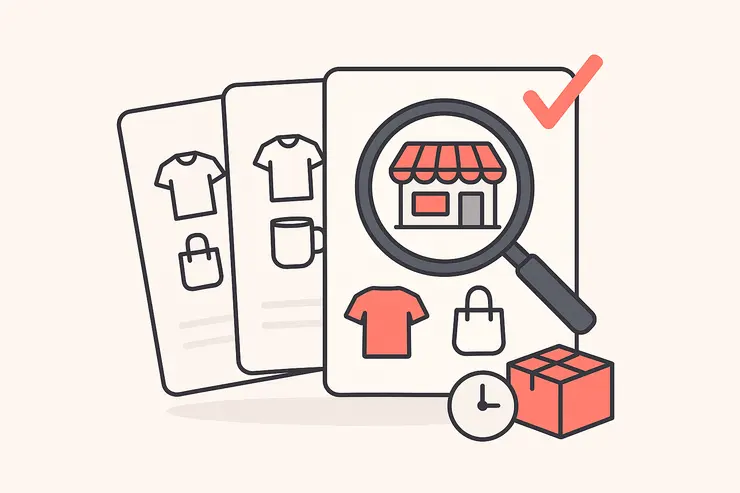
When a store looks worth studying, open its product list and read the whole thing, not just the homepage hero. Koala Inspector loads the full catalog with each product's image, name, price, and variations, plus a stats header showing total product count, the high-to-low price range, and the date the first product was published. You can sort by date added to see what is new, by price to map the pricing ladder, or by name. Favorite the products worth coming back to and they stay saved across sessions.
What this tells a researcher: the price range shows where the store positions itself and how much room there is to undercut or premium-price against it. The date-added order shows the cadence at which they launch, which is a proxy for how actively they test. A catalog that is mostly one price point is a single-product brand; a broad ladder is a curated store testing many bets. Need the data in a spreadsheet for your own scoring? Export the catalog, prices, apps, and theme to CSV; that costs one token, and the free plan includes a limited number of exports each month.
3. Track what is selling and how the mix changes over time
A single snapshot tells you what a store sells today. Product research is really about what is moving and what they are testing next. The product view flags likely best-sellers, and the Product Trends view surfaces products gaining momentum across stores, so you can spot something climbing before the category saturates. Best-seller ranking is a directional signal built from public activity, not an exact unit count, so use it to rank candidates rather than to forecast revenue.
To watch change over time instead of re-checking by hand, add a store to Shop Tracking. It monitors the store and records changes to a per-store activity feed: products added or removed, price changes, variant changes, theme swaps, and apps installed or dropped, across more than ten event types. When a competitor quietly adds three products in the same sub-niche and raises a price, that is them telling you what is working for them. Tracking costs 15 tokens per store and is a paid-plan feature; Premium covers up to 50 stores at once. For fast-moving categories like fashion and electronics, checking weekly catches shifts you would otherwise miss; for steadier niches, monthly is usually enough.
4. Compare several stores before you commit
No single store is the market. Line up several stores selling into the same niche and read them side by side: who carries the widest catalog, who prices highest, whose traffic is growing, and which products appear in more than one of them. Products that show up across several independent stores, holding their price, are the validated bets. Products that only one store carries are still experiments.
The same comparison points to where you can win. If every competitor is missing a variant, a size, or a price tier, that gap is your opening. The Find Retailers feature takes a single product and finds other places it is sold, which helps you see how widely a "winning product" is already resold and whether the space is crowded before you enter it.
What each data point is telling you
- Product list, prices, variations, apps, theme are read from the store's public pages, so treat them as fact: this is exactly what the store publishes.
- Estimated monthly traffic, traffic sources, top keywords are directional. Read them to compare stores and confirm a category is pulling demand, not as exact visitor counts.
- Best-seller ranking and Product Trends are directional signals for ranking candidates, not precise sales figures.
- Shop Tracking change feed is the highest-signal input over time: it shows the moves a competitor is actually making, dated, so you can react instead of guess.
All of it is modeled from what any visitor's browser can already see on a store's public pages, never from a store's private dashboard, and the store owner cannot tell their store is being studied.
Where to go deeper
This page is the product-research workflow. For the bigger picture of how Koala Inspector fits into competitive research, see the main Koala Inspector overview. For dropshipping-specific method, read our guides on Shopify product research and how to find winning products.