Guide to High-Ticket Dropshipping: A Market Analysis & How To Get Started in 2026
 By Ana GelevskaMay 9, 2025 · Updated June 4, 2026
Dropshipping has a well-known entry-level problem: your margins are thin, your product is everywhere, and the only lever left is price. One way out is to move up market. High-ticket dropshipping is that move.
Instead of selling $20 items and hoping volume carries you, you sell products at $500, $1,000, or more. A single sale does what would take dozens of low-ticket transactions to replicate. That math has drawn a lot of sellers in, but the execution is different enough that it deserves its own guide.
What is High-Ticket Dropshipping?
High-ticket dropshipping means selling expensive products, typically priced above $500, through a standard dropship model: no inventory, no warehouse. Your supplier ships directly to the customer, and your margin is the spread between wholesale and retail.
The price threshold varies. Some define it at $200, others at $1,000. The more useful definition is functional: a product where a single sale meaningfully moves your monthly revenue, and where the buyer expects more than a checkout box. That's the operational reality that shapes everything else in this model.
How Does High-Ticket Dropshipping Work?
The mechanical structure is the same as any dropshipping operation: build a store, connect with suppliers who hold inventory, drive traffic to your product pages, and collect the markup when a customer orders. The supplier handles fulfillment.
What changes at higher price points is the context around that transaction. Buyers research longer. They read reviews, compare specifications, email with questions, and sometimes call. You need to be ready for that, which means supplier relationships matter more, product knowledge matters more, and store credibility matters more.
The low-overhead model still holds. You're not fronting inventory costs, so a bad product decision doesn't sink you financially. That's the same advantage as low-ticket dropshipping. The difference is the per-sale economics.
High-Ticket vs Low-Ticket Dropshipping: What's the Difference?
The core tradeoff is volume versus margin.
- High-ticket dropshipping sells fewer items at a larger spread, often $100 or more in profit per sale, compared to roughly $10-$30 on conventional dropshipping products.
- Low-ticket dropshipping sells in volume. Products usually sit below $50, margins are thin, and success depends on consistently moving a lot of units.
A concrete illustration: consider a $30 item where you net $5 after product cost and fees. To clear $3,000 in a month, you need 600 sales. With a high-ticket product at $150 profit per sale, you need 20. The difference in operational load is significant. Fewer orders mean fewer shipping issues to resolve, fewer customer service threads, and a more manageable refund rate.
The catch is that 20 sales at $500+ each don't arrive on autopilot. The sales cycle is longer, trust requirements are higher, and your store has to look the part.
Pros & Cons of High-Ticket Dropshipping
Benefits
Higher profit per sale. The math is the main draw. High-ticket profit per sale often runs $100 or more, versus $10-$30 on standard dropshipping products. A 20-sale month at $150 margin each produces the same $3,000 as 600 sales of a $30 item. That difference compounds quickly in terms of operational costs and your own time.
Lower order volume to manage. Customer service, returns, shipping problems, and support tickets all scale with order count. Selling 20 premium items a month rather than 600 low-ticket orders cuts that workload substantially. You can spend the time you'd have spent on support volume actually improving your store and sourcing better products.
Less crowded supplier relationships. High-ticket niches attract fewer sellers than mass-market categories. Suppliers have more incentive to maintain consistent stock and quality for a handful of serious partners than for the revolving door of low-ticket sellers. You can also negotiate better terms when your order values are higher.
Challenges
Longer sales cycles. A customer considering a $1,500 product does not typically buy on first contact. Research periods can stretch to weeks. Your marketing needs to support that: retargeting, email sequences, detailed product pages, and enough social proof that someone feels comfortable making a significant purchase from a store they just found.
Higher customer expectations. Buyers who spend $500 or more have specific standards around communication, packaging, and delivery timelines. A response time that's acceptable for a $20 order is not acceptable for a $2,000 one. The cost of a bad experience is also higher: a dissatisfied customer at this price point leaves reviews, disputes charges, and shares their experience. One problem order can cancel the margin from two or three successful ones.
Capital exposure per transaction. Even without holding inventory, high-ticket dropshipping creates per-order exposure. If a $1,200 item ships damaged or arrives defective, you are handling a $1,200 problem. Return shipping, replacement costs, and payment disputes hit harder than they would on a $25 item. Vetting your supplier's quality control and damage policies before you start selling matters.
How to Find High-Ticket Dropshipping Products
Two approaches, both valid, and most experienced sellers use a combination.
The first is category-first research. You identify a niche with consistent demand and credible supplier options, then find the specific products in that niche that have strong search interest and realistic margins. Tools like Google Trends and our Koala Inspector Shopify spy tool help here. You're looking for evergreen demand patterns, not spikes.
The second is keyword-first. You look at what people are actively searching for in a product area, find surges or steady volume in a specific item, and match that to an available supplier. This is faster to start but requires more ongoing attention because trends shift.
Both approaches require checking periodic demand, overall search volume, and supplier pricing. See our detailed breakdown of dropshipping product and niche research methods for the full process.
Best Niches for High-Ticket Dropshipping
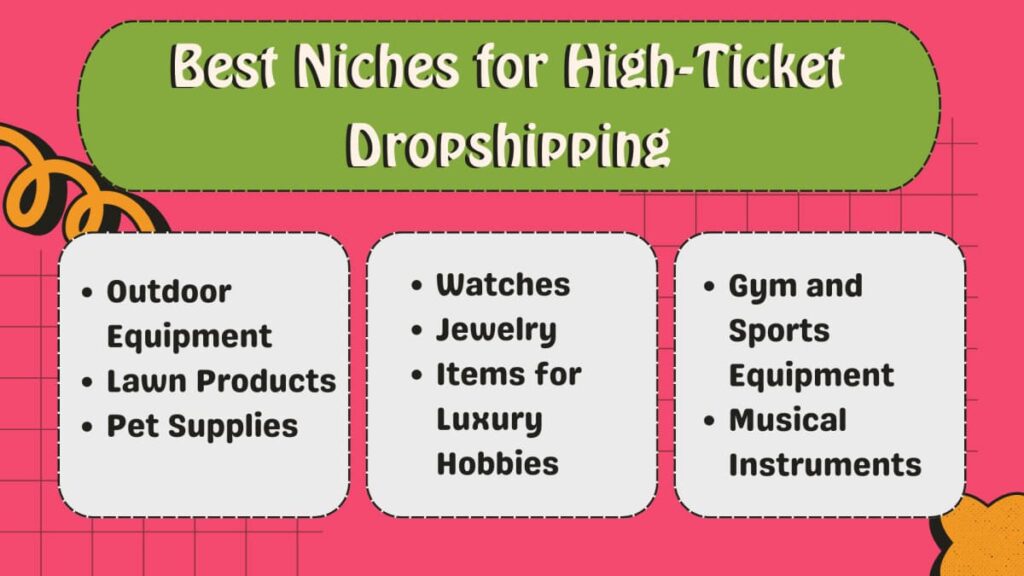
The most reliable high-ticket niches are ones where demand cycles continuously rather than spiking once and fading.
Home and Garden
Furniture is one of the most dependable high-ticket categories, and average order values are strong: sectional sofas run $800 to $2,500, dining sets $600 to $1,800, and specialty beds $700 to $3,000. Outdoor furniture, pergolas, and premium grills follow similar pricing. You're not chasing a trend. People buy furniture constantly, and bulky items are difficult to impulse-return.
Outdoor Equipment
Outdoor gear cycles through seasonal demand without going dormant. Winter hiking boots make way for trail runners, which lead into summer camping gear, which leads back to cold-weather equipment. A well-structured outdoor store doesn't have an off-season because the category itself rotates. The same principle applies to tents, backpacks, and hiking gear.
Gym and Sports Equipment
Connected fitness systems sell for $700 to $2,500. Complete home gym setups run $500 to $3,000. This category has held up well past the pandemic-era peak: there's a durable segment of buyers who prefer training at home. The periodic spikes around New Year and summer are marketing opportunities on top of baseline demand, not the only demand.
Watches and Jewelry
Luxury accessories behave differently from most product categories. Demand does not correlate strongly with economic conditions at the mid-tier level, which keeps this a stable category. The complication in jewelry is that buyer preference is highly specific, so you're better off organizing your store by category type (earrings vs. bracelets, or gold vs. gemstone) and letting buyers self-select rather than trying to predict individual taste. Frequent Google Trends checks help, but the structure of the store matters more than any single product pick.
Pet Supplies
Two out of three US households have pets. That base doesn't shrink. The category has moved well past basics: premium pet furniture, orthopedic beds, and high-end training equipment all land in high-ticket territory. The repeat purchase rate is also higher than in most categories because pet owners buy ongoing.
Musical Instruments
Instruments are evergreen. A decent guitar doesn't go out of season. The main operational issue is shipping: large or delicate instruments are fragile and expensive to replace if damaged. Either build dedicated logistics protocols into your supplier agreements, or focus on the accessory and add-on segment where shipping is simpler.
Items for Luxury Hobbies
Niches like high-end photography, home theater equipment, and premium cooking gear have smaller total audiences but strong purchase intent and minimal price sensitivity. Volume will never match mass-market categories, but margins can be proportionally higher, and these buyers are usually very clear about what they want.
Finding High-Quality Suppliers for High-Ticket Dropshipping
Your supplier is where most high-ticket operations succeed or fail. A bad supplier for a low-ticket product costs you a $15 refund. A bad supplier for a $1,500 product costs you that plus the damage to your reputation and a potential dispute with your payment processor.
The main directories and platforms: Amazon, Alibaba, and AliExpress remain the most accessible global sources. For more curated, regional options, BigBuy, Brandsgateway, Spocket, and AppScenic have built reputations in the premium product space.
What to Look for in High-Ticket Dropshipping Suppliers
Consistency is the first filter. Your supplier needs to carry your products reliably, at the same quality level, without frequent stockouts. A supplier who's great most of the time but unreliable during peak periods is a liability at higher price points where customers have higher expectations and less patience.
Exclusivity matters more in high-ticket than in low-ticket. If your supplier is selling the same product to five of your direct competitors, your only differentiator is price. That's a race you don't want to be in.
Packaging and presentation count. Buyers spending $500 or more notice the unboxing experience. Work with suppliers who treat packaging as part of the product, not an afterthought.
Communication quality: you will have questions, and so will your customers. A supplier you can reach, who provides clear updates on stock and shipping, is worth paying a small premium for. Get communication norms established before the first order, not after a problem.
6 Steps to Getting Started with High-Ticket Dropshipping
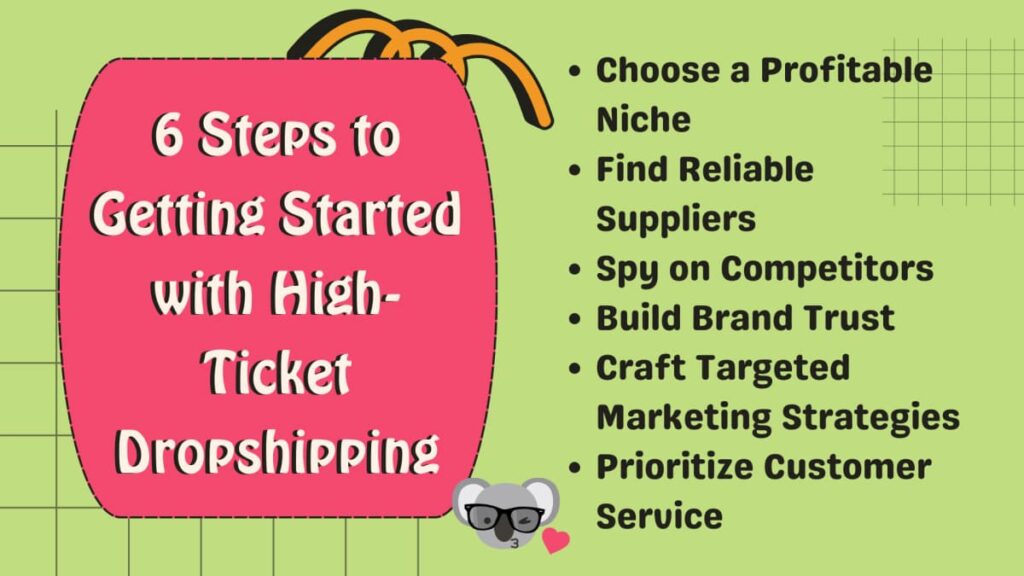
1. Choose a Profitable Niche
Start with categories that have consistent, year-round demand or predictable seasonal cycles. Evergreen niches like home furniture, outdoor equipment, and gym gear give you a stable foundation. Sub-niches within those categories, found through Google Trends research and Koala Inspector's product research features, let you carve out a specific position without competing against the entire category at once.
Avoid chasing spikes. A trending item that sells for six weeks then disappears is not a high-ticket business; it's a high-ticket gamble.
2. Find Reliable Suppliers
This step deserves more time than most first-timers give it. Request samples before committing. Check how a supplier handles damage claims, stockouts, and returns. Talk to other sellers if you can. A great supplier who is reliable and responsive is one of the real competitive advantages in this model because most sellers don't put in the work to find one.
3. Research Your Competitors
Look at what established stores in your niche are doing well. Koala Inspector lets you review competitor products, pricing, traffic estimates, and top sellers without guesswork. This is especially useful early on: you're not copying, you're identifying what the market has already validated. Check pricing ranges, see which products are moving, and find gaps where you can position better.
4. Build Brand Trust
A buyer spending $800 on something from a store they've never heard of needs reassurance. This comes from multiple places: professional site design, clear contact information, genuine customer reviews, and specific return and warranty policies stated plainly. Money-back guarantees and visible trust signals (secure payment badges, business registration information) reduce friction at the point of purchase.
Social proof in context matters. A testimonial from someone who bought the specific product a customer is looking at carries more weight than a generic five-star average.
5. Create Targeted Marketing
High-ticket buyers research before they buy. Your marketing strategy should reflect that. SEO-driven content that answers specific questions about your products builds organic traffic from buyers who are already in research mode. Retargeting campaigns capture buyers who visited but didn't convert. Email sequences that provide product information and comparison guidance support longer decision timelines. The goal is to stay in view during the weeks a buyer spends deciding, not to push for an immediate sale on first contact.
6. Invest in Customer Service
At this price point, your customer service is part of the product. A buyer who gets a fast, helpful response when they have a pre-sale question is significantly more likely to purchase. A buyer who has a problem post-sale and gets it resolved quickly is much more likely to leave a good review and refer others.
That means fast response times, clear communication about shipping timelines, and proactive updates when there are delays. Whether you handle this yourself or outsource it, build detailed guidelines so the quality is consistent.
High-Ticket and Low-Ticket Items: Can You Sell Both?
The short answer is yes, but think carefully about whether they belong in the same storefront.
Low-ticket products build traffic. They attract buyers who might not be ready to spend $1,000 today, but who are in your niche and may upgrade later. High-ticket products build margin and brand credibility. A store that carries both can use the low-ticket volume to fund paid advertising for high-ticket items, while the premium product selection reinforces quality positioning across the entire catalog.
The risk is tone mismatch. A storefront trying to sell a $15 impulse item and a $1,500 premium item to the same buyer can feel incoherent. Segment thoughtfully. Some sellers run separate stores for each price tier; others solve it with clear category organization and distinct landing pages for different audiences. The right structure depends on how different the buyer profiles actually are for your specific products.
The underlying logic still holds: the margin you earn on a single premium sale can fund the acquisition cost for dozens of low-ticket customers. Used together deliberately, each segment makes the other more viable.
Written by
Ana Gelevska
eCommerce Content Writer
Ana Gelevska is a content writer with more than five years of experience creating content for eCommerce brands and global clients. She digs into each topic and the people it is for, then turns it into clear, useful articles that Shopify sellers and dropshippers can act on.
Connect on LinkedIn