Top Shopify Home Decor Stores, Ranked by Traffic and Updated Weekly
 By Koala TeamApril 2, 2024 · Updated October 12, 2026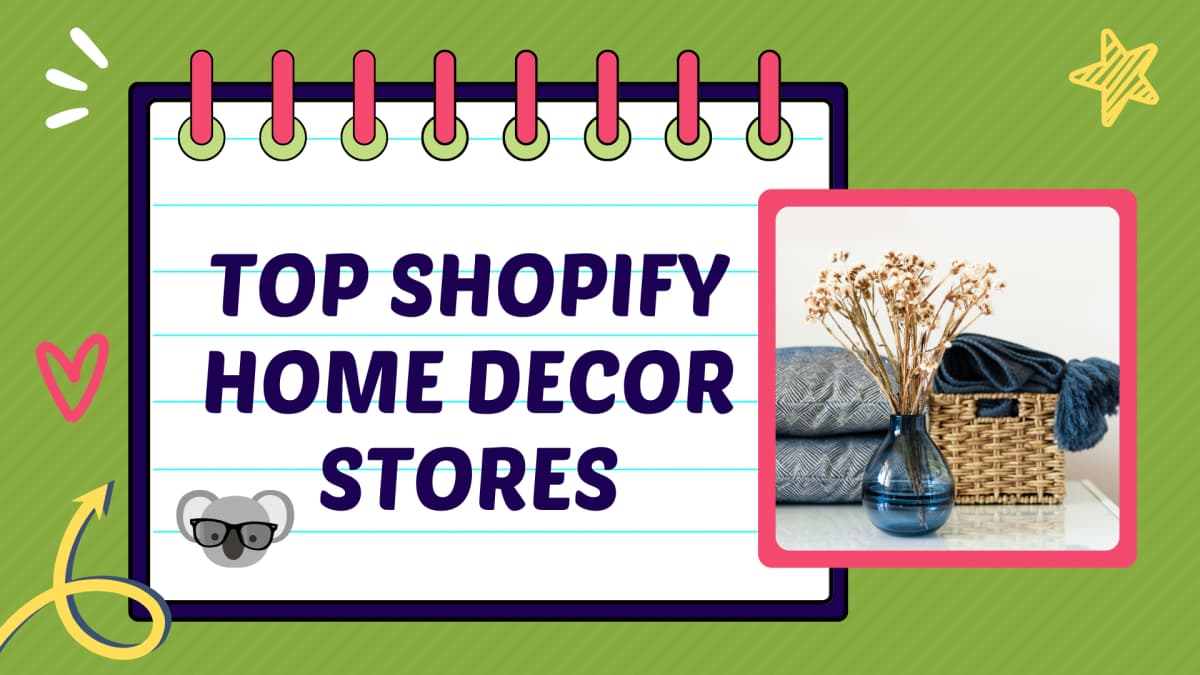
Home decor is a wide, loosely drawn niche on Shopify. Wall art, rugs, textiles, lighting, tableware and personalized gifts all count, and people keep redecorating, so the category stays busy year after year.
The ranking below sorts the stores whose main business is decor by estimated monthly visits, from Koala's own store data, and it is rebuilt every Monday. It shows which kinds of decor store draw a real audience and gives you a shortlist of brands to study.
See Shopify Store Data With Koala Inspector
Simply install the free Koala Inspector Chrome Extension, open any Shopify store, and click the Koala Inspector extension to open a world of information in just 1 click.
Feel free to try it out on the top shopify home decor stores below!

Updated October 12, 2026. Part of the free Shopify Niche Index.
The busiest Shopify home decor stores right now
As of October 12, 2026, the biggest Shopify home decor store in Koala Inspector's Shopify Niche Index is DeoDap (deodap.in), with about 4M visits a month. Lulu and Georgia (3.3M) and Rugs USA (3M) come next. Below are the 25 busiest stores that mainly sell home decor products, out of the 3.9K Shopify home decor stores we track, ranked by estimated monthly visits.
| # | Store | Visits / month | Based in | Products |
|---|---|---|---|---|
| 1 | DeoDapdeodap.in | 4M | India | 13K |
| 2 | Lulu and Georgiawww.luluandgeorgia.com | 3.3M | United States | 10K |
| 3 | Rugs USAwww.rugsusa.com | 3M | United States | 11K |
| 4 | Flying Tiger Copenhagenflyingtiger.com | 2.9M | Denmark | 10K |
| 5 | The Paw Printthepawprint.store | 2.1M | United States | 383 |
| 6 | Wander Printswanderprints.com | 1.5M | United States | 24K |
| 7 | Magnoliamagnolia.com | 1.3M | United States | 2.8K |
| 8 | Macornermacorner.co | 1.1M | United States | 25K+ |
| 9 | Pawfect Housepawfecthouse.com | 1M | United States | 25K+ |
| 10 | Rifle Paper Co.riflepaperco.com | 960K | United States | 3.2K |
| 11 | Society6society6.com | 928K | United States | 25K+ |
| 12 | Bouclairwww.bouclair.com | 843K | Canada | 1.7K |
| 13 | Posterizedwww.posterized.in | 842K | India | 1.9K |
| 14 | MoMA Design Storestore.moma.org | 737K | United States | 4K |
| 15 | English Elmenglishelm.com | 730K | United States | 25K+ |
| 16 | McGee & Co.www.mcgeeandco.com | 702K | United States | 3K |
| 17 | Vibecraftsvibecrafts.com | 642KJanuary 2026 | India | 9.5K |
| 18 | COAT Paintscoatpaints.com | 532K | United Kingdom | 1.2K |
| 19 | Tailored Canvasestailoredcanvases.com | 486K | United States | 5.6K |
| 20 | Paper Sourcewww.papersource.com | 485K | United States | 18K |
| 21 | Andy okayandyokay.com | 484K | Sweden | 1.5K |
| 22 | Mavigadgetmavigadget.com | 451K | United States | 14K |
| 23 | Chumbakwww.chumbak.com | 448K | India | 2K |
| 24 | British Homes Directwww.britishhomesdirect.co.uk | 442K | United Arab Emirates | 106 |
| 25 | DoyoBestdoyobest.com | 431K | Hong Kong SAR China | 10K |
Visits are Koala's modeled estimates for September 2026 unless a row shows another month.
Open any store on this list with Koala Inspector and see every app it runs, its theme and its best sellers, free. Site Traffic (3 tokens) shows where its visitors come from.
Big stores that also sell home decor products
These stores sell home decor products too, but most of their business is in another niche, so they sit outside the ranking. They still compete for the same shoppers and are worth a look.
| Store | Visits / month | Based in |
|---|---|---|
| DUSKdusk.com | 5M | United Kingdom |
| Natural Lifewww.naturallife.com | 4.1M | United States |
| xToolwww.xtool.com | 3.1M | United States |
| GreaterGoodgreatergood.com | 2.5M | United States |
| Arhauswww.arhaus.com | 2.3M | United States |
| Astrotalk Storeastrotalk.store | 2.1M | India |
| Driftdrift.co | 1.9M | United States |
| Nestasianestasia.in | 1.7M | India |
| REBELfromrebel.com | 1.6M | United States |
| TOASTwww.toa.st | 1.5M | United Kingdom |
| Zulilywww.zulily.com | 1.5M | United States |
| ALMAGEMSalmagems.com | 1.4M | United States |
| Disturbiawww.disturbia.us | 1.4M | United States |
| Early Settler Australiaearlysettler.com.au | 1.3M | Australia |
| Steady Handswww.steady-hands.com | 1.2M | United States |
| buddhastoneshopbuddhastoneshop.com | 1.1M | Hong Kong SAR China |
| TWOPAGES CURTAINStwopagescurtains.com | 1.1M | United States |
| Home Essentialshomeessentials.in | 1M | India |
| Laura Jameswww.laura-james.co.uk | 1M | United Kingdom |
| MesonArtwww.mesonart.com | 999K | Hong Kong SAR China |
Cite this list: Koala Inspector's Shopify Niche Index, "Top 25 Shopify home decor stores by monthly visits", data as of October 12, 2026, https://koala-apps.io/blog/top-shopify-stores/home-decor/. Free to quote and reuse with credit to Koala Inspector, under CC BY 4.0.

Want to see the apps, theme and best sellers on any Shopify store?
Download for free and start exploring a whole new ecommerce world!
How to read the home decor ranking
Look at what the leaders sell before you look at their size. Wall art, prints and personalized pieces make up a large share of the busiest decor stores, and rugs are a strong category of their own. Those products multiply into sizes, frames, colors and designs, which is why catalogs in this niche run large and many of the stores here list thousands of products. When you size up a print or rug store, count its product types rather than its SKUs.
Read the table of bigger stores that also sell home decor, under the ranking, too. Furniture retailers and lifestyle brands sell plenty of decor without it being their main business, and they compete for the same shoppers on cushions, lamps and vases. If you plan to sell decor accessories, those stores are part of your competition.
To study any store on either list, open it with Koala Inspector. The theme, installed apps, full catalog and likely best sellers are free, so you can see which designs and price points a decor store pushes before you pick your own range.
Is Home Decor a Good Online Business?
Home decor holds up well as an online niche because the purchase decision is largely visual: customers browse and compare before they buy, which favors ecommerce. The category has grown steadily over the past several years in both the US and Europe, and demand has held up well as more of those purchases move online.
What drives repeat business is the way people think about their homes. A bedroom refresh leads to new bedding, which leads to artwork, which leads to lighting. A store that keeps its catalog fresh gives those shoppers a reason to come back for the next room.
The decor brands worth studying have a clear product identity. McGee & Co. sells a warm, designer-led look built around its founder's interior design work. MagicLinen sells European linen. The Citizenry sells globally sourced artisan goods. Each knows exactly who it is selling to, and the catalog, photography and prices all follow from that. That focus is worth studying even in weeks when a brand sits outside the ranking.
Can I Sell Home Decor on Shopify?
Shopify handles the operational side of home decor retail well. Inventory management, payment processing, shipping rate calculations, and checkout all work out of the box. The theme library has solid options for image-heavy stores, which matters when you are selling products that people need to visualize in a room.
The platform also integrates cleanly with suppliers if you are dropshipping, and with fulfillment services if you are holding inventory. Furniture retailers with high order values run on Shopify too, which tells you the platform scales across price points.
Checkout matters here as well: merchants who cut checkout friction have seen conversion rate lifts of up to 30% in furniture and home decor.
What Makes a Good Shopify Home Decor Store?
These are the habits to copy from well-run decor stores:
- A narrow, defensible identity. Strong decor brands have a clear customer in mind. Trying to carry everything from $20 throws to $2,000 sofas under a generic brand rarely builds loyalty.
- Photography that does the work. Home decor is bought based on how it looks in a space. Lifestyle images outperform plain product shots. McGee & Co. and The Citizenry are strong examples.
- Reviews with detail. A vague "Love it!" helps less than a review that says "Fits perfectly in my 9x12 bedroom, the linen is thicker than I expected." Specific reviews reduce return anxiety.
- Logical navigation. Shoppers browse by room, by style, and by product type. Having all three navigation paths available keeps them on the site longer.
- Pricing consistency. Pick a lane (budget, mid-market or premium) and keep your catalog prices coherent. Mixing a $25 candle with a $1,500 sofa without a clear brand story confuses buyers.
- Checkout speed. Slow or complicated checkouts are a documented problem in home decor, where cart values are often high and buyers are already cautious.
Is Home Decor a Good Dropshipping Niche?
Yes, home decor is a workable dropshipping niche. Products are non-perishable, ship without special handling in most cases, and have enough variety to support niche positioning. A store that sells only Scandinavian-style wooden accessories, for example, can build a distinct brand without carrying inventory.
The main constraints to plan around:
- Fragile items (ceramics, mirrors, glassware) need good packaging specs from your supplier, because returns and damage complaints hurt reviews fast.
- Shipping times matter more than in some niches because home decor is often bought for a specific date (a move, a renovation, a gift).
- Photos are everything. If your supplier images look like stock shots on a white background, you will lose to stores that have lifestyle photography.
Impulse-buy items under $50 and considered purchases in the $150-$500 range both work well in dropshipping home decor. The stores that combine both in a coherent catalog tend to do better than those anchored to one price point.
How Profitable Is the Home Decor Business?
Margins vary by sub-category. Textiles and soft furnishings (throws, cushions, bedding) tend to carry better margins than furniture because shipping costs are lower relative to product value. Decorative accessories and wall art sit somewhere in between.
Order values in decor run from small impulse buys to rugs and statement pieces that cost hundreds. Higher-ticket stores can afford more expensive customer acquisition because each conversion is worth more. Lower-ticket stores need volume and repeat purchases to build a viable business.
The steady growth of the home decor market suggests the category has room for new entrants, particularly those who build a recognizable brand rather than competing on price alone.
Questions people ask
What are the biggest Shopify home decor stores?
As of October 12, 2026, DeoDap (deodap.in) is the biggest in Koala Inspector's Shopify Niche Index by estimated traffic, with about 4M visits in September 2026. Lulu and Georgia and Rugs USA are next.
How much traffic does a top Shopify home decor store get?
As of October 12, 2026, the median store in this list gets about 842K visits a month, and it takes about 431K a month to make the list at all.
How many Shopify home decor stores are there?
As of October 12, 2026, Koala tracks 39K live Shopify stores in this niche. 3.9K of them get enough traffic to estimate, and this list ranks the busiest 25 that mainly sell home decor products.
Written by
Koala Team
Koala Apps Editorial Team
The Koala Team is the crew behind Koala Inspector. We test tools, track what is selling across Shopify, and turn it into practical roundups and reference guides for store owners and dropshippers.
Top Shopify Stores By Category
- Top Shopify Auto Parts Stores, Ranked by Traffic
- Top Shopify Baby Stores, Ranked by Traffic
- Top Shopify Beverage Stores, Ranked by Traffic
- Top Shopify Fitness Stores, Ranked by Traffic
- Top Shopify Food Stores, Ranked by Traffic
- Top Shopify Handbag Stores, Ranked by Traffic
- Top Shopify Health & Supplement Stores, Ranked by Traffic
- Top Shopify Jewelry Stores, Ranked by Traffic
- Top Shopify Kitchen Stores, Ranked by Traffic
- Top Shopify Outdoor Stores, Ranked by Traffic
- Top Shopify Shoe Stores, Ranked by Traffic
- Top Shopify Toy Stores, Ranked by Traffic
- Top Shopify Beauty Stores, Ranked by Traffic and Updated Weekly
- Top Shopify Vegan Stores
- Top Shopify Clothing Stores, Ranked by Traffic and Updated Weekly
- Top Shopify Pet Stores, Ranked by Traffic and Updated Weekly
- Top Shopify Tech Stores, Ranked by Traffic and Updated Weekly
- Top Shopify One Product Stores
- Top Shopify Candle Stores
- Top Shopify Dropshipping Stores
- Top Shopify Fashion Stores, Ranked by Traffic and Updated Weekly
- Top Shopify Antique Stores
- Top Shopify Craft Stores, Ranked by Traffic and Updated Weekly
- Top Shopify T-Shirt Stores
- Top Shopify Art Stores
- Top Shopify Gaming Stores
- Top Shopify Furniture Stores, Ranked by Traffic and Updated Weekly
- Top Shopify Electronics Stores, Ranked by Traffic and Updated Weekly
- Top 25 Shopify Stores, Ranked by Traffic and Updated Weekly