Top Shopify Beauty Stores: 15 Leaders Ranked on Koala's Own Data
 By Assaf ShalinSeptember 21, 2026
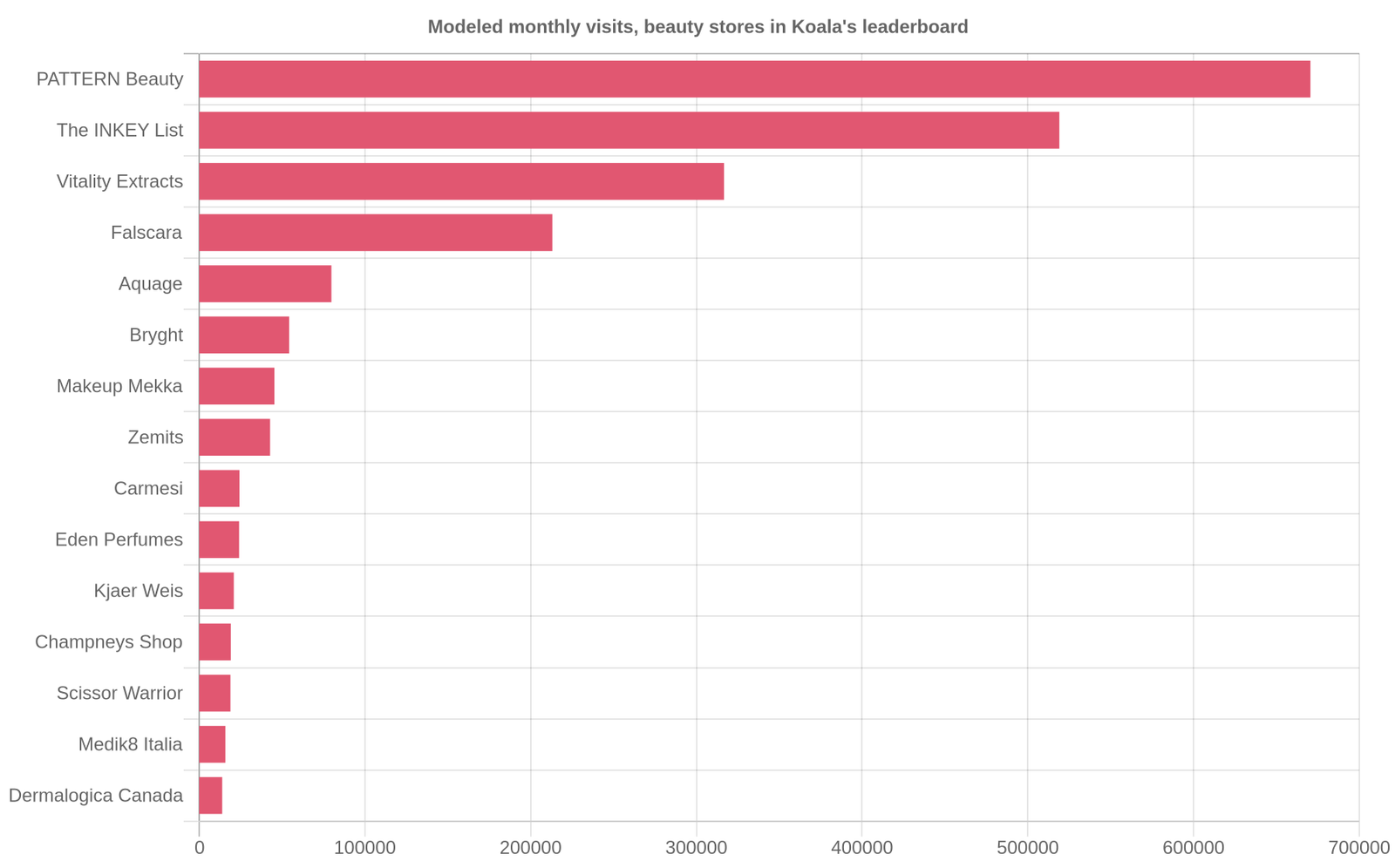
The leading beauty and skincare stores on Shopify right now are PATTERN Beauty, The INKEY List, Vitality Extracts, Falscara and Aquage. What separates them from the rest of the category is the machinery behind the storefront: the top three run 21, 27 and 19 apps, and one of them commits roughly $75,700 a month to that stack. Below is a ranked leaderboard of 15 beauty stores built from Koala's own store intelligence, with modeled monthly traffic, how many apps each one runs, what those apps cost, and one thing from each store you can copy this week.
Every figure here comes from Koala's data and covers the stores Koala tracks, which is a large sample of active Shopify stores rather than all of Shopify. Read it as a leaderboard inside Koala's coverage, not a definitive global ranking of every Shopify beauty store. For the wider picture across all niches, the top 100 Shopify stores list sits alongside this one, and the full Top Shopify Stores hub breaks the rest of the categories out.
Top 15 Shopify beauty and skincare stores
| Rank | Store | Sub-category | Apps | Modeled monthly visits | Modeled monthly app spend |
|---|---|---|---|---|---|
| 1 | PATTERN Beauty | Hair care | 21 | ~670,500 | ~$43,300 |
| 2 | The INKEY List | Face and body care | 27 | ~519,000 | ~$46,700 |
| 3 | Vitality Extracts | Spa and aromatherapy | 19 | ~316,700 | ~$75,700 |
| 4 | Falscara | Make-up | 12 | ~213,100 | ~$5,000 |
| 5 | Aquage | Hair care | 18 | ~79,800 | ~$500 |
| 6 | Bryght | Face and body care | 18 | ~54,300 | ~$5,900 |
| 7 | Makeup Mekka | Make-up | 7 | ~45,400 | not recorded |
| 8 | Zemits | Spa equipment | 2 | ~42,800 | not recorded |
| 9 | Carmesi | Hygiene and toiletries | 18 | ~24,300 | ~$15,700 |
| 10 | Eden Perfumes | Fragrance | 13 | ~24,100 | ~$6,900 |
| 11 | Kjaer Weis | Make-up | 22 | ~20,900 | ~$45,400 |
| 12 | Champneys Shop | Spa and body care | 3 | ~19,100 | ~$1,000 |
| 13 | Scissor Warrior | Hair care tools | 7 | ~18,900 | not recorded |
| 14 | Medik8 Italia | Face and body care | 17 | ~15,800 | ~$11,500 |
| 15 | Dermalogica Canada | Face and body care | 22 | ~13,900 | ~$36,700 |
Traffic and app spend are modeled from public signals any visitor's browser can already load, sampled over time. Treat them as comparable estimates for ranking stores against each other, not as accounting. App counts are read from each storefront directly, so those are exact.

Want to see store data on any Shopify store?
Download for free and start exploring a whole new ecommerce world!

The 15 stores, and what to take from each
1. PATTERN Beauty (~670,500 visits, 21 apps). Tracee Ellis Ross's line for curly, coily and tight-textured hair. The whole site is organised by hair pattern rather than by product type, so a shopper self-selects into a routine instead of browsing a shampoo aisle. Copy this: replace your top-level "Shop all" navigation with the one attribute your customer already knows about themselves.
2. The INKEY List (~519,000 visits, 27 apps). Single-ingredient skincare sold on explanation. Every product is named for what is in it, and the education sits on the product page instead of in a separate blog nobody reads. It runs the heaviest app stack in this list at 27. Copy this: put the "why this ingredient, for which concern" answer on the buying page itself.
3. Vitality Extracts (~316,700 visits, 19 apps). Essential oils and diffusers, and the biggest app spender in the whole beauty leaderboard at roughly $75,700 a month modeled. That is real money committed to bundling, subscription and retention tooling on a low-unit-price catalog, which tells you where the margin is. Copy this: in a repeat-purchase category, spend on the apps that bring a buyer back rather than the ones that decorate the first visit.
4. Falscara (~213,100 visits, 12 apps). DIY lash extension kits. One product concept, explained obsessively, with application video doing the heavy lifting. Note the app spend: about $5,000 a month, roughly a fifteenth of Vitality Extracts on two thirds of the traffic. Copy this: a tight product concept lets you run a light stack and put the budget into content instead.
5. Aquage (~79,800 visits, 18 apps). Marine botanical hair care with a sustainability position built into the packaging story. It runs 18 apps on roughly $500 of modeled monthly app spend, the leanest spend-per-app in the list. Copy this: a large stack does not have to be an expensive one. Most of those 18 slots are free or near-free tiers.
6. Bryght (~54,300 visits, 18 apps). "Skincare for every (body) part," which is a positioning line that immediately widens the basket from face to body. Copy this: a one-line promise that implies a second product is worth more than a discount code.
7. Makeup Mekka (~45,400 visits, 7 apps). Norwegian vegan cosmetics sold on price. It reaches this traffic level on 7 apps, which is the lightest stack of any store in the top ten here. Copy this: in a value category, speed and clarity beat a checkout full of widgets.
8. Zemits (~42,800 visits, 2 apps). Professional esthetics equipment sold to clinics, with free training bundled in. Two apps. Two. Copy this: when the purchase is considered and B2B, the conversion work is the training offer, not the app stack.
9. Carmesi (~24,300 visits, 18 apps). Indian period care and women's grooming, sold as a category-wide routine rather than a single product. Copy this: subscription plus a clear hygiene promise turns a commodity into a recurring order.
10. Eden Perfumes (~24,100 visits, 13 apps). South African affordable fragrance, positioned directly against designer scents. Copy this: an explicit comparison frame ("your favourite scent, for less") does the pre-selling before a shopper has read a note list.
11. Kjaer Weis (~20,900 visits, 22 apps). Refillable certified-organic luxury make-up. It spends roughly $45,400 a month on apps at about 20,900 modeled visits, which is the highest spend-per-visitor in this list by a wide margin, and it fits a high-AOV refill model where every retained customer is worth a lot. Copy this: let average order value decide your app budget, not traffic.
12. Champneys Shop (~19,100 visits, 3 apps). The retail arm of a British spa brand, selling the at-home version of a treatment people already know. Three apps. Copy this: an offline brand can convert on recognition alone, so put the budget into the product range instead.
13. Scissor Warrior (~18,900 visits, 7 apps). Japanese hair shears for stylists and barbers. Deeply unglamorous, highly specific, and it out-traffics several consumer beauty brands. Copy this: selling to the professional in a category is a quieter and less contested route than selling to their client.
14. Medik8 Italia (~15,800 visits, 17 apps). A market-specific storefront for a clinical skincare brand, fully localised rather than a translated homepage. Copy this: if a second market is more than 10% of your traffic, give it a real store rather than a language toggle.
15. Dermalogica Canada (~13,900 visits, 22 apps). Professional skin care founded in 1986 and sold through licensed therapists as well as direct. It runs 22 apps on roughly $36,700 modeled monthly app spend at the smallest traffic figure in this list, which is what a mature brand's stack looks like once loyalty, pro accounts and appointment booking all live on the storefront. Copy this: a store's app count grows with its business model, not with its visitor count.
What the top beauty stores have in common
Line the fifteen up and two patterns fall out of the numbers immediately.
The leaders run heavy stacks. The three biggest stores by modeled traffic run 21, 27 and 19 apps. The smaller stores in this list run between 2 and 12. Read the direction of causation carefully before you copy it. Apps arrive as a business gets more complicated, with a subscription programme, a loyalty tier, a second market and a wholesale channel each bringing one along. The count follows the complexity, so the useful question next month is which job you are adding, not which number you are chasing.
App spend is not a function of traffic. Across this list modeled monthly app spend runs from about $500 at Aquage to about $75,700 at Vitality Extracts, a 150-fold spread. The gap survives even between stores at near-identical traffic: Kjaer Weis sits at roughly 20,900 modeled visits on about $45,400 of app spend, while Champneys, at roughly 19,100 visits, spends about $1,000. Forty-five times the budget at the same visitor count. What separates them is average order value and business model, not scale.
The practical read for a new beauty store: your app budget should follow your margin per order, and your app count should follow how many distinct jobs your store actually does. A single-product lash brand and a refillable luxury make-up line both belong in this leaderboard, and neither one's stack would work on the other. If you want the wider benchmark for what apps cost across categories, we broke it down in how much Shopify apps cost.
How to check any beauty store yourself
The leaderboard above is a starting point. The version that actually moves your store forward is the one you build from the five or six competitors you are genuinely up against, and you can assemble it in an afternoon.
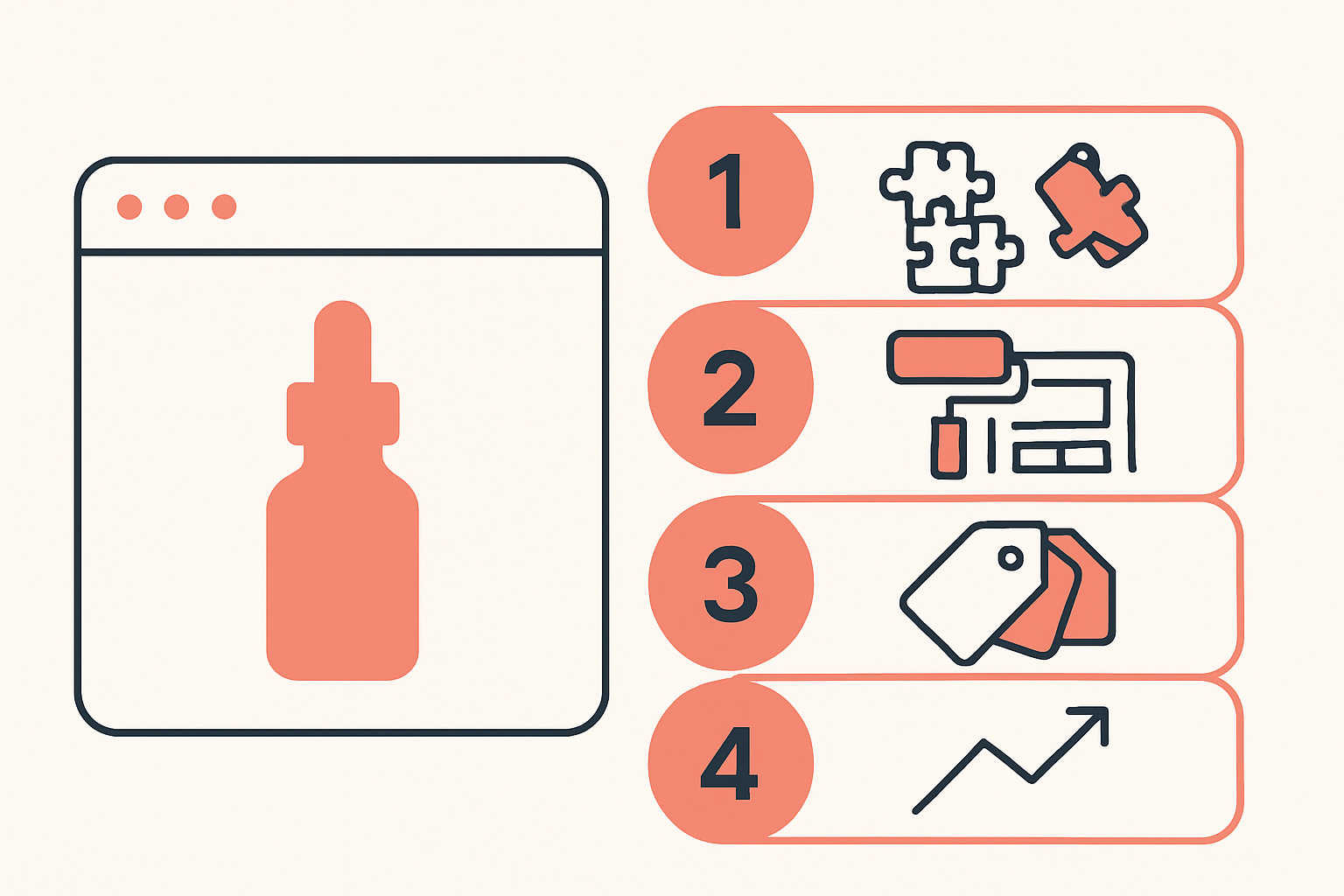
Install Koala Inspector, open any Shopify beauty store in Chrome, and click the icon. Four reads, in this order:
- The app list. Every app the store runs, grouped by type, free to read. This is where the reviews app, the email platform, the subscription tool and the bundler show up. Write down anything that appears on three or more of your competitors.
- The theme. The active theme, with a link to it, so you can see what the layout you keep admiring actually is before you commission a custom build.
- The catalog. Product range, prices and a best-sellers filter, so you can see the price band the category is really selling at rather than the one the homepage advertises.
- Site Traffic. Average monthly traffic over the last three months with a trend chart, the month-over-month change, engagement figures (bounce rate, average visit duration, pages per visit), where the traffic comes from, the top keywords bringing it in, and audience demographics and geography. This one costs 3 tokens.
Then build the shortlist: five stores, a row each for apps, theme, price band and traffic direction. The store that is growing while running fewer apps than you is the one to study hardest. Our guide to Shopify competitor analysis turns that table into a working routine.
What sellers say about Koala Inspector
Verified reviews from the Chrome Web Store.
“The service has been great, very responsive and the most comprehensive spying of global markets Ive seen!”
 Adrienne Greenwood
“Super simple to use and gives tons of detail of other stores. It helped me learn how to improve my store.”
 Jessica Walker
“Awesome customer support. Insights into store AOV, products, traffic and campaign tracking is extremely helpful!”
 Gabe Abramovich
Know what the winners run before you spend a dollar
Beauty is the most crowded consumer category on Shopify, and the expensive mistake is building a store in the dark: picking a theme because it looked good in a demo, installing twelve apps because a YouTube video listed them, and finding out nine months in that your best competitor runs four and converts twice as well.
You do not have to guess at any of it. Open the stores in this leaderboard, read their apps and themes for free, and spend tokens on Site Traffic for the three that matter most to you, so you can see whether a store you are about to copy is actually growing. The free plan comes with 15 tokens a month and no credit card, which is roughly five full traffic reads, and that is enough to settle a launch plan.
Install Koala Inspector free and inspect your first beauty store in the next ten minutes. If you need more than five deep reads a month, Premium adds 220 tokens and tracking for up to 50 stores.
Shopify beauty stores: FAQ
The questions founders ask before launching in this category.
How do I install Google Analytics on Shopify?+
Shopify's own setup guide runs in four steps. Create a Google account and a Google Analytics account, then create (or move in) a Google Analytics 4 property and add a web data stream, noting the Tag ID it gives you. Install the Google & YouTube sales channel on your store and follow Google's set-up-your-tag article to add the GA4 tags. Finally link the Analytics property to your Google Ads account if you run ads. One catch that traps a lot of new beauty stores: Google Analytics cannot track anything while your storefront is still in private mode, so turn password protection off before you judge whether the tags are working.
Can you make 10k a month on Shopify?+
Yes, and beauty is one of the categories where it happens fastest, because the products are small, repeat-purchased and easy to ship. The honest caveat is that $10k is revenue, not income. One seller who hit $10K in month one on Reddit reported roughly $500 of profit on it, which is a 5% margin after ad spend and cost of goods. In Koala's beauty leaderboard the stores clearing that level comfortably are the ones with 19 or more apps doing the repeat-purchase work: reviews, email and SMS flows, subscriptions and bundling. Plan for the margin, not the headline number.
Are Shopify point of sale payments secure?+
Shopify is certified Level 1 PCI DSS compliant, and Shopify says that compliance extends by default to every store on the platform, covering all six PCI standard categories from network security to access control and monitoring. So the payment path itself is handled for you. What stays yours is operational: staff permissions and PINs in the POS app, two-step authentication on the Shopify account, and keeping card reader firmware current. For a beauty brand running a counter or a pop-up beside the online store, that checklist is the part worth writing down.
What Shopify app stack do you use on your store?+
Across every store Koala tracks, the most-installed apps are Judge.me Product Reviews (963 stores), Klaviyo email and SMS (731), Klarna On-Site Messaging (427), Shopify Inbox (387) and Microsoft Clarity (331). That is the working spine: proof, email, payment reassurance, live chat and session recording. Beauty leaders build on top of it. The three biggest beauty stores in Koala's leaderboard run 21, 27 and 19 apps, while several smaller ones in the same category run between 2 and 12.
Does Kim Kardashian use Shopify?+
Yes. SKIMS runs on Shopify, and the agency that built the original storefront, SDG, documents it as a headless Shopify and Hydrogen build in its public case study. It is shapewear rather than beauty, so it does not appear in the ranking on this page, but it is a useful reminder that a celebrity brand doing serious volume sits on the same platform as a first-year skincare store. The difference is the stack on top, which is exactly what you can read on any Shopify store.
How to pick the right Shopify theme?+
Start from what already works in your category rather than from the Shopify Theme Store grid. Across the stores Koala tracks the theme distribution is tight: Trademark leads on 324 stores, Shopify's free Dawn follows on 297, then Horizon on 151, Savor on 115 and Rise on 114. Free versus premium is the question beauty founders ask constantly on r/shopify, and the data answers it calmly, because a free Shopify theme sits second on that list. Pick for the page types you actually need (ingredient-led product pages, shade or variant pickers, routine bundles), check it on a phone first, and buy a paid theme once revenue justifies it.
Sources
- Koala's own store intelligence, September 2026: modeled monthly traffic, app counts and modeled monthly app spend for the beauty and fitness stores inside Koala's leaderboard, plus the platform-wide app and theme install counts quoted above. See the top 100 Shopify stores for the cross-category view of the same dataset.
- Shopify Help Center, setting up Google Analytics 4 - the four-step install and the private-mode catch.
- Shopify, PCI compliance - Level 1 PCI DSS certification extending by default to every store, across all six PCI categories.
- SDG, SKIMS Shopify and Hydrogen case study - the agency's record of building the original SKIMS storefront on Shopify.
- Reddit, a first-month $10K dropshipping month - $10K in revenue against roughly $500 of profit.
- Reddit, free Shopify theme versus premium for a new skincare brand - the theme question beauty founders keep asking.
- Shopify Theme Store - the free and paid themes referenced above.
Written by
Assaf Shalin
Co-founder & Developer, Koala Apps
Assaf Shalin is a co-founder of Koala Apps and one of the developers behind Koala Inspector. He builds the tools that let Shopify sellers see what is actually working in other stores, from installed apps and themes to best-selling products. On the blog he covers the technical side of store research: how competitor research really works, what public store signals can and cannot tell you, and how to turn them into decisions.
Connect on LinkedInTop Shopify Stores By Category
- Top Shopify Vegan Stores
- Top Shopify Clothing Stores
- Top Shopify Pet Stores
- Top Shopify Tech Stores
- Top Shopify One Product Stores
- Top Shopify Candle Stores
- Top Shopify Dropshipping Stores
- Top Shopify Fashion Stores
- Top Shopify Antique Stores
- Top Shopify Craft Stores
- Top Shopify T-Shirt Stores
- Top Shopify Art Stores
- Top Shopify Gaming Stores
- Top Shopify Home Decor Stores
- Top Shopify Furniture Stores
- Top Shopify Electronic Stores
- Top 100 Shopify Stores 2026