Top Shopify Craft Stores, Ranked by Traffic and Updated Weekly
 By Koala TeamApril 3, 2024 · Updated October 12, 2026
Shopify craft stores make their money in one of three ways: craft supplies (yarn, fabric, beads, paper), finished handmade goods, and DIY kits for beginners. The ranking below sorts the stores whose main business is crafts and hobbies by estimated monthly visits, from Koala's own store data, and it is rebuilt every Monday. The niche follows Shopify's Hobbies & Creative Arts category, which is wider than crafts alone, so you will also find model kit shops, art print sellers and musical instrument brands in it.
The arts and crafts market is large and still growing. It was valued at $56.26 billion in 2026 and is projected to reach $91.95 billion by 2035, a 5.6% compound annual growth rate, per Business Research Insights. That demand spreads across supplies, finished goods, and kits, which is part of why craft is a useful category to study on Shopify.
See Shopify Store Data With Koala Inspector
Simply install the free Koala Inspector Chrome Extension, open any Shopify store, and click the Koala Inspector extension to open a world of information in just 1 click.
Feel free to try it out on the top shopify craft stores below!

Updated October 12, 2026. Part of the free Shopify Niche Index.
The busiest Shopify craft and hobby stores right now
As of October 12, 2026, the biggest Shopify craft and hobby store in Koala Inspector's Shopify Niche Index is The Woobles (thewoobles.com), with about 2.2M visits a month. Yarnspirations (1.9M) and Missouri Star Quilt Company (1.8M) come next. Below are the 25 busiest stores that mainly sell craft and hobby products, out of the 1.3K Shopify craft and hobby stores we track, ranked by estimated monthly visits.
| # | Store | Visits / month | Based in | Products |
|---|---|---|---|---|
| 1 | The Wooblesthewoobles.com | 2.2M | United States | 789 |
| 2 | Yarnspirationswww.yarnspirations.com | 1.9M | United States | 13K |
| 3 | Missouri Star Quilt Companywww.missouriquiltco.com | 1.8M | United States | 25K+ |
| 4 | Diy Art Clubwww.diy-artclub.com | 1.8M | Netherlands | 4.1K |
| 5 | Mood Fabricswww.moodfabrics.com | 1.8M | United States | 25K+ |
| 6 | LoveCraftswww.lovecrafts.com | 1.5M | United Kingdom | 25K+ |
| 7 | Lion Brand Yarnwww.lionbrand.com | 1.3M | United States | 13K |
| 8 | Hobbiihobbii.com | 1.2M | United States | 4.8K |
| 9 | Gibsonwww.gibson.com | 1.1M | United States | 683 |
| 10 | Diamond Art Clubwww.diamondartclub.com | 1.1M | United States | 4.9K |
| 11 | DROOLdrool-art.com | 890K | United Kingdom | 4.6K |
| 12 | Singerwww.singer.com | 751K | United States | 4.7K |
| 13 | Ohuhuohuhu.com | 698K | United States | 1K |
| 14 | Number Artistnumberartist.com | 626K | United States | 2.9K |
| 15 | Simon Says Stampwww.simonsaysstamp.com | 605K | United States | 25K+ |
| 16 | USA Gundam Storewww.usagundamstore.com | 586K | United States | 25K+ |
| 17 | STICK IT UPwww.stickitup.xyz | 546K | India | 4.4K |
| 18 | Jacknjellifyshop.jacknjellify.com | 520KNovember 2025 | United States | 61 |
| 19 | Mary Maximwww.marymaxim.com | 509KFebruary 2026 | United States | 10K |
| 20 | PSTR studiowww.pstrstudio.com | 492K | Netherlands | 2.8K |
| 21 | Harumiowww.harum.io | 485KOctober 2025 | South Korea | 4.9K |
| 22 | Crafthubcraft-hub.com | 471K | United States | 1.4K |
| 23 | ANAVRIN®byanavrin.com | 462K | Singapore | 29 |
| 24 | Lieblingsgarnlieblingsgarn.de | 448K | Germany | 4.4K |
| 25 | Swee Lee Singaporewww.sweelee.com.sg | 399K | Singapore | 25K+ |
Visits are Koala's modeled estimates for September 2026 unless a row shows another month.
Open any store on this list with Koala Inspector and see every app it runs, its theme and its best sellers, free. Site Traffic (3 tokens) shows where its visitors come from.
Big stores that also sell craft and hobby products
These stores sell craft and hobby products too, but most of their business is in another niche, so they sit outside the ranking. They still compete for the same shoppers and are worth a look.
| Store | Visits / month | Based in |
|---|---|---|
| Posterizedwww.posterized.in | 842K | India |
| SpeedCubeShopspeedcubeshop.com | 602K | United States |
| Inkartoinkarto.com | 539K | India |
| Shark Robotsharkrobot.com | 514K | United States |
| Odessashop-odessa.co | 492K | United Kingdom |
| DAISOdaisous.com | 487K | United States |
| Paper Sourcewww.papersource.com | 485K | United States |
| Atari®atari.com | 418K | United States |
| KIKAGoodswww.kikagoods.com | 368K | Hong Kong SAR China |
| Bird Collectivewww.birdcollective.com | 347K | United States |
| My Game Tablesmygametables.com | 331K | United States |
| NEIBACneibacshop.com | 330K | Italy |
| F1 Authenticswww.f1authentics.com | 324K | United Kingdom |
| Touch of Moderntouchofmodern.com | 270K | United States |
| Crazinoscrazinos.com | 269K | India |
| Galactic Toys & Collectiblesgalactictoys.com | 246K | United States |
| Umai Clothingumaiclothing.com | 242K | United States |
| HTVRONTwww.htvront.com | 239K | United States |
| JYP JAPAN ONLINE STOREjypj-store.com | 238K | Japan |
| viviON BLUEvivionblue.com | 225K | Japan |
Cite this list: Koala Inspector's Shopify Niche Index, "Top 25 Shopify craft and hobby stores by monthly visits", data as of October 12, 2026, https://koala-apps.io/blog/top-shopify-stores/crafts/. Free to quote and reuse with credit to Koala Inspector, under CC BY 4.0.

Want to see the best sellers and apps on any Shopify store?
Download for free and start exploring a whole new ecommerce world!
How to read the craft ranking
Sort the list by what each store sells before you compare sizes. A yarn shop, a quilting fabric store, a paint-by-number brand and a guitar maker can sit a few rows apart, and they share almost nothing beyond the category. Pick out the stores that sell what you sell, or plan to, and study those.
Supply stores carry the deepest catalogs, often in the thousands or tens of thousands of products, because makers expect every color, weight and pattern to be in stock. Supplies also bring repeat orders, since a knitter who finishes one project needs yarn for the next.
Open a store from the list in Koala Inspector to see its full catalog and likely best sellers for free. For a supply store, the best sellers show which colors and weights move; for a kit brand, which projects people buy first.
What Works for Shopify Craft Stores
Craft stores sort into three business models, and the model decides almost everything about how a store prices, stocks, and markets.
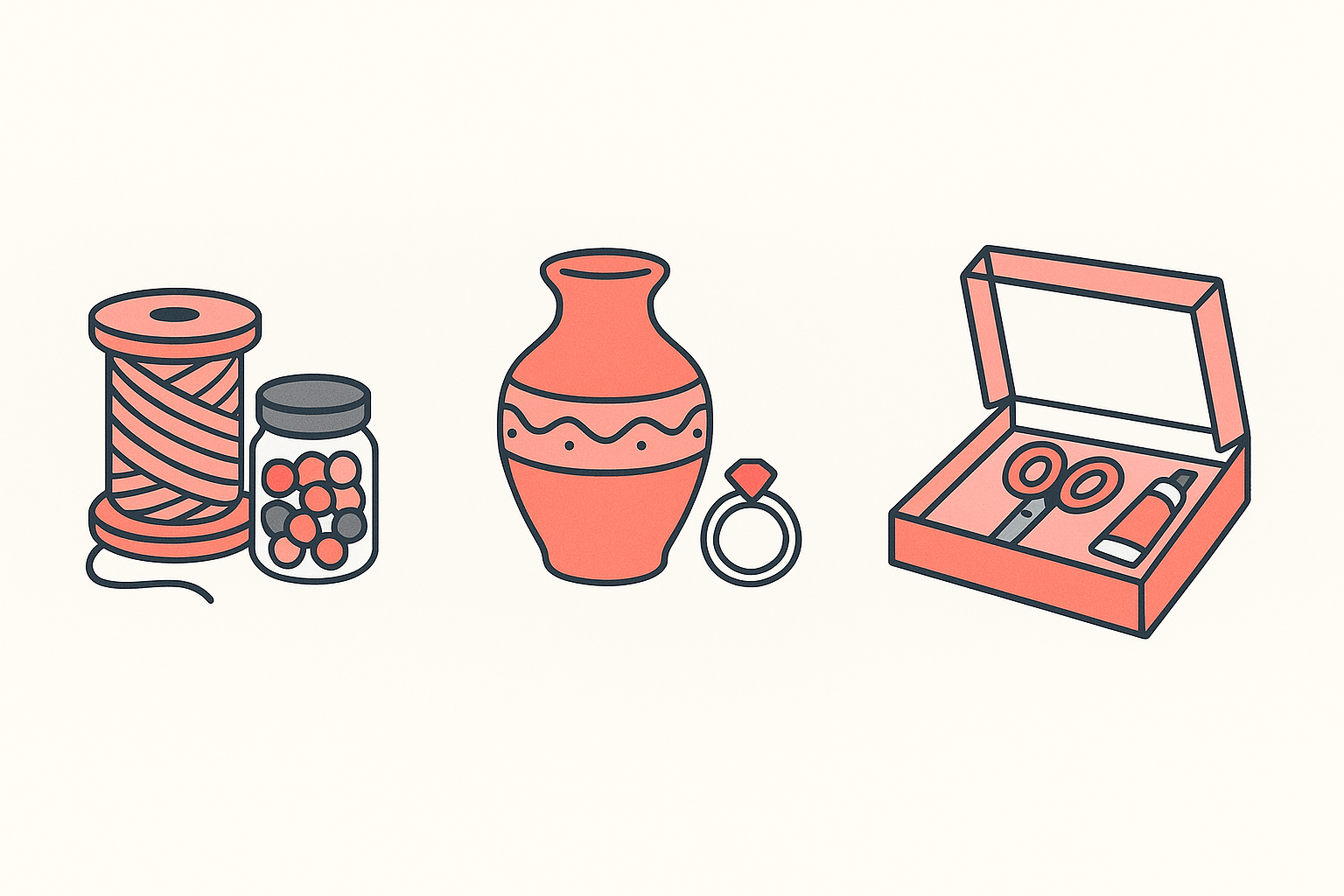
Supplies (yarn, beads, paper, fabric) sell cheap and often. The economics depend on volume, repeat orders, and a full range of colors, weights, and sizes, which is why the yarn and fabric stores in the ranking list so many products. A supply store competes on selection and reliability more than on a brand story.
Finished handmade goods flip that math. Prices are higher and catalogs smaller. Customers pay for craftsmanship, a recognizable look, or a personal touch, so the work goes into product photography, materials, and a clear story rather than catalog breadth. Heath Ceramics, a maker of handmade tableware, is a good example of this approach to study.
DIY kits and tools sit in the middle. The Woobles sells beginner crochet kits, and paint-by-number and diamond painting brands sell a whole project in one box. Kits convert because they remove the guesswork for a first-time crafter, which is its own form of value.
Price and catalog size follow the model. Supply stores sell low-priced items across thousands of SKUs, handmade brands sell fewer and pricier pieces from a tight range, and kit brands land in between.
Community and tutorials are the moat

The hardest advantage to copy is content. The Woobles built a crochet brand around step-by-step beginner tutorials, so buying a kit and learning the skill happen in the same place. Yarn and stamping brands publish free patterns, project ideas, and how-to videos that pull in search traffic and give past customers a reason to come back for more supplies. For a craft audience, a library of patterns or tutorials does double duty: it ranks in search and it turns a one-time buyer into a repeat one.
Starting a Shopify Craft Store
If you are setting up a craft store, use the ranking to find a few stores that share your model and copy what they do well. A practical path:
- Pick your model first. Supplies, finished handmade, or kits. This one choice sets your pricing, your catalog size, and how you photograph products. Trying to be all three at once is the most common early mistake.
- Match your catalog to the model. A supply store needs depth (every color and weight a maker expects). A handmade store needs a tight, well-shot range. Do not pad a handmade catalog to look bigger; it dilutes the brand.
- Price for the model, not the competition. Handmade brands such as Heath Ceramics show that buyers will pay premium prices for craftsmanship. Underpricing handmade work to look competitive usually just erases the margin.
- Plan content from day one. A few patterns, project guides, or tutorial videos give you organic search traffic and repeat visits. This is where craft brands beat generic stores.
- Use visual channels. Craft products photograph well, which suits discovery platforms. One Shopify seller reported that Pinterest drove about 60% of their store's traffic and converted better than Instagram, a pattern that fits visual, project-based products like crafts.
With Koala Inspector you can open any craft store from the ranking and see its product count, price range, theme and installed apps for free, plus a traffic estimate for 3 tokens.
Is Shopify a Good Place to Sell Crafts?
Yes. Shopify works well for craft businesses because you control everything: your storefront design, checkout, SEO, pricing, and email list. That ownership compounds over time in a way a marketplace listing cannot.
Visual presentation matters more for craft products than for most categories, and Shopify's theme ecosystem is built for it. The Craft theme is designed for visual storytelling with large image sections; Canopy adds a store locator, color swatches, and quick-view for faster launches; and Exhibit is built for gallery-style presentation with carousels and generous white space.
The Shopify App Store also covers the problems craft sellers actually hit: per-unit inventory tracking, custom product options (yarn weight, bead color, size), subscription boxes, digital downloads, and loyalty programs. Most fit into existing Shopify workflows with no custom code.
Can I Dropship Crafts From Shopify?
Yes, and Shopify is a practical platform for it. Dropshipping lets you carry a wide range of craft items without holding stock yourself. You connect to a supplier, they fulfill orders on your behalf, and you run the storefront and marketing. The main advantage on Shopify is that your store is fully yours to grow: you own the customer data, you can run your own ads, and you can switch suppliers without migrating platforms. If you go this route, spend the time up front picking a niche you can speak to with some authority, because a focused store is far easier to market than a general craft catalog.
Is It Better to Sell Crafts on Shopify or Etsy?
For long-term growth, Shopify is the stronger option. Etsy works as a starting point because it brings built-in traffic, but the platform limits how much you can grow on your own terms.
A real example of the operational difference: one store owner compared repricing and updating variants across 70 products. The same task took 5 hours on Etsy (even with scripting) and 21 minutes on Shopify. That kind of friction adds up at scale.
Here is how the two platforms compare directly:
| Shopify | Etsy | |
|---|---|---|
| Control | Full control over design, checkout, SEO, and customer data. | Limited customization, the same layout as every other Etsy store. |
| Fees | Monthly plans from $29 to $299, plus transaction fees unless you use Shopify Payments. | No monthly fee. $0.20 per listing, plus a transaction fee per sale. |
| SEO | You manage your own optimization. | Etsy controls your store's search presence. |
| Ads | Run Facebook, Google, or Pinterest ads to your own storefront. | Etsy Ads are more expensive and lock you into the Etsy ecosystem. |
The main trade-off is traffic. Etsy brings built-in buyers. With Shopify, you build your own audience, which takes longer but gives you something Etsy can never take away.
For more category benchmarks, see our roundups of the top Shopify art stores, home decor stores, and candle stores.
Questions people ask
What are the biggest Shopify craft and hobby stores?
As of October 12, 2026, The Woobles (thewoobles.com) is the biggest in Koala Inspector's Shopify Niche Index by estimated traffic, with about 2.2M visits in September 2026. Yarnspirations and Missouri Star Quilt Company are next.
How much traffic does a top Shopify craft and hobby store get?
As of October 12, 2026, the median store in this list gets about 698K visits a month, and it takes about 399K a month to make the list at all.
How many Shopify craft and hobby stores are there?
As of October 12, 2026, Koala tracks 18K live Shopify stores in this niche. 1.3K of them get enough traffic to estimate, and this list ranks the busiest 25 that mainly sell craft and hobby products.
Written by
Koala Team
Koala Apps Editorial Team
The Koala Team is the crew behind Koala Inspector. We test tools, track what is selling across Shopify, and turn it into practical roundups and reference guides for store owners and dropshippers.
Top Shopify Stores By Category
- Top Shopify Auto Parts Stores, Ranked by Traffic
- Top Shopify Baby Stores, Ranked by Traffic
- Top Shopify Beverage Stores, Ranked by Traffic
- Top Shopify Fitness Stores, Ranked by Traffic
- Top Shopify Food Stores, Ranked by Traffic
- Top Shopify Handbag Stores, Ranked by Traffic
- Top Shopify Health & Supplement Stores, Ranked by Traffic
- Top Shopify Jewelry Stores, Ranked by Traffic
- Top Shopify Kitchen Stores, Ranked by Traffic
- Top Shopify Outdoor Stores, Ranked by Traffic
- Top Shopify Shoe Stores, Ranked by Traffic
- Top Shopify Toy Stores, Ranked by Traffic
- Top Shopify Beauty Stores, Ranked by Traffic and Updated Weekly
- Top Shopify Vegan Stores
- Top Shopify Clothing Stores, Ranked by Traffic and Updated Weekly
- Top Shopify Pet Stores, Ranked by Traffic and Updated Weekly
- Top Shopify Tech Stores, Ranked by Traffic and Updated Weekly
- Top Shopify One Product Stores
- Top Shopify Candle Stores
- Top Shopify Dropshipping Stores
- Top Shopify Fashion Stores, Ranked by Traffic and Updated Weekly
- Top Shopify Antique Stores
- Top Shopify T-Shirt Stores
- Top Shopify Art Stores
- Top Shopify Gaming Stores
- Top Shopify Home Decor Stores, Ranked by Traffic and Updated Weekly
- Top Shopify Furniture Stores, Ranked by Traffic and Updated Weekly
- Top Shopify Electronics Stores, Ranked by Traffic and Updated Weekly
- Top 25 Shopify Stores, Ranked by Traffic and Updated Weekly