Printify Pricing on Shopify: Every Cost Per Order, and When Premium Pays Off
 By Ana GelevskaOctober 28, 2026
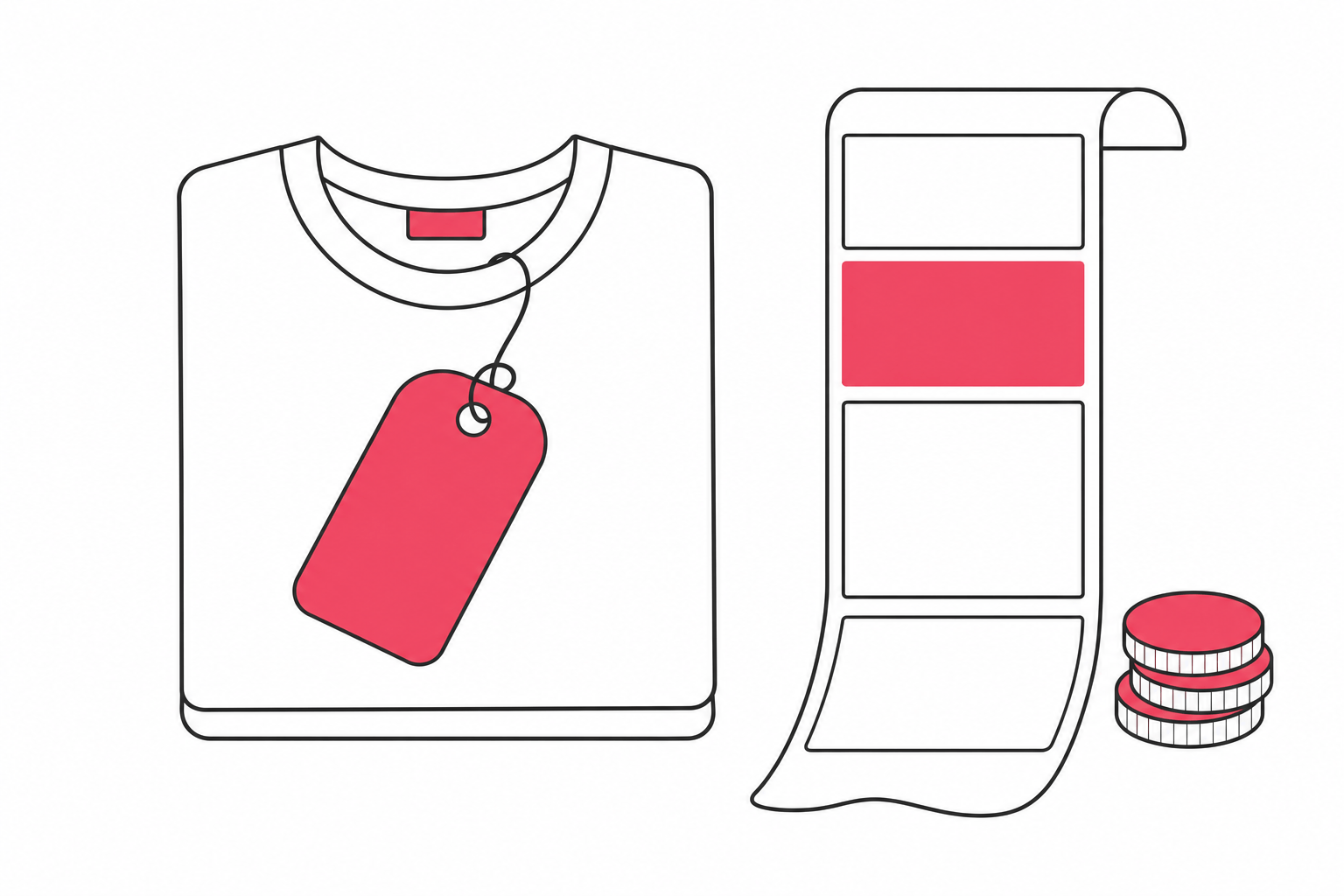
Printify costs nothing to join. There is no platform fee, no listing fee and no minimum order, and the Free plan carries unlimited product designs across up to 5 stores. The bill arrives per order instead, and it has more lines on it than the base cost most sellers budget for.
The Printify link at the end of this article is a partner link. It costs you nothing and it changed nothing in what follows: every figure here was read off Printify's own pages, Shopify's own pricing page and the Shopify App Store on 28 October 2026.
This is what you actually pay to run Printify on a Shopify store: the three published plans, the four lines inside a single order, the arithmetic that decides whether the paid plan is worth buying, and the four places the margin quietly leaks. If you want the upstream explanation of what the platform is and how an order flows through it, our guide to Printify print on demand covers that ground.
What Printify charges: the three plans
Printify publishes three tiers, read on 28 October 2026.
| Plan | Price | Stores per account | Product discount |
|---|---|---|---|
| Free | $0 a month | 5 | None |
| Premium | From $39 a month, or from $24.99 a month billed yearly | 10 | Up to 20% on all products, up to 33% on new products |
| Enterprise | Custom pricing | Unlimited | Additional discounts on all products |
Every tier gets unlimited product designs, the Product Creator, integrations with Shopify, Etsy, eBay and the rest, manual order creation and 24/7 merchant support. Premium adds the discounts above, order management through Printify Connect, AI mockups and 1:1 mentorship. Enterprise adds a custom API integration, a dedicated account manager and branded customer support.
Printify's own pricing FAQ answers the question most sellers ask next, which is where the money comes from if the platform is free: Printify earns a margin on the product fulfillment price you pay when a customer orders, and states there are no platform fees, listing fees or hidden charges.
So the subscription is optional. The per-order cost is not.
The real bill is per order, and it has four lines
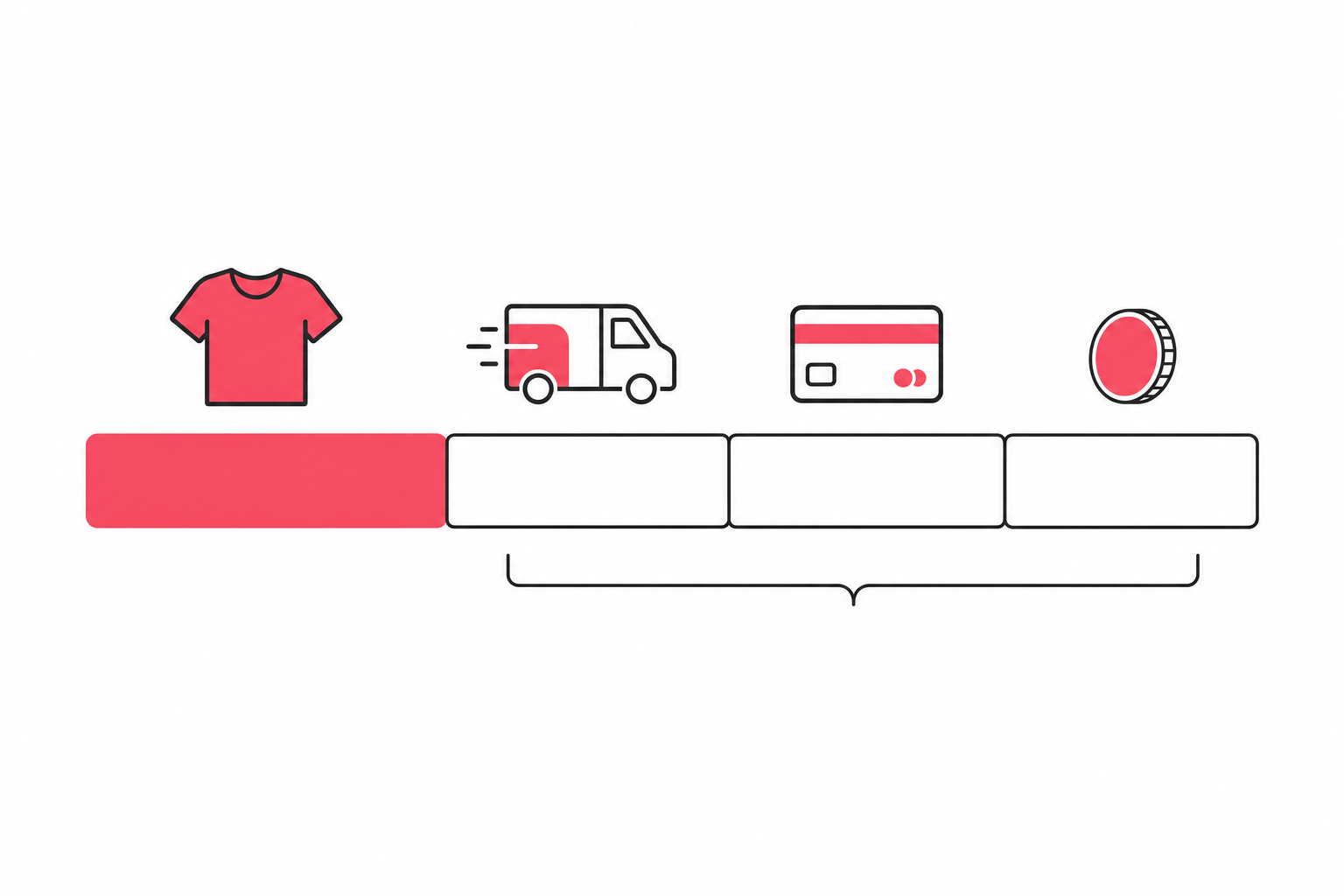
Here is every line that fires when a customer buys, with figures read on 28 October 2026.
1. The product cost. Set by the print provider you picked for that product. Printify's own profit calculator on its pricing page uses a fulfillment cost of $8.77 for a Unisex Jersey Short Sleeve Tee with one print, and is explicit that the figure covers one item with one print and excludes shipping fees, taxes and other storefront expenses. Treat that as a reference point for a mid-range tee, not as your number: Printify lists more than 70 print providers and over 2,000 customizable products, and base prices differ across them.
2. Shipping. Published per print provider on Printify's shipping rates page, and it moves with the destination. Monster Digital and SwiftPOD both state that shipping to European countries carries an additional $3.50 charge, and both warn that deliveries to Alaska, Hawaii, Puerto Rico and unincorporated US territories can take an extra 7 to 12 business days. Pull the rate table for the specific provider you selected before you set a shipping policy around it.
3. The holiday surcharge. From 15 October 2026 to 17 January 2027, every order shipped to the US carries a flat $0.40 surcharge, with Printify stating its underlying rate is unchanged from last year. Small per order, and it lands on every single one through the quarter that usually carries your volume.
4. Shopify's cut. Shopify lists Basic at $39 a month billed monthly or $29 a month billed yearly, with online card rates from 2.9% plus 30 cents, and a 3-day free trial followed by $1 a month for 3 months. The subscription is fixed; the card rate is per order and belongs in this list. Our breakdown of what a Shopify store costs per month has the rest of the platform bill, apps included.
A worked example: one tee sold at $26
Take the $8.77 reference tee, price it at $26 in a Shopify store on Basic, and ship it inside the US during the surcharge window.
| Line | Amount |
|---|---|
| Retail price | $26.00 |
| Printify product cost | -$8.77 |
| Shopify card fee, 2.9% plus $0.30 | -$1.05 |
| US holiday surcharge | -$0.40 |
| Left before shipping, ads and returns | $15.78 |
Shipping is the swing line, and it is deliberately missing from that table. Charge it at checkout and it roughly cancels out. Offer free shipping and the whole provider rate moves into the cost column, which on a US tee is usually the difference between a healthy order and a thin one.
The figure that matters is the last row, not the markup multiple. A 3x markup on $8.77 would have put this tee at $26.31 and felt disciplined, and it still says nothing about whether $26 is the right price. That answer is further down.
When Printify Premium pays for itself
Premium's real job is the discount. Printify's own FAQ is blunt about this: downgrading from Premium to Free loses you no platform functionality and no sales channels, only the discounted product prices. So the plan is the price of a discount, and the question is pure arithmetic.
At the published maximum of 20% off products, every $8.77 product cost saves you $1.75.
- Billed monthly at $39: about 23 orders a month before the plan has paid for itself.
- Billed yearly at $24.99 a month: about 15 orders a month.
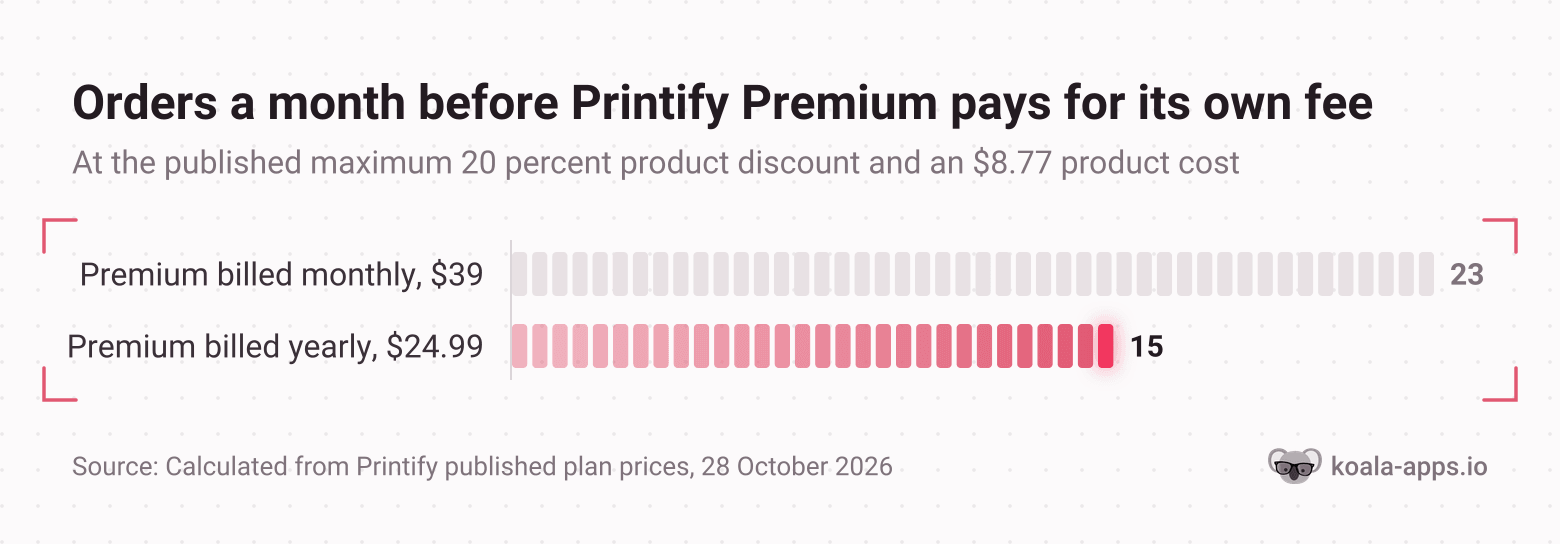
Two honest caveats sit on top of that, both of which push the real number higher.
The headline is "up to" 20%, which is a ceiling rather than a rate. If the discount on your specific products lands at 10%, double both order counts. Check the discounted price on the products you actually sell before you subscribe, because the only product discount that matters to you is the one on your catalogue.
And Premium plans are non-refundable, with Printify stating you must unsubscribe before the renewal date to avoid being charged for the following month. A quiet month you forgot to cancel is a sunk fee, so set the reminder when you subscribe rather than after the first one surprises you. All plan figures above were read on 28 October 2026.
Four places the margin leaks
There is no single "Printify price" for your product. With more than 70 print providers and over 140 print facilities, the same design carries several different base costs and several different shipping tables depending on who you route it to. Picking a provider is a pricing decision disguised as a logistics one, and our guide to choosing a print on demand supplier walks through how to judge one on delivery times and margin rather than on the catalogue photo.
A defect costs you more than the product. Printify's Merchant Protection covers a free reprint or refund within 30 days on a manufacturing error. Read the mechanics on Printify's Merchant Protection page, though: you send photos, the team inspects, a replacement goes out, and if the reprint cannot be made a full order refund is placed into your Printify account within 1 business day. That is credit on your Printify balance. The refund you give your own buyer leaves your Shopify payout as cash, and the card fee on the original sale is already spent. Budget for a defect rate, because Printify covering the item does not make the order free for you.
Extra sales channels are a paid feature. The Free plan caps you at 5 stores per account and Premium at 10, as of 28 October 2026. If you are running separate stores per niche, that cap arrives before the discount math does.
Your own catalogue is the only discount that counts. Printify's maximum 33% applies to new products and the 20% to all products, which means the blended saving on a catalogue of older bestsellers is lower than the headline. Price the plan against your top sellers, not against the best case in the table.
Set your retail price from the market, not from a markup
Everything above gives you a floor. It says nothing about the ceiling, which is what a buyer in your niche will actually pay for a printed tee with your design on it. Cost-plus pricing answers the wrong question, and we wrote a whole guide on how to run a competitor pricing analysis on Shopify for exactly this reason.
Print on demand makes that easier than most categories, because your competitors are findable and their prices are public. Koala Inspector opens on any public Shopify store and reads it for free: the full product catalogue with prices and variants, the likely best sellers, a stats header with the catalogue's high and low price and its first-published date, the active theme, and every installed app grouped by type. The app list is how you confirm a store is actually a print on demand store before you treat its prices as comparable to yours.
That matters because print on demand is a crowded shelf. Of the 250 most-installed apps across the Shopify stores Koala tracks, three are print on demand apps: Printful runs on 24,965 of them, Printify on 14,117 and Gelato on 4,658, read on 28 October 2026.
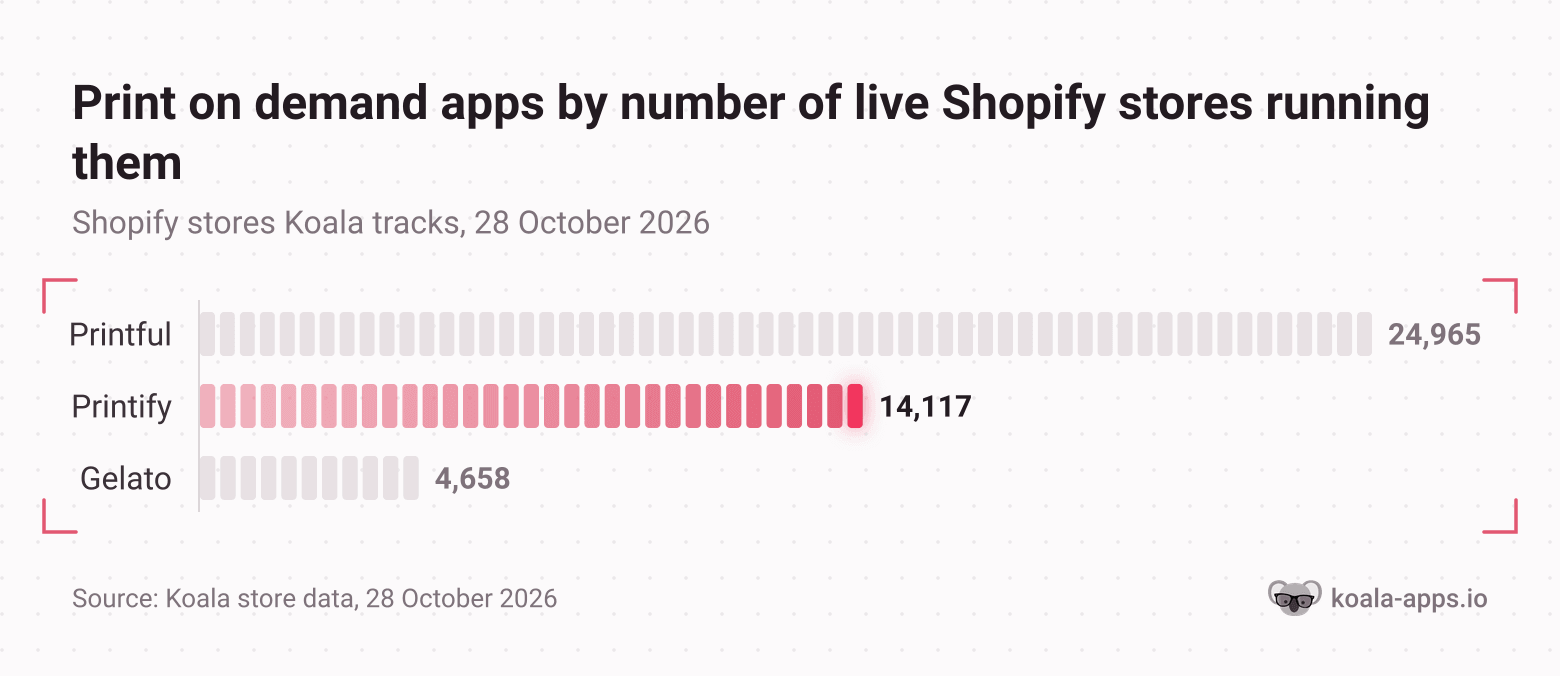
Read that as a map of where to look. Fourteen thousand live stores running the same fulfillment platform you are means there is a published price for almost any garment and almost any niche, and you can read a dozen of them in an afternoon instead of guessing at a multiple.
Koala Inspector's free plan is $0 a month with 15 tokens, no card required, and catalogue browsing, best sellers, app detection and theme detection never cost a token. Two paid screens go further when a specific competitor is worth the spend: Site Traffic (3 tokens) shows volume, sources, geography and keywords, and Ad Campaigns (2 tokens) shows the Google and Facebook or Instagram ads they are running, which tells you what offer their price is built to support. For the research method itself, our guide to print on demand product research covers how to turn that into a shortlist of designs worth making.
Printify pricing FAQ
The cost questions Shopify sellers ask most, answered from Printify's published pages on 28 October 2026.
Is Printify free to use with Shopify?+
Yes. Printify's published pricing lists a Free plan at $0 a month with unlimited product designs and up to 5 stores per account, and its own pricing FAQ states there are no platform fees, listing fees or hidden charges, because Printify earns a margin on the fulfillment price you pay when a customer orders. Shopify is the part that is not free: Shopify lists Basic at $39 a month billed monthly or $29 a month billed yearly, read on 28 October 2026.
How much does Printify charge per shirt?+
It depends on the garment and the print provider you pick, because Printify lists more than 70 print providers and each sets its own base price. As a reference figure, the profit calculator on Printify's pricing page uses a fulfillment cost of $8.77 for a Unisex Jersey Short Sleeve Tee with one print, and states that figure excludes shipping fees, taxes and other storefront expenses. Read on 28 October 2026.
Is Printify Premium worth it?+
Premium is the price of a discount, so the answer is arithmetic. Printify lists Premium from $39 a month, or from $24.99 a month billed yearly, with up to 20% off all products and up to 33% off new products, as of 28 October 2026. At the maximum 20% off an $8.77 product cost you save $1.75 an order, so the monthly plan clears its fee at about 23 orders a month and the yearly rate at about 15. A smaller real discount raises both counts in proportion.
What does running Printify and Shopify together cost per month?+
The fixed part is Shopify's plan. Shopify lists Basic at $39 a month billed monthly or $29 a month billed yearly, with online card rates from 2.9% plus 30 cents, and offers a 3-day free trial followed by $1 a month for 3 months, read on 28 October 2026. Printify adds $0 a month on its Free plan. Everything else is variable and arrives per order as product cost, shipping and Shopify's card fee.
Does Printify refund me if a product arrives faulty?+
Printify's Merchant Protection covers a free reprint or refund within 30 days on a manufacturing error. Its Merchant Protection page asks for photos of the fault for inspection, after which a replacement is sent, and states that if there are issues with the reprint a full order refund is placed into your Printify account within 1 business day. Note where that money lands: credit on your Printify balance, while the refund you give your own buyer leaves your Shopify payout in cash.
Is there a shipping surcharge on Printify orders right now?+
Yes, for US deliveries over the holiday period. Printify's shipping rates page states that from 15 October 2026 to 17 January 2027 every order shipped to the US carries a flat $0.40 surcharge, with the underlying rate unchanged from last year. Shipping rates themselves are published per print provider and vary by provider and destination.
How many stores can one Printify account connect?+
Five on the Free plan, ten on Premium and unlimited on Enterprise, as listed on Printify's pricing page on 28 October 2026. The integration list covers Shopify, Etsy, eBay, Amazon, TikTok Shop, Wix, WooCommerce, Squarespace, BigCommerce, PrestaShop and Printify's own pop-up store, so the cap is on connected stores rather than on platforms.
How long does it take to connect Printify to a Shopify store?+
Printify's Shopify page gives a setup time of under 10 minutes and describes two routes: install the Printify app from the Shopify App Store, or sign up for a free Printify account and connect your existing Shopify store from the Printify dashboard. On the Shopify App Store the Printify listing carries a 4.7 rating from 4,357 ratings, read on 28 October 2026.
The short version
Printify's plan page is the easy half of the bill and the smaller half. What decides whether your store makes money is the per-order stack: a product cost set by whichever print provider you routed to, a shipping rate that changes with the destination, a $0.40 US surcharge through 17 January 2027, and Shopify's 2.9% plus 30 cents on top. Run that math on your own top seller before you run it on a calculator's sample tee.
The paid plan is worth exactly what its discount returns. At the published ceiling of 20% off an $8.77 product, that is roughly 23 orders a month on monthly billing and 15 on yearly, and a smaller real discount moves both numbers up. Start on the free tier, measure your actual discounted prices for a month, then decide.
If print on demand is the model you want, Printify is free to join, carries no minimum order and connects to a Shopify store in under 10 minutes, which makes testing the economics cheap. Price the products against what the stores already selling your niche charge, keep the four leak points above in your spreadsheet, and the margin will survive its first busy quarter.
Written by
Ana Gelevska
eCommerce Content Writer
Ana Gelevska is a content writer with more than five years of experience creating content for eCommerce brands and global clients. She digs into each topic and the people it is for, then turns it into clear, useful articles that Shopify sellers and dropshippers can act on.
Connect on LinkedIn