How Much Does a Shopify Store Cost Per Month? The Honest Breakdown
 By Assaf ShalinSeptember 16, 2026
A Shopify store costs about $29 to $79 a month for the platform, plus 2.9% + $0.30 on every card payment, plus whatever your apps bill. Apps are the line that decides your total. Across the stores Koala tracks, the monthly app bill runs from $299 to over $130,000, and app count barely predicts it.
That last part is why most "Shopify pricing" articles leave you no wiser. The plan price is public and takes thirty seconds to look up. The app bill is the one that ruins a budget, and nobody can quote it to you because it depends entirely on which tools you pick and what tier you land on.
Here is the whole monthly bill, split into the four lines that actually move.
| Line | Typical monthly cost | What sets it |
|---|---|---|
| Shopify plan | $29 to $79 | Which plan you pick |
| Payment processing | 2.5% to 2.9% + $0.30 per order | Your plan and your revenue |
| Apps | $0 to $150 starting out, $2,000 to $14,000 at scale | Which tools you install and their tier |
| Everything else (domain, theme, ads) | Under $1 for the domain, $0 to $420 once for a theme, ads uncapped | Your launch choices and your growth plan |
All plan and processing figures below are the published US prices read off Shopify's own pricing page on 16 September 2026. Two things to know before you compare them to anything else: Shopify's pricing page defaults to the yearly billing toggle, so the monthly figure you see is the yearly-equivalent one, and every price here is quoted in USD without conversion.
Line 1: the Shopify plan
The plan is the only line you can know in advance with certainty.
| Plan | Yearly billing | Monthly billing | Online card rate (US) |
|---|---|---|---|
| Basic | $29/mo | $39 USD/mo | 2.9% + 30¢ |
| Grow | $79/mo | $105 USD/mo | 2.7% + 30¢ |
| Advanced | $299/mo | $399 USD/mo | 2.5% + 30¢ |
| Plus | from $2,300/mo | not listed separately | 2.25% + 30¢ |
Source: Shopify Plans and Pricing, read 16 September 2026.
The gap between the two billing columns is the part people miss. Basic at "$29" is $29 only if you commit to a year up front. Pay month to month and the same plan is $39, which is $120 more across a year for the privilege of being able to leave.
Shopify also says the platform "starts with a free 3-day trial, no credit card required" and that after the trial "most plans start at just $1 per month for the first 3 months, then switch to standard monthly pricing." That promo makes the first quarter nearly free and makes month four a surprise, so put the real number in your forecast from day one.
New stores almost always belong on Basic. Grow earns its extra $50 a month when the 0.2% card-rate saving plus the features you actually use outweigh the subscription difference, which for most stores happens somewhere in the low tens of thousands of monthly revenue.
Line 2: payment processing
Processing is a percentage, so it scales with you whether you plan for it or not.
On Basic in the US, Shopify's published online standard card rate is 2.9% + 30¢, read off the pricing page on 16 September 2026. Run the arithmetic on a few revenue levels and it stops being abstract:
| Monthly revenue | Orders (at $50 average) | Card fees on Basic |
|---|---|---|
| $2,000 | 40 | about $70 |
| $10,000 | 200 | about $350 |
| $50,000 | 1,000 | about $1,750 |
At $50,000 a month your processing bill is roughly sixty times your plan fee. That is the moment the plan tiers start to matter: moving to Grow at 2.7% saves about $100 a month on that revenue, against $50 more in subscription.
The fixed 30¢ is the part that punishes low-ticket stores. On a $12 impulse product, 2.9% + 30¢ is 5.4% of the sale. If your average order is small, raising it by bundling is worth more to your margin than any plan change.
Line 3: the app bill, and how to estimate yours
This is the line that decides your total, and it is the one no pricing page can give you.
Koala tracks a large set of live Shopify stores and reads their installed app stacks. Looking at the top stores in that set with a recorded app spend on 14 September 2026, the spread is enormous:
- The median store spends about $5,000 a month on apps and runs 12 of them.
- The middle half sits between roughly $2,000 and $14,000 a month.
- The cheapest store in the set runs 10 apps for $299 a month. The most expensive runs 23 apps for about $133,000 a month.
Two stores from that snapshot make the point better than the percentiles do. essencemakeup.com runs 10 apps at about $1,750 a month. marcellamodanyc.myshopify.com runs 23 apps at about $98,197 a month. Both are large stores. Their app bills are two orders of magnitude apart.
App count does not predict the bill
The obvious mental model is "more apps, bigger bill." It holds on average and falls apart on any individual store.
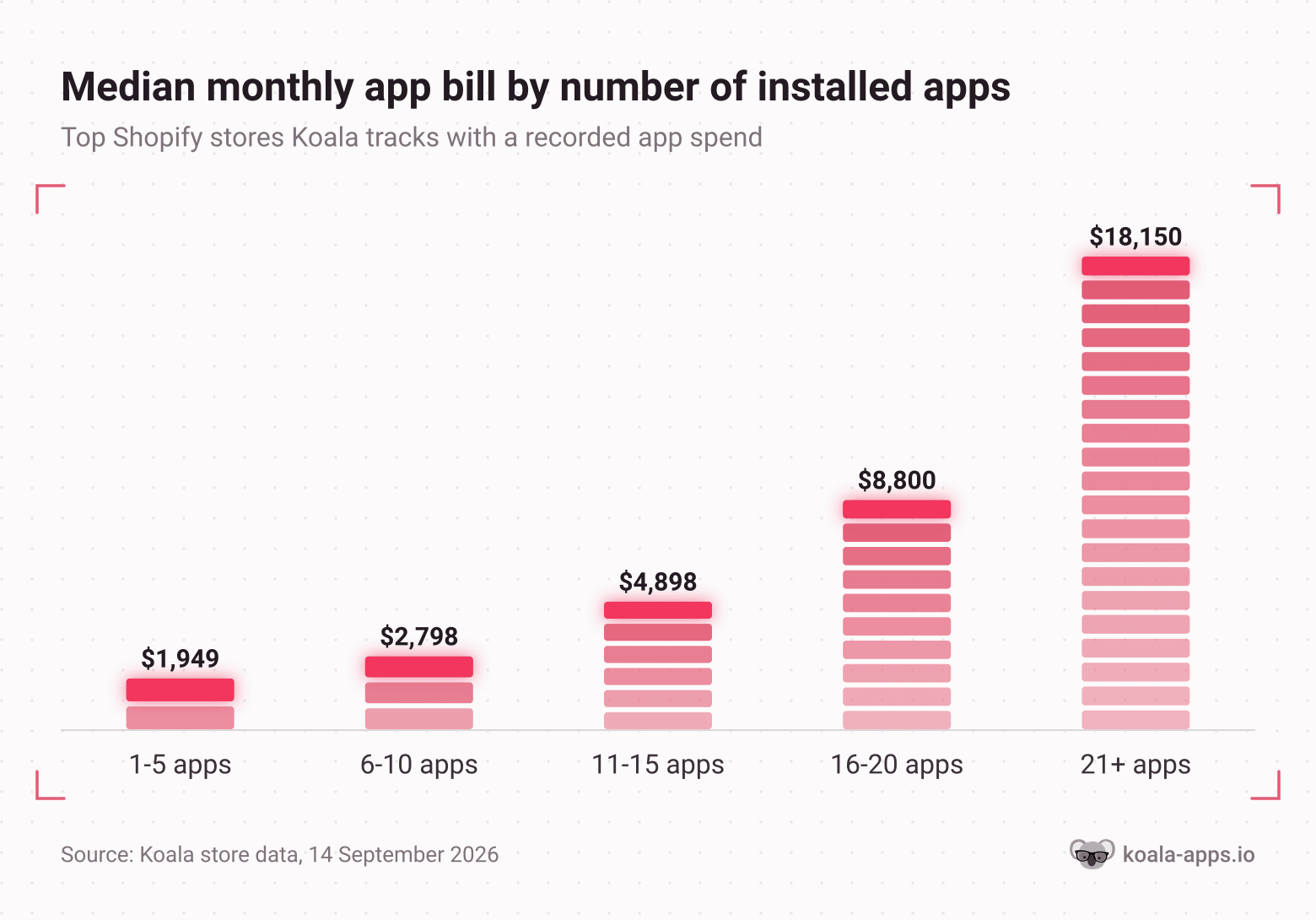
The medians climb cleanly from about $1,949 for stores running 1 to 5 apps up to about $18,150 for stores running 21 or more. Now look inside one band: among stores running 6 to 10 apps, the bill ranges from $299 to $46,099 a month. Same number of apps, a 150x difference in cost.
What drives that is tier, not count. A review app, a bundling app and an email app all have a $0 plan and a $999 plan, and which one you land on depends on your order volume and your catalog size. Ten cheap apps cost less than one enterprise app.
Your category sets your baseline
Category is a better predictor than count. Median monthly app spend across the top stores Koala tracks, grouped by the store's category:
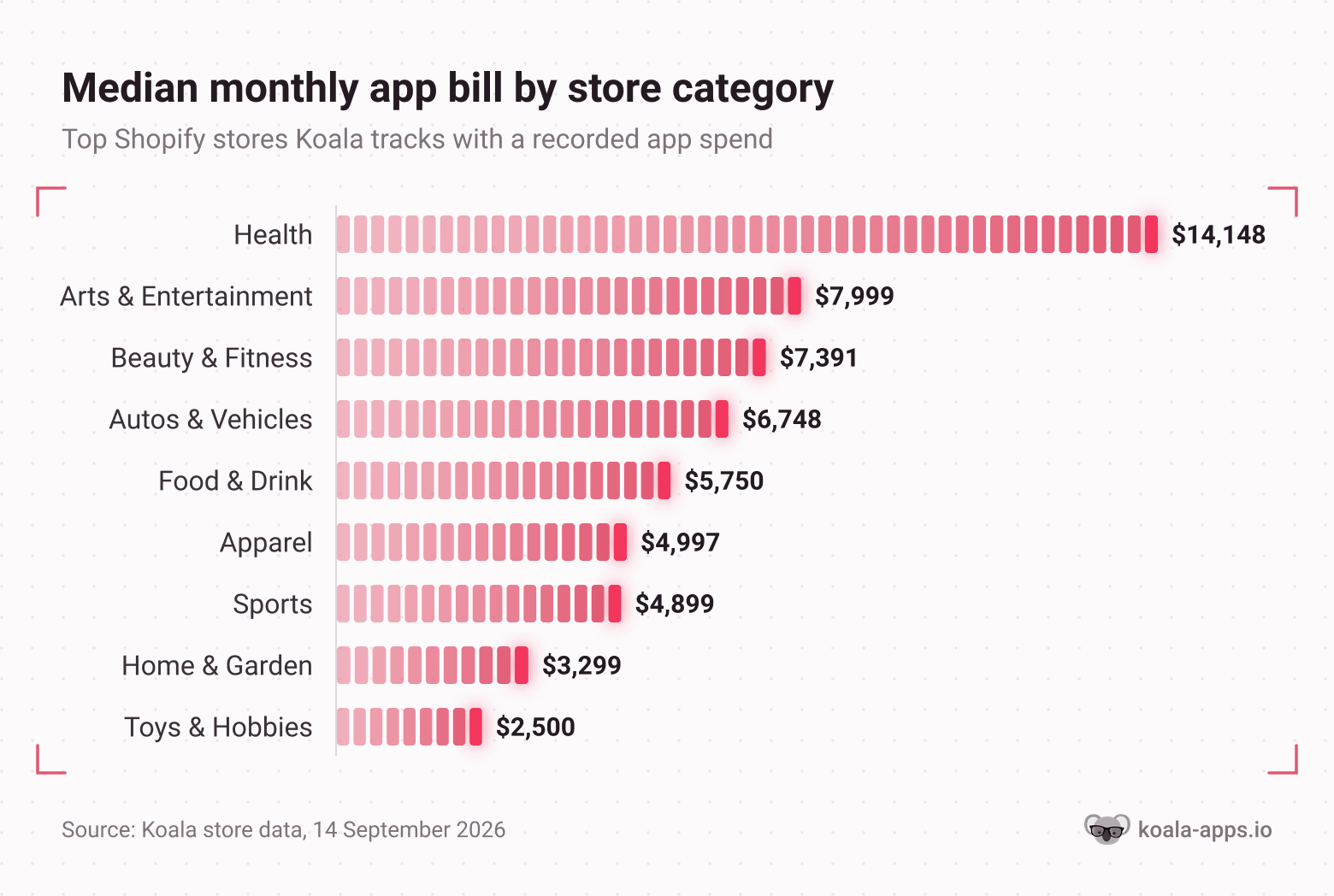
Health stores sit highest at a median of about $14,148 a month across 18 apps. Beauty and fitness follows at about $7,391. Apparel, the largest group in the snapshot, sits at about $4,997 across 11 apps. Toys and hobbies is the cheapest at about $2,500 across 9 apps.
Read these as the shape of spending at the top of each category, not as your bill. They cover the stores Koala tracks rather than all of Shopify, and every store in this cut is a high-revenue one. What they tell a smaller store is the direction the bill travels as you grow in your category, and which categories carry structurally heavier stacks.
The method: price your stack off stores your size
You do not have to guess. The stack you will end up running is already installed on stores selling what you sell, and it is readable from the outside.
- Pick 5 to 8 stores in your category that are roughly one step ahead of where you want to be in twelve months. Not the category giants, the ones you could plausibly become.
- Read each store's installed apps. Open the store in Chrome with Koala Inspector active and the app detector lists every app on the store, grouped by type, with a link to each one in the Shopify App Store. It is free and takes seconds per store.
- Write down every app that appears on three or more of them. That intersection is your real stack. Apps that appear once are somebody's experiment.
- Price each one at the tier your volume puts you in, not at the tier the big store is on. Most apps publish per-order or per-contact pricing bands.
- Add 20% for the tier you will cross into. Apps bill by usage, so success raises this line automatically.
That gives you a number you can defend, built from tools proven on real storefronts rather than a shortlist from a YouTube video. Our full data study on what top stores spend on apps goes deeper on the distribution, and the most-installed apps list shows which tools show up most often.
Line 4: everything else
The remaining costs are real but small next to apps, and most of them are one-time or yearly rather than monthly.
- Domain. Shopify says domains "typically start at $9 USD/year, billed annually." That is under $1 a month. You can also connect a domain you already own from another registrar.
- Theme. Free themes exist and several are made by Shopify. Paid themes in the Shopify Theme Store currently list between $150 and $420 as a one-time purchase. Launch on a free theme, buy a paid one when you have revenue to justify it. Our guide to choosing a Shopify theme covers what actually matters at that decision.
- Ads. Uncapped by definition and usually the largest number on the page once you start. There is no published figure to quote because it is entirely your choice, but a realistic product test is measured in hundreds of dollars, not tens.
- Point of sale. Casual in-person selling comes with a paid plan. Shopify lists POS Pro at "+$89 USD/month for each POS Pro location" on its POS pricing page, read 16 September 2026, so a physical shop is a separate monthly line.
Three realistic budgets
Pick the row that matches where you are. Every figure is in USD per month.
Bare minimum: prove the product exists
You want to find out whether anyone will buy this before you spend money proving it.
| Line | Cost |
|---|---|
| Shopify Basic (yearly billing) | $29 |
| Free theme | $0 |
| Domain (annual, spread monthly) | under $1 |
| Apps, all on free tiers | $0 |
| Recurring total | about $30 |
Processing sits on top at 2.9% + 30¢ per order, so it only exists once you have sales. Ads are whatever you choose to test with. This budget is entirely achievable and it is how most stores should start.
A serious first year: build something that can grow
You have a product, you are past the first sales, and you are willing to pay for tools that remove friction.
| Line | Cost |
|---|---|
| Shopify Basic (yearly billing) | $29 |
| Paid theme (one-time $150 to $420, first year) | $13 to $35 |
| Domain | under $1 |
| Core app stack (reviews, email, upsell, support) | $50 to $150 |
| Recurring total | about $95 to $215 |
Add processing at 2.9% + 30¢ and an ad budget you can afford to lose. Every app on this line should have earned its place by fixing something you can point at in your own analytics.
A scaling store: apps become the biggest line
You are past the point where the plan matters and into the territory the Koala data describes.
| Line | Cost |
|---|---|
| Shopify Grow or Advanced | $79 to $299 |
| App stack | $2,000 to $14,000 |
| Domain and theme | negligible |
| Recurring total | about $2,100 to $14,300 |
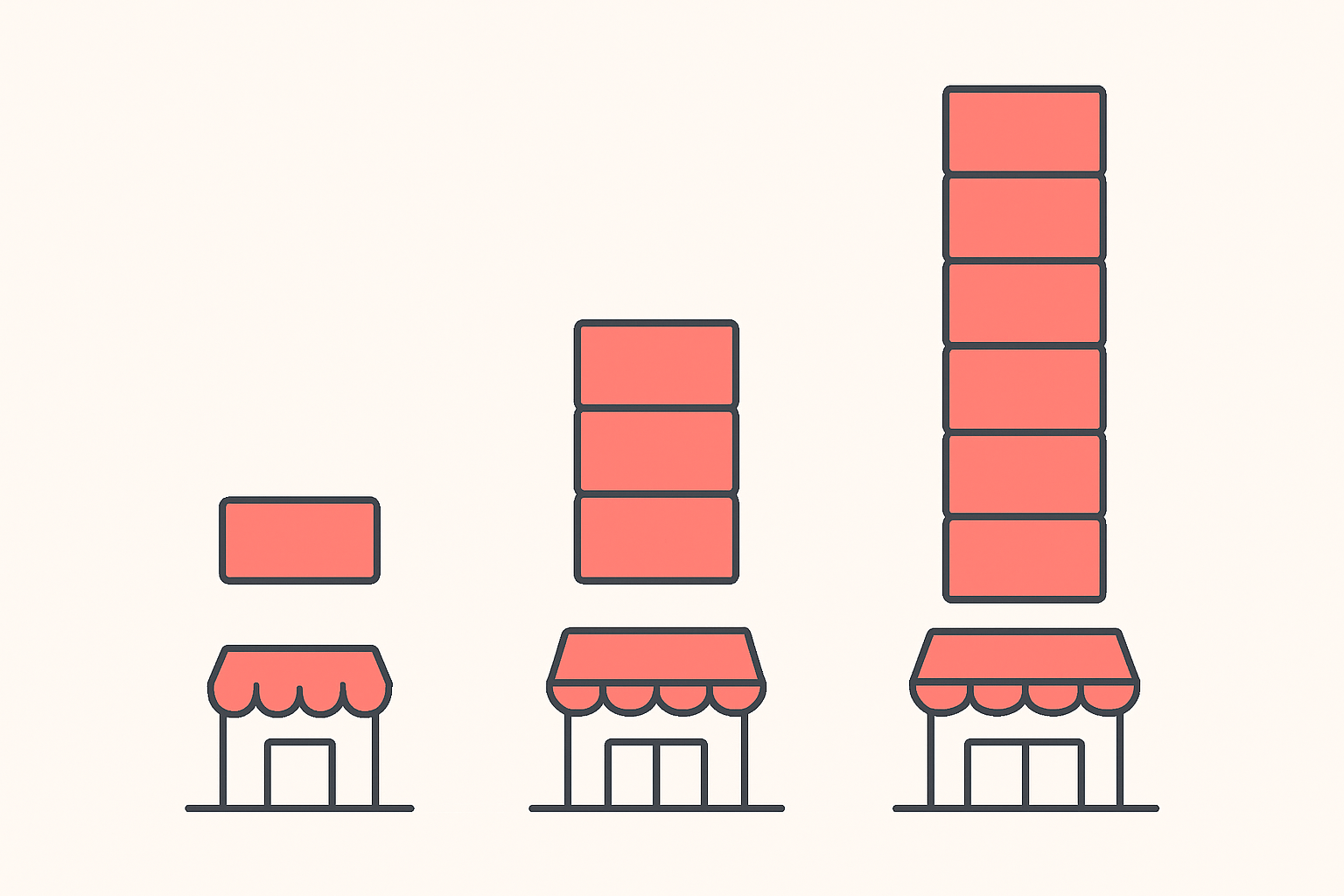
Processing on Grow drops to 2.7% + 30¢ and on Advanced to 2.5% + 30¢ on the US rates published on 16 September 2026, which at this volume is worth more than the subscription difference. The $2,000 to $14,000 band is the middle half of the top stores in Koala's snapshot, so it is the honest range for a store operating at that level rather than a worst case.
The costs people forget
These are the lines that turn a budget that looked fine into a month that did not.
The trial that quietly converts. One merchant on r/smallbusiness put it plainly: "shopify was too confusing and I ended up losing around 100$ just on free trial as I forgot to cancel it." Put the renewal date in your calendar the day you sign up.
Apps that bill by usage. Your app bill is not fixed. Email tools price by contact count, review tools by order volume, bundling tools by revenue share. Growing 3x can more than triple this line. One EU merchant running since 2021 described "paying $4-6k a month in third-party app fees on top of platform fees" as the cost of getting their compliance stack working.
Third-party payment gateway fees. If you use a gateway other than Shopify Payments, Shopify charges an additional transaction fee on top of whatever that gateway charges. Check your plan's terms before switching.
Apps you stopped using. Uninstalling an app does not always end a subscription that was set up outside Shopify billing. Audit your app list quarterly and read what each one is still charging.
Chargebacks and refunds. Processing fees are generally not returned on a refund, so a returned order costs you the fee twice over.
Your own time. Not a cash cost, but it is the one that decides whether the rest is worth it.
What merchants say about Koala Inspector
Verified reviews from the Chrome Web Store.
“Very easy to use and install. Helps with identifying Shopify stores quickly and saves time by listing best sellers. Also has handy feature of the traffic which I found very valuable.”
 Ali Baloch
“I was a bit skeptical about all the hype but gave Koala Inspector a shot. It's user-friendly and provides useful data on what's working for others. The support team is also there when you need them.”
 Martin René
“Great tool for competitor research and customer support is really quick!”
 Aiswarya S
Shopify cost questions, answered
The questions that come up alongside a budget, with the published figure and where it came from.
Can you run a Shopify store for free?+
Not permanently. Shopify offers a free 3-day trial with no credit card required, and says most plans then run at $1 per month for the first 3 months before standard pricing starts. After that the platform is a paid subscription, with Basic listed at $29 a month on yearly billing in the US as of 16 September 2026. You can keep everything around the plan free for a while by using a free theme, a free subdomain on the myshopify.com address and apps on their free tiers, but the plan itself always has a price.
How much do Shopify apps cost per month?+
Anywhere from nothing to tens of thousands. Many popular apps have a genuine free tier, so a new store can cover reviews, email capture and chat for close to $0. Among the high-revenue stores in Koala's data, the median app bill is about $5,000 a month, the middle half falls between roughly $2,000 and $14,000, and the range runs from $299 to over $130,000. Those are large stores. A first-year store that picks carefully usually lands between $0 and $150 a month.
What is the cheapest Shopify plan?+
Basic is the cheapest plan Shopify publishes on its pricing page, listed at $29 a month on yearly billing or $39 a month billed monthly in the US as of 16 September 2026. It carries the highest card rate of the standard plans at 2.9% plus $0.30 per online transaction, so it is cheapest in subscription terms and most expensive per sale. Starter and retail-only plans exist for specific setups, but Basic is the entry point for a full online store.
How much does DSers cost?+
DSers publishes a free Basic plan, then Advanced at $19.90 a month, Pro at $49.90 a month and Enterprise at $499.90 a month, each with a 14-day free trial, as listed on dsers.com on 16 September 2026. Most new dropshipping stores start and stay on the free tier for a long time, so budget $0 for it in month one and revisit when order volume forces the upgrade.
am i eligible for the offer after i transfer the development stores?+
Development stores are not transferable to a merchant. Shopify's developer documentation states that dev stores cannot be transferred to a client and that you should use a client transfer store instead. A client transfer store is the supported path, and the merchant picks and pays for a plan when they take ownership, so promotional plan pricing is decided at that moment rather than inherited from the build. Check the current terms in your Partner dashboard before you promise a client a rate.
can i use my own domain name with shopify?+
Yes. Every store gets a permanent yourstore.myshopify.com address, and you can point a custom domain at it either by buying one through Shopify or by connecting a domain you already own from another registrar. Shopify says domains typically start at $9 USD a year, billed annually. Either way the domain is a yearly cost, not a monthly one, so on a monthly budget it lands under $1.
should i find a chinese dropshipping agent for my ebay store?+
An agent is worth paying for once you have a product selling steadily and shipping time or supplier consistency is the thing holding you back. Before that, an agent is a fixed cost attached to a product you have not proven. The costs on this page are Shopify costs, and an eBay store carries a different fee structure, so price an agent against the orders you already have rather than the orders you hope for.
Can you make 10k a month on Shopify?+
Some stores do and most do not. The costs on this page are what stands between revenue and profit: at $10,000 a month on Basic you would pay $29 for the plan and roughly $290 plus $0.30 per order in card fees, leaving apps and ads to decide whether anything is left. The stores that get there usually run a lean app stack and know their numbers, which is why looking at what comparable stores actually run is a better starting point than a generic checklist.
are shopify point of sale payments secure?+
Shopify states it is certified Level 1 PCI DSS compliant and that this compliance extends by default to all stores powered by Shopify, covering all six PCI standard categories. On the cost side, casual in-person selling is included with a paid plan, and Shopify lists POS Pro at an extra $89 USD a month for each POS Pro location, so a physical location is a separate monthly line rather than part of the plan price.
Check the stack before you pay for it
Limited startup capital is the constraint almost every new store is working under, and the fastest way to waste it is to buy a tool you did not need because a video told you to.
Before you install anything, spend ten minutes reading what stores like yours already run. Install Koala Inspector free, open five competitors in your category, and the app detector lists every app on each store, grouped by type, with a link straight to its App Store listing and its pricing. The apps that repeat across all five are the ones worth paying for. Everything else can wait until your revenue asks for it.
That one habit turns your app budget from a guess into an estimate, and the app budget is the line that decides what a Shopify store costs you.
Sources
- Shopify, Plans and Pricing - Basic, Grow, Advanced and Plus prices on both the yearly and monthly billing toggles, the US online standard card rates, the free 3-day trial and the $1 per month for the first 3 months offer. Read 16 September 2026, US pricing, USD.
- Shopify, Domains - domains "typically start at $9 USD/year, billed annually." Read 16 September 2026.
- Shopify, Theme Store - free themes and paid theme prices listed between $150 and $420. Read 16 September 2026.
- Shopify, POS pricing - "+$89 USD/month for each POS Pro location." Read 16 September 2026.
- Shopify, PCI compliance - Level 1 PCI DSS certification extending by default to all stores powered by Shopify across all six PCI standard categories.
- Shopify, Development stores - "Dev stores can't be transferred to a client" and the direction to use a client transfer store instead. Read 16 September 2026.
- DSers, Pricing - free Basic plan, Advanced at $19.90/month, Pro at $49.90/month and Enterprise at $499.90/month, each with a 14-day free trial. Read 16 September 2026.
- r/smallbusiness, "Shopify was frustrating so I downgraded and it kinda worked" - the forgotten free trial that cost around $100.
- r/shopify, "US founders have no idea how broken Shopify is in the EU" - "$4-6k a month in third-party app fees on top of platform fees" from a DTC brand running on Shopify since 2021.
- Koala Inspector reviews on the Chrome Web Store.
App spend, app counts and category medians are Koala's own store intelligence, snapshotted 14 September 2026 across 228 top Shopify stores with a recorded app spend. They cover the stores Koala tracks rather than every store on Shopify, and every store in this cut is a high-revenue one. Quote them with that caveat attached.
Written by
Assaf Shalin
Co-founder & Developer, Koala Apps
Assaf Shalin is a co-founder of Koala Apps and one of the developers behind Koala Inspector. He builds the tools that let Shopify sellers see what is actually working in other stores, from installed apps and themes to best-selling products. On the blog he covers the technical side of store research: how competitor research really works, what public store signals can and cannot tell you, and how to turn them into decisions.
Connect on LinkedIn