Shopify Order Tracking Apps: What Busy Stores Actually Install
 By Koala TeamSeptember 1, 2026
A shopper pays, waits two days, hears nothing, and emails you. Multiply that by your order volume and you have the single most repetitive job in Shopify support. One dropshipper describes it plainly on r/dropshipping: past roughly 50 orders a day the questions became a real problem, and before automating anything they were losing two-plus hours a day to order status emails. The fix is a tracking page the customer can check themselves, plus notifications that arrive before they think to ask.
This guide ranks the order tracking apps busy Shopify stores actually install, counted across the stores Koala tracks, then shows you how to read the tracking app on any competitor's storefront yourself.
What's in this guide
- The order tracking apps busy stores install
- How we measured
- What Shopify already gives you free
- The four apps worth shortlisting
- Free tier, entry price and installs, side by side
- What sits next to tracking in a real stack
- See what tracking app a store you admire is running
- Shopify order tracking questions people ask
The order tracking apps busy stores install
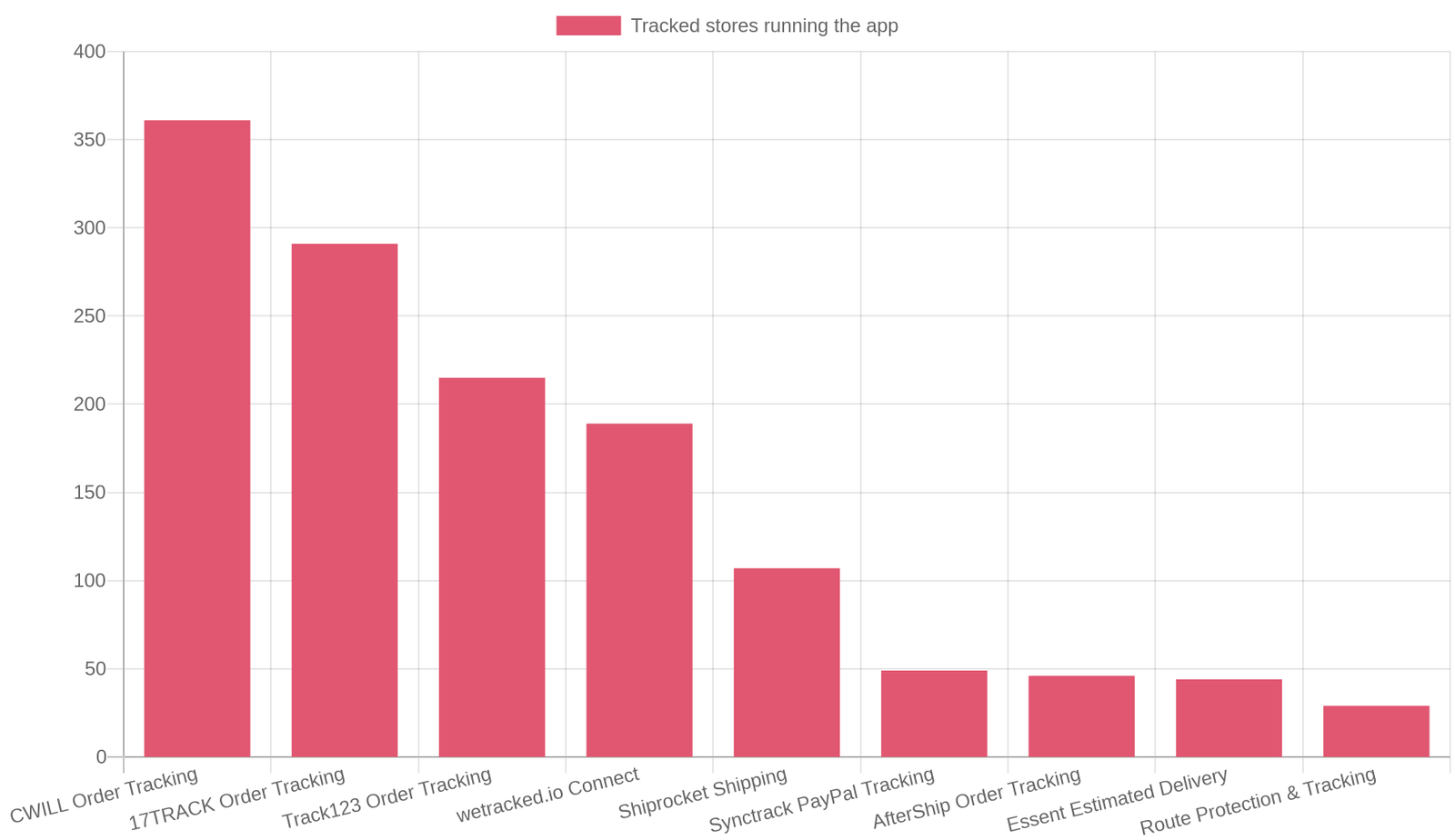
Every other roundup on this keyword ranks by review count, which measures how long an app has been selling. Here is the number that measures adoption: how many of the Shopify stores in Koala's store intelligence have each app installed right now.
| Rank | App | What it does | Tracked stores |
|---|---|---|---|
| 1 | CWILL Order Tracking | Branded tracking page, notifications, upsells | 361 |
| 2 | 17TRACK Order Tracking | Branded tracking page, multi-carrier sync | 291 |
| 3 | Track123 Order Tracking | Map-based tracking page, notifications | 215 |
| 4 | wetracked.io Connect | Tracking sync and marketplace connection | 189 |
| 5 | Shiprocket: eCommerce Shipping | Shipping and fulfilment with tracking built in | 107 |
| 6 | Synctrack PayPal Tracking Sync | Pushes tracking numbers to PayPal and Stripe | 49 |
| 7 | AfterShip Order Tracking | Branded tracking page, delivery estimates | 46 |
| 8 | Essent Estimated Delivery Date | Delivery dates on product and cart pages | 44 |
| 9 | Route: Protection & Tracking | Shipping protection with tracking attached | 29 |
Three things in that table are worth acting on.
The category has a clear top three, and it is tighter than the review counts suggest. CWILL leads on 361 tracked stores, with 17TRACK on 291 and Track123 on 215. On the Shopify App Store the order is different again, with 17TRACK carrying 3,971 reviews at 4.9 stars against CWILL's 2,895 at 5.0 and Track123's 1,599 at 4.9. Reviews reward age. Installs show you what merchants are choosing now.
The long tail is doing a different job. Synctrack on 49 tracked stores exists to push tracking numbers into PayPal, which protects you in disputes rather than informing the customer. Essent's delivery date app on 44 puts an arrival estimate on the product page, before the order exists. Route on 29 attaches tracking to shipping protection. If your problem is chargebacks or pre-purchase hesitation rather than support volume, those are the shortlist, not the top three.
Shipping platforms carry tracking as a side effect. Shiprocket on 107 tracked stores is a fulfilment tool that happens to notify customers. If you already run one, check what it sends before you pay for a second app to do the same job.
How we measured
What was counted. App installations recorded across the Shopify stores in Koala's store intelligence, rolled up to 250 distinct apps and 24,182 total store installations.
Window and date. A single snapshot, taken on 1 September 2026. Counts move between snapshots as the tracked set changes, so quote the date with the number.
Coverage. These are the stores Koala tracks, which skews toward active, established merchants. It is a large sample of Shopify, not a census of it, so read every count as a ranking signal rather than a platform-wide market share.
What is not counted. An app with no recorded installation in the snapshot is absent rather than counted as zero, and each app is grouped by the job its Shopify listing describes, so a fulfilment platform appears once even though it also sends tracking emails.
What Shopify already gives you free
Before you install anything, know your baseline. Shopify documents three native routes a customer can already use. The order status page is reachable by signing in, by clicking a tracking link in an email, or by entering an order number and verifying contact details, and Shopify's own wording is that "customers can return to this page to check the status of their delivery." Shipping emails go out at key points during delivery. And orders from your store sync automatically to the customer's Shop account, which adds push notifications for shipping milestones, live map tracking and estimated delivery dates.
That baseline handles a customer who kept the email. It falls down in three places, and those three gaps are what every app on this list sells against: the tracking link hands the shopper to a carrier site instead of your store, there is nothing proactive when a parcel stalls in transit, and multi-carrier or dropshipped orders arrive as a jumble of carrier formats.
The four apps worth shortlisting

CWILL Order Tracking is the most installed in Koala's data at 361 tracked stores, and it carries a 5.0 rating from 2,895 Shopify App Store reviews. It covers 1,600 or more carriers, puts a customisable tracking page under your own domain, sends email, SMS and push notifications, shows an estimated delivery date on product and checkout pages, and adds upsells on the tracking page itself. Free covers 20 orders a month; the Essential plan is $11 a month for 200. Who it suits: a store that wants the tracking page to earn revenue rather than just answer a question. Check before installing: 20 free orders a month is the tightest free tier of the four, so a store past a few orders a day is paying from week one.
17TRACK Order Tracking runs on 291 tracked stores and holds a 4.9 rating from 3,971 reviews, the largest review base in the category. It reaches 3,300 or more carriers, supports 18 or more languages, and includes a one-click option to hide Chinese origin details on a shipment. Free covers 50 shipments a month and the Basic plan starts at $9. Who it suits: cross-border and dropshipping stores where the carrier list is long and the origin is best left unadvertised. Check before installing: carrier breadth is its main claim, so confirm your specific carriers are on the list rather than assuming a big number covers them.
Track123 Order Tracking sits on 215 tracked stores at a 4.9 rating from 1,599 reviews. Its pitch is an interactive map-based tracking page, with AI product recommendations, Apple Wallet tracking, 14 or more languages, a dropshipping mode that conceals supplier information, and automatic sync to PayPal and Klaviyo. Free covers 50 orders a month, and Growth is $9 a month for 300. Who it suits: a store already running Klaviyo that wants delivery events feeding its flows. Check before installing: the map page is the differentiator, so look at a live demo on mobile before you commit, because that is where most tracking checks happen.
AfterShip Order Tracking is the category's best-known name and sits at 46 tracked stores in Koala's snapshot, with a 4.7 rating from 1,300 reviews. It connects 1,100 or more carriers, offers a branded tracking page with product recommendations, automated email and SMS, AI-estimated delivery dates and analytics on on-time performance. Free covers 50 shipments a month and Essentials starts at $11. Who it suits: a store that wants carrier performance reporting, not only customer messaging. Check before installing: its lower install count here reflects the stores Koala tracks and the plan you land on, so compare the per-shipment price at your real volume rather than at the entry tier.
Merchants argue this out in public. A Shopify Community thread asking how stores handle "where is my order" messages names AfterShip, Trackr and Track123 as already covering the routine questions, and lands on the same conclusion the data supports: the apps close the simple cases, and the ones left over are exceptions, like a parcel stuck in transit for eight days or delivered but not received. Price the app on the simple cases, then staff the exceptions.
Free tier, entry price and installs, side by side
| App | Free tier | Paid entry | App Store rating | Tracked stores |
|---|---|---|---|---|
| CWILL Order Tracking | 20 orders/month | $11/mo (200 orders) | 5.0 (2,895) | 361 |
| 17TRACK Order Tracking | 50 shipments/month | $9/mo | 4.9 (3,971) | 291 |
| Track123 Order Tracking | 50 orders/month | $9/mo (300 orders) | 4.9 (1,599) | 215 |
| AfterShip Order Tracking | 50 shipments/month | $11/mo (100 shipments) | 4.7 (1,300) | 46 |
| Shopify order status page | Included in your plan | None | Native | Every store |
Prices and ratings are as listed on the Shopify App Store in September 2026. Install counts are Koala's own snapshot of 1 September 2026.
The free tiers matter more than the headline price, because they tell you the order volume at which this becomes a real line item. At 50 free shipments a month you are covered until roughly two orders a day. Past that, every app here lands between $9 and $11 to start, which answers the merchant asking on r/ecommerce how small stores handle these emails without paying $500 a month. They do not. The category's entry price is roughly a tenth of that, and the expensive tools are support desks, not trackers.
What sits next to tracking in a real stack
A tracking app rarely works alone. Look at what else the same stores run and the pattern shows up fast. Across the stores Koala tracks on 1 September 2026, Shopify Inbox sits on 682 stores, close to double CWILL's 361. Klaviyo is on 1,293 and Judge.me on 1,619, with Shopify Forms on 447.
Read that as a post-purchase sequence rather than a leaderboard. Inbox, which is free and rated 4.6 from 5,506 reviews, catches the questions the tracking page did not answer. Klaviyo turns delivery events into flows, which is why both Track123 and CWILL advertise a Klaviyo integration. Judge.me asks for the review once the parcel has actually landed, and a review request sent before delivery is the fastest way to earn a bad one. The tracking app is the piece in the middle that tells the other two when the parcel arrived.
If you are budgeting the whole stack rather than one app, our guide to how much Shopify apps cost breaks down what a working set adds up to, and the most popular Shopify apps covers the full ranking this snapshot comes from.
See what tracking app a store you admire is running
A ranking across thousands of stores tells you what is normal. It does not tell you what works in your niche, at your average order value, shipping from your country. That answer is sitting on your competitors' storefronts right now.
Koala Inspector is a free Chrome extension with a Shopify app detector built in. Open a store you admire, open the extension, and the Apps screen names every app that store has installed, grouped by what each one does, with a link out to each app's Shopify App Store listing. It costs no tokens and needs no card.
Here is what that looks like on a real store. essencemakeup.com is a beauty merchant in Koala's data with roughly 584,099 modeled monthly visits and about $2.76 million in modeled monthly sales, running 10 installed apps at around $17.50 a month in app subscriptions. That is a fraction of the $55 median app spend across the 300 busiest stores Koala tracks, which run 11 apps at a median of about $287,680 in modeled monthly sales. Ten well-chosen apps beat twenty, and the app detector tells you which ten.
The read takes about a minute per store:
- Pick three stores selling what you sell, at your price point. Ideally ones you already lose customers to.
- Open each one and read the Apps screen. Note anything in the shipping, fulfilment and customer support groups.
- Count the overlaps. An app on two of three stores is your niche's default. An app on one is somebody's experiment.
- Buy an order from the one you rate most. You get their full post-purchase sequence in your own inbox: the confirmation, the shipping email, the tracking page, the timing.
- Copy the sequence, not just the app. The app is $9. The sequence is the part that stops the emails.
That fourth step is the one merchants skip, and it is why so many install a tracking app and still field the questions. Merchants asking for order tracking software recommendations on r/smallbusiness get a list of names and no sense of how a good store sequences them. Reading three real stacks gives you both.

Want to see apps on any Shopify store?
Download for free and start exploring a whole new ecommerce world!

What researchers say about Koala Inspector
Verified reviews from the Chrome Web Store.
“The service has been great, very responsive and the most comprehensive spying of global markets Ive seen!”
 Adrienne Greenwood
“Super simple to use and gives tons of detail of other stores. It helped me learn how to improve my store.”
 Jessica Walker
“Awesome customer support. Insights into store AOV, products, traffic and campaign tracking is extremely helpful!”
 Gabe Abramovich
Shopify order tracking questions people ask
Shopify order tracking questions people ask
The questions merchants ask alongside order tracking, answered straight.
Can I use my own domain name with Shopify?+
Yes. Every store gets a default myshopify.com address, and you can either buy a custom domain through Shopify or connect one you already own from another registrar. It matters more than it looks for tracking, because a branded tracking page served on your own domain keeps the delivery experience inside your brand instead of handing the customer off to a carrier site. Both CWILL Order Tracking and 17TRACK advertise a tracking page you can put under your own domain. Note that the default myshopify.com name itself can only be changed once.
Can Koala Inspector inspect Shopify shops?+
Yes, that is what it is built for. Koala Inspector is a free Chrome extension that opens on any Shopify store and shows the store overview, the active theme, the full product catalogue with likely best-sellers and prices, and every app the store has installed, grouped by what each app does. Those features cost no tokens. Traffic breakdowns, ad campaigns, product trends and ongoing competitor tracking sit behind tokens, and the free plan includes 15 tokens a month with no card required. On a site that is not built on Shopify it tells you so instead of guessing.
How do I stay updated on my order status?+
As a shopper, Shopify gives you three routes with no app involved. The order status page can be reached by signing into your account, by clicking the tracking link in a shipping email, or by entering your order number and verifying your contact details, and Shopify says customers can return to that page to check the status of their delivery. Shipping emails arrive at key points during delivery. Orders from a Shopify store also sync automatically to the Shop app, which adds push notifications for shipping milestones, live map tracking and estimated delivery dates. As a merchant, a tracking app adds a branded page on your own domain plus proactive notifications, so the shopper stops emailing you to ask.
Can you make 10k a month on Shopify?+
Yes, and against an established store it is a modest number. Across the 300 busiest stores in Koala's store intelligence on 1 September 2026, the median store showed roughly $287,680 in modeled monthly sales on about 27,059 modeled monthly visits. Those are gross figures before product cost, shipping, fees, ad spend and refunds, and the sample is the busy end of the market rather than a typical new store. What is useful is how they get there: the median store at that level runs 11 apps and spends about $55 a month on them, so the stack is not what separates a $10k month from a $300k one.
Are Shopify point of sale payments secure?+
Shopify states that it is certified Level 1 PCI DSS compliant and that this compliance extends by default to all stores powered by Shopify, covering the store, its shopping cart and its hosting. Level 1 is the highest of the four PCI merchant levels, and it covers the payment plumbing for both online and in-person selling. Your own operational security sits outside that: staff account permissions, device access on the shop floor and who is allowed to issue refunds are still your responsibility.
Which Shopify preorder app do you use for partial payments and deposits?+
Downpay: Partial Pay & Deposit is the clearest fit for deposits on the Shopify App Store. It lets customers pay a deposit or pay in parts on pre-order and made-to-order products, and collects the balance by auto-charge, manual collection or invoice. As of September 2026 it carries a 5.0 rating from 84 reviews and starts at $29 a month. Deposits and tracking pair up more than merchants expect, because a made-to-order product has the longest wait and therefore the highest volume of order status questions. Our roundup of the best Shopify pre-order apps covers the wider category.
The deposit category is covered in full in our best Shopify pre-order apps roundup.
Read three stacks before you pay for one
The order tracking category is cheap, crowded and easy to get right, and the top three apps in Koala's data all start under $12 a month with a usable free tier. The decision that actually matters is which post-purchase sequence you copy, and that answer lives on the storefronts of stores already selling to your customers.
See any Shopify store's tracking app free
Install Koala Inspector, open a store you admire, and read every app it runs, grouped by what each one does. No card, no tokens for the app detector.
Sources referenced
- Shopify, Order tracking, for the native order status page, shipping emails and Shop app behaviour.
- Shopify App Store listings for CWILL Order Tracking, 17TRACK Order Tracking, Track123 Order Tracking, AfterShip Order Tracking, Shopify Inbox and Downpay, for features, ratings and pricing as of September 2026.
- Shopify, PCI compliance, for the Level 1 PCI DSS certification statement.
- Merchant discussion on the Shopify Community (handling "where is my order" messages, bulk fulfilment and tracking) and on Reddit (r/dropshipping, r/ecommerce, r/smallbusiness).
Every install count and store figure on this page is Koala's own store intelligence, snapshotted 1 September 2026. Cite it with the date attached.
Written by
Koala Team
Koala Apps Editorial Team
The Koala Team is the crew behind Koala Inspector. We test tools, track what is selling across Shopify, and turn it into practical roundups and reference guides for store owners and dropshippers.