Best Ecomhunt Alternatives in 2026 (Curated Feeds vs Store-First Research)
 By Ana GelevskaAugust 24, 2026
The strongest Ecomhunt alternative for most sellers is Koala Inspector, a free Chrome extension that opens any live Shopify store and reports its products, likely best-sellers, price range, installed apps, active theme and live ad campaigns. Ecomhunt sells a hand-picked daily product feed from $23 a month. A store-first tool answers the harder question: who is already selling this.
Ecomhunt does what it says. Its team, in its own words, "hand-picks products with real momentum" and drops new winning products every single day. That is a genuine service, and for a beginner staring at a blank product page it beats guessing.
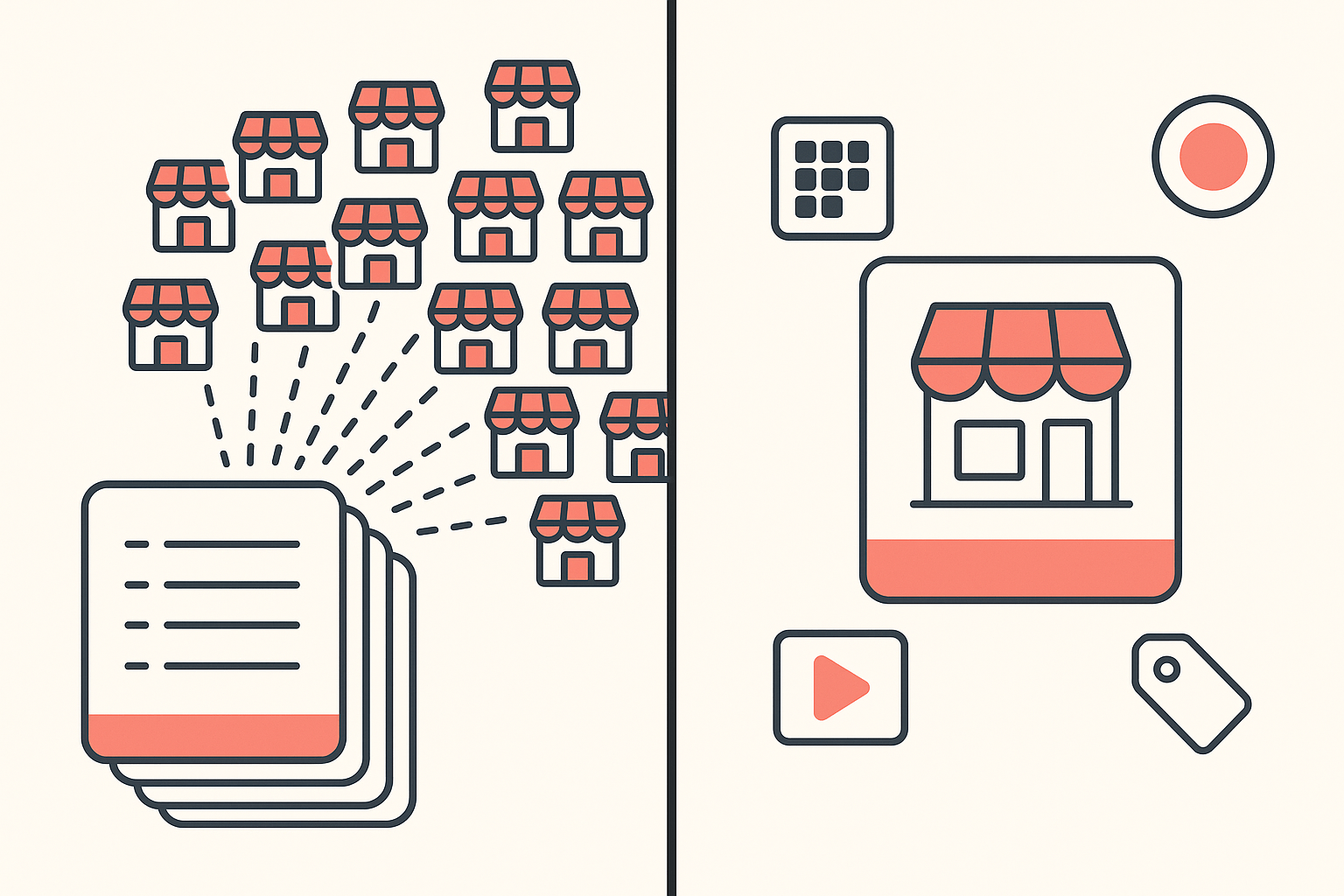
The problem is structural. A curated feed is a shared list. The morning a product lands on it, every subscriber sees the same item, the same supplier and often the same creative angle. Speed is the whole game in dropshipping, and a list you paid to join is a list your competitors paid to join too.
This guide compares seven alternatives on the job that actually decides your ad budget: working out whether a product is already crowded before you spend on it.
Quick answer: the top Ecomhunt alternatives
Every price below was read from the vendor's own published page in August 2026, except Peeksta's, which is noted where it appears.
- Best free pick: Koala Inspector. Store analysis, app detection, theme detection and best-seller browsing cost nothing, plus 15 tokens a month for the deeper reads.
- Best Meta ad library: Winning Hunter, from $49/mo, with TikTok and Pinterest from the $79 tier.
- Best product database: Dropship.io, from $39/mo on monthly billing.
- Best all-in-one with fulfilment: Sell The Trend, from $29.97/mo with a free trial.
- Best for Shopify sales estimates: PPSPY, from $39/mo with a no-card trial.
- Cheapest paid entry point: Peeksta, listed from $19.99/mo.
Why sellers go looking for an Ecomhunt alternative
Three reasons come up again and again in seller communities, and none of them are complaints about the curation quality.
A shared list creates its own competition. A widely upvoted r/dropshipping thread on finding niches early opens with the same diagnosis: new sellers keep entering oversaturated niches where margins are paper-thin and ad costs are sky-high. A daily feed is efficient at putting a product in front of thousands of sellers at once, which is exactly the mechanism that turns a fresh pick into a crowded one.
The list cannot tell you how late you are. A r/dropshipping thread comparing research methods puts it sharply. TikTok shows you what sells but "doesn't show you how many merchants are already running that product in Meta ads", and the writer's conclusion is blunt: you launch, your cost per click comes back brutal, and $500 disappears in a few days competing with sellers who are already past the learning phase. Chatbots have the same hole. So does any static database.
Ideas are cheap and validation is not. Curated feeds, TikTok hashtags, Amazon best sellers and AI chat all produce candidates for free or close to it. What is scarce is a fast, honest read on the competition already selling that candidate, which is a question about live stores rather than about products.
How to tell a product is already crowded
Here is the check to run before a product from any list gets ad budget. Every signal below is readable on live stores, and it costs nothing but ten minutes.
- Count the sellers. Search the exact product title and take note of how many independent Shopify stores come back with it. One or two means an opening. A page of them means you are bidding against people who started earlier.
- Read the listing age. A product page first published four months ago on a store that is still running it has survived a test you have not run yet. That is a competitor, not an opportunity.
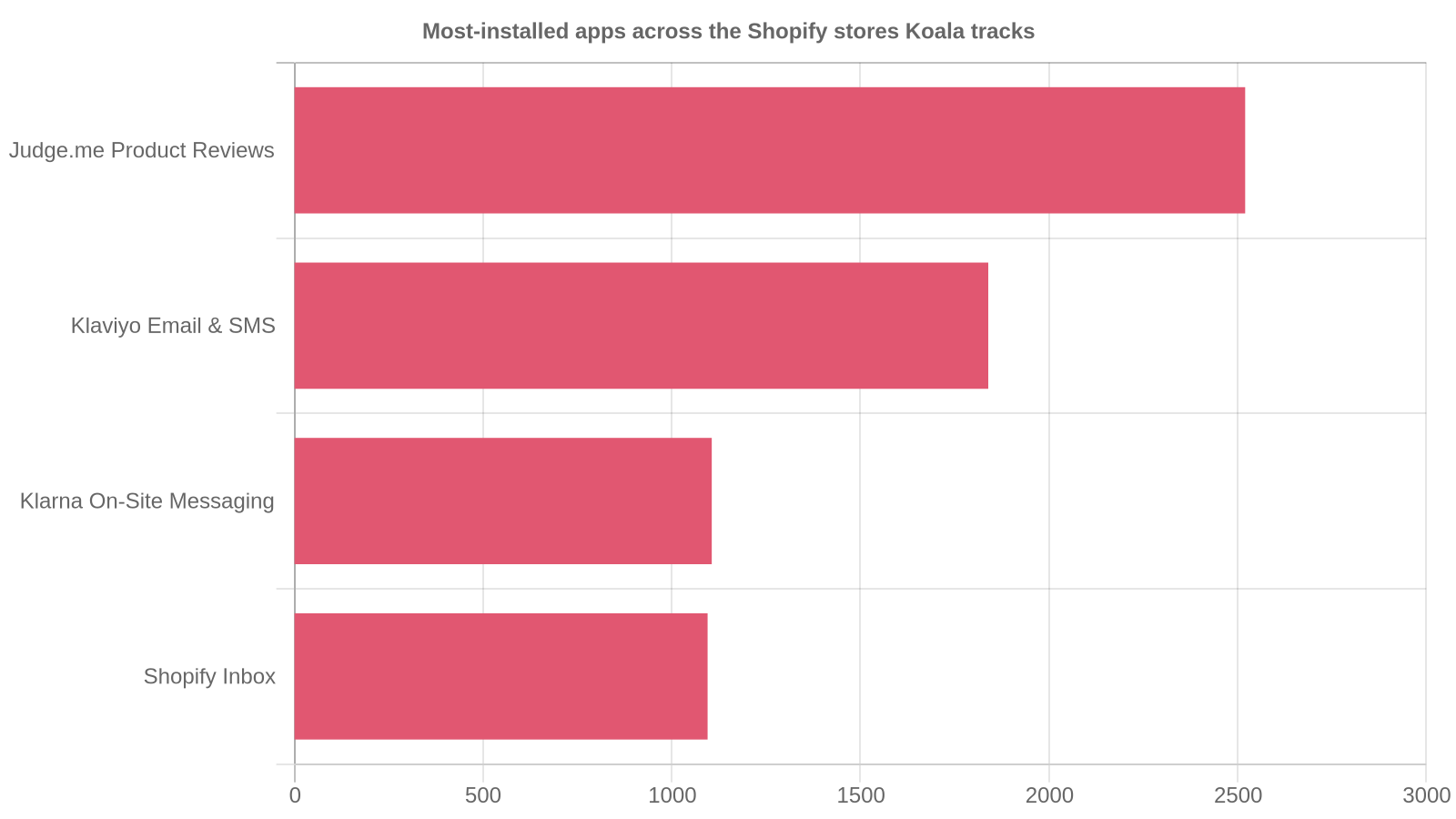
- Read the app stack behind it. A store with a review app, an email platform and a page builder installed has already spent money on conversion. In Koala's own data, across the stores Koala tracks, the top-ranked stores run a median of 11 Shopify apps, and the most-installed of them are conversion machinery: Judge.me appears on 2,520 tracked stores, Klaviyo on 1,839, Klarna's on-site messaging on 1,106 and Shopify Inbox on 1,095. Read that as a ranking of what serious storefronts bother to install rather than a census of Shopify.
- Count the live creatives. A competitor running several ads on one product right now has budget behind it and a creative that has already been tested. Entering there means paying to learn what they have already learned.
- Look at the discount. When the same item shows up at three different price points with strike-through pricing on two of them, the margin race has started and the winner is whoever can buy traffic cheapest.
None of those five signals live on a curated feed, because a feed is a list of products and every one of these is a fact about a store. Our guide on how to tell if a dropshipping product is saturated walks the same checks in more depth.
Koala Inspector was built for exactly this pass. Open a store and the dashboard loads on its own: active theme, category, product count, creation date, price range, catalog and likely best-sellers, all free. Find Suppliers costs 2 tokens and lists the suppliers selling the same product, split into exact matches and similar products, each with its delivery time, your landed cost and your estimated profit per unit. The count of exact matches already on sale is the fastest version of signal one, and the profit figure at your selling price shows how much margin is left to fight over. Ad Campaigns costs 2 tokens and splits a store's Google and Facebook or Instagram ads into tabs, with the URL, title, description and tags on each card, which covers signal four.
Where Shop Tracking changes the answer
A single look tells you where a product stands today. Saturation is a rate of change, so the more useful reading is what a competitor did over the last month.
Shop Tracking adds a competitor store to ongoing monitoring: Koala re-scans it and records apps added or removed, theme changes, products added or removed, price changes and variant changes to a per-shop activity feed, with more than ten event types in total. Watch three stores in your niche for two weeks and the pattern is unmistakable. When the same product appears in all three feeds and the prices start dropping, the window has closed. When one store quietly adds a product and nobody follows, you are early.
Shop Tracking costs 15 tokens per shop and needs a paid plan. Premium is $22 a month, includes 220 tokens and tracks up to 50 stores. See full pricing for the token packs.
The 7 best Ecomhunt alternatives
1. Koala Inspector (best free alternative)
Koala Inspector is a Chrome extension for Shopify research. Install it once, land on any Shopify store, and the analysis runs by itself.
The free tier is genuinely free. App detection, theme detection, catalog browsing, best-seller filtering, favorites and inspection history cost zero tokens with no card. The deeper reads run on tokens, and the free plan grants 15 a month: AI Shop Chat 1 token, CSV export 1, Find Suppliers 2, Ad Campaigns 2, Product Trends 2, Site Traffic 3, Shop Tracking 15 per shop. Premium is $22 a month for 220 tokens plus tracking on up to 50 stores.
- What you see about a store: products, likely best-sellers, price range, installed apps, active theme, traffic profile, live Google and Meta campaigns, and change history on tracked shops.
- Pricing (August 2026): free forever with 15 tokens a month, no card. Premium $22/mo. Token packs from $3.99.
- Best for: validating a product idea against the stores already selling it, without a subscription.
2. Winning Hunter (best Meta ad library)
Winning Hunter pairs a Meta ad library with Shopify sales tracking. Its pricing page publishes Basic at $49/mo, Standard at $79/mo and Premium at $249/mo, with extra seats at $20 each and roughly 40% off on annual billing. The detail most roundups skip: Basic is Meta only and tracks 2 brands. TikTok ads, Pinterest ads and the full dashboard filter set start at $79, where brand tracking rises to 30.
- What you see: Meta ad creatives, advertiser research, store revenue estimates, TikTok Shop search.
- Pricing (August 2026): $49 to $249/mo. No free plan.
- Best for: media buyers who need creative volume and days-running filters.
3. Dropship.io (best product database)
Dropship.io is the closest thing here to Ecomhunt's core promise, with a searchable database in place of a hand-picked feed. Its pricing page lists Basic $39/mo, Standard $59/mo and Premium $99/mo on monthly billing, dropping to $26, $34 and $49 on annual. Everything is metered in credits, from 10,000 product library credits on Basic up to 50,000 on Premium, and every tier includes a free trial.
- What you see: a product database with sales and revenue metrics, shop tracking, an ad library, TikTok Shop tracking.
- Pricing (August 2026): $39 to $99/mo monthly. Free trial, no permanent free tier.
- Best for: sellers who want to search a large catalog themselves rather than read a curated list.
4. Sell The Trend (best all-in-one)
Sell The Trend bundles product discovery, ad research and order fulfilment in one subscription, which makes it the natural upgrade for anyone who wants the feed and the store in the same tool. Its pricing page publishes Lite at $29.97/mo, Essential at $49.97/mo and Pro at $99.97/mo, falling to $19.97, $32.97 and $66.64 a month on annual billing, with a free trial on every tier. The Facebook winning ads finder starts at Essential and the TikTok viral ads finder at Pro.
- What you see: AI product discovery, a daily handpicked winner, ad finders, store connection and automated fulfilment.
- Pricing (August 2026): $29.97 to $99.97/mo monthly. Free trial, no permanent free tier.
- Best for: sellers who want research and fulfilment on one bill.
5. PPSPY (best for Shopify sales estimates)
PPSPY concentrates on Shopify store and product sales estimation, so it answers "how much is this store making" better than it answers "what should I sell". Its plan page publishes Standard $39/mo, Pro $99/mo and Business $299/mo, and its FAQ states you can register with an email for a trial with no card required. It does not report the apps or the theme a store runs.
- What you see: store and product sales estimates, store strategy signals, product research.
- Pricing (August 2026): $39 to $299/mo. Trial with no card.
- Best for: sizing a competitor before you decide to compete with them.
6. Minea (best multi-network ad coverage)
Minea tracks ads across Meta and TikTok from one dashboard, with Pinterest coverage referenced across the site. Its pricing publishes Starter at $49/mo, Premium at $99/mo and Business at $199/mo, falling to $39, $79 and $158 a month on quarterly billing, with AI analysis credits rising from 10 a month on Starter to unlimited on Business. It leans on training content alongside the tool.
- What you see: Meta and TikTok ad creatives, product discovery, supplier signals.
- Pricing (August 2026): $49 to $199/mo quarterly or monthly.
- Best for: European sellers buying across more than one network. Our Minea alternatives comparison goes deeper on the trade-offs.
7. Peeksta (cheapest paid entry point)
Peeksta is a product-research and ad-spy platform aimed at dropshippers, and it has the lowest paid entry price in this comparison. Its own site was unreachable while this was written, so the tiers here come from Capterra's Peeksta listing: Starter $19.99/mo, Advanced $49.99/mo and Premium $99.99/mo, with a free version noted and no free trial. Check the live pricing page before you subscribe.
- What you see: product research and ad creative tooling on a low monthly commitment.
- Pricing (as listed on Capterra, August 2026): $19.99 to $99.99/mo.
- Best for: sellers who want a paid database at the lowest monthly outlay.
Pricing shape compared
The entry price is the least interesting column. What matters is what shape the bill takes and how much you can do before you pay anything.
| Tool | Entry price (monthly billing) | Top published tier | Free plan | Pricing shape |
|---|---|---|---|---|
| Koala Inspector | $0 | $22/mo Premium | Yes, 15 tokens/mo, no card | Free core plus tokens for deep reads |
| Ecomhunt | $23/mo Basic | $49/mo Suite | No | Flat tiers by feed size and tracker sessions |
| Peeksta | $19.99/mo Starter | $99.99/mo Premium | Free version listed | Flat tiers |
| Sell The Trend | $29.97/mo Lite | $99.97/mo Pro | No, free trial | Flat tiers plus fulfilment |
| Dropship.io | $39/mo Basic | $99/mo Premium | No, free trial | Credit quotas per tier |
| PPSPY | $39/mo Standard | $299/mo Business | Trial, no card | Flat tiers |
| Winning Hunter | $49/mo Basic | $249/mo Premium | No | Flat tiers, networks gated by tier |
| Minea | $49/mo Starter | $199/mo Business | No | Flat tiers plus AI credits |
Prices read from each vendor's own published page in August 2026, except Peeksta's, taken from its Capterra listing. They move, so check before you subscribe.
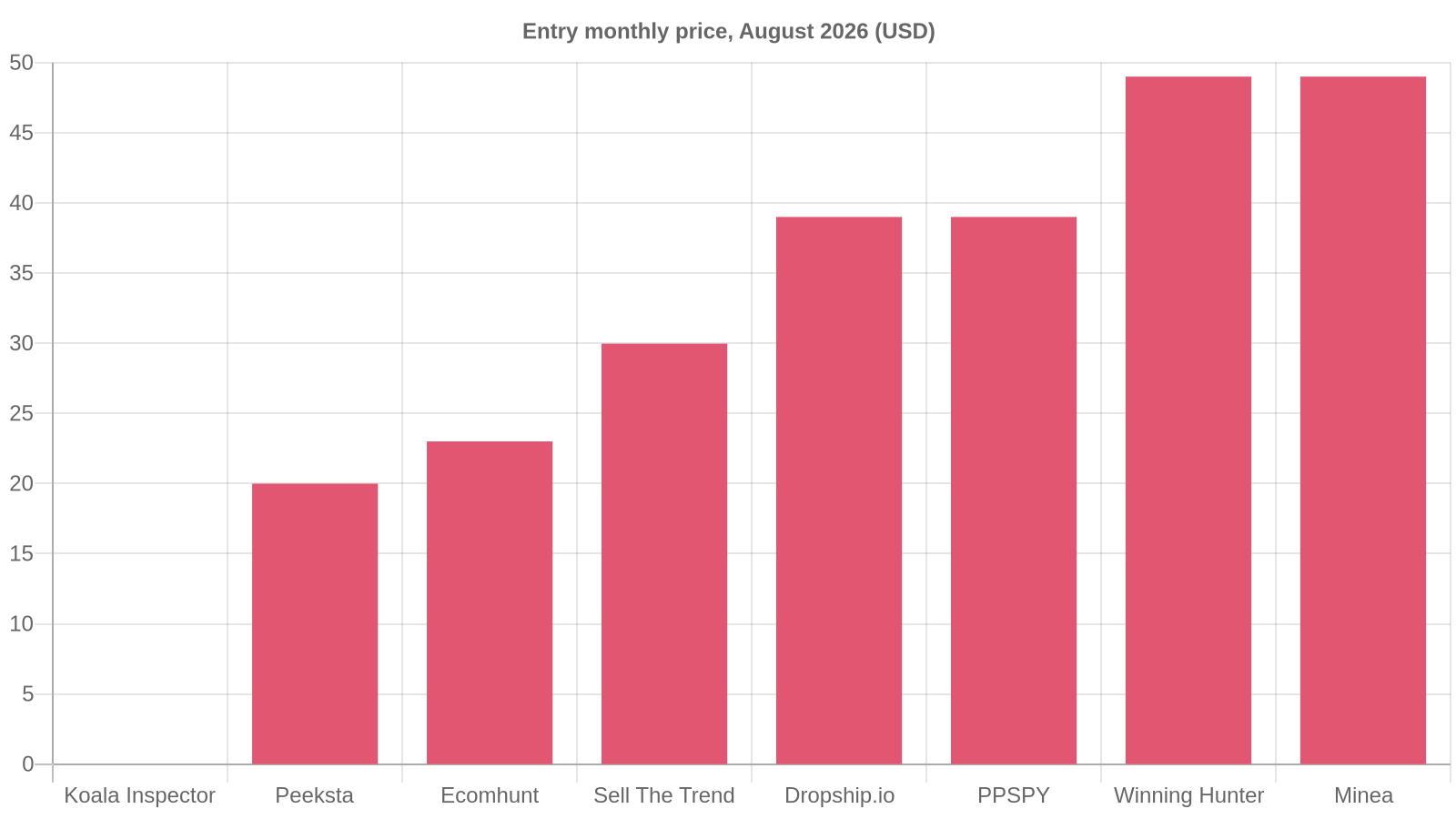
Two things fall out of that table. Six of the eight tools cannot be used at all until you pay, so your first competitor check becomes a paid experiment. And the only paid plan below every ad-spy entry tier, at $22 a month, is the one covering a job none of the others do: reading the storefront that already sells the product you were about to test.
Which one should you actually pick
Prices as of August 2026.
- You have a shortlist and want to know if you are late. Koala Inspector, free. Run the five-signal check above on the stores already selling it.
- You want ideas handed to you every morning. Stay on Ecomhunt or move to Sell The Trend, and check every pick against live stores before it gets budget. Our Ecomhunt extension breakdown covers what the extension itself shows.
- You buy Meta media daily. Winning Hunter at $79 for the full filter set, with Koala Inspector free alongside for the storefront read.
- You want to search a big database yourself. Dropship.io at $39.
- Your main question is what a store earns. PPSPY at $39.
- You want the lowest paid monthly commitment. Peeksta at $19.99, verified on its own page first.
What researchers say about Koala Inspector
Verified reviews from the Chrome Web Store.
“Awesome customer support. Insights into store AOV, products, traffic and campaign tracking is extremely helpful!”
 Gabe Abramovich
“Invaluable for competitive insights, Koala Inspector is easy to navigate and helps stay ahead in the Shopify marketplace.”
 Merico Monaldo
“Very easy to use and install. Helps with identifying Shopify stores quickly and saves time by listing best sellers. Also has handy feature of the traffic which I found very valuable.”
 Ali Baloch
Check the competition before you pay for the traffic
Saturation is expensive because it is invisible at the moment you decide. The product looks fresh on the list, the creative looks new, and the bill arrives two weeks later in the form of a cost per click nobody warned you about. The five signals above turn that guess into a ten-minute read on stores that are already live.
Install Koala Inspector free and open the first store already selling your next product idea. No card, no trial clock. Then put your three closest competitors on Shop Tracking and let the change feed tell you when the window is closing.
Ecomhunt alternatives FAQ
Every plan price in these answers was read in August 2026.
Ecomhunt alternatives FAQ
The questions sellers ask before they switch product-research tools.
What are some good alternatives to Koala Inspector?+
The closest alternatives are the tools built around searchable ad and product databases: Winning Hunter, Dropship.io, Sell The Trend, PPSPY, Minea and Peeksta. Each runs on a paid subscription, from $19.99 a month on Peeksta's Starter tier up to $299 a month on PPSPY's Business plan, and each is strongest at scanning a database rather than at reading one live storefront. None of them reports the apps installed on a Shopify store you open or the theme it runs, which is the specific job Koala Inspector does for free.
What is the best free Ecomhunt alternative?+
Koala Inspector. It is a Chrome extension with a free plan that covers store analysis, app detection, theme detection, catalog browsing and best-seller filtering at no token cost and no card. The free plan also grants 15 tokens a month, which covers deeper reads such as Find Suppliers at 2 tokens or a full traffic profile at 3 tokens.
How much does Ecomhunt cost?+
Ecomhunt publishes three paid tiers on its pricing page, read in August 2026: Basic at $23 a month or $279 billed annually, Pro at $39 a month or $468 annually, and Suite at $49 a month or $588 annually. The tiers differ mainly in how many live trending products and tracker sessions you get, and every paid plan carries a 30 day money-back guarantee.
Is Ecomhunt still worth it in 2026?+
It is worth it if you want ideas handed to you and you have a way to check them. Ecomhunt hand-picks new winning products every day, so the feed saves you the hunt. The risk is that every subscriber opens the same list on the same morning, so a pick can be crowded within days. Pair the feed with a store-first tool that shows you how many sellers already list the product and how established their stores are.
How do I know if a product from a curated list is already saturated?+
Check five things on live stores rather than on the list. How many other shops already sell the same item, how long their listings have been up, how deep their app stack is, how many ads they are running on it right now, and how far their prices have already been cut. A product sold by several established stores with mature app stacks and discounting under way is crowded, whatever the feed says.
Does Ecomhunt show live Shopify competitor stores?+
No. Ecomhunt is built around a curated product database and supplier-side signals, so it points you at items rather than at the Shopify stores selling them. Reading a live storefront, its catalog, its price range, its installed apps and its active theme is a different job, and it is what Koala Inspector's free tier is built for.
Sources
- Ecomhunt, pricing page - the Basic, Pro and Suite prices, the annual figures, the per-tier trending-product and tracker-session limits and the money-back guarantee, read 24 August 2026.
- Ecomhunt, homepage - the daily hand-picked product drop and the wording of the curation promise.
- Winning Hunter, pricing page - the $49, $79 and $249 monthly tiers, the per-seat price, the brand-tracking limits and which networks unlock at which tier.
- Dropship.io, pricing page - the Basic, Standard and Premium prices, the annual figures and the per-tier credit quotas.
- Sell The Trend, pricing page - the Lite, Essential and Pro prices, the annual figures and the free trial.
- PPSPY, plans page - the Standard, Pro and Business prices and the no-card trial.
- Minea, homepage - the Starter, Premium and Business prices, the quarterly figures and the Meta and TikTok coverage.
- Capterra, Peeksta listing - the Starter, Advanced and Premium prices and the free-version note, used because peeksta.com did not respond.
- Reddit, r/dropshipping on finding niches before they get saturated - oversaturated niches, thin margins and high ad costs named as the common beginner mistake.
- Reddit, r/dropshipping on where sellers actually find winning products - the gap between what a product list shows and how many merchants are already advertising the item.
- App install counts and the median app-stack figure are Koala's own data, aggregated across the Shopify stores Koala Inspector tracks (August 2026).
Written by
Ana Gelevska
eCommerce Content Writer
Ana Gelevska is a content writer with more than five years of experience creating content for eCommerce brands and global clients. She digs into each topic and the people it is for, then turns it into clear, useful articles that Shopify sellers and dropshippers can act on.
Connect on LinkedIn