Shopify for Clothing Brands: What 105 Busy Apparel Stores Actually Run
 By Assaf ShalinNovember 5, 2026
Shopify suits a clothing brand better than almost any other category it serves, and its own numbers show it. Apparel is the single biggest category among the 300 busiest Shopify stores Koala tracks: 105 of them, measured on 2 November 2026, spread across general Apparel, Footwear, Women's Clothing, Clothing Accessories, Casual Apparel and Athletic Apparel. The platform handles sizes, colours, drops and returns well enough that the biggest sellers in the category stayed on it, so the real question for a new brand is not whether Shopify works but what the brands already winning your segment have bolted onto it.
That second question is answerable, and the rest of this page answers it with the stacks those 105 stores actually run.
Apparel is the platform's biggest category, and its heaviest
Across the 105 apparel stores in that set, the mean installed app count is 18.2 and the median is 18, against 14.4 for the full 300-store benchmark in our Shopify app stack report. Clothing stores carry more software than the average busy store because they carry more problems.
The load is not even across apparel either. Casual Apparel averages 22.1 installed apps and Athletic Apparel 21.4, while Clothing Accessories runs the lightest at 15.9.
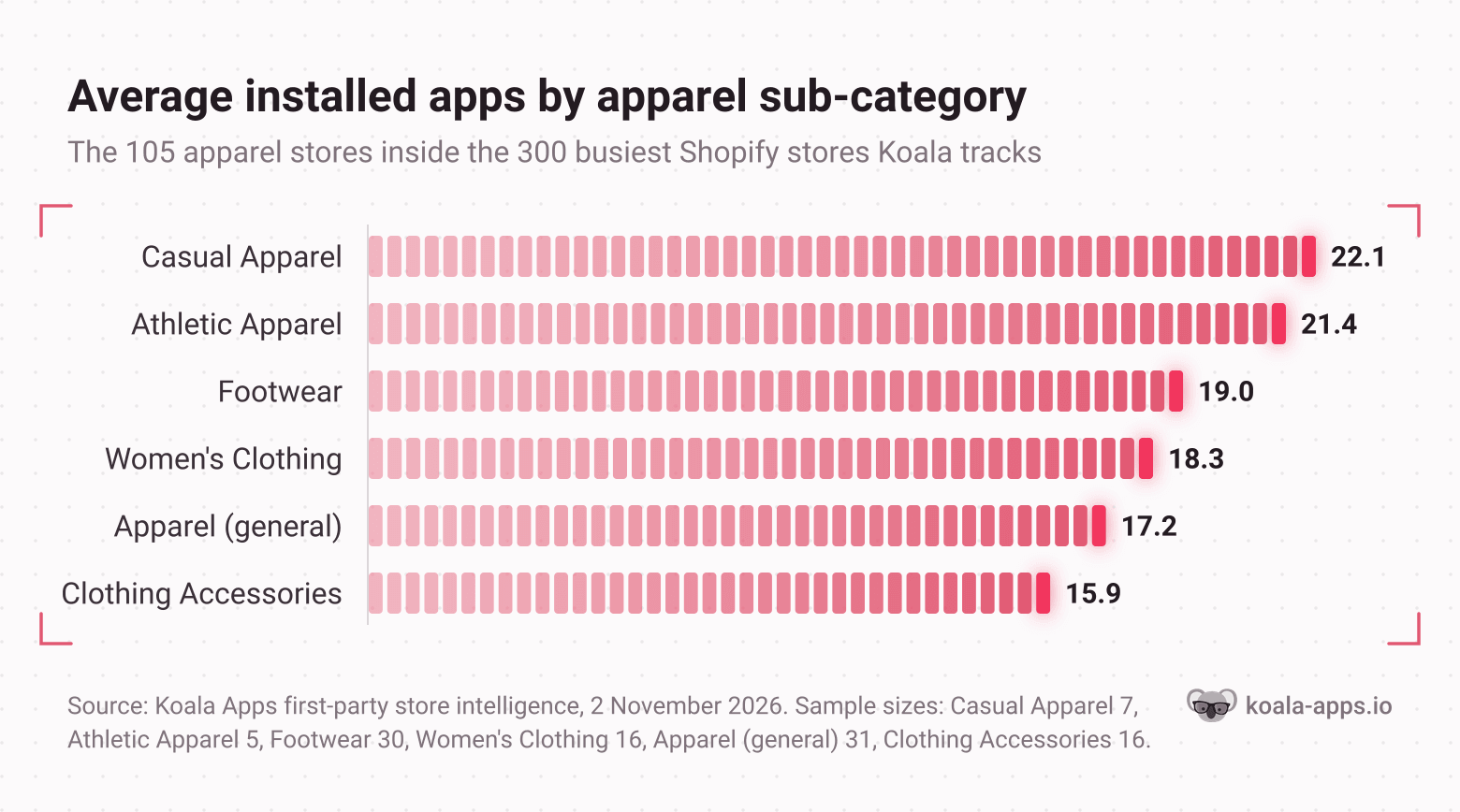
Read the small samples carefully. Casual Apparel and Athletic Apparel are 7 and 5 stores respectively inside this set, so treat those two bars as a direction rather than a precise figure. Footwear at 19.0 across 30 stores and general Apparel at 17.2 across 31 are the sturdiest numbers on the chart. All of it covers the stores Koala tracks, not all of Shopify.
The five problems a clothing store has to solve
A general store sells a thing. A clothing store sells a thing in nine sizes and four colours, to someone who cannot try it on, with a return rate that decides whether the margin survives. Five jobs follow from that, and every app in the next section exists to do one of them.
Size and variant handling. Size times colour times fit produces variant counts that a single-SKU store never meets. Shopify's default ceiling is 2048 variants per product, so the platform itself is not the constraint. Your product page is: nine size buttons and four colour swatches have to stay readable on a phone, and out-of-stock combinations have to look out of stock instead of broken.
Returns. Apparel returns are a cost of doing business rather than an exception, and they need a flow a customer can run alone. A returns portal that issues a label and offers an exchange before a refund is the difference between a return and a lost customer.
Fit guidance. Most size-related returns are decided before checkout, at the moment someone guesses between a medium and a large. A size chart tied to the actual garment measurements, plus a recommender that uses what the shopper already owns, removes guesses from the one screen where guessing costs you twice.
Lookbook merchandising. Clothing sells in outfits. The stores that do this well run collection pages that read like a lookbook, shoppable imagery, and product pages that show the same garment styled rather than only flat.
Seasonal drops. A drop concentrates demand into an hour. That needs back-in-stock alerts, pre-orders for the sizes that sold through, and an email and SMS list warmed up before the drop rather than after it.
What the busiest apparel stores install
Four apps sit under almost every apparel stack in Koala's data, and each one owns a different layer.
| Layer | App | Tracked stores running it |
|---|---|---|
| Social proof | Judge.me Product Reviews | 199,567 |
| Email and SMS | Klaviyo | 198,118 |
| Payment flexibility | Klarna On-Site Messaging | 92,770 |
| Photo reviews | Loox | 52,238 |
Those are store counts across all the Shopify stores Koala tracks, measured on 2 November 2026, not counts inside the 105. They are the base layer any category builds on: proof that the garment looks like the photo, a list you own, and a price presented in instalments on a product that costs more than an impulse buy.
The apparel-specific layer sits on top, and it maps straight onto the five problems above.
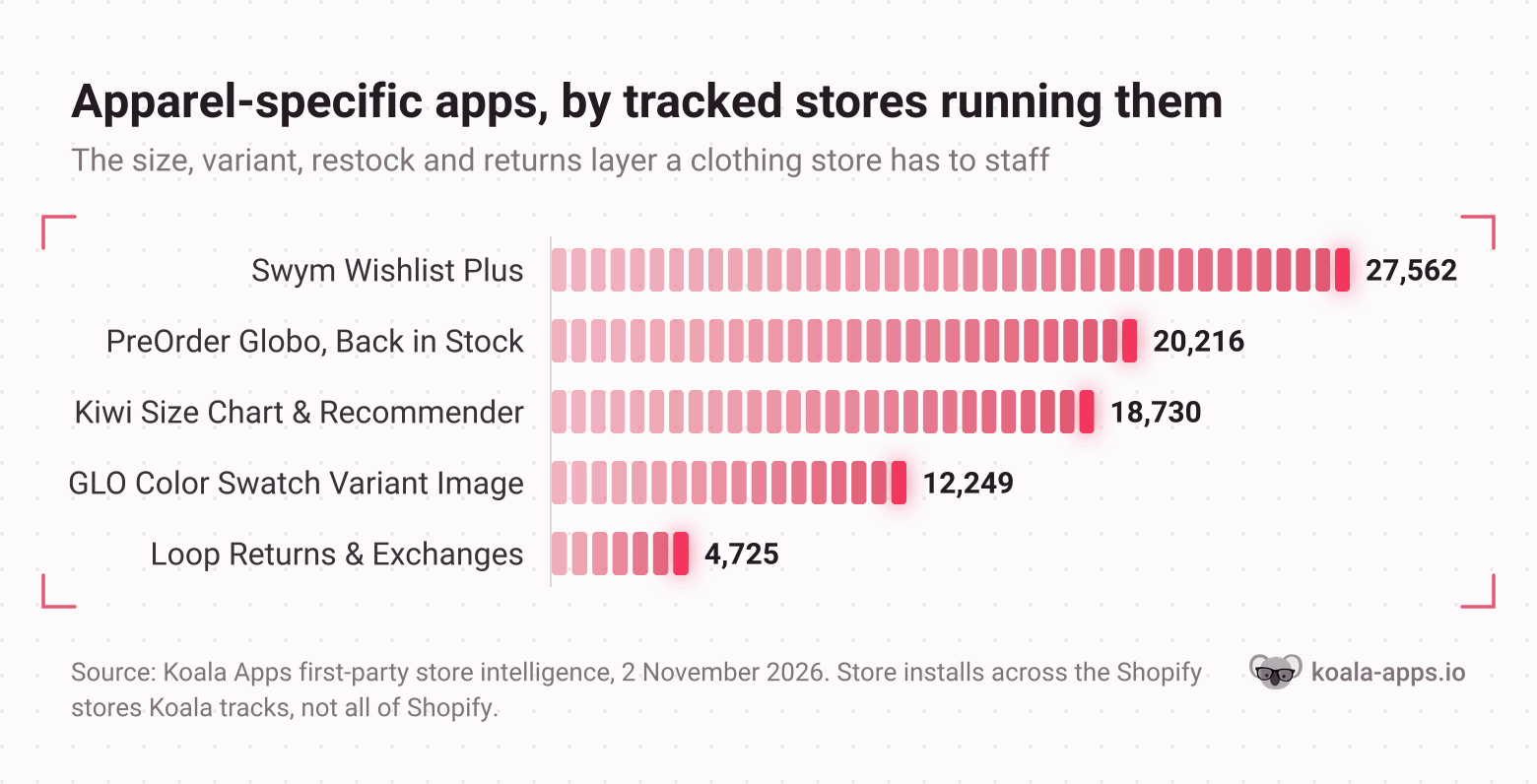
Wishlists and back-in-stock alerts lead because they both solve the drop: a shopper who wanted the sold-out size tells you so, and you email them when it lands. Size charts and colour swatches handle the product page. Returns software sits lowest because it is the layer brands add once volume makes manual returns painful, which makes an early install a genuine competitive edge rather than table stakes.
Our hand-picked list of the best Shopify apps for clothing stores goes through each of these categories in detail, and the best Shopify themes for clothing covers the layout half of the same problem.
What Shopify costs in November 2026
Verified on Shopify's US pricing page on 5 November 2026. The page shows yearly billing by default, so these are the yearly-equivalent monthly figures, with the pay-monthly price beside them.
| Plan | Paid yearly (per month) | Paid monthly | Who it fits |
|---|---|---|---|
| Basic | $29 | $39 | A new brand with one person running it |
| Grow | $79 | $105 | Steady orders, a second staff account, lower card rates |
| Advanced | $299 | $399 | Multiple staff, deeper reporting, international pricing |
| Plus | $2,300 | From $2,300 | High volume, custom checkout, multiple storefronts |
Shopify also lists a 3-day free trial with no credit card, then a promotional $1 a month for 3 months before the plan price starts. Prices are US dollars and change, so check the live page before you budget against these.
Basic carries a clothing brand further than most founders expect. The jump to Grow is usually forced by staff accounts and card rates rather than by anything missing from the storefront.
Budget for the apps on top, because the plan is the small number
Of the 105 apparel stores, 99 carry a modeled monthly app spend figure in Koala's data. The median is about $27,300 a month and the middle half lands roughly between $9,800 and $81,000.
Those are the busiest apparel stores on the platform, and that number is a description of what volume funds rather than a target. Do not read it as a startup budget. Read it as proof that app subscriptions become a real line item, billed on your Shopify invoice rather than appearing in your sales reports, and that they scale with orders.
A new clothing brand can cover the five jobs above for well under $100 a month, because the review, email and wishlist layers all have genuine free tiers at low order volume. We break the pricing tiers down properly in how much Shopify apps cost. The discipline is simple: install an app when you can name the job it does and the number it should move, and uninstall it when the number does not move.
Read three rival stacks before you buy a single app
This is the part most launch guides skip, and it is the one that saves you money.
A founder on r/smallbusiness this autumn put it exactly right while asking where to put a limited marketing budget for a European activewear brand: Meta ads, micro-influencers, user-generated content, or their own Reels. Limited marketing budget came up 5 times in our latest research window against 3 in the one before, so that question is getting louder, not quieter. Every answer in a thread like that is somebody's guess. Meanwhile the brands already selling in that exact segment have paid to find out, and their answers are sitting on their storefronts.
So do this instead of working from a generic apparel app checklist:
- Pick three clothing brands already selling well in your segment. Your segment, not apparel in general. A streetwear drop brand and a bridal label solve different problems.
- Open each storefront with the Koala Inspector Shopify app detector and list every app it runs, grouped by type.
- Compare the three lists. What all three run is the category standard. What one runs alone is an experiment you can watch rather than fund.
- Build your stack from the overlap, and leave the rest until you have a reason.
The app detector is free, it costs no tokens, and each app it finds links straight to its Shopify App Store listing so you can check pricing before you commit. There is also a browser-based Shopify app detector if you would rather paste a store URL than install anything.
Three stacks take about ten minutes to read. Three stacks learned by trial takes months of subscriptions.
What merchants say about Koala Inspector
Verified reviews from the Chrome Web Store.
“Very easy to use and install. Helps with identifying Shopify stores quickly and saves time by listing best sellers. Also has handy feature of the traffic which I found very valuable.”
 Ali Baloch
“I was a bit skeptical about all the hype but gave Koala Inspector a shot. It's user-friendly and provides useful data on what's working for others. The support team is also there when you need them.”
 Martin René
“Great tool for competitor research and customer support is really quick!”
 Aiswarya S
Shopify for clothing brands FAQ
Shopify for clothing brands FAQ
The questions apparel founders ask before and just after launch.
Is anyone actually running ChatGPT ads for their Shopify store?+
Yes, and the merchants doing it publicly describe it as a test rather than a channel they rely on. Threads in r/digital_marketing in late 2026 are full of sellers asking each other how much spend it takes before the data means anything and how the cost per click compares with Google, which is the shape of a channel nobody has benchmarked yet. For a clothing brand with a small budget, the sensible order is to make your existing paid traffic convert first, because a new ad surface does not fix a product page that loses visitors at the size selector. If you do test it, ring-fence the spend as a learning budget and judge it against the cost per order you already get elsewhere.
Are Shopify point of sale payments secure?+
Shopify is a PCI DSS compliant provider and states so on its own security pages, which means card data is handled inside Shopify's certified environment rather than stored by you. For a clothing brand that sells at markets, pop-ups or a studio alongside the online store, that matters twice over: the same compliance covers the card reader and the online checkout, and stock and customer records stay in one admin instead of two. Your own obligations are the ordinary ones, which are a strong admin password, two-step verification on every staff account, and staff permissions that match what each person actually does.
Can I use my own domain name with Shopify?+
Yes. Every store is issued a myshopify.com address when you sign up, and Shopify's own domain documentation covers both buying a domain through Shopify and connecting one you already own from another registrar. The myshopify.com address keeps working underneath as the store's permanent identifier. For a clothing brand the custom domain is worth doing before your first campaign, because the domain is the thing people type, screenshot and tag.
Can I use Shopify for free?+
There is no permanently free Shopify plan. As of 5 November 2026 Shopify's pricing page offers a 3-day free trial with no credit card required, followed by a promotional 1 US dollar a month for 3 months, after which Basic is 29 US dollars a month on the yearly billing the page shows by default, or 39 a month if you pay monthly. Build your product pages, size guides and policies during the trial so the first paid month starts with a store that can take an order.
Do I need to be a designer or developer to use Shopify?+
No. Shopify's own website builder page leads with the line that you can make your mark with no code needed, and the theme editor is drag and drop, so a clothing brand can launch a full catalogue without touching Liquid. The harder skill is merchandising judgement. One fashion merchant on r/shopify described running the Prestige theme, customising it heavily and still not converting, then asking what the point of a premium theme was. A theme gives you a layout, and the product photography, the size guidance and the order you put information in are what make it sell.
Has anyone experienced a drop in sales when bot add to cart activity suddenly spikes on Shopify?+
Merchants ask this on r/shopify regularly, and the first thing to separate is whether your orders fell or only your conversion rate did. Automated traffic inflates sessions and add-to-carts without ever reaching checkout, so the rate drops on its own while real orders sit flat, and that reads as a sales collapse on a dashboard. Check the raw order count for the same period, then segment sessions by country, device and referrer in Shopify's analytics, because a sudden spike from one unexpected source is the usual signature. If real orders did fall, look for a change you shipped in the same window such as a theme update, a new app, or a price or shipping change, before you blame the traffic.
How we measured
The store figures come from Koala's own store intelligence: the 300 Shopify stores with the highest modeled traffic among the stores Koala tracks, read on 2 November 2026. Of those 300, 105 sit in one of six apparel sub-categories, which is the largest category group in the set. App install counts are store counts across the full set of Shopify stores Koala tracks, read on the same date, so they are much larger numbers than the 105 and should be read as platform-wide popularity among tracked stores.
What is counted: Shopify apps a store's public storefront runs, the store's category, installed app count, and a modeled monthly app spend where one can be derived, which was 99 of the 105 apparel stores. What is not counted: private or custom apps with no public storefront footprint, apps installed but disabled on the storefront, and any store outside Koala's tracked set. Traffic and sales figures used to rank the sample are modeled from public signals any visitor's browser can already see, sampled over time, never from a store's private dashboard.
Coverage: these are the stores Koala tracks, not every Shopify store, so treat every figure here as a benchmark for busy apparel stores rather than a platform-wide statistic. Shopify plan prices were read directly from Shopify's US pricing page on 5 November 2026 and move without notice.
Numbers and charts on this page are free to quote with a link back to this URL.
Start with the stack your competitors already paid to find
A limited budget is the normal starting condition for a clothing brand, and the cheapest research you can do is reading what the brands beating you already decided.
Install Koala Inspector free, open the three clothing stores you most want to beat, and read their app stacks before you add another subscription to yours.
Sources
- Koala Apps first-party store intelligence, read 2 November 2026: the 105 apparel stores inside the 300 busiest tracked Shopify stores, their app counts by sub-category, the store-install counts per app, and the modeled monthly app spend. Methodology in the "How we measured" section above.
- Shopify, Pricing - Basic, Grow, Advanced and Plus prices on both billing cadences, the 3-day free trial and the promotional first months, read 5 November 2026.
- Shopify, PCI compliant hosting - the PCI DSS compliance statement behind the point of sale answer, read 5 November 2026.
- Shopify Help Center, Domains - the default myshopify.com address and the two routes to a custom domain, read 5 November 2026.
- Shopify, Ecommerce website builder - the no-code theme editor claim, read 5 November 2026.
- Shopify.dev, ProductVariant - the default limit of 2048 product variants per product, read 5 November 2026.
- r/smallbusiness, "If you were starting an activewear brand today" - the limited-marketing-budget question this page is built around, read 5 November 2026.
- r/shopify, "Best Shopify themes for conversion (fashion website)?" - the merchant running Prestige and still not converting, read 5 November 2026.
- r/digital_marketing, "What are people actually seeing from ChatGPT Ads so far?" and "How much budget did you need before ChatGPT Ads gave you usable data?" - merchants treating ChatGPT Ads as an unbenchmarked test, read 5 November 2026.
Written by
Assaf Shalin
Co-founder & Developer, Koala Apps
Assaf Shalin is a co-founder of Koala Apps and one of the developers behind Koala Inspector. He builds the tools that let Shopify sellers see what is actually working in other stores, from installed apps and themes to best-selling products. On the blog he covers the technical side of store research: how competitor research really works, what public store signals can and cannot tell you, and how to turn them into decisions.
Connect on LinkedIn