Best Shopify Wishlist Apps in 2026, Ranked by the Stores Running Them
 By Koala TeamOctober 22, 2026
The most-installed wishlist app on Shopify is Swym Wishlist Plus, running on 27,606 stores across the Shopify stores Koala tracks. Notify! Back in Stock+Wishlist follows on 6,570, Growave: Loyalty & Wishlist on 5,180, Wishlist Hero on 4,817 and Swish (Wishlist King) on 3,634, counted on 22 October 2026.
One number on that list needs a warning attached before you act on it. Swym paused Wishlist Plus for every merchant in October 2026 after a security incident, and the app is not installable from the Shopify App Store today. The detail is in the Swym section below, and it changes what the leaderboard means rather than what it says.

Want to see apps on any Shopify store?
Download for free and start exploring a whole new ecommerce world!

The category is unusually concentrated, and that is useful
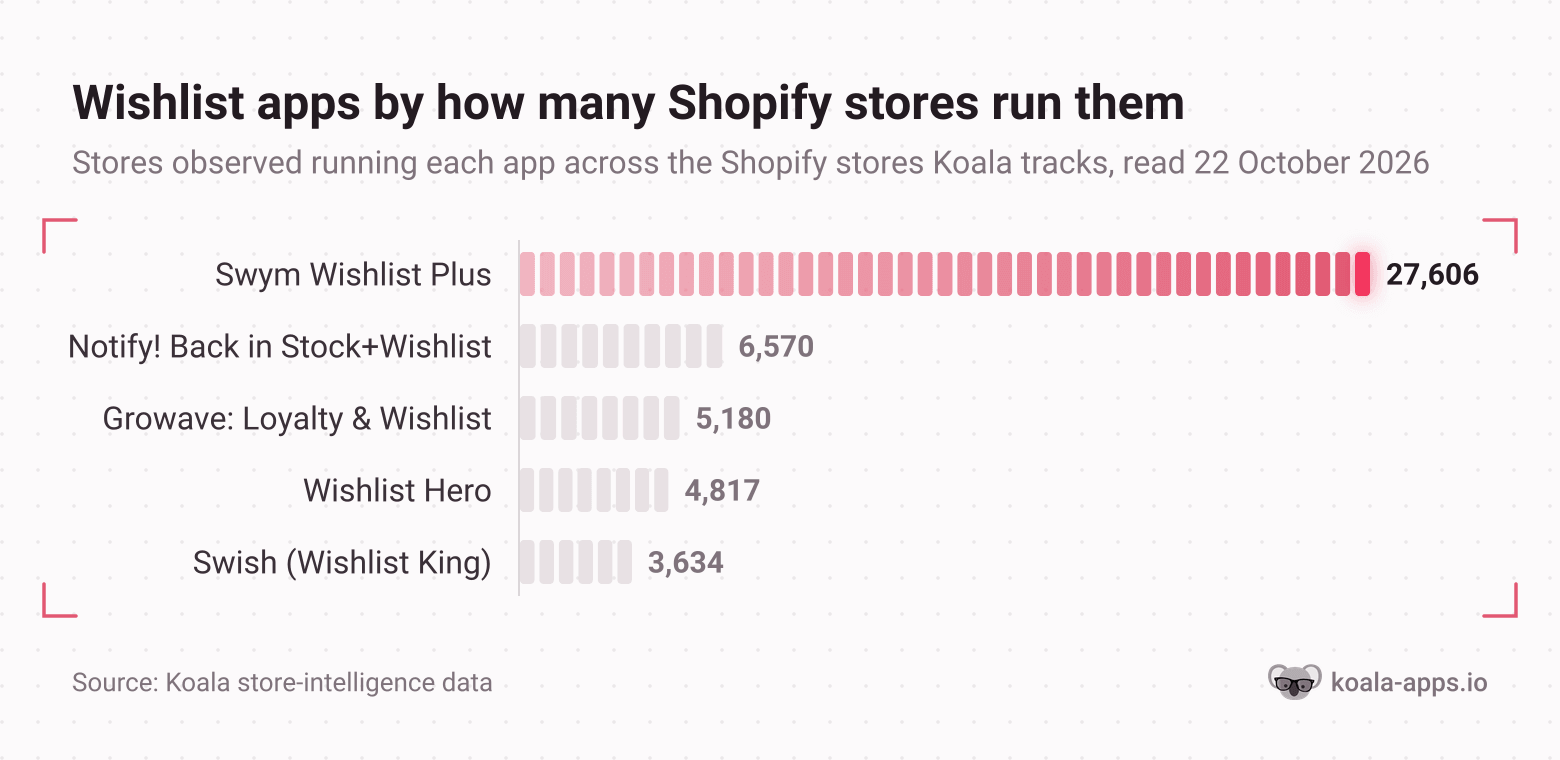
Swym runs on more than four times the stores of the app in second place. In most Shopify app categories the top three sit within shouting distance of each other. Here one app took the whole category and the rest share a flat tail between roughly 3,600 and 6,600 stores.
A gap that wide usually means one app arrived first, became the answer every agency gave, and never had to defend the position on features. The flat tail underneath says the same thing from the other side: nothing since has separated itself enough to pull merchants away. For you, that is good news. The apps in the tail are competing on price and on the things Swym made merchants stop asking about, which is why one of them sends alert emails on a four dollar plan.
Two caveats before you read anything into the order. These are counts across the Shopify stores Koala tracks, not a census of the platform, and that coverage leans toward the dropshipping and direct-to-consumer stores our users research. And an install count measures adoption, not results. It tells you what merchants in your niche kept paying for, which beats a ranked opinion as a starting point, and it says nothing about whether the app will earn its fee in your store.
Swym's position also makes the point that an install count is history rather than a recommendation. It was earned over years and it survives an app being switched off, because the app is still sitting in all those admins. Read the leaderboard as a map of what the category chose, then check the app is still something you can buy.
Swym Wishlist Plus, 27,606 stores
Swym Wishlist Plus is the app that defined this category. Its parent product covers wishlists, save for later, back in stock and gift registry, and Swym's own site describes automating price drop, low stock and back-in-stock alerts, which is the fullest alert set any app here claims.
Here is the part that matters this month. On 20 October 2026 Swym published an incident FAQ describing unauthorised activity that affected some merchant stores, in which attackers attempted to inject malicious code into storefronts through the app in order to redirect shoppers away. Swym's response was to pause the app for every merchant at once and revoke Shopify access for Wishlist Plus and all other Swym apps, impacted or not, as a precaution. The FAQ tells merchants to turn off the Swym theme app embeds, check theme files for edits, and search them for a named malicious domain. Swym reports no evidence that merchant data or customer personal information was compromised, except on stores where the malicious code was actually deployed and a shopper then entered details on the external site. Wishlist data is preserved while access is paused, and no restore date has been given.
The App Store agrees. The old Wishlist Plus listing now returns a page saying the app is not currently available on the Shopify App Store, and Swym's developer page lists two apps today, Swym Gift Lists and Registries and Swym Back in Stock Alerts, with Wishlist Plus absent from both.
So the honest reading: 27,606 stores is a real measure of how thoroughly this app won the category, and it is not a reason to pick it this week. If you already run it, follow the FAQ steps rather than this page. If you are shopping, pick from the four below and revisit Swym when it returns.
Notify! Back in Stock+Wishlist, 6,570 stores
Notify! reached second place from the restock side. It is a Built for Shopify app rated 4.9 across 3,933 reviews, and the wishlist is the newest of three things it does, alongside restock alerts and pre-orders. Buttons go on out-of-stock product, home and collection pages, alerts go out by email, SMS and push, and the listing names a guest wishlist among its list types.
Shoppers can save without an account. What they get back is the restock alert, which Notify! sends across all three channels, plus a low-stock counter and low-stock notifications on the paid tiers. Price-drop alerts are not named on the listing, so if a sale email is the one you want, look at Wishlist Hero or Swish instead.
The free plan is the real entry point and the limits tell you what it is for: 10 restock notifications, 5 pre-orders and 50 wishlist actions a month. Kickstart at $9.90 a month takes that to 500 alerts and 2,000 wishlist actions with full widget and email customisation, Starter is $19.90 and Standard is $39.90 with 1,500 alerts and 10,000 wishlist actions.
That install count is doing something specific. Very few of those 6,570 stores went looking for a wishlist app. They installed Notify! for restock alerts, found a wishlist bundled in, and switched it on. Which makes it the obvious pick if your products go out of stock often, and a strange one if they never do, because you would be paying for the half of the app you do not use.
Growave: Loyalty & Wishlist, 5,180 stores
Growave is the broadest bundle in the category: loyalty points, VIP tiers, referrals, product reviews and wishlists in one app, rated 4.8 across 1,289 reviews. The wishlist side lists favourites, save for later, public wishlists, guest wishlists and gift or in-store registries, with multiple lists, share links, add to cart and conversion analytics.
Guest saving is supported. Alerts are where the plan card bites. Stock alerts and price alerts appear under wishlist customisation, but back-in-stock emails are named specifically on the Growth plan at $199 a month. The free plan covers 200 orders a month across loyalty, wishlist and reviews together, Entry is $15 a month to 500 orders, Growth is $199 and Plus is $499.
Read the install count as a loyalty number that happens to include a wishlist. Growave also appears in our loyalty app roundup at the same store count, because it is the same installs counted from the other side. The case for it is arithmetic: if you were going to pay for points, reviews and a wishlist separately, one free tier covering all three to 200 orders a month is the cheapest way to test whether any of them move anything. The case against is equally plain. If the wishlist is all you want, you are shopping in the wrong aisle, and the alert email you came for costs $199.
Wishlist Hero, 4,817 stores
Wishlist Hero by Revamp is the price-performance pick and the only app here that answers the account question in writing. Its listing states that shoppers can use the wishlist as a guest user with no login required. Rated 4.7 across 416 reviews, with one-click theme setup and free help, saving from product, collection and quick-view pages, sharing by email or social, and multiple currencies and languages.
On alerts it is the cheapest serious option in the category. Low-stock and on-sale email reminders arrive on the Silver plan at $4 a month, which is where the price-drop email most merchants actually want starts. Back-in-stock alerts are not named on the listing, so a store with frequent stockouts is better served by Notify!. Tracking is unusually complete for the price, with Klaviyo, GA4, Facebook and TikTok pixels on the same Silver tier.
Plans run on wishlist additions rather than orders: free to 500 additions a month, Silver $4 to 1,000, Gold Plus $17 to 5,000 with SendGrid, Klaviyo and OmniSend integrations and a REST API, and Platinum $29 to 10,000.
A 4,817-store install count with 416 reviews says this app sells on price and keeps the stores it wins. It is the one to start with if you want saved items plus a sale email and would rather not think about it again.
Swish (Wishlist King), 3,634 stores
Swish is the premium end, and the only app here with no free plan at all. It is Built for Shopify, rated 4.9 across 289 reviews, the highest rating in the roundup, and it is priced by the Shopify plan you are on: Basic $19 a month, Shopify $29, Advanced Shopify $49 and Shopify Plus $99 with white-glove onboarding, a dedicated account manager and Hydrogen and headless support. Every tier includes all features and free setup, and every tier carries a 30-day trial.
Guest wishlists are named among its list types, alongside public wishlists, favourites and save for later. On alerts it is the most complete of the four installable apps, with purchase alerts, price alerts and stock alerts all listed, plus Klaviyo, GA4 and Meta integrations and Tapcart support out of the box.
The smallest install count here is the most informative one on the page. Charging $19 before a store has saved a single item filters out everyone browsing for a free heart icon, so 3,634 stores means 3,634 merchants who decided a wishlist was worth a line item. The free setup service is what they are buying along with it, and for a store on a heavily customised theme that is usually the expensive part.
The comparison table
Install counts are Koala's own, read on 22 October 2026. Guest saving, alerts, ratings and prices come from each app's Shopify App Store listing, read on 22 October 2026, and every app is linked so you can check it yourself before you subscribe.
| App | Login needed to save? | Alerts it sends | Stores in Koala's tracked set | Cheapest plan with alerts | Rating |
|---|---|---|---|---|---|
| Swym Wishlist Plus | Not verifiable, listing withdrawn | Price drop, low stock, back in stock (app paused) | 27,606 | Not installable today | Listing withdrawn |
| Notify! Back in Stock+Wishlist | No, guest wishlist listed | Back in stock by email, SMS and push; low stock | 6,570 | Free plan, 10 alerts/month | 4.9 (3,933) |
| Growave: Loyalty & Wishlist | No, guest wishlist listed | Stock alerts, price alerts; back-in-stock emails on Growth | 5,180 | $199/month for back-in-stock emails | 4.8 (1,289) |
| Wishlist Hero | No, stated outright on the listing | Low stock and on-sale email reminders | 4,817 | $4/month (Silver) | 4.7 (416) |
| Swish (Wishlist King) | No, guest wishlist listed | Purchase alerts, price alerts, stock alerts | 3,634 | $19/month (Basic) | 4.9 (289) |
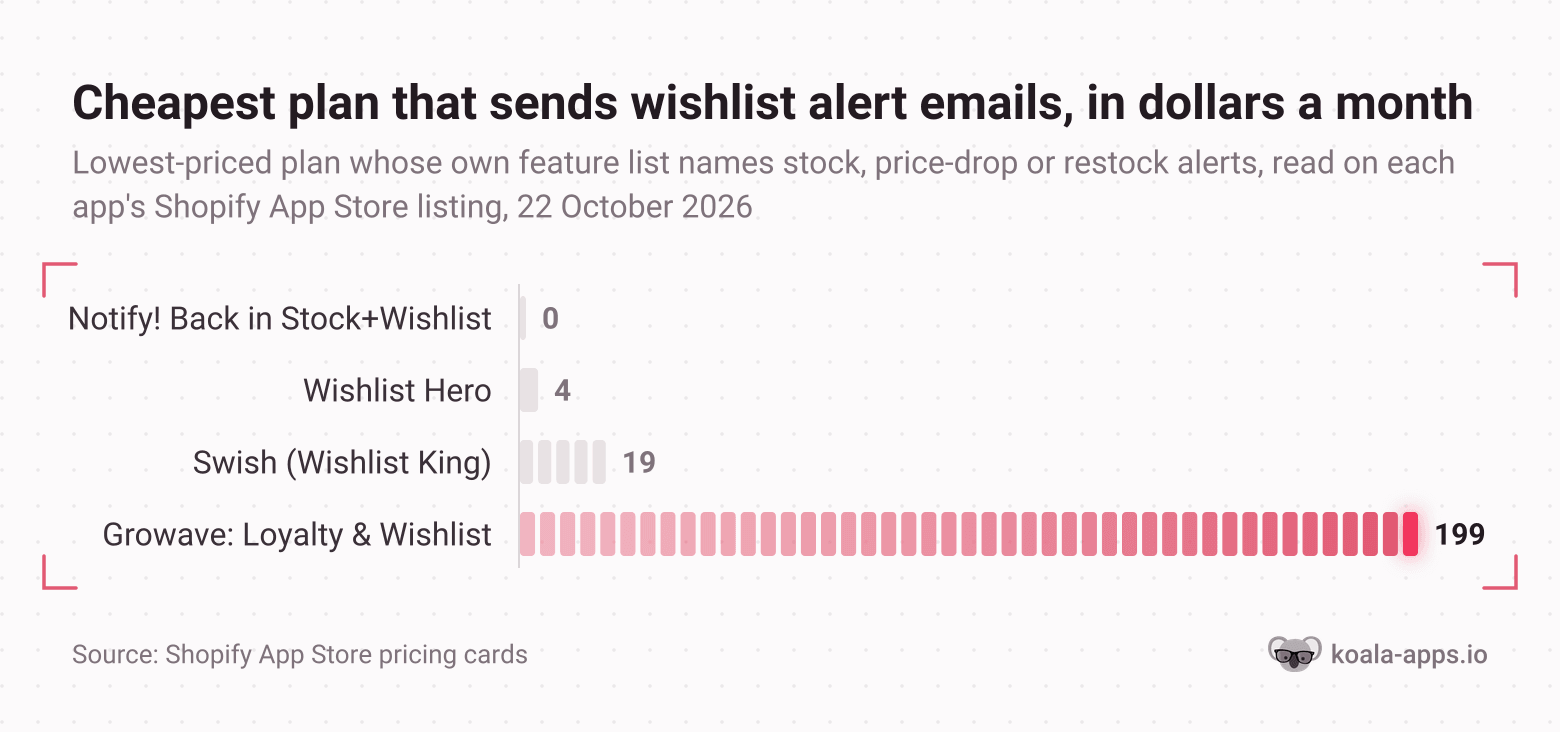
That chart is the whole buying decision compressed into four bars. Every app here will put a heart on your product page. The spread is in what it costs to email the shopper afterwards, and it runs from nothing to $199 a month for a feature that is technically the same job in all four apps.
What a wishlist actually tells you
A saved item is the clearest statement of intent a store gets without a sale. The shopper found the product, liked it enough to come back to, and stopped short of paying. Nielsen Norman Group's research on saving products for later describes the mental split precisely: adding to a list meant "I definitely want that" while adding to the cart meant "I might want that", and shoppers used the cart as a holding area for items they were not ready to buy and did not want to abandon.
That research also explains why the login question decides whether any of this works. Across the sites studied, participants were reluctant to use wishlists that required registration, because of the setup effort expected, and one checkout was derailed when the save option demanded an account. The recommendation was blunt: do not require registration or login for save for later. Every installable app on this page now supports guest saving, which is that lesson absorbed by a whole category.
The same logic runs in the other direction, and this is the part most merchants miss. If your own saved items tell you what your shoppers want before they buy, then a competitor's most-favourited and best-selling products tell you what their shoppers want before you stock it. Koala Inspector shows that side for free: a store's full catalogue, its likely best sellers, and the products users favourite. One of those is your own demand signal. The other is everyone else's, and it is available to you without running a single test of your own.
Which turns the usual stocking question around. Instead of listing a product and waiting a quarter to find out whether anyone saves it, you can read what the stores already winning your niche are selling hardest, and stock against that.
Check what the stores in your niche installed
The most common complaint merchants post about their own store is some version of "my conversion rate is flat and I cannot work out what I am missing". Working it out from inside your own admin is slow. Reading the stack of a store already beating you is fast, and a wishlist app is one of the easiest things to spot.
Koala Inspector's Shopify app detector lists every app installed on any live Shopify storefront and groups them by type, with a link out to each one in the App Store. It is completely free and costs no tokens, so you can check as many stores as you like.
The check takes a few minutes per store:
- Search your main keyword, open the top three stores outranking you, or paste a competitor's URL straight into the extension.
- Click Koala Inspector and read the app list. Wishlist apps show under the marketing and conversion grouping.
- Open the same store's product page and look for the save control: a heart, a "Save for later" link, an "Add to wishlist" button. That tells you how they configured what they bought.
- Try saving an item as a guest. If the store asks you to sign in first, you have just watched a competitor lose the shoppers the research above says they will lose.
Run that across three competitors and the pattern separates a category standard from one store's budget. If all three run a wishlist app, the saved-items email is table stakes in your niche. If none of them do, the four dollars a month below is the cheapest edge on this page.
Install Koala Inspector free and check your three closest competitors before your next subscription.
Picking one
Three store shapes cover almost all of it.
Your products go out of stock. Notify! is the answer and the wishlist comes free with it. The restock alert is worth more to you than a price-drop email, and the free plan proves the mechanism before you pay anything. Our back-in-stock app roundup covers that category properly if restock alerts are the real job.
You want saved items and a sale email, and nothing else. Wishlist Hero at $4 a month. It states guest saving on the listing, sends low-stock and on-sale reminders from the cheapest paid tier, and carries pixel tracking most apps reserve for higher plans.
You were going to buy loyalty or reviews anyway. Growave, on the free tier, to 200 orders a month. Three apps in one is the cheapest way to find out which of the three your customers respond to. Go in knowing back-in-stock emails sit at $199.
And if your theme is heavily customised or you run headless, Swish earns its $19 on the setup service alone.
Whichever you pick, set the bar before you install. Count wishlist adds for a month, count what the alert emails brought back, and uninstall if the second number does not clear the fee. Our profit margin calculator runs that sum against your own figures.
Then run one nudge at a time. Stacking a wishlist prompt, a loyalty popup and an exit offer on the same product page is where merchants lose track of which one moved anything.
How we counted
- Install counts: the number of Shopify stores in Koala's tracked set observed running each app, read on 22 October 2026. This is Koala's own store coverage, weighted toward the dropshipping and direct-to-consumer stores our users research, so read it as a strong sample of working merchants rather than a Shopify-wide census.
- Which apps qualify: the wishlist apps that appear in Koala's 250 most-installed Shopify apps. An app below that line is not on this page, so treat the list as the category's leaders rather than every wishlist app on the platform.
- Guest saving, alerts, ratings and prices: taken from each app's Shopify App Store listing on 22 October 2026 and linked in the table. "Guest wishlist listed" means the listing names it among the app's supported list types. Only Wishlist Hero states the no-login behaviour in a sentence, which is why its row reads differently.
- The alert price chart: the lowest-priced plan whose own feature list names stock, price-drop or restock alerts. Where a listing names the feature without naming a plan, we used the plan card that names it.
- Swym Wishlist Plus: counted because the installs are real and currently in place, and marked unverifiable on every listing-derived column because the listing has been withdrawn.
- Rankings: by install count only. No app paid for a position on this page.
What merchants say about Koala Inspector
Verified reviews from the Chrome Web Store.
“great app for ecommerce, there are a lot of useful information. Friendly customer service!”
 Lavender Yuzu
“Excellent tool for Shopify research! simple, accurate, and packed with insights. Highly recommend it.”
 Data Analysis
“The service has been great, very responsive and the most comprehensive spying of global markets Ive seen!”
 Adrienne Greenwood
Sources for the answers below: Nielsen Norman Group on saving products for later, the Shopify Community thread on building a wishlist page without an app, PCI compliance, customer accounts, domains, customising themes and Shopify reports.
Shopify wishlist apps: frequently asked questions
Does Shopify have a wishlist built in?+
Do Shopify wishlists need customer accounts?+
Does a wishlist raise conversion?+
Anyone actually running ChatGPT ads for their Shopify store?+
Yes, it is a live channel. OpenAI now runs a self-serve Ads Manager with cost-per-click bidding and budget controls, so a Shopify store can buy placements inside ChatGPT answers. Published benchmarks are still thin, so treat it as a test budget rather than a plan. The cheaper experiment is the one on this page: a shopper who saved three products already told you what they want, and emailing them when the price moves costs a few dollars a month instead of a new ad account.
Are Shopify point of sale payments secure?+
Shopify is certified Level 1 PCI DSS compliant and that compliance extends by default to every store it powers, so card data on integrated POS hardware is handled by Shopify's payment infrastructure rather than sitting in your systems. Account hygiene stays your job: staff permissions, two-step verification and a locked-down admin. If you sell in person too, check that saved items reach the till. Growave covers Shopify POS on its plans, and Swish lists Shopify Admin and Customer Accounts among the surfaces it works with.
Can I use my own domain name with Shopify?+
Yes. Buy a domain through Shopify or connect one you already own from another registrar, and Shopify's domains documentation covers both paths. Point it at your store and set it as primary. For a wishlist that matters more than it sounds, because the price-drop email carries a link back to the saved product, and a link on your own domain gets opened where a myshopify.com address gets second-guessed.
Can Shopify spy on sales?+
Shopify does not publish your sales figures and no competitor can read your admin. What anyone can see is your public storefront: the products you list, the prices you set, the apps your theme loads and the reviews you show. Research tools, Koala Inspector included, work entirely from those public signals, which is why any sales figure they give you is a modelled estimate rather than a reported number. Your order data stays yours.
Do I need to be a designer or developer to use Shopify?+
No. Shopify's theme editor is a drag-and-drop interface and its documentation on customising themes covers what most stores need without code. Wishlist apps follow the same pattern: every app here installs through theme app extensions, so the heart icon and the saved-items page appear without you editing a template, and three of the four offer free setup or one-click theme integration on the listing. Development time is for the edge cases, such as a headless storefront.
How can I check my Shopify store's sales for free?+
Your own numbers live in Shopify admin under Analytics, where sales over time, by product and by customer are free on every plan. For a wishlist decision the report to find first is sales by product, because the gap between what gets viewed and what gets bought is the gap an alert email closes. For a store you do not own, Koala Inspector gives you a free read of its catalogue, its likely best sellers and its full app list, so you can see what the stores in your niche chose.
Keep going
- Best Shopify apps is the full category index.
- Best Shopify back-in-stock apps is the other half of the alert question, in depth.
- Best Shopify loyalty apps covers Growave's other half and the rest of the retention stack.
- Shopify app detector checks any storefront's full app list free.
- Best Shopify product review apps is the third app most stores buy alongside these two.
Written by
Koala Team
Koala Apps Editorial Team
The Koala Team is the crew behind Koala Inspector. We test tools, track what is selling across Shopify, and turn it into practical roundups and reference guides for store owners and dropshippers.