Guide To Buying Prebuild Shopify Stores 2026
 By Ana GelevskaJune 6, 2025 · Updated June 4, 2026
Buying a prebuilt Shopify store can cut weeks off your launch timeline. Instead of wiring up a theme, loading products, and configuring apps from scratch, you start with something functional on day one. The catch is that "prebuilt" covers a wide range of quality, and a bad purchase can cost more to fix than building fresh would have.
This guide covers what the different types of prebuilt stores actually include, what to check before you pay, which platforms are worth using, and how tools like Koala Inspector can help you verify what a seller tells you about a store's traffic, products, and suppliers.
Types of Prebuilt Shopify Stores
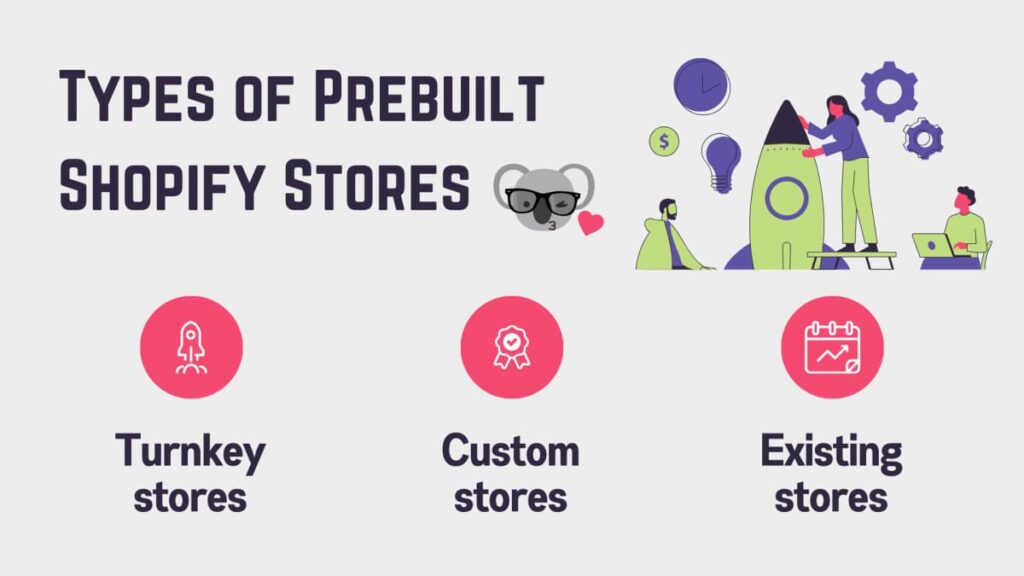 There are 3 main types of prebuilt Shopify stores.
Turnkey stores
A turnkey store ships with a theme, a product catalog, basic app configurations, and sometimes supplier connections already set up. The goal is minimal work before launch, typically days rather than weeks. These are the most common option on dedicated prebuilt-store platforms.
Custom stores
Custom stores sit between a turnkey purchase and building from scratch. A developer or agency builds to your specifications, with more attention to unique design and niche-specific features. Setup takes longer and costs more, but the result is less generic than a mass-produced turnkey product.
Existing stores
These are operating businesses for sale. They come with actual traffic data, revenue history, and customer lists, which makes due diligence more intensive. An existing store with a real track record costs considerably more than a turnkey template, but you are buying a proven business rather than potential.
What to Look for When Buying a Prebuilt Shopify Store
A clean-looking store at the right price is not enough. Work through these areas before you commit.
What is actually included
Confirm exactly what transfers: the store itself, supplier connections, any automation apps, the domain, and social media accounts if applicable. Sellers sometimes list extras to justify the price that are not transferable or are free plugins you could install in ten minutes.
Post-purchase support
Ask specifically what support is available after the sale and for how long. If you are new to Shopify, basic setup questions can stall you for days. Some sellers include a short onboarding period; others hand over the login and disappear.
Transfer process
Clarify the handover steps in writing before you pay. A Shopify store transfer involves transferring store ownership, the domain registrar account, supplier login credentials, and any third-party app accounts. Get a written checklist of every asset included and confirm each one transfers with the sale.
Traffic sources and volume
Look at where the traffic actually comes from. A store with a healthy split of paid, organic, and social traffic is in a better position than one that depends entirely on a single paid channel. Use Koala Inspector to cross-check competitor traffic sources, the keywords sending visitors to similar stores, and whether stated traffic levels are plausible for the niche.
Conversion rates
The Shopify industry average conversion rate sits between 1% and 3%. If a seller claims significantly above that, ask for detailed analytics access to verify it. Below average conversion on a store with decent traffic can mean a UX problem you will need to fix, or that the traffic is low quality.
Average order value
Compare the store's AOV against market benchmarks for the niche. A low AOV limits your margin for paid acquisition, which matters a lot if organic traffic is thin.
Issues To Watch For When Buying a Prebuilt Store
Unrealistic profit claims
If a seller quotes margins that look nothing like what comparable stores report, treat it as a red flag. Use Koala Inspector to pull real sales data from similar stores in the same niche and cross-check what is plausible given the product prices and supplier costs. According to Dropship.io data, a typical dropshipping markup might look like a supplier shipping a product globally for $9.99 while the store sells it for $39.99 - margins that hold only when supplier costs and return rates are accurately represented.
Poor customer reviews
Search for the store brand name on social platforms and review sites. Negative reviews about shipping delays, product quality, or non-existent customer service will follow the store to you.
Reluctance to share financials
A seller who cannot or will not provide detailed revenue and expense records for the past 6 to 12 months is a problem. Insist on actual Shopify analytics exports, ad spend summaries, and supplier invoices. Verbal assurances are not evidence.
Negotiation Tips and Strategies
Store valuation
Shopify stores are commonly valued at a multiple of monthly net profit, typically 12x to 36x depending on growth rate, brand strength, niche stability, and how much owner involvement the business requires. A store that runs without the seller's daily attention is worth more than one that depends on their specific supplier relationships or ad account.
Identifying room for improvement
If you can see clear improvements the current owner has not made, use that as leverage. Poor product descriptions, no email capture, no upsells, a slow theme, or thin SEO are negotiating points, not reasons to walk away.
Structuring the deal
Discuss what is included in the purchase price versus ongoing costs. Some sellers offer payment plans or earnouts tied to revenue targets, which reduces your upfront risk. Get non-compete language in writing if the seller operates in the same niche.
Post-Purchase Steps
Taking ownership is the easy part. Converting that into a profitable business requires working through branding, SEO, and marketing before you start spending on acquisition.
Customization and branding
Change what makes the store look like every other store from the same template. That usually means a new logo, updated color palette, rewritten product descriptions, and original product photography. Generic supplier images appear on dozens of competing stores; original images stand out in paid ads and can lift conversion.
Your brand identity should be consistent across the store, product pages, email flows, and any social accounts included in the sale. Product descriptions deserve particular attention, since they directly affect SEO and give customers the information they need to buy.
Optimizing for search engines and conversions
Write unique meta titles and descriptions for every product category and key product page. Set up conversion tracking before you start spending on traffic so you can measure what actually moves the needle. A/B test your product page layout and checkout flow before scaling ad spend.
If the store's SEO is starting from scratch, prioritize the pages with the strongest commercial intent and the clearest product-market fit.
Building a marketing strategy
Decide where your target customers spend time and focus there first rather than spreading across every channel. Blog content, video tutorials, and buying guides build organic traffic over time. Email sequences for new subscribers and abandoned carts are reliable revenue recovery. Paid social works well for visual products with clear differentiators; search ads work better for products people already know they want.
Where to Buy Prebuilt Shopify Stores in 2026
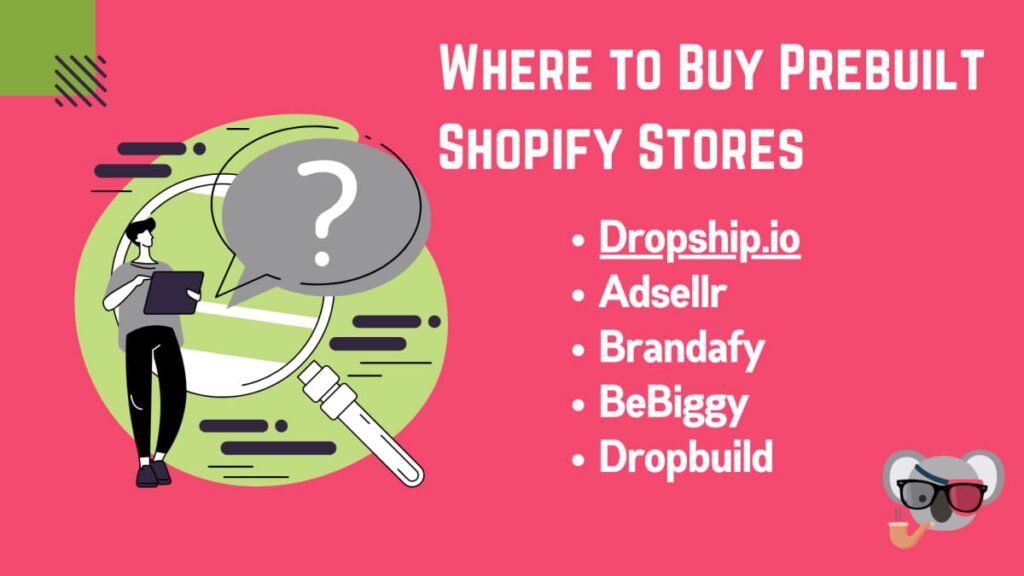 Here are the 5 most popular platforms to buy prebuilt stores in 2026.
1. Dropship.io
Dropship.io offers a range of prebuilt stores tailored for dropshipping, with a large product selection and optimized designs. They report over 102,000 dropshipping stores launched through their platform. A 30-product store is available for around $49 with delivery in under 24 hours.
| Overview | Details |
|---|---|
| Cons | Relatively pricey and limited customization options |
| Price (Basic) | $29/month |
| Price (Standard) | $49/month |
| Price (Premium) | $79/month |
| Customer support | Limited assistance for design modifications |
2. Adsellr
Adsellr focuses on trending products and niches and is known for its market research capability and store optimization. A one-product store starts at around $389; a 25-product store runs approximately $789.
| Overview | Details |
|---|---|
| Pros | Supports various business sizes, marketing material integration, additional services |
| Cons | High entry price and limited information on additional services |
| Prices | Packages including products, SEO optimization, and store design from $350 |
| Customer support | Dedicated project manager, post-sale support for troubleshooting and maintenance |
3. Brandafy
Brandafy focuses on UX and delivers Shopify stores with cohesive designs and curated product ranges.
| Overview | Details |
|---|---|
| Pros | Fast shipping time (4-10 days), strong UX, comes with product review and shipping setups |
| Cons | Setup takes around 14 days; simple stores from $21, advanced from $997 |
| Prices (Premium) | $197 |
| Prices (Custom) | $599 |
| Customer support | Comprehensive support through acquisition and ongoing management |
4. BeBiggy
An easy-to-use platform with user-friendly designs ready for immediate launch. Automated features and fast setup make BeBiggy a popular starting point.
| Overview | Details |
|---|---|
| Pros | Ownership flexibility, many automated features, fast setup |
| Cons | Weak product descriptions and slow loading times on some stores |
| Prices | Range of $119 to $999 |
| Customer support | Can be limited |
5. Dropbuild
Dropbuild caters to both beginners and experienced sellers and is known for reliable ongoing support and high-quality store aesthetics.
| Overview | Details |
|---|---|
| Pros | High-quality aesthetics, comprehensive guidance, tailored elements, and technical optimization |
| Cons | Long setup time and higher price point |
| Price | $499, which includes everything needed to get started |
| Customer support | Dedicated project manager and ongoing support for troubleshooting, maintenance, and optimization |
Prebuilt Shopify Stores vs. Existing Shopify Stores
The core difference is track record. A prebuilt store is newly created, often unlaunched, with no sales history but full design and product setup already done. An existing store has operational history - traffic, revenue, customers - which gives you proof the business model works, but at a significantly higher cost and with the responsibility of maintaining existing customer relationships.
Prebuilt stores are the faster, cheaper entry point. The setup is done; you start selling and building brand equity from day one. Existing stores offer immediate cash flow and a tested business model, but require a larger upfront investment and more extensive due diligence before purchase.
If you want to get into e-commerce without a large capital outlay and are willing to do the brand-building work yourself, a prebuilt store makes sense. If you want a business with demonstrated revenue and are prepared to pay a premium for it, buy an existing store.
Top Marketplaces for Existing Shopify Stores
Here are the 5 most popular marketplaces for buying established Shopify stores.
1. Flippa
One of the largest marketplaces for online businesses, including Shopify stores. Flippa lists new stores alongside established operations, with prices starting at a few hundred dollars. Listings include traffic and revenue data, which makes it accessible for buyers at all experience levels.
2. Empire Flippers
Empire Flippers focuses on quality over volume. Its screening process is more rigorous than most platforms, and it primarily handles higher-value acquisitions. The platform provides hands-on support through the entire buying process.
3. Motion Invest
Motion Invest specializes in smaller websites and starter stores. The buying process is straightforward, the interface is easy to use, and it is a practical option for first-time buyers who want to start with something manageable.
4. Acquire
Acquire is a higher-end marketplace with detailed financial reporting and personalized support through the buying process. It suits experienced buyers who are looking for stores with meaningful revenue and clear growth potential.
5. Website Closers
Website Closers is a brokerage rather than a self-serve marketplace. Brokers match buyers with sellers and assist through negotiation and transfer. They sometimes hold listings that do not appear publicly, which can be useful for buyers with specific criteria.
The Importance of Research Before Buying a Prebuilt Shopify Store
Skipping research is the most common mistake buyers make. A store can look polished and come with a persuasive sales pitch, and still have a broken supplier relationship, a niche with shrinking demand, or traffic numbers that do not hold up under scrutiny. Research is how you avoid those problems.
Products and niche research
Identify whether the niche has sustained demand rather than a recent trend spike. Check sales history, seasonal patterns, and what competitors are doing well. Koala Inspector is built for exactly this kind of product and niche research on Shopify - you can see what products competitors are running, where their traffic comes from, and which apps they are using.
Supplier evaluation
A bad supplier is one of the hardest problems to fix after purchase. Slow shipping, poor quality control, and unresponsive customer service will hit your store's reviews and return rate almost immediately. If the store's supplier is built into its appeal, verify the relationship is transferable and that the terms are clearly documented.
Store design and functionality
Test the store on mobile - a significant share of e-commerce traffic is mobile, and a poor mobile experience directly reduces conversion. Work through the checkout process yourself. Check which apps are installed and what they cost in ongoing subscription fees.
If the theme needs replacement, that is a significant project. Check the Shopify theme your competitors use to get an idea of what performs well in the niche, and factor the cost of a replacement into your offer price if needed. You can also explore our guide to the best Shopify themes for ideas.
Market research
Look at how many well-established competitors are in the space. A niche with no competition can mean there is no demand; a niche where ten well-funded brands dominate can mean there is no room for a new entrant. Find where your target customers spend time and what they are already buying.
How to Conduct Effective Research
Tools for product research
Google Trends
Google Trends shows whether search interest for a product or category is growing, flat, or declining. It is most useful for comparing product ideas or identifying seasonal demand patterns. The Google Trends guide we wrote for dropshipping research walks through the same process step by step, and the approach works equally well for prebuilt store research.
Jungle Scout
Jungle Scout provides keyword data and sales volume estimates primarily for Amazon, but the category-level demand data is useful for sizing a niche before committing to a store.
AliExpress Dropshipping Centre
If the store sources from AliExpress, this tool shows order volumes and trend data by product, which helps you validate whether a supplier's products have real demand or are just filling a catalog.
Helium 10
Helium 10 focuses on Amazon but the keyword research data is useful for understanding search demand in categories that overlap with Shopify.
Ecomhunt
Ecomhunt tracks trending products for dropshippers and provides daily updates on new products, sales data, and market signals.
Evaluating suppliers
Order samples
Request samples before you commit to any supplier relationship. Working through the order, shipping, and product experience yourself is the only way to know what your customers will receive.
Check platform ratings
Look at the supplier's reviews on AliExpress, Alibaba, or whatever platform they use. Focus on feedback about product quality, consistency, and how issues get resolved, not just the star rating.
Communicate directly
Talk to the supplier before the sale closes. Ask about minimum order quantities, production capacity, lead times, and what happens when there are problems with an order. A supplier that communicates clearly before you are a customer is a reasonable proxy for how they will communicate after.
Analyzing competitor stores
Study what competitors are doing well in terms of design, navigation, and checkout flow. Look at which Shopify theme they are using and what apps are installed. Koala Inspector shows you the theme and apps behind any Shopify store, which makes this process considerably faster than guessing from the frontend.
Market research strategies
Facebook Audience Insights
Demographic and psychographic data from Facebook Audience Insights helps you understand who your potential customers are before you invest in ads targeting them.
Surveys and customer interviews
Direct feedback from people who might buy your products will surface problems and preferences that no analytics tool shows you. Even a small number of interviews can reframe your product positioning or price point.
Industry reports
Published market research and industry reports are useful for understanding broad trends and sizing the opportunity. Use them to sanity-check the niche, not to replace the specific store-level data you should be gathering.
Alternatives to Buying Prebuilt Stores
Building your own store from scratch
Building from scratch gives you complete control and no inherited problems. The tradeoff is time - most people underestimate how long it takes to pick a theme, load a product catalog, configure shipping, and set up the apps needed to run a real store. It is the right choice if you want to understand every part of the platform or need features that prebuilt stores cannot accommodate.
Pros: Full control over design, no inherited technical debt, opportunity to learn the platform deeply.
Cons: Takes significantly longer to launch, steeper learning curve, higher risk of costly setup mistakes.
Hiring a developer instead of buying prebuilt
Cost: A custom-built Shopify store from a developer typically starts in the thousands. A solid prebuilt store runs $100 to $2,000. Ongoing maintenance costs are similar between the two, though custom stores with bespoke functionality tend to cost more to update.
Time: A prebuilt store can be live within days after purchase. A custom development project typically runs one to six months.
Flexibility: Custom-built stores can accommodate almost any functionality. Prebuilt stores are more constrained but faster to launch, and most e-commerce functionality is available through Shopify's app ecosystem anyway.
Wrapping Up
Buying a prebuilt Shopify store is a legitimate shortcut into e-commerce, but the shortcut applies to setup, not to judgment. The stores worth buying require the same due diligence as any business acquisition: verified financials, confirmed supplier relationships, traffic you can actually explain, and a niche with real demand.
Use Koala Inspector to do your competitive intelligence work before you sign anything. Seeing what is behind similar stores in the same niche gives you a much clearer picture of what you are actually getting into.
Is it worth buying a prebuilt Shopify store?
A prebuilt store is worth it if you want a fast launch without handling the technical setup yourself. It is the right choice for marketers or operators who want to focus on brand-building and customer acquisition rather than store configuration. Whether a specific store is worth it depends on the niche quality, the supplier relationships included, and what the asking price reflects about the business's actual potential.
How much does a typical prebuilt store cost?
Most prebuilt Shopify stores cost between $100 and $2,000. Lower-cost options typically include a basic theme and sample products. Higher-priced options add premium design, configured apps, verified supplier connections, and sometimes marketing assets. Platforms like Dropship.io list 30-product stores from around $49; more comprehensive builds from agencies like Dropbuild start at $499.
Can I change suppliers after buying a prebuilt store?
Yes. Shopify gives you full control over supplier settings, product sourcing, and app integrations. Switching suppliers requires updating product listings and shipping configurations, but it is a standard operational task. Many buyers switch suppliers to improve quality, reduce costs, or shorten delivery times.
What is the average time to profitability for a prebuilt store?
Most prebuilt Shopify stores reach profitability within 3 to 6 months, depending on the niche, marketing budget, and product quality. Stores with targeted paid campaigns and a clear value proposition tend to move faster. Stores relying entirely on organic traffic take longer, sometimes 6 to 12 months before seeing consistent revenue.
Are there legal considerations when buying an existing store?
Yes. Buying an existing Shopify store involves ownership transfer, intellectual property rights, supplier contracts, customer data handling, and financial disclosures. Get written agreements covering every asset included in the sale. If the store has a customer email list or social following, confirm how the data transfer complies with applicable privacy regulations.
Written by
Ana Gelevska
eCommerce Content Writer
Ana Gelevska is a content writer with more than five years of experience creating content for eCommerce brands and global clients. She digs into each topic and the people it is for, then turns it into clear, useful articles that Shopify sellers and dropshippers can act on.
Connect on LinkedIn