Best shopify apps to increase sales
 By Ana GelevskaSeptember 19, 2024 · Updated June 4, 2026
The Shopify App Store has over 12,000 apps, and 87% of Shopify merchants use them to run their stores (the average merchant installs six). That's a lot of noise to cut through. The apps that actually move revenue tend to address a specific friction point in your funnel, not just add features.
This list covers 15 apps across seven categories, chosen because they address real conversion and retention problems. The category grouping matters: a store burning money on ad traffic with a weak checkout needs different tools than a store with solid traffic and poor repeat purchase rates.
One practical note before diving in: if you spot a Shopify store with a setup you admire and want to know which apps it runs, Koala Inspector lets you see exactly that. You can also try the free Shopify App Detector as a Chrome Extension.
15 Best Shopify Apps To Increase Sales
The best app stack for your store depends on where your biggest revenue leak is. The categories below map to the main parts of the customer journey. Start with the one that's costing you the most money right now.
Product Discovery and Merchandising
Searchspring
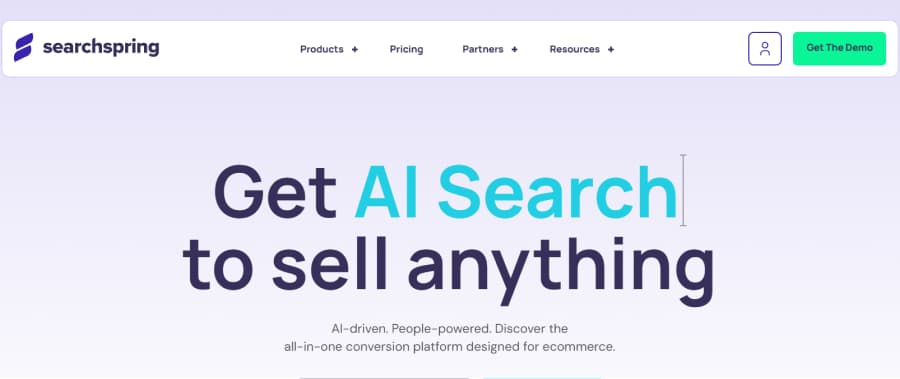 Searchspring is a product discovery and merchandising platform built for stores with deep catalogs. Its search goes well beyond keyword matching: autocomplete, spell correction, synonym expansion, and natural language processing all work together so shoppers find products even when they search loosely.
The merchandising side is worth noting separately. You can set up rules to push featured products into specific search results or category pages, create custom landing pages for campaigns, and display banners that respond to what a shopper is actively looking for. Searchspring also provides analytics on search behavior, so you can see which queries lead to dead ends (a common revenue leak in large catalogs).
Searchspring fits stores with hundreds or thousands of SKUs where default Shopify search leaves money on the table. Smaller stores with tight product ranges probably won't see enough lift to justify the cost.
Cart Optimization and Checkout
Bold Upsell
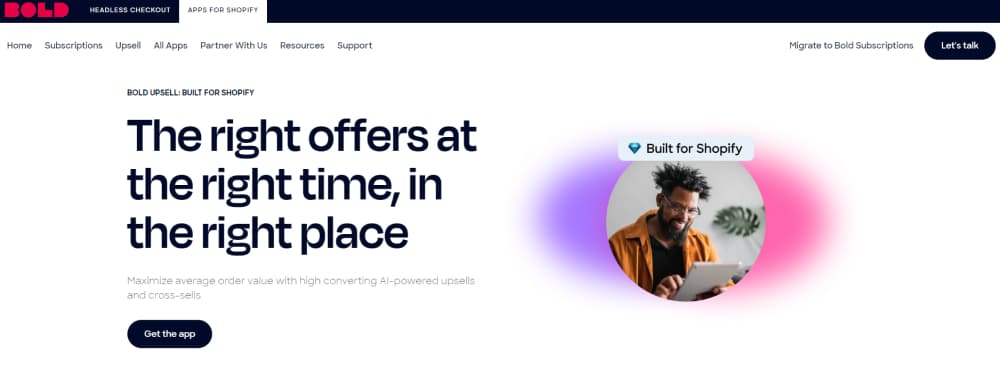 Bold Upsell automates upsells and cross-sells at the cart and checkout stage. The core mechanic is straightforward: when a customer adds a product, Bold can surface a related item or an upgraded version before they complete the purchase.
The one-click upsell format is where the real AOV gains come from. Shoppers don't have to re-enter payment details; the add is just one tap. One Shopify merchant shared data showing a upsell app in this category generating roughly $350 in extra revenue in a single month on a $20 spend, which gives a sense of the economics when the offer-product match is right.
The more advanced rules (triggering different upsells based on cart value, product type, or customer history) take some setup time. Customer support is generally well reviewed.
Ordergroove
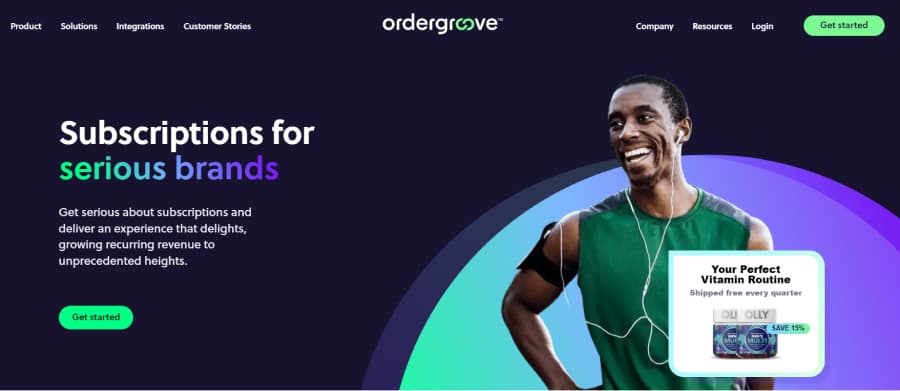 Ordergroove handles subscription management. If your store sells anything that gets reordered, subscriptions are the most reliable path to predictable revenue because they eliminate the re-acquisition cost on every cycle.
Ordergroove's specific strength is its flexibility with subscription structures: classic subscribe-and-save, curated boxes, memberships, and gift subscriptions can all be set up without custom development. The dynamic discount engine lets you test what subscription incentive converts best, and one-click reorder removes the main friction point that causes churn.
It fits consumables businesses and any store where repeat purchase is logical but currently ad-dependent.
Customer Engagement and Retention
Yotpo
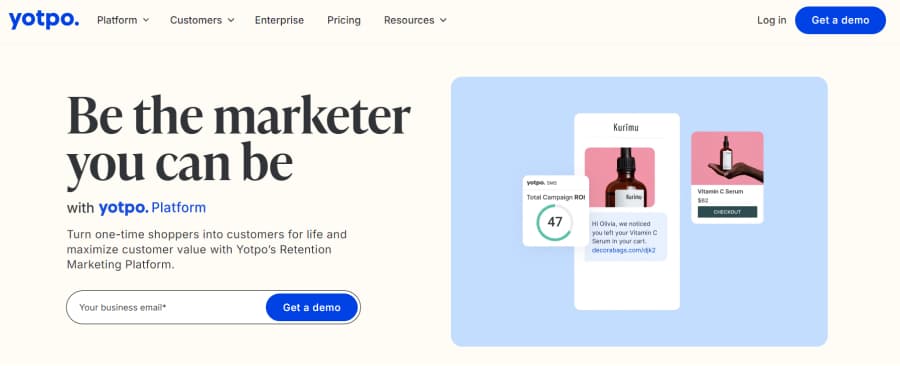 Yotpo is one of the most widely used customer engagement platforms on Shopify. Its reviews product collects photo and video reviews alongside text, which matters because product pages with visual social proof convert better than those with text reviews alone. The Q&A feature reduces pre-purchase hesitation by letting potential customers see real questions answered.
Beyond reviews, Yotpo handles loyalty programs, referral campaigns, and SMS/email marketing in one platform. The bundled approach means fewer integration points to maintain and customer data that flows between features (a loyalty member who leaves a review can be segmented differently in email, for example).
There's a free plan that covers reviews. The SMS and loyalty features are paid tiers and where most of the revenue-driving functionality lives.
Smile.io
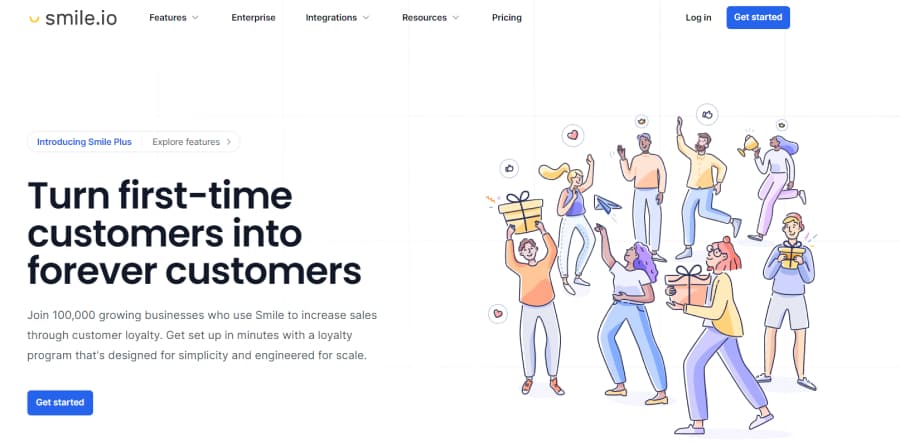 Smile.io focuses on loyalty programs: points, referrals, and VIP tiers. The appeal is simple setup rather than feature depth. Getting a basic points program live takes an afternoon, not a developer sprint.
What makes loyalty worth the investment: acquiring a new customer costs substantially more than retaining an existing one. Referral programs in particular can bring in customers who already have social proof from the person who referred them, which compresses the trust-building phase. Smile's white-label options let you brand the program so it feels native rather than bolted on.
It works best for stores with decent repeat purchase potential. A one-time-purchase niche (custom wedding gifts, for example) won't see much return from a points program.
Marketing and Promotion
Klaviyo
 Klaviyo is the email and SMS platform most serious Shopify operators end up on. The numbers shared publicly by merchants are hard to ignore: Shopify store owners consistently report $8 or more returned for every $1 spent on Klaviyo, and abandoned cart flows regularly achieve 40% open rates.
The reason for the performance is segmentation depth. Klaviyo pulls purchase history, browsing behavior, and order data directly from Shopify, so you can build segments and flows based on what someone actually did in your store rather than just demographics. A customer who bought once six months ago gets different messaging than someone who buys every 30 days.
The drag-and-drop builder and pre-built flow templates mean you don't need an email developer to get started. A/B testing is built in, which matters for improving subject lines and send times over time.
Privy
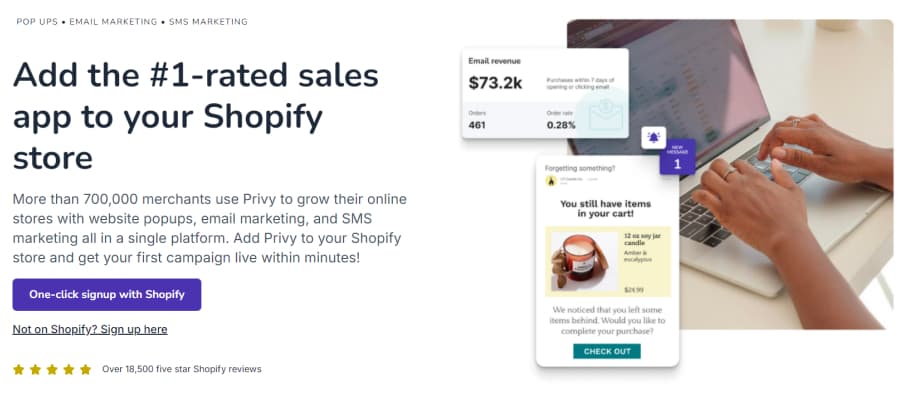 Privy sits at the entry-level end of the email marketing category. It does three things: list building via popups and forms, abandoned cart emails, and basic SMS campaigns.
The abandoned cart recovery is where most smaller stores see direct, measurable impact. The automated sequence catches shoppers who left without buying and gives you a second shot at the sale. Segmentation and personalization options are more limited than Klaviyo, but the free tier makes Privy the logical starting point for stores that are just setting up email automation.
Omnisend
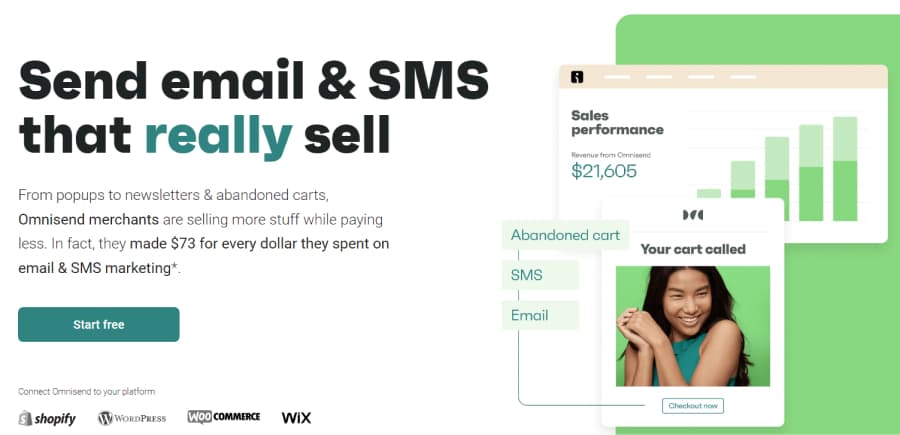 Omnisend covers email, SMS, and web push notifications in one platform. It sits between Privy and Klaviyo in terms of complexity and cost.
The multi-channel automation is Omnisend's practical differentiator. You can build a single workflow that sends an email first, then an SMS if there's no open, then a push notification as a final touchpoint. For stores that have an engaged subscriber base across channels, coordinating those touchpoints in one place prevents overlap and reduces the chance of over-messaging. Segmentation and A/B testing are solid across all channels.
Analytics and Reporting
Metrilo
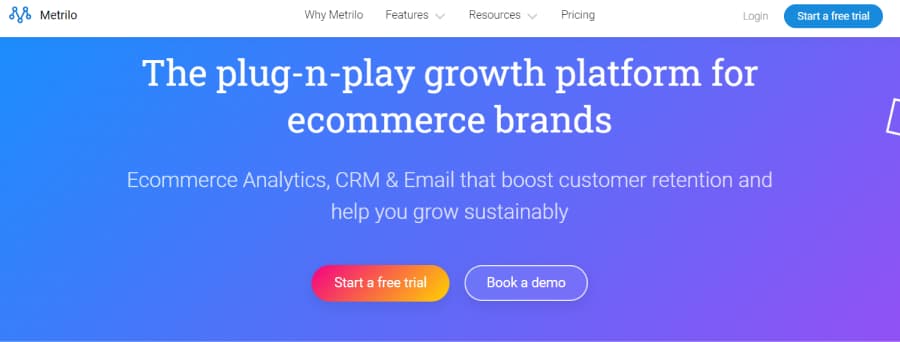 Metrilo combines a CRM, email marketing tool, and analytics dashboard in one platform. The analytics are the most distinctive piece: cohort analysis, revenue attribution by marketing channel, product performance tracking, and customer retention metrics all live in a single interface.
The CRM filters on behavioral data, so you can segment customers by total spend, purchase frequency, or last purchase date and email them directly from the same tool. For a data-oriented operator who wants one place to understand what's driving revenue and act on it, Metrilo reduces the need to stitch together GA4, your email platform, and a separate CRM. There is a learning curve on the analytics features.
Inventory and Order Management
ShipBob
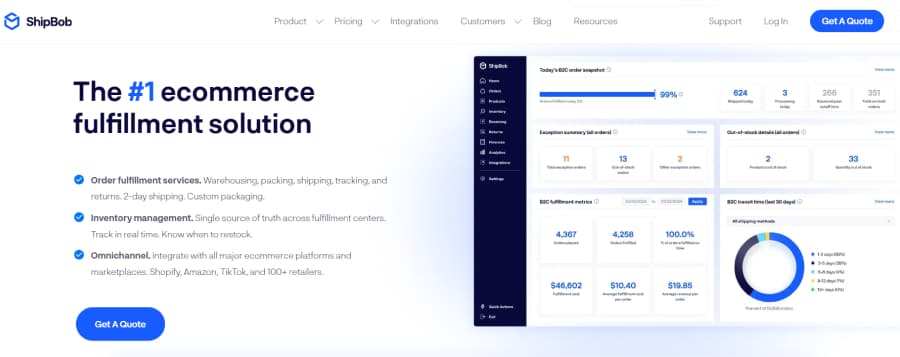 ShipBob is a third-party logistics provider that also has deep Shopify integration. The direct sales impact is shipping speed: when customers get their orders in two days instead of a week, refund rates drop and reviews improve. ShipBob handles warehousing, picking, packing, and returns across a network of US fulfillment centers, so customers in different regions get fast delivery without you operating your own warehouse network.
This is primarily for stores that have outgrown self-fulfillment and need to reduce shipping times to stay competitive. It's not cheap, so the economics need to pencil out at your average order volume.
Syncio
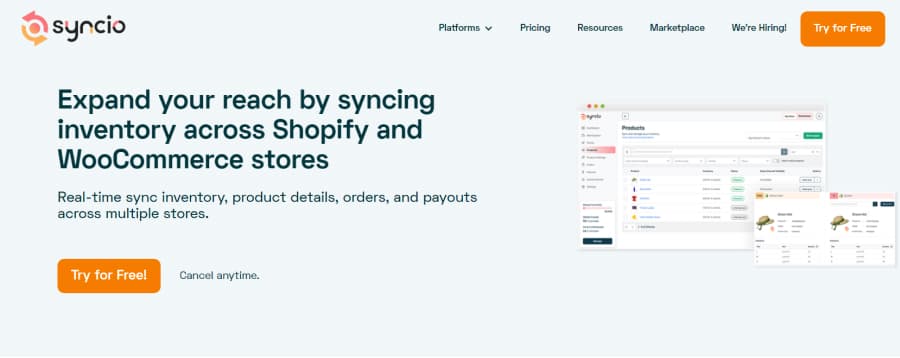 Syncio solves the inventory sync problem for stores selling across multiple sales channels or managing products from multiple suppliers. It keeps product information and inventory levels in sync in real time so you don't oversell or show inaccurate stock levels.
The practical upshot for sales is fewer cancelled orders from stockouts and fewer complaints from customers who ordered something shown as available. Order fulfillment automation cuts down the manual work on the operational side. Syncio is most useful for multi-channel or multi-location stores where keeping inventory accurate across systems becomes a genuine time drain.
Customer Support and Service
Gorgias
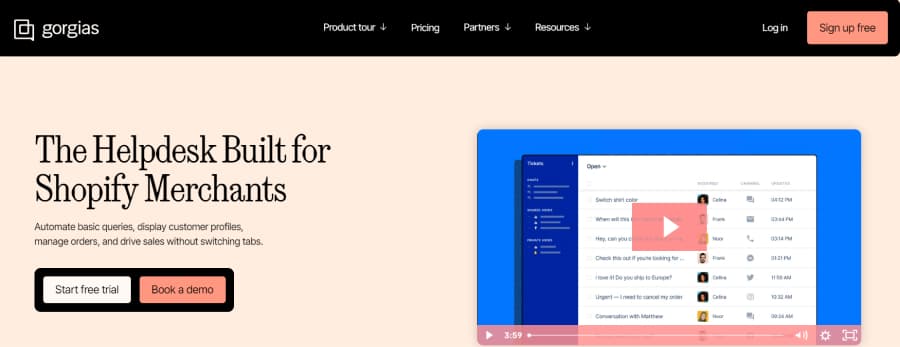 Gorgias centralizes customer support channels (email, live chat, social media DMs, phone) into a single inbox inside Shopify. The key integration is that Gorgias pulls order data alongside each conversation, so support agents can see what a customer ordered, when it shipped, and the history of previous contacts without switching tabs.
Macros let agents respond to common questions quickly and consistently. The automation rules handle the highest-volume repetitive requests (order status, return initiation) without agent involvement. Fast, consistent support has a direct connection to conversion: shoppers who get questions answered before purchase are more likely to complete the checkout.
Zendesk
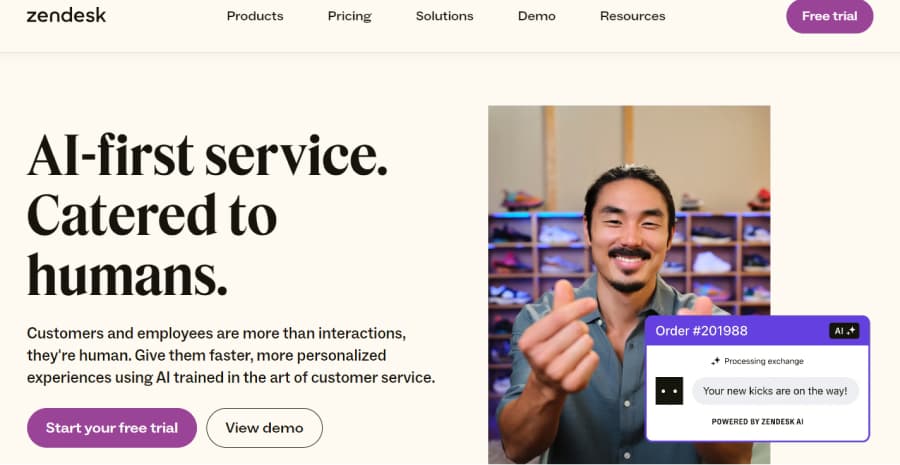 Zendesk is a broader customer service platform that integrates with Shopify. It's a better fit for larger operations that already run Zendesk across other business units, or for stores with complex support workflows that need advanced ticket routing, SLA management, and a self-service knowledge base.
The reporting is detailed: you can track response times, ticket volume by topic, and customer satisfaction scores. For a store doing high support volume with a dedicated team, that visibility into support operations matters. For a smaller store, Gorgias tends to be simpler to set up and use.
Site Speed and Performance
Tapita
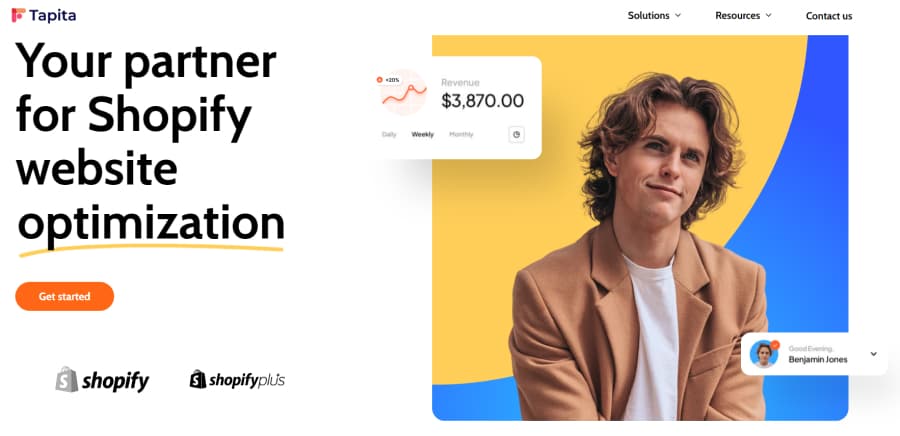 Tapita is a performance optimization app that compresses images, enables lazy loading, and minifies code. The direct connection to sales is through Core Web Vitals: a slower store scores worse in Google's page experience signals, ranks lower, and loses visitors who bounce before the page loads.
Average Shopify conversion rates run between 1% and 3%. A slow page can cut that significantly. Tapita is worth installing for stores in competitive search categories where organic traffic matters, or anywhere page speed has flagged in a Lighthouse audit.
Pagefly
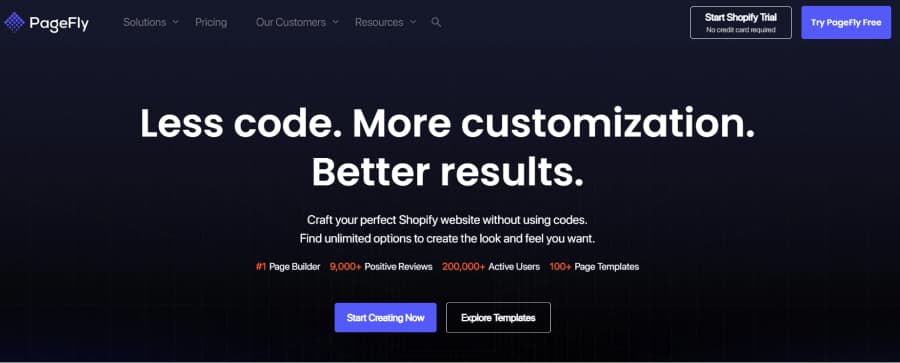 Pagefly is a no-code page builder. It lets you build custom landing pages, product pages, and collection pages using a drag-and-drop interface without touching code.
The reason it affects sales: Shopify's default product page templates are generic. A landing page built for a specific campaign or a product page designed around the actual questions buyers have for that product will convert better than a template applied across the entire catalog. Pagefly pages are mobile-optimized and pass Core Web Vitals benchmarks. It's most useful for stores that run paid traffic campaigns and want dedicated landing pages for each ad set.
How to build a stack that actually works
A few things that Shopify merchants consistently report getting wrong when adding apps:
Add one at a time. Install apps individually, not in batches. If something breaks or your conversion rate drops, you need to know which app caused it.
Match the app to the actual problem. A loyalty program doesn't help if your traffic is too low to generate repeat purchasers. An upsell app doesn't help if your checkout is losing people due to trust issues. Identify your biggest revenue leak first, then pick the tool.
Most apps that target the same metric won't stack cleanly. Two email marketing tools, two review apps, two upsell apps on the same store create conflicts and confuse customers. Pick one per category.
How to measure whether an app is paying for itself
The metrics worth tracking before and after installing any new app:
- AOV (average order value): the primary signal for upsell and cross-sell apps.
- Repeat purchase rate: the signal for loyalty and retention apps.
- Abandoned cart recovery rate: the signal for email/SMS apps.
- Conversion rate: relevant across almost every category; establish a baseline before installing.
Set a 30-day window. If the revenue attributed to the app doesn't exceed its cost by a meaningful margin in that window, either the configuration needs work or it's the wrong fit for your store. Apps that serve many customers vary considerably across different store types, which is why what works for one merchant may not work for another.
Written by
Ana Gelevska
eCommerce Content Writer
Ana Gelevska is a content writer with more than five years of experience creating content for eCommerce brands and global clients. She digs into each topic and the people it is for, then turns it into clear, useful articles that Shopify sellers and dropshippers can act on.
Connect on LinkedIn