Can AI Build My Shopify Store?
June 6, 2025 · Updated June 4, 2026
Yes, AI can build your Shopify store. Not in a sci-fi "hands off and wait" way, but practically: today's AI tools handle the parts of store setup that used to eat the most time, from generating product descriptions and picking a layout to writing FAQ answers and suggesting navigation structure. Tools like Shopify Magic are free and already inside your Shopify admin. Others, like AutoDS or GemPages, go further and can get a store from blank to sales-ready in under 10 minutes.
That said, they're not all the same thing. Some focus purely on content generation. Some automate the full dropshipping workflow. Some give you a drag-and-drop builder with AI-assisted design. Knowing the difference saves you from buying the wrong subscription.
This post covers the 5 most useful AI Shopify store builders right now, what each one actually does, and how to figure out which one fits your situation.
What is an AI Shopify store builder?
 An AI Shopify store builder uses machine learning to handle tasks that would otherwise require manual work or hiring specialists: selecting a theme, writing product copy, structuring page layouts, and in some cases sourcing products and routing orders automatically.
The category spans a wide range. Some tools are baked into Shopify itself (Shopify Magic), so you get them whether you think about it or not. Others are third-party apps that bolt onto your store and extend what Shopify can do natively.
Key capabilities to look for when choosing one:
- Content generation - writing product descriptions, email copy, FAQ responses, and meta descriptions from a short prompt.
- Layout building - drag-and-drop editors or AI-generated page structures, often with conversion-tested templates.
- SEO tooling - auto-generating meta tags, alt text, and page titles so you're not doing that manually for every product.
- Automation for dropshipping - product importing, order routing, price monitoring, and fulfillment handled without you touching it.
- Customer support - AI chatbots that answer common questions so you're not doing it yourself.
The right answer to "which AI can build my Shopify store" depends on three things: your budget, the type of store you're building (brand store, dropshipping, print-on-demand, etc.), and which part of the setup causes you the most friction.
How do AI Shopify Store Builders Work?
 Most AI store builders work by taking some input from you (a product category, a URL, a few keywords, or a product photo) and generating store elements from it. The underlying models are trained on ecommerce data, so they know what a good product description looks like, what sections a landing page typically needs, and which design patterns tend to convert.
There are two distinct patterns in the market right now.
Fully automated builders take over the entire setup process. AutoDS AI is the clearest example: you pick a niche, and it builds a Shopify store with imported products, optimized listings, and pricing rules already in place. Foxify sits in a similar space for design, generating page sections and layouts without you starting from scratch. Both eliminate the blank-canvas problem for new sellers.
Store assistants work inside your existing store rather than replacing setup. Shopify Magic fits here: it generates product descriptions, email copy, and FAQ answers when you ask it to. Sidekick, Shopify's AI chat interface, answers questions about your store's performance and suggests actions based on your actual data. These tools don't build a store for you, but they significantly cut the time spent on individual tasks once you're up and running.
Merchants who have switched to AI-assisted content workflows report saving 15-20 hours per week on content tasks that used to be manual.
5 Best AI Builders for Shopify
 These are the 5 most practical AI Shopify builders as of 2026:
1. Shopify Magic
 Shopify Magic is built directly into Shopify and free on every plan. It generates product descriptions, email copy, FAQ answers, and image alt text from a short prompt. You can write a two-line product brief and get a full description in seconds, then edit it to match your brand's tone.
Because it's native, there's no integration friction. It works wherever Shopify has a text field, including your theme editor, email marketing, and blog. The content it produces is tuned for ecommerce, meaning it's generally structured the way product pages should be rather than just grammatically correct prose.
Pros:
- No extra cost: Free on all Shopify plans, no trial or tiered access.
- Works where you already are: Available throughout the Shopify admin without switching tools.
- Fast for high-volume tasks: If you're uploading 50 products, generating descriptions one by one through Magic is much faster than writing from scratch.
- Handles more than product copy: Email subjects, blog post drafts, and FAQ responses are also supported.
Cons:
- Content only: Shopify Magic doesn't touch your store's design, layout, or technical setup. It generates text; that's the scope.
- Output needs editing: It's a starting point, not a finished draft. The AI doesn't know your brand voice, so expect to spend time tuning every output before publishing.
Pricing: Free for all Shopify users.
2. AutoDS AI
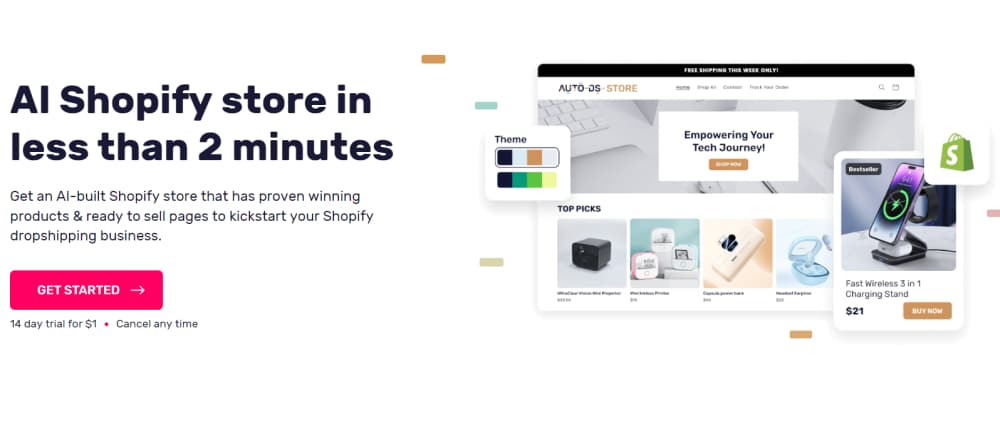 AutoDS AI is built for dropshipping. Its flagship feature is automated store creation: you choose a product niche, and it generates a Shopify store with imported products, optimized listings, pricing rules, and fulfillment connections already configured. The claim is a store ready to test ads in under 10 minutes.
Beyond initial setup, AutoDS runs the operational side of dropshipping: monitoring supplier prices, routing orders, tracking fulfillment, and flagging stock issues. That's where it earns its subscription fee for active sellers, not just as a one-time builder.
Pros:
- Fast initial setup for dropshipping: Getting a store to a testable state is the biggest time sink for new dropshippers. AutoDS compresses it significantly.
- Ongoing automation: Price monitoring, order routing, and fulfillment tracking run without manual intervention.
- Analytics: Real-time data on which products are performing and where margins are being squeezed.
Cons:
- Dropshipping-specific: If you're building a branded product store or selling your own goods, AutoDS isn't the right fit. It's designed around the dropshipping workflow specifically.
- Customization limits: The AI-generated listings are functional but generic. Getting them to reflect a real brand identity takes manual effort on top of what AutoDS produces.
Pricing:
- Basic Plan: $19/month (product imports and price monitoring).
- Advanced Plan: $37/month (automation features and analytics).
- Custom Plan: Variable, for high-volume accounts needing bulk imports and advanced AI features.
3. GemPages
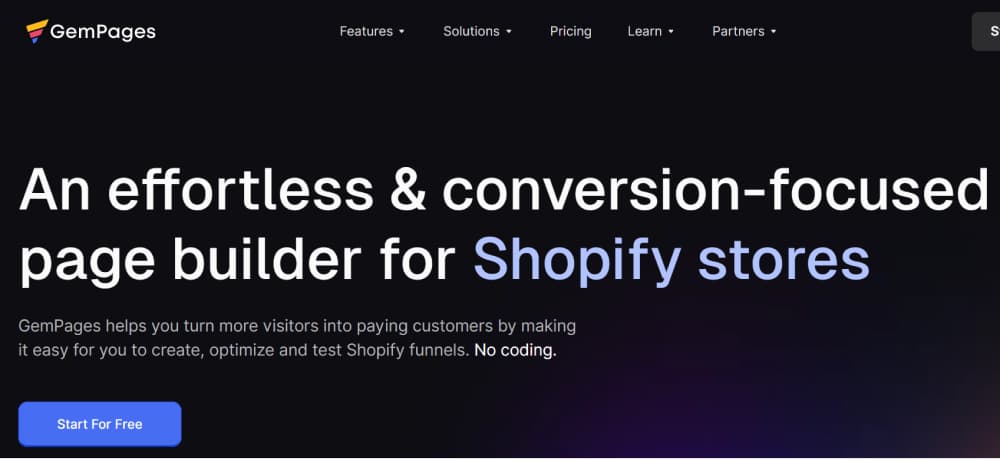 GemPages is a no-code page builder with a genuinely useful AI feature: its "Image-to-Layout" tool. You drop in a screenshot or a URL, and it generates an editable Shopify page from it. If you've seen a layout you like on a competitor's store, that's a practical way to start from something instead of a blank canvas.
Beyond that AI feature, GemPages is a full drag-and-drop builder with a library of templates designed around conversion goals (product pages, collection pages, landing pages). It's the tool to use if your current Shopify theme is limiting you and you want more control over page structure without hiring a developer.
Pros:
- Image-to-layout is genuinely fast: Generating a starting point from a reference image or URL is faster than building from a blank template.
- Conversion-focused templates: The template library is built around what works for product pages, not just aesthetics.
- Full design control without code: You're not constrained by your theme's section structure.
Cons:
- Takes time to learn: The editor is powerful, but the volume of options is real. Budget a few hours to get comfortable with it before using it for production pages.
- Advanced features cost more: A/B testing, which is useful once you have traffic, is only on higher-tier plans.
Pricing:
- Starter: $19/month.
- Professional: $29/month (adds page speed optimization features).
- Advanced: $59/month (full feature access including advanced integrations and analytics).
4. Shogun Page Builder
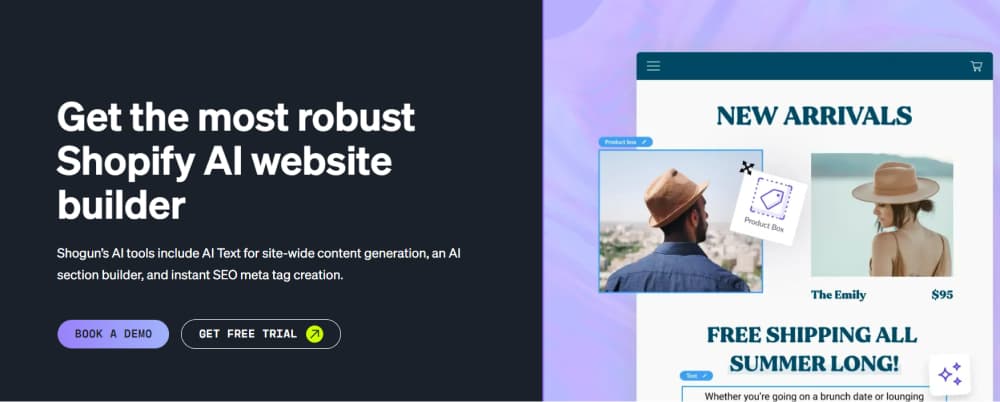 Shogun is a Shopify page builder that's been around long enough to have grown into a more comprehensive toolkit. Its AI Text feature generates SEO-optimized copy for product pages. Its AI Designer generates custom page sections from a text prompt. Both save time on the work that would otherwise go to a copywriter or designer.
Where Shogun differentiates from simpler builders is A/B testing and personalization. You can run split tests on page sections, route different visitors to different layouts based on behavior, and track which variations convert better. For stores with meaningful traffic, that capability has real financial value.
Pros:
- AI Text cuts copywriting time: Not as comprehensive as a dedicated tool, but good enough for most product page copy.
- A/B testing and personalization: If you're past the early "get traffic" stage and focusing on conversion, Shogun gives you the tools to test systematically.
- Works alongside your existing theme: You don't have to rebuild your store from scratch to use Shogun.
Cons:
- Expensive: The Build plan is $39/month. The plans where A/B testing is actually available start at $149/month. That's a serious subscription for a small store.
- Feature-heavy for simple use cases: If you mainly want better product descriptions and a landing page or two, Shogun is more than you need.
Pricing:
- Build Plan: $39/month (AI Text and basic A/B testing).
- Measure Plan: $149/month (advanced analytics, personalization, full AI tools).
- Optimize Plan: $299/month (unlimited A/B testing, priority support).
5. Foxify
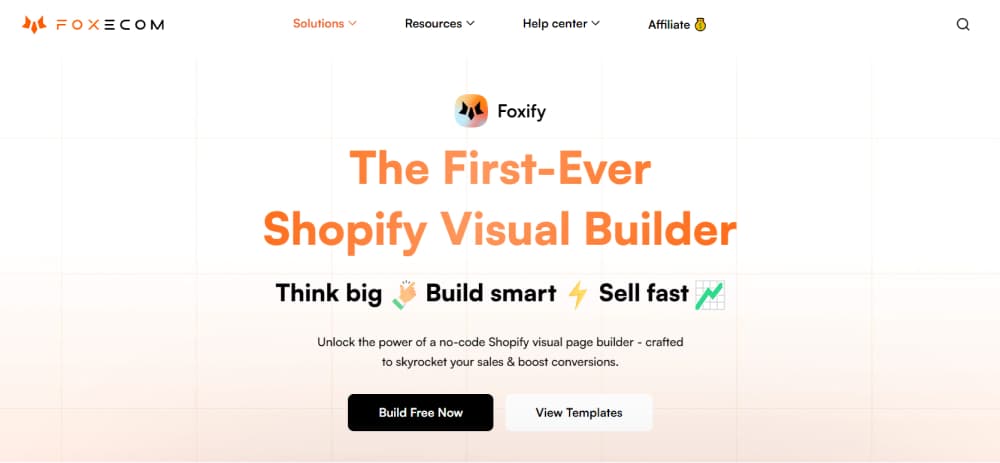 Foxify is a Shopify page builder with a drag-and-drop editor built specifically for device performance. Its AI generates product headlines, descriptions, and design layouts. The notable extras are built-in upsell and cross-sell functionality, which most page builders don't include natively, meaning you'd typically add a separate app for that.
Mobile performance is where Foxify puts emphasis. Given that Google data shows 53% of mobile visits are abandoned if load time exceeds 3 seconds, that's not a trivial focus. Foxify's pages are optimized by default rather than relying on you to manually configure performance settings.
Pros:
- Upsell and cross-sell built in: Saves you from adding a separate app and managing another integration.
- Mobile-first performance: Pages are built to load fast on mobile by default.
- Easy for non-technical users: The editor is straightforward, and AI content generation reduces the blank-page friction.
Cons:
- Less AI depth than competitors: The AI content generation is helpful but not as sophisticated as what Shogun or GemPages offers.
- No A/B testing: If structured testing matters to you, this isn't the tool.
- Full feature set requires higher plans: The upsell extensions that differentiate Foxify are on the more expensive tiers.
Pricing:
- Starter Plan: $14/month (basic page building).
- Pro Plan: $29/month (AI tools and mobile optimization).
- Premium Plan: $49/month (upsell/cross-sell extensions, advanced customization).
8 Main Benefits of Using an AI Shopify Builder Over a Traditional One
Here's where AI builders actually make a difference compared to building manually or with a standard theme editor:
1. Saves Time
The average new Shopify store takes hours to get to a state worth showing anyone. AI tools compress the bottlenecks: generating product descriptions for 20 SKUs in 20 minutes instead of 20 hours, building a page layout in minutes from a reference image, routing orders automatically rather than logging into supplier portals manually.
2. No Tech or Design Skills Needed
The limiting factor for most new sellers isn't motivation, it's not knowing HTML or not having a design background. AI builders work around that entirely. You don't need to understand CSS to make a professional-looking page in GemPages. You don't need to know how order routing works to set it up in AutoDS.
3. Cost-Effective
Hiring a copywriter for product descriptions, a designer for landing pages, and a developer for custom features adds up fast. AI tools handle a lot of that work at subscription prices that are a fraction of freelancer rates.
4. Optimized for Conversions
The templates and page structures in these tools aren't arbitrary. They're built around patterns from stores that convert well: clear value propositions above the fold, social proof near the add-to-cart button, FAQ sections that address the real objections. You get the benefit of that without doing conversion research yourself.
5. Better Customer Experience
AI chatbots handle the repetitive support questions (shipping times, return policies, order status) that eat up a disproportionate amount of owner time. Customers get answers faster, and you're not stuck in your inbox.
6. Ongoing Improvement
Businesses that adopt AI tools report an average 10-12% revenue increase, in part because AI keeps working after the initial setup. Price monitoring catches margin erosion before you notice it. Analytics surface underperforming products before they drain ad spend.
7. Personalization
AI tools can adjust product recommendations, surface different content based on traffic source, and tailor marketing messages to different audience segments. That level of personalization was previously something only large brands with engineering teams could pull off.
8. SEO and Content Optimization
Meta descriptions, alt text, page titles, and blog content are all things AI can generate at scale. That matters because most store owners skip SEO work on individual products simply because there's too much of it to do manually. AI makes it practical to do it on every page.
Which AI Shopify builder is the easiest to use?
Shopify Magic. It's free, built into the platform you're already using, and requires no installation or learning curve. You just start typing in any Shopify text field and Magic is there.
For new sellers specifically, that zero-friction access matters. You don't have to figure out a new tool while also figuring out Shopify. Magic handles the content generation while you focus on the rest of setup.
If you need more than content generation, GemPages is the next easiest step up. Its Image-to-Layout feature gives you a concrete starting point rather than a blank canvas, which lowers the intimidation factor of building pages from scratch.
Can AI Shopify builders integrate with other Shopify apps?
Yes. Most work inside Shopify's app ecosystem and connect to the tools already in your stack. GemPages and Shogun both integrate with major review apps, email platforms, and analytics tools. AutoDS connects to the supplier networks dropshippers already use.
The integrations that matter most depend on your setup: email marketing, reviews, and analytics are the most commonly needed. Check each tool's integration page before committing, particularly if you have existing apps you're not willing to replace.
How much does it cost to build an AI website on Shopify?
Shopify Magic is free on all Shopify plans, which start at $39/month for Basic. That covers AI-assisted content generation at no extra cost.
For page building, GemPages starts at $19/month and Foxify at $14/month. Shogun starts at $39/month but the plans with serious features start at $149/month. AutoDS starts at $19/month and is worth it if you're doing dropshipping at any real volume.
The practical minimum for an AI-assisted Shopify store: $39/month (Basic Shopify plan) with Shopify Magic handling content for free. Adding GemPages or Foxify for better page control runs $14-19/month more.