50 secret websites to make money
 By Ana GelevskaApril 2, 2024 · Updated June 4, 2026
Most lists of "money-making websites" recycle the same dozen side-hustle platforms. This one is different. Below are 50 tools and platforms that operators actually use to build real e-commerce and content income, sorted by what they help you do: AI-powered store automation, influencer marketing, niche research, dropshipping automation, and conversion rate optimization.
None of these are instant or guaranteed. You still need a plan, a niche, and the patience to test. But if you pick the right tools for the right problems, the work compounds faster than it would grinding without them.

Best Websites That Use Artificial Intelligence (AI) in E-commerce
AI in e-commerce has moved well past hype. According to market research, the AI retail sector is forecast to reach $45 billion by 2032, and the practical applications are already here: automated messaging, fraud screening, product description generation, personalization engines. For Shopify merchants and dropshippers, the real gain is time -- tasks that used to take hours can run on their own once you set them up. Here are 10 AI tools worth putting to work.
1. Recart
Recart handles the Facebook Messenger side of customer communication. You set up automated messages for each stage of the buying journey -- browse abandonment, cart recovery, order confirmation, and post-purchase follow-up -- and it runs them without manual input.
The Shopify integration lets you launch Facebook Messenger campaigns automatically. There is a free trial, so you can check open rates against your email before committing.
2. Signifyd
Fraudulent orders are a recurring problem for dropshipping businesses and small retailers. Signifyd integrates with Shopify and screens every order automatically, using a combination of behavior data and machine learning to flag suspicious transactions.
You get full visibility into each order, and the system can approve or reject automatically based on risk score. It saves real money on chargeback losses and shifts the liability for approved orders to Signifyd.
3. Scribe
Scribe turns any process you walk through on screen into a formatted step-by-step guide, with screenshots captured automatically. The Chrome extension records what you click, then generates the documentation.
You can package those guides as SOPs to sell, use them to train virtual assistants, or publish them as content on a Shopify storefront.
4. Boomy
Boomy lets you generate original music tracks without knowing music theory or production software. You pick a style, the AI composes a track, and you can adjust tempo, instrumentation, and add lyrics.
Boomy also handles distribution to streaming platforms, where you earn royalties. Alternatively, you can sell compositions directly as a service.
5. Vimeo Create
Vimeo Create takes product images and answers to a few prompts, then assembles a short video ad. It is built for merchants who need polished ad creative without a video production background.
You can use it for your own Shopify store's ads, or offer the service to other merchants who need product videos but cannot produce them in-house.
6. Dialogue
Dialogue is a Shopify personalization app that tracks visitor behavior to build a picture of each shopper's interests. Based on that profile, it surfaces product recommendations most likely to result in a purchase.
You can also control how those recommendations appear on the page. For merchants with large catalogs, it removes the guesswork from product discovery.
7. Tribescaler
Tribescaler helps you write hooks for Twitter/X that are structured to get shared. It uses AI to generate and test tweet formats against patterns that tend to go viral.
For e-commerce businesses, a single well-timed viral post can add thousands of followers and bring meaningful traffic to a store without paid ads.
8. Tidio
Tidio combines live chat with an AI chatbot so shoppers get an immediate response whether a human agent is available or not. The chatbot handles common questions about shipping, returns, and product details.
The Shopify integration is direct. For small teams, Tidio lets you run customer support around the clock without hiring additional staff.
9. Octane
Octane uses short quizzes to guide shoppers to the right product. Instead of browsing a full catalog, a visitor answers three or four questions and gets a personalized recommendation.
Octane also automates follow-up marketing messages based on quiz responses, so the segmentation feeds directly into your campaigns.
10. Mesa
Mesa is a Shopify workflow automation platform. It connects your store's apps and automates the handoffs between them, using templates for common tasks like tagging customers, triggering emails, or syncing inventory.
For stores running multiple apps, Mesa eliminates the manual coordination that otherwise falls through the cracks.
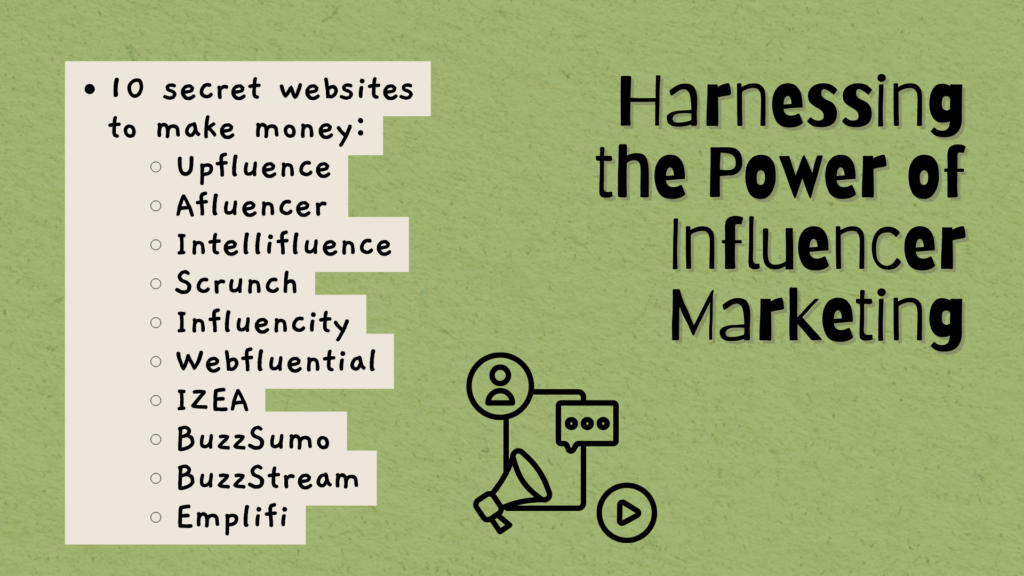
Websites That Use Influencer Marketing To Make Money
The influencer marketing industry hit $16.4 billion in 2022 and has grown since. The channels have shifted -- attention is on short-form video, creator communities, and micro-influencers with tight audience relationships -- but the core mechanic is the same: a trusted voice recommending a product converts better than a banner ad. These 10 platforms connect e-commerce businesses with influencers, or give influencers the tools to land brand deals.
1. Upfluence
Upfluence is designed for e-commerce and direct-to-consumer brands. It covers the full campaign workflow: finding influencers, managing the relationship, tracking deliverables, and measuring performance.
Integrations include Shopify, WooCommerce, Instagram, and TikTok. Third-party tools for email, CRM, and payment processing connect as well.
2. Afluencer
Afluencer makes it easier to find influencers whose audience and content style match your campaign goals. Brands post collaboration opportunities; influencers apply.
For influencers, Afluencer provides access to a live feed of brand deals and pre-built templates for pitching. The marketplace model cuts out the cold outreach on both sides.
3. Intellifluence
Every influencer on Intellifluence has opted in to brand partnerships, which means you are not pitching people who have never heard of your product category. The platform has over 200,000 opted-in creators.
Shopify payment processing is built in, along with campaign analytics so you can track whether an influencer partnership is actually moving product.
4. Scrunch
Scrunch positions itself as a creator economy tool with a database of over 20 million influencers. You can filter by niche, platform, audience size, and engagement rate to find the right match for a product campaign.
Influencers can also use Scrunch's educational content to improve how they pitch to brands and grow their following.
5. Influencity
Influencity connects businesses and influencers, then manages the relationship from first contact through campaign reporting. The AI-powered analytics measure reach, engagement, and estimated ROI for each collaboration.
For dropshipping businesses trying influencer outreach for the first time, Influencity handles the operational side so you can focus on finding the right creative angle.
6. Webfluential
Webfluential lets brands pitch influencers directly with structured campaign proposals. A library of templates speeds up the brief-writing process, and the analytics dashboard tracks campaign performance.
The built-in calculator estimates potential Twitter earnings, which is useful for influencers deciding whether a deal is worth taking.
7. IZEA
IZEA has been connecting brands and creators since the early days of sponsored content. For brands, it manages the full sponsored content workflow. For aspiring influencers, it provides a path to first paid gigs and a structured way to build a content portfolio.
8. BuzzSumo
BuzzSumo is primarily a content intelligence tool, but the influencer discovery feature is strong. You can identify who is driving shares in a given topic area, check their engagement rates across Twitter and Facebook, and see which content formats perform best in your niche.
It also gives you a read on what your competitors are publishing and what is performing for them.
9. BuzzStream
BuzzStream is an outreach platform for building word-of-mouth. You can manage influencer and press contacts, track email conversations, and see which outreach threads are getting responses.
For dropshipping businesses running outreach alongside content, BuzzStream keeps the relationship history organized so you do not lose track of who you talked to and what was agreed.
10. Emplifi
Emplifi uses social listening to monitor what customers are saying before you build a campaign around an assumption. You can track brand mentions, competitor activity, and trending topics in your niche.
It also centralizes social media management across platforms, so campaigns stay consistent whether you are posting on Instagram, TikTok, or X.
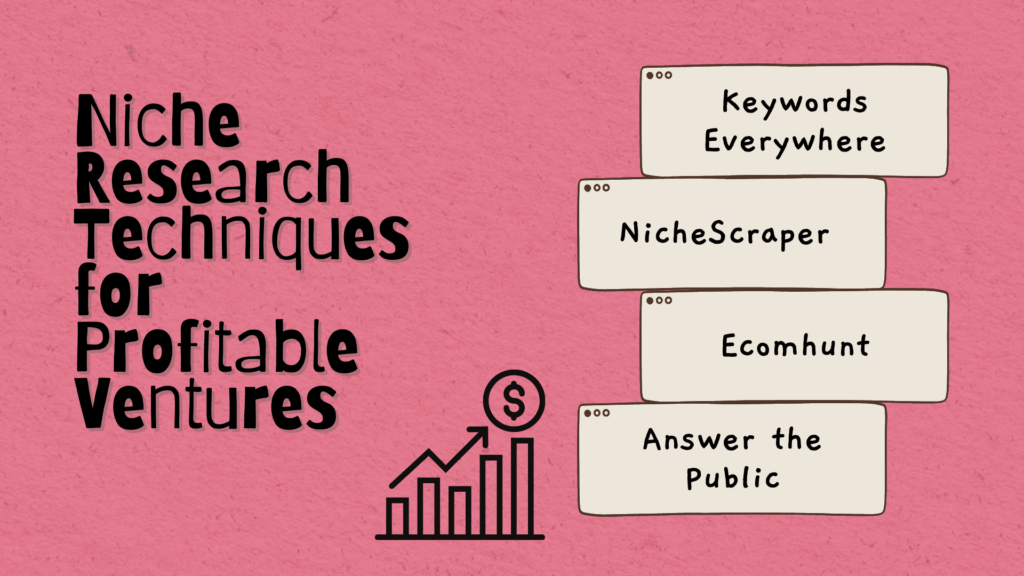
Websites To Help With Niche Research Techniques To Make Money
Picking the wrong niche is one of the fastest ways to burn through a budget. A seasonal niche, a market with no margin, or a category dominated by one massive player all look fine on paper until you are six months in and going nowhere. Good niche research tells you where demand exists, what competitors are not covering, and whether the numbers work before you build anything. Here are 10 tools that help you answer those questions with real data.
1. Keywords Everywhere
Keywords Everywhere is a browser extension that adds search volume, cost-per-click, and trend data directly to Google, Amazon, and other search interfaces as you browse. You see the numbers in context, not in a separate dashboard.
The competitor analysis feature lets you pull traffic estimates for any Shopify store URL, which helps you gauge whether a niche is generating real buyer traffic.
2. NicheScraper
NicheScraper runs product testing across millions of items and surfaces the ones with strong recent sales velocity. The data is pulled from Shopify stores and other sources, not just AliExpress.
For dropshippers, it shortens the product research phase considerably -- instead of testing dozens of products manually, you start with ones that are already selling.
3. Ecomhunt
Ecomhunt curates a daily list of products with strong sales momentum on Shopify. Each entry includes supplier links, ad examples from Facebook, and engagement data.
It is most useful in the early stages of building a store, when you need to find a winning product before committing to a niche.
4. Answer the Public
Answer the Public visualizes search queries as question maps. Enter a topic and it returns hundreds of "how," "what," "why," and "which" questions people are actively typing into Google.
For niche research, those questions reveal unmet informational needs -- gaps you can fill with product content, blog posts, or a store built around a specific customer problem.
5. SimilarWeb
SimilarWeb gives you traffic estimates for any website, plus a breakdown of traffic sources, top pages, and audience demographics. You can compare two competitors side by side and see where their visitors come from.
The niche research application is direct: find a market where the existing players are getting decent traffic but leaving obvious gaps in their product range or content.
6. Jungle Scout
Jungle Scout started as an Amazon product research tool but its data applies broadly to niche selection. You get sales estimates, review counts, and keyword search volumes to evaluate whether a product category is worth entering.
The keyword module feeds directly into your Shopify store's content strategy once you have settled on a niche.
7. Facebook Audience Insights
This Facebook tool shows you the size and composition of audiences for any interest category. You can narrow by age, location, spending behavior, and connected pages to understand whether an audience is large enough to build a business around and whether that audience is reachable through ads.
It is also a useful starting point for dropshipping on Facebook.
8. Answer Socrates
Answer Socrates aggregates "People Also Ask" and autocomplete data from Google to surface the most common questions in any topic area. Unlike keyword tools focused on volume, it shows you the specific language people use when they have a problem to solve.
Those phrases translate directly into product titles, FAQ content, and category descriptions for a niche store.
9. Exploding Topics
Exploding Topics tracks keyword and topic growth before they peak. The idea is to find a niche that is gaining momentum but has not yet attracted serious competition.
For dropshippers, getting into a product category six months early can mean lower ad costs and less crowded search results.
10. AlsoAsked
AlsoAsked maps related questions from Google's "People Also Ask" boxes in a tree structure so you can see how topics branch. Enter a broad niche keyword and you get the specific sub-questions buyers are asking at each stage of their research.
That structure is useful for planning a content strategy for a Shopify store -- each branch is a potential blog post or FAQ section.
Websites To Make Money With Dropshipping Automation and Outsourcing
When a dropshipping business is small, most tasks are manageable manually. As order volume grows, manual order placement, inventory tracking, and customer communication become the bottleneck. Automation tools handle those repetitive tasks so the business scales without proportionally scaling your time. Here are 10 tools built specifically for that.
1. Spocket
Spocket connects Shopify stores to a catalog of suppliers, the majority based in the US and EU. Adding a product to your store takes a few clicks, and order fulfillment -- including shipping -- is automated once a customer checks out.
The custom invoice feature lets you add your brand to the packing slip, so customers get a branded experience even though a third party ships the order.
2. Recapture
For any dropshipping business, Recapture reduces the revenue lost to abandoned carts. It sends automated follow-up emails and SMS messages to shoppers who did not complete checkout, with timing and copy you control.
Cart recovery sequences typically pay for the tool many times over, especially on stores with higher average order values.
3. Shopify Flow
Shopify Flow automates processes inside your Shopify store using a visual workflow builder. You can set rules like "when a product goes out of stock, tag the order and notify the supplier" or "when a customer orders for the third time, add them to a VIP segment."
Pre-built templates cover the most common workflows, and the automation runs across all your Shopify apps.
4. SaleHoo
SaleHoo is a directory of verified wholesale and dropshipping suppliers with over a million listed products. Every supplier is checked before being added, which removes the risk of landing on a scam or low-quality operation when you are just starting.
SaleHoo also includes training courses for new sellers who need to learn the sourcing basics before diving in.
5. DSers (Shopify integration)
The DSers integration automates adding products to your Shopify store, sourced from AliExpress. Once an order comes in, DSers can place the supplier order automatically without you touching it.
It handles bulk ordering too, which matters once you are managing more than a handful of transactions per day.
6. Spark Shipping
Spark Shipping connects multiple suppliers to multiple sales channels -- Shopify included -- and keeps inventory, pricing, and order data in sync across all of them. If you buy from several suppliers, managing them through one tool instead of separate logins saves a significant amount of administrative time.
7. Zendesk
Customer support is one of the harder parts of running a dropshipping store, since you have less control over shipping times and fulfillment quality than a brand with its own warehouse. Zendesk centralizes customer inquiries from email, chat, and social into one queue and routes them to the right agent.
Faster resolution times lead to fewer chargebacks and better reviews, both of which affect long-term profitability.
8. Automizely
Automizely automates marketing communications for Shopify stores: welcome emails, cart abandonment sequences, shipping notifications, and post-purchase review requests. You set it up from a template library and it runs continuously.
For dropshippers without a dedicated marketing team, Automizely maintains customer engagement without ongoing manual effort.
9. Ordoro
Ordoro handles order management, inventory tracking, and shipping from one dashboard. You can connect multiple Shopify stores and manage them all from the same interface.
The dropshipping module routes orders automatically to the right supplier based on rules you set, removing a step that otherwise requires human judgment on each order.
10. Wholesale2b
Wholesale2b provides access to millions of wholesale products and connects them directly to your Shopify store. When an order comes in, it finds the closest supplier with the lowest shipping cost and processes the fulfillment automatically.
Tracking information is pushed to the customer automatically as well, which cuts down on "where is my order" support tickets.
Websites That Help With Conversion Rate Optimization (CRO)
Getting traffic to a Shopify store is one problem. Turning that traffic into paying customers is a separate one, and it is often where stores leave the most money on the table. Conversion rate optimization (CRO) is the practice of testing and improving the elements of your store that influence whether a visitor buys. These 10 tools give you the data and the testing infrastructure to do that systematically.
1. HotJar
HotJar records how visitors interact with your Shopify store through heatmaps, click maps, and session recordings. The heatmaps show you which sections of a page get attention and which are being ignored.
Session recordings let you watch real visitors navigate your store and spot exactly where they get stuck or leave. That behavioral data tells you what to fix before you start testing.
2. HelloBar
HelloBar adds a customizable bar or notification banner to the top of your e-commerce site. You can use it for a discount offer, an announcement, or a call to action tied to a specific campaign.
It works with Shopify and comes with pre-built templates. For stores running promotions, a well-timed HelloBar can meaningfully lift conversion on the pages that see the most traffic.
3. OptinMonster
OptinMonster is a lead generation tool focused on turning anonymous visitors into known contacts. Exit-intent pop-ups, inline forms, and timed offers give you multiple touchpoints to capture an email before a visitor leaves.
The A/B testing module lets you compare different offers and copy to find what converts best before rolling it out site-wide.
4. Instapage
Landing pages built with Instapage can be set up without writing code. The tool is designed for ad campaigns where sending traffic to a generic homepage wastes the targeting precision you paid for.
A focused landing page for a single product or offer typically converts better than a storefront homepage, especially for cold traffic.
5. Omniconvert
Omniconvert builds personalized on-site experiences based on visitor data: location, cart contents, traffic source, and browsing history. Pop-ups and surveys can be targeted to specific segments rather than shown to everyone.
For Shopify stores with returning customers, personalization at the product and offer level compounds over time as the data improves.
6. CrazyEgg
CrazyEgg maps user behavior through heatmaps, scroll maps, and mouse movement recordings. Unlike simpler tools, it can tell you not just what people click, but whether the clicks are happening in areas tied to revenue.
The A/B testing feature lets you run experiments directly from the CrazyEgg interface without touching your store's code.
7. SurveyMonkey
Direct customer feedback is one of the fastest ways to understand why a conversion rate is low. SurveyMonkey lets you build and deploy surveys to your Shopify store visitors using templates for common e-commerce questions.
A simple post-checkout survey asking "what almost stopped you from buying?" often surfaces issues that no heatmap would catch.
8. Optimizely
Optimizely is a full-featured experimentation platform. You can run A/B tests, multivariate tests, and feature flags across your Shopify store without writing code.
For stores with enough traffic to reach statistical significance, Optimizely gives you a rigorous framework for making changes based on evidence rather than assumption.
9. ContentSquare
ContentSquare takes behavioral analytics further than basic heatmaps. It can attribute specific interactions -- a button click, a scroll depth, a product hover -- to downstream revenue, so you know which on-page elements are actually contributing to sales.
The A/B testing module connects test results directly to conversion data.
10. ConvertBox
ConvertBox is a targeted on-site messaging tool. You can build pop-ups, slide-ins, and CTAs that trigger based on visitor behavior, and run A/B tests to find which version drives more action.
The segmentation rules let you show different offers to first-time visitors versus returning ones, or to cart abandoners versus browsers who never added anything.
Conclusion - Best Hidden Websites to Make Money
Fifty tools is a lot to absorb. The practical approach is to pick one problem -- product research, customer messaging, conversion rate, or supplier automation -- and start there with one tool before adding more.
Another resource worth having in your toolkit is the Koala Inspector Shopify spy tool. It is a free Chrome extension that shows you what is running inside any Shopify store: their best-selling products, installed apps, themes, and in many cases their suppliers. If you want to understand what a competitor is doing before you copy or compete with them, it is the fastest way to get that information.
Written by
Ana Gelevska
eCommerce Content Writer
Ana Gelevska is a content writer with more than five years of experience creating content for eCommerce brands and global clients. She digs into each topic and the people it is for, then turns it into clear, useful articles that Shopify sellers and dropshippers can act on.
Connect on LinkedIn