How to Properly Use Shopify Lite Plan
 By Ana GelevskaFebruary 14, 2023 · Updated June 4, 2026
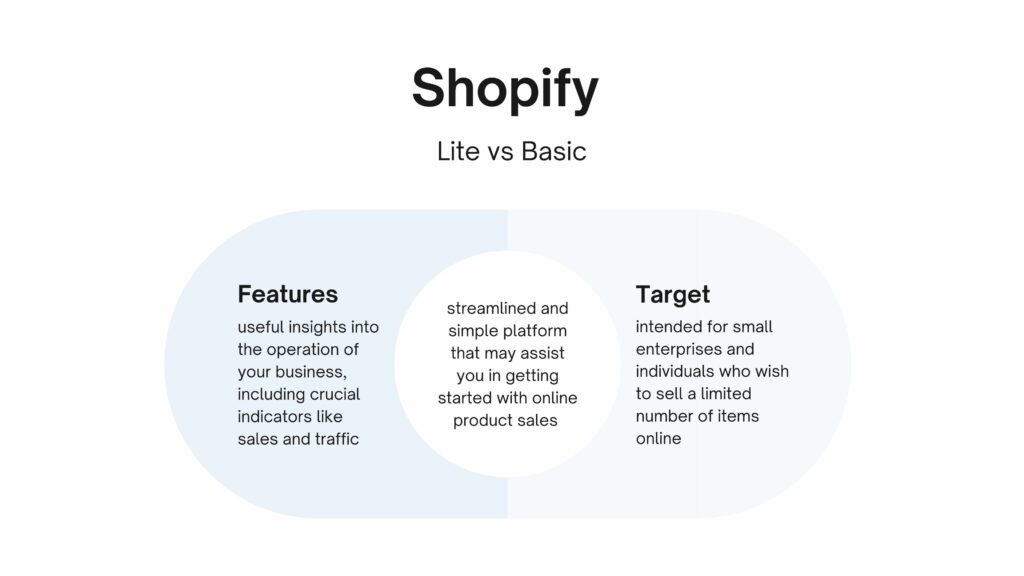
Shopify Lite is the plan Shopify built for sellers who already have an audience but do not need a full storefront. If you run a WordPress blog, an Instagram account with real followers, or a Facebook page with engaged customers, Shopify Lite gives you Shopify's checkout and inventory tools without requiring you to build a separate Shopify website.
A note on availability: Shopify Lite at $9/month is closed to new signups. Shopify replaced it with the Starter plan at $5/month, which covers the same core use case: Buy Buttons and social selling without a hosted storefront. If you are already on Shopify Lite, your account stays active. If you are researching options now, the Starter plan is the current equivalent. The rest of this guide applies to both plans since the mechanics are the same.
What Shopify Lite actually does
The plan does not include a Shopify-hosted storefront. Instead, it gives you three things:
- Buy Buttons: A short code snippet you embed on any existing website or blog. Customers click, see a Shopify checkout popup, and complete the purchase without leaving your site. You manage inventory, orders, and payments from the Shopify dashboard.
- Social selling: Connect your Facebook Shop or Instagram Shopping to your Shopify account and manage those sales alongside any other orders, all from one place.
- Point of sale: The Shopify POS app lets you take card payments in person using a card reader. This is handy for market stalls, pop-ups, or in-person events if you already sell online elsewhere.
What it does not include: a Shopify-hosted storefront, a blog, or more than one staff account. If you need those, the Basic plan at $29/month is the next step up.
Shopify Lite vs Basic Shopify
The straightforward comparison:
| Shopify Lite / Starter | Basic Shopify | |
|---|---|---|
| Price | $9/mo (Lite) or $5/mo (Starter) | $29/mo |
| Hosted storefront | No | Yes |
| Buy Buttons | Yes | Yes |
| Facebook + Instagram selling | Yes | Yes |
| POS | Yes (basic) | Yes (basic) |
| Staff accounts | 1 | 2 |
| Abandoned cart recovery | No | Yes |
| Discount codes | No | Yes |
Shopify Lite makes sense if you have existing traffic somewhere else and just need a checkout layer. If you are starting an online store from scratch, the Basic plan gives you the storefront you will need.
How to set up Shopify Lite (step by step)
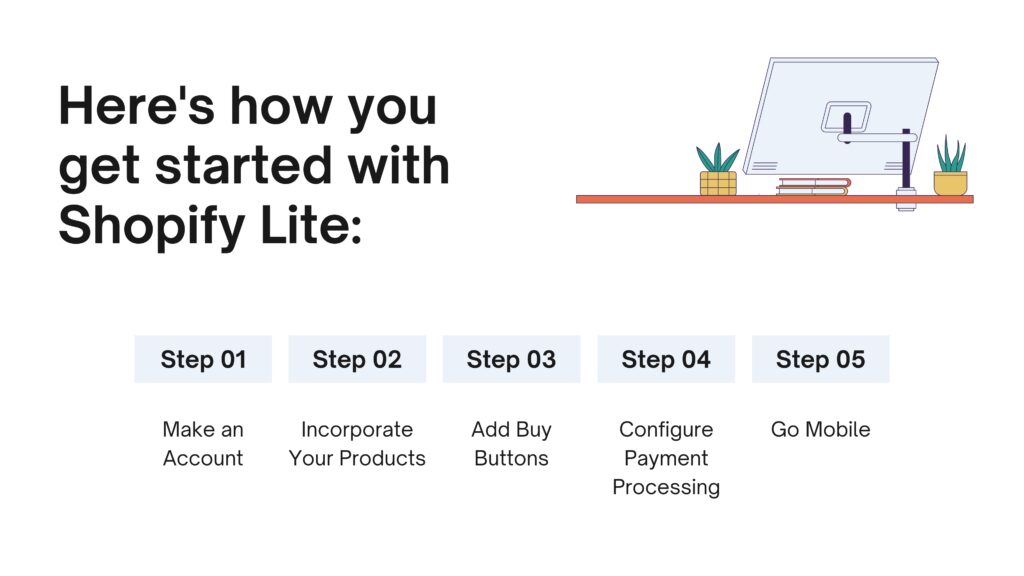
Step 1: Create your account
Go to shopify.com and sign up. During the onboarding flow, Shopify will ask about your selling goals. If the Starter plan is offered, that is the current equivalent of Shopify Lite. Complete the setup and you will land in the Shopify admin dashboard.
Step 2: Add your products
In the admin, go to Products and click Add product. Fill in the product title, description, price, and at least one image. Set inventory tracking on if you have limited stock. Do this for each item you plan to sell before moving to the next steps.
Step 3: Create a Buy Button
Go to Sales Channels and add the Buy Button channel. From there, select a product or collection and customize the button's appearance. Shopify generates a code snippet. Paste it into the HTML of your existing website or blog wherever you want the checkout to appear. Customers click the button, a checkout opens, and Shopify handles the transaction.
Step 4: Set up payments
Go to Settings > Payments. Shopify Payments is the default option and has no transaction fee. If Shopify Payments is not available in your country, you can connect PayPal or another gateway, though Shopify charges an additional transaction fee for third-party processors (2% on the basic tier). Set this up before your first sale.
Step 5: Use the mobile app
Download the Shopify app on iOS or Android. You can fulfill orders, update inventory, and check basic sales figures from your phone. If you sell in person, you can also process card payments through the POS tab after pairing a card reader.
Shopify Lite features in detail
Buy Buttons are the core feature. The button script is lightweight and works on most CMS platforms, including WordPress, Squarespace, and Wix. Each button or collection widget opens a Shopify-powered cart and checkout in a modal overlay, so the customer does not leave your site.
Single staff account: Only one login per Shopify Lite account. If you need someone else on your team to access the admin, you would need to upgrade. For solo entrepreneurs and small D2C businesses, one account is usually enough.
POS app: Connect the Shopify POS app to a card reader (Shopify sells its own readers) to accept in-person payments. Transactions sync back to the same inventory and orders view, so you can see your total sales across online and offline in one place.
Basic analytics: The dashboard shows recent orders, top products by revenue, and a sales summary. You also get a finances report and product-level reports. It is functional for a small operation but limited compared to what the Shopify or Advanced plans provide.
Integrating Shopify Lite with Instagram
Instagram has around 2 billion monthly active users, according to the platform's own figures. Shopping on Instagram works through Facebook Commerce Manager, which connects to your Shopify product catalog.
Step 1: In your Shopify admin, go to Sales Channels and add Facebook & Instagram. This links to Meta Business Suite.
Step 2: In Commerce Manager, go through the catalog and shop setup. Your Shopify products sync to an Instagram product catalog.
Step 3: Once approved (approval can take a few days), you can tag products in feed posts, Reels, and Stories. Followers tap the tag, see product details, and can check out either on Instagram (US accounts) or via your site.
Step 4: Orders from Instagram flow back into your Shopify orders view alongside any other sales channel. You manage fulfillment in one place.
One practical note: Instagram Shopping approval requires your account to comply with Meta's commerce policies and have a connected Facebook page. Accounts with very few followers are sometimes rejected. If that happens, the Buy Button route on your own website is a reliable fallback while you build an audience.
Integrating Shopify Lite with Facebook
Facebook Shops let visitors browse and buy directly from your Facebook page. The setup overlaps with the Instagram integration since both run through Commerce Manager.
Step 1: Connect your Facebook page under Sales Channels > Facebook & Instagram in Shopify admin.
Step 2: Set up your Facebook Shop in Commerce Manager. Your Shopify catalog syncs automatically once the connection is live.
Step 3: Shopify fulfills orders from Facebook the same way as any other channel. Payment terms depend on your Commerce Manager setup and country.
Facebook's advertising tools are separate from the Shopify integration. If you run Facebook ads, you can point them to your Facebook Shop or directly to the Buy Button on your site.
Integrating Shopify Lite with WordPress
WordPress is the most practical use case for Buy Buttons, since it is by far the most widely used CMS. The integration takes about 15 minutes.
Step 1: Install the official Shopify Buy Button channel in your Shopify admin. Generate a Buy Button for your product or collection.
Step 2: Copy the embed code. In WordPress, add a Custom HTML block to the page or post where you want the product to appear, and paste the code.
Step 3: Publish the page. The Buy Button will render on the frontend. Customers can add to cart and complete the checkout without leaving WordPress.
If you use a page builder like Elementor or Divi, paste the embed into an HTML widget instead of the WordPress block editor. The result is the same.
You can also add the Shopify Buy Button plugin from the WordPress plugin directory. It provides a simpler UI for generating embed codes without copying JavaScript manually, though both methods work equally well.
Shopify Lite pricing
Shopify Lite costs $9 per month. As of 2023, Shopify closed it to new signups and now offers the equivalent Starter plan at $5 per month. Existing Lite subscribers keep their plan.
On either plan, Shopify Payments transaction fees apply at the same rate as the Basic plan. For US merchants, online credit card rates through Shopify Payments are 2.9% + 30 cents per transaction. Third-party payment processors incur an additional 2% transaction fee on top of whatever the processor charges.
There are no product listing fees, no per-sale commissions beyond the payment processing rate, and no long-term contract. Month-to-month billing.
When to upgrade to Basic Shopify
Shopify Lite covers a specific situation: you have existing traffic and just need checkout functionality on top of it. It does not work well as your only sales channel if you do not already have an audience, because it gives you no storefront for organic discovery.
Upgrade to Basic Shopify if you need any of the following: a hosted storefront with a custom domain, abandoned cart recovery emails, discount codes, gift cards, or more than one staff account. The Basic plan at $29/month includes all of these.
If you want to research what your competitors on Shopify are selling before committing to a plan or strategy, Koala Inspector gives you a look at any Shopify store's apps, theme, and product data. It is a useful reference when you are figuring out your own setup.
Written by
Ana Gelevska
eCommerce Content Writer
Ana Gelevska is a content writer with more than five years of experience creating content for eCommerce brands and global clients. She digs into each topic and the people it is for, then turns it into clear, useful articles that Shopify sellers and dropshippers can act on.
Connect on LinkedIn