Zendrop: Everything You Need to Know in 2026
 By Ana GelevskaJanuary 13, 2025 · Updated July 31, 2026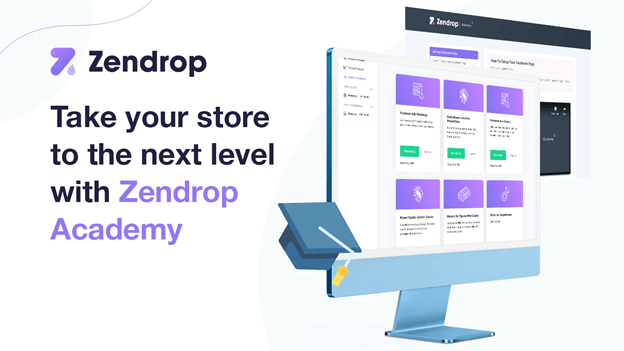
Zendrop is a dropshipping and fulfillment platform that connects an online store to a catalog of over one million products, then routes each customer order to a supplier who ships it directly to the buyer. It integrates with Shopify, Wix, TikTok Shop and ClickFunnels, ships from fulfillment centers in China and the United States, and is built for sellers who hold no stock of their own.
Most guides to Zendrop repeat its marketing page. This one works from Zendrop's own support documentation, where the plan limits, the processing windows and the country-by-country delivery averages are written down. Two of those details contradict what the pricing page implies, and both matter before you pick a tier.
Table of Contents
- Zendrop at a glance
- How does Zendrop work?
- How does Zendrop compare to other fulfillment platforms?
- What does the Zendrop free plan include?
- How long does Zendrop take to ship?
- What does a Zendrop store actually cost to run?
- When does a seller outgrow Zendrop?
- Pick the product before you pick the supplier
- Zendrop FAQ
Zendrop at a glance
Zendrop is a supplier network plus an automation layer. You import products, it handles sourcing, routing and tracking, and you keep the storefront and the marketing. Here is the whole specification in one block, every line taken from Zendrop's live pricing page, support center or Shopify App Store listing.
| Spec | Detail |
|---|---|
| What it is | Dropshipping and fulfillment platform with a supplier catalog |
| Storefronts supported | Shopify, Wix, TikTok Shop, ClickFunnels |
| Catalog size | Over 1 million items |
| Ships from | Fulfillment centers in China and the United States |
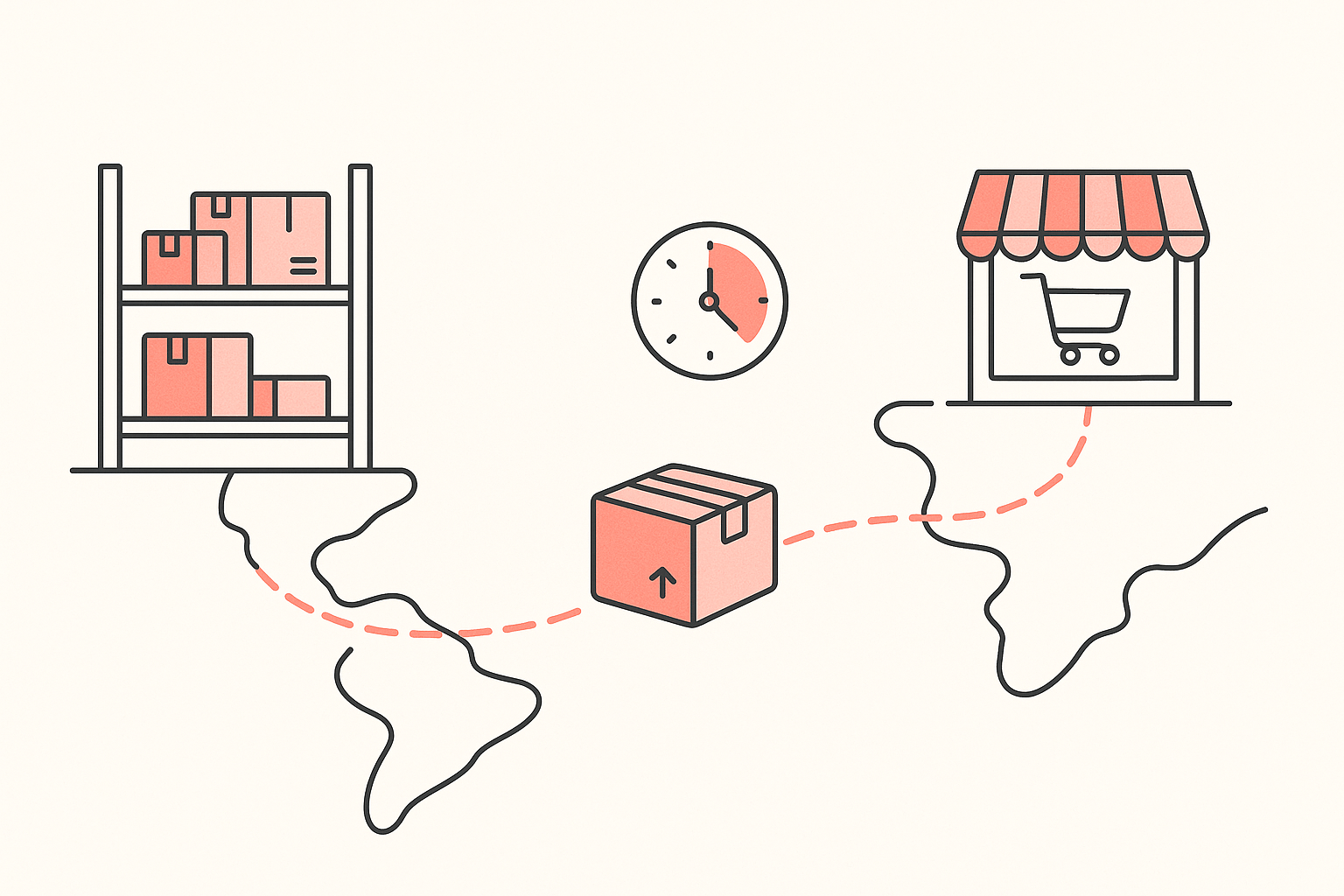
| US delivery | 2 to 8 days from US warehouses, after a 1 to 3 business day processing window |
| Global delivery | 10 to 15 days on average, plus processing |
| Plans bought direct | Free $0, Pro $49/month or $399/year, Plus $79/month or $549/year |
| Plans bought via Shopify or Wix | Beginner $29 (1 to 20 linked products), Pro $49 (21 to 100), Plus $79 (101 or more) |
| Shopify App Store rating | 4.5 stars from 1,153 reviews |
| Extras on higher tiers | Custom branding, print on demand, Zendrop Academy, chargeback management, private product listings |
| What it does not do | Import products or process orders on the free tier, ship to Turkey, ship liquids or ointments to Israel, or ship US-supplier stock outside the US |
Two of those lines are the ones people get wrong. Zendrop is no longer Shopify-only, and the free tier is a catalog browser rather than a way to sell.
How does Zendrop work?
Zendrop sits between your storefront and a supplier. You add products from its catalog to your store, and when a customer buys, the order details go to the supplier automatically, the supplier packs and ships, and tracking flows back to your store without you touching a spreadsheet. If a product is not in the catalog, you can submit a sourcing request and Zendrop looks for a supplier.
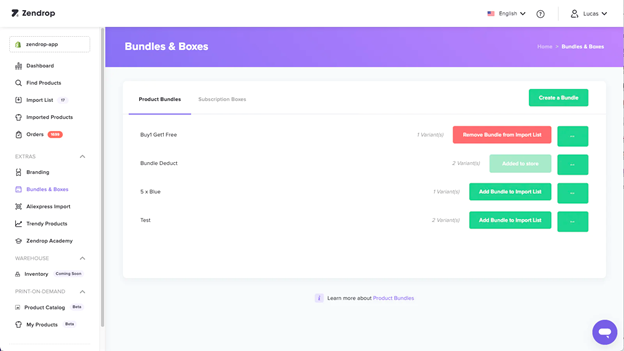
The paid tiers add the parts that stop being optional once orders arrive daily: automated fulfillment, custom branding on packaging and inserts, print on demand, and product bundles. The same three-stage loop is covered platform by platform in our guide to fulfilling dropshipping orders on Shopify.
How does Zendrop compare to other fulfillment platforms?
Zendrop competes on the spread between catalog depth and shipping speed. It carries over a million items and holds stock in US warehouses, which is the combination most catalog-only platforms cannot match. Sell The Trend takes the aggregator route instead, connecting to AliExpress and CJDropshipping and letting you filter suppliers by shipping origin, processing time and region, with a 14-day free trial. AutoDS prices its own automation at $26.90 per month billed monthly, or $19.90 annually, which undercuts Zendrop's $49 Pro tier.
Koala's own store-intelligence data adds a useful piece of context here. Across the Shopify stores Koala tracks, in the most recent snapshot, the sourcing and fulfillment apps that appear most often are Printful (255 stores), DSers (222), CJdropshipping (182) and Printify (175). Compare that with Judge.me at 3,022 stores and Klaviyo at 2,323, and the shape of the market becomes clear: reviews and email are near-universal, while the fulfillment layer is a long tail of platforms with no dominant winner. Read those counts as a sample of the stores Koala tracks rather than a census of Shopify, and expect the ranking to move.
The practical read: the supplier platform is a reversible decision. You can move a store from one to another in an afternoon. The product you chose to sell is the decision that is expensive to get wrong.
What does the Zendrop free plan include?
Zendrop's free plan costs $0 per month and lets you browse the full catalog, but Zendrop's support documentation states plainly that on the free tier "you can browse the catalog, but you can't import products or process orders." The pricing page presents a shared feature list across all three tiers, which reads far more generously than that. Trust the support article.
So the free plan is a way to evaluate the catalog before you pay. Selling through Zendrop starts at $29 per month on the Beginner tier if you are billed through Shopify or Wix, or $49 on Pro if you buy direct.
Zendrop credits follow the same pattern. Credits are a virtual currency for paying for unfulfilled orders, and they arrive with paid plans, through onboarding tasks, or by manual top-up. On Plus they can cover up to 10% of an order's total cost. They will not pay for sample orders or for the subscription itself.
Research is the part of a dropshipping stack that genuinely stays free. Koala Inspector keeps app detection, theme detection, store analysis and product research free forever on 15 monthly tokens with no card, so you can study the stores already selling a product before you spend anything on fulfillment.
How long does Zendrop take to ship?
Zendrop publishes real numbers, which is more than most platforms in this category do. Products shipped from its US warehouses reach US customers in 2 to 8 days after a standard 1 to 3 business day processing window, and global shipping averages 10 to 15 days plus that same processing time.
The country table, last updated 21 May 2026, gives the averages that actually land:
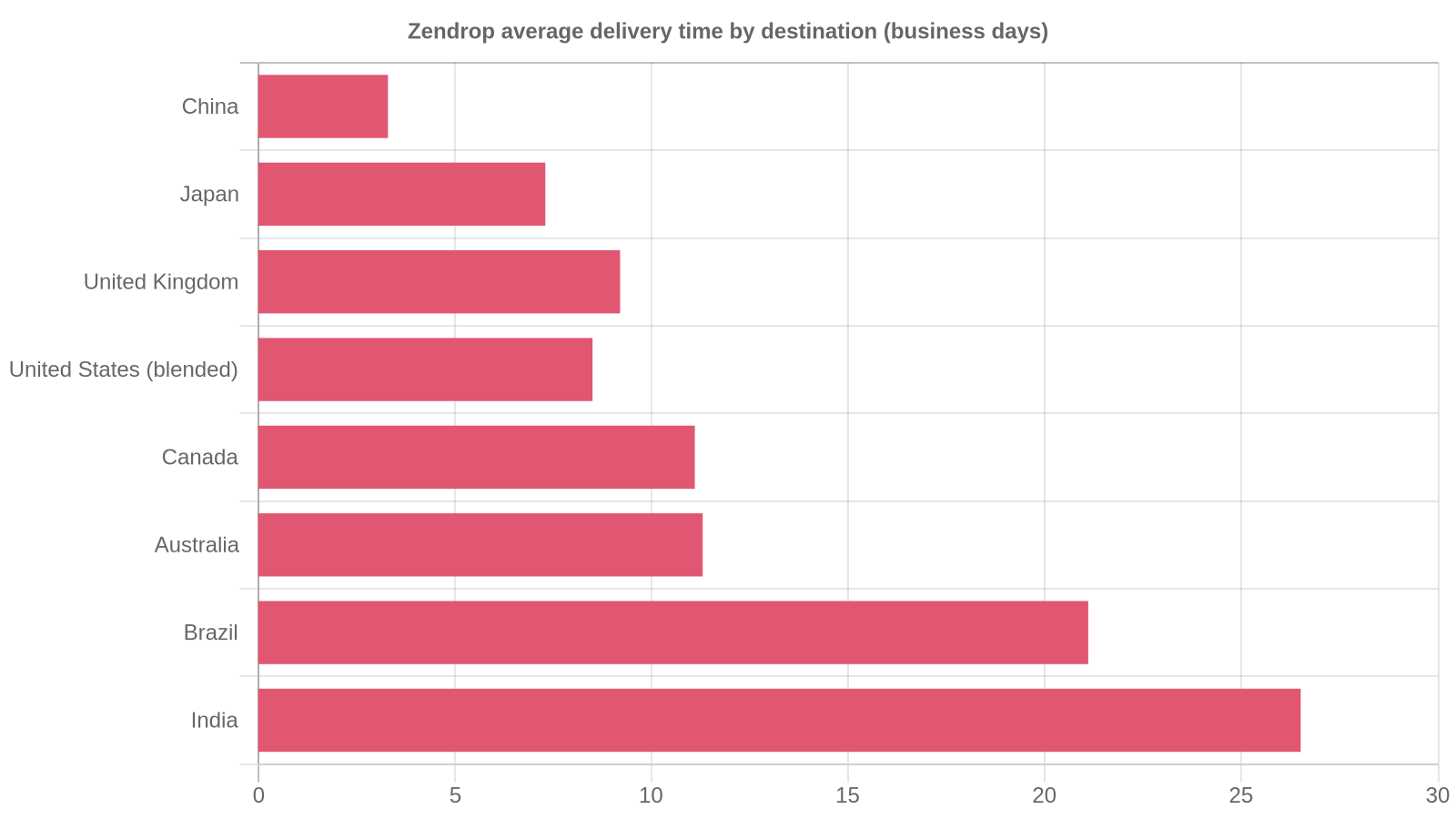
The US figure of 8.5 business days is a blend. Zendrop's own breakdown puts US-warehouse products at 3 to 5 business days and China-sourced products at 10 to 15, so your real delivery time depends entirely on which half of the catalog you sell from. Filtering the catalog to US stock is the single change that moves that number.
This is the question sellers keep asking each other. One merchant on r/dropshipping asked directly whether 10 to 15 day shipping to the US still converts, and another wanted to know how long orders sit before they ship at all. Processing time is the part people forget to add.
What does a Zendrop store actually cost to run?
The Zendrop subscription is one line in a bigger bill. AutoDS's breakdown of Shopify dropshipping costs puts Shopify Basic at $39 per month billed monthly or $29 annually, apps at $20 to $60 per month while testing and $40 to $150 once you are growing, and payment processing at 2.9% plus $0.30 per transaction on Basic. Ad spend dwarfs all of it: $50 to $500 for a testing phase, and $500 to $5,000 or more for scaling.
Stack a $49 Pro plan on that and the subscription is a rounding error next to the ad budget. The number that decides whether you make money is the margin between what a product costs you and what a customer pays, which is set at product-selection time. One seller two months into a store put it bluntly: the biggest problem was margins. Our full cost to start a dropshipping business guide models the rest.
When does a seller outgrow Zendrop?
A seller outgrows Zendrop when margin rather than fulfillment becomes the constraint. Two triggers show up repeatedly. The first is consistent volume on a handful of proven products, where a negotiated per-unit price from a dedicated agent beats catalog pricing by enough to fund more ad spend. The second is a delivery promise a 10 to 15 day China route cannot keep, which pushes you toward domestic stock or a third-party warehouse.
Zendrop's own answer at that stage is its Private Agent Program, described in its documentation as invite-only for high-volume sellers with enhanced processing and shipping. Sellers are already comparing notes on it publicly, including one asking how well it holds up for scaling.
The tell that you are ready is boring and specific: the same three or four SKUs account for most of your revenue, month after month. Until that happens, a catalog platform is the right tool, because you are still searching. Our comparison of dropshipping platforms covers where each one fits, and how to find dropshipping suppliers covers the agent route.
Pick the product before you pick the supplier
Choosing a fulfillment platform and choosing what to sell are the same project. A seller comparing Zendrop against its rivals is really trying to answer a different question: which products are already moving, and which competitors are worth copying? Fulfillment is the easy half of that, and it is the half you can change later.

Koala Inspector is the research half. It is a free Chrome extension, rated 4.6 out of 5 by more than 250,000 users, that opens any public Shopify store and shows you what is inside it:
- Products and likely best-sellers, with prices, variants and the date each was first published, so you can see what a competitor is actually pushing rather than what sits on the homepage. Free.
- Every app the store has installed and its active theme, which tells you how a working store in your niche is built. Free.
- Ad campaigns running on Google and Facebook or Instagram, with the creative, headline and landing page, for 2 tokens.
- Site traffic: monthly visits and trend, sources, top keywords, geography and demographics, for 3 tokens.
- Find Retailers, which surfaces other stores and marketplaces selling the same product, for 2 tokens. This is the fastest way to check whether a "winning product" is already resold everywhere.
- Shop Tracking, which watches a competitor and logs apps added or removed, theme changes, new products and price changes, for 15 tokens per shop.
Traffic and sales figures are estimates modeled from public signals any visitor's browser can already see. Use them to rank stores against each other and spot direction of travel, not as accounting.
The free tier gives you 15 tokens a month with no credit card, and the free features stay free forever. Premium is $22 a month for 220 tokens and up to 50 tracked stores, which is under half the price of Zendrop's cheapest fulfillment tier. Run it across the stores already selling what you are considering, then let Zendrop handle the shipping.
Install Koala Inspector free from the Chrome Web Store and check your next product idea against a real store before you import it.
The verdict
Zendrop is a solid fulfillment platform with a well-documented shipping profile, real US warehouse stock, and a 4.5-star rating from 1,153 Shopify App Store reviews. It earns its place for a seller who wants sourcing, routing and tracking handled in one account across Shopify, Wix, TikTok Shop or ClickFunnels.
Two things to price in before you subscribe. The free tier will not let you sell, so budget from $29 a month at minimum. And the blended 8.5-day US average hides a wide spread, so filter to US stock if your customers are American. Pair it with real competitor research and you are choosing products on evidence, then letting a platform move the boxes.
Zendrop FAQ
Is Zendrop free? There is a free tier at $0 per month, and Zendrop's support documentation says it lets you browse the catalog but not import products or process orders. Selling requires a paid plan, starting at $29 per month on Beginner through Shopify or Wix, or $49 on Pro bought direct.
Does Zendrop work with WooCommerce? Zendrop's site lists Shopify, Wix, TikTok Shop and ClickFunnels. WooCommerce is not among them.
How fast does Zendrop ship to the US? Products held in US warehouses reach US customers in 2 to 8 days after 1 to 3 business days of processing. China-sourced products take 10 to 15 business days. Zendrop's blended US average is 8.5 business days.
Where does Zendrop ship from? Fulfillment centers in China and the United States. Products from US suppliers ship domestically within the US only. Zendrop does not ship to Turkey, and liquids and ointments cannot go to Israel.
Is Zendrop worth it for a beginner? It removes the supplier-relationship problem, which is the part beginners find hardest, and its shipping data is published rather than promised. The cost only makes sense once you have a product worth fulfilling, so do the research first. Koala Inspector is free and shows you what live Shopify stores in your niche are selling, which apps they run and which ads they are buying.
How do I find products worth selling on Zendrop? Study stores that already sell them. Open a competitor's storefront with Koala Inspector to see its catalog, likely best-sellers, prices, installed apps and running ad campaigns, then search Zendrop's catalog for the products that keep appearing. Our guide to finding winning products walks through the full method.
Written by
Ana Gelevska
eCommerce Content Writer
Ana Gelevska is a content writer with more than five years of experience creating content for eCommerce brands and global clients. She digs into each topic and the people it is for, then turns it into clear, useful articles that Shopify sellers and dropshippers can act on.
Connect on LinkedIn