What is Ecommerce Packaging?
 By Ana GelevskaApril 16, 2024 · Updated June 17, 2026
Ecommerce packaging is the set of materials used to protect and present a product on its way from your warehouse to a customer's door. That covers the outer box or mailer, any cushioning inside (bubble wrap, foam, paper void fill), and the branded touches like tissue, custom tape, or a thank-you card. Good packaging does two jobs at once: it keeps the product intact in transit, and it shapes the first physical impression a buyer has of your brand. The right choice depends on what you ship, how fragile it is, your budget, and how much of the unboxing moment you want to own.
This guide breaks down the main packaging types side by side, what each one actually costs per unit, how to think about sustainability without greenwashing, and the ISTA 6 testing that Amazon sellers run into.
Protective packaging vs presentation packaging
There are two broad jobs packaging does, and treating them as the same thing is where money gets wasted:
- Protective packaging is the structural layer that keeps the product intact in transit: boxes, mailers, void fill, corner guards.
- Presentation packaging is the branded layer: printed boxes, tissue paper, custom tape, inserts. It is optional, and it shapes whether a customer remembers you.
You can have excellent protection with a plain poly mailer, or a beautiful branded box that gets crushed because the wall is too thin. The best decisions handle both at once, sized to the product so you are not paying to ship air.
Ecommerce packaging types compared
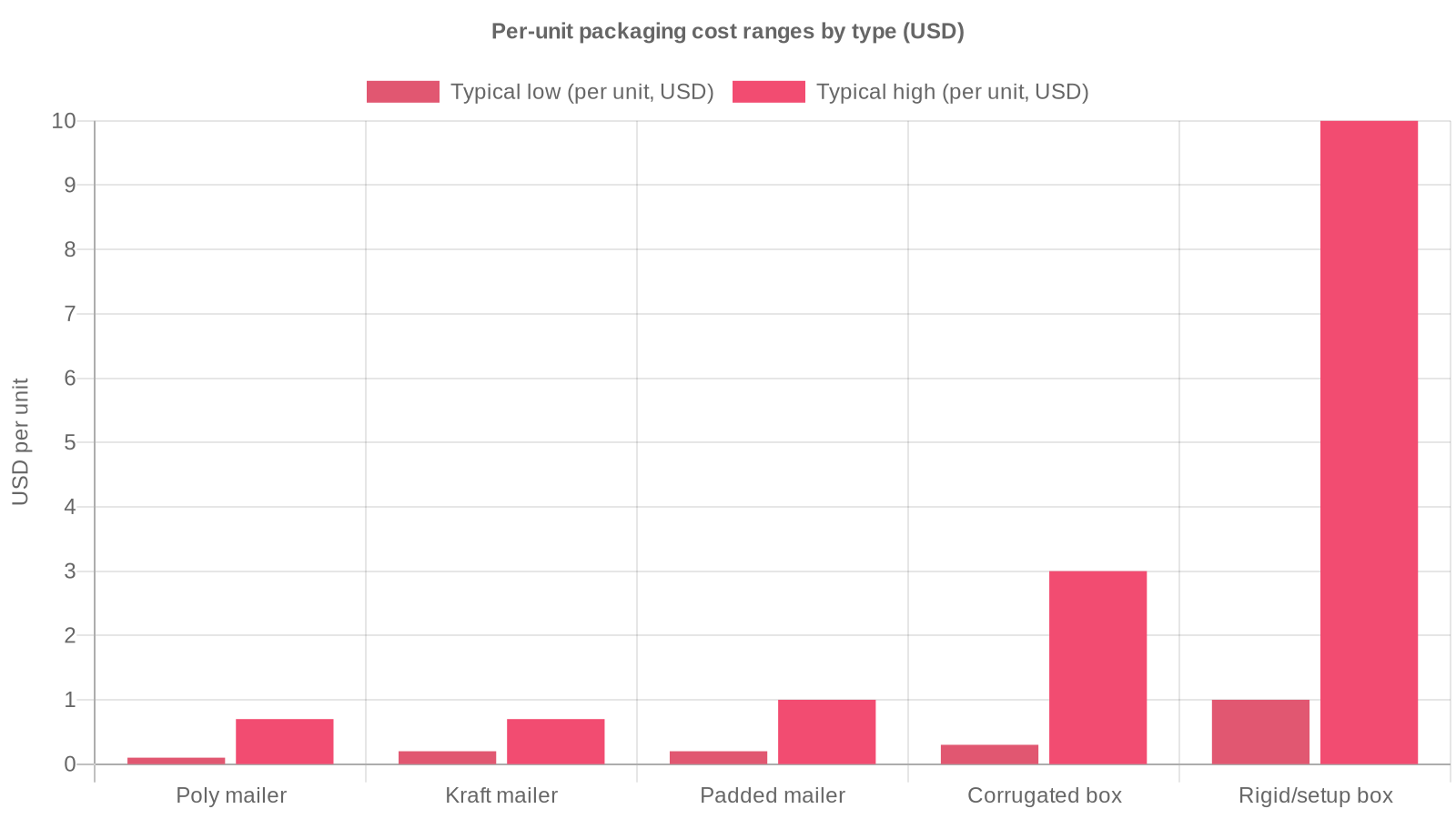
Five formats cover the large majority of online orders. The cost figures below are per-unit ranges for the packaging material itself, sourced from a 2026 packaging cost guide, and they move with order volume, size, and print coverage.
| Packaging type | Best for | Protection | Branding potential | Typical cost per unit |
|---|---|---|---|---|
| Poly mailer | Soft goods: apparel, textiles, flat accessories | Low (no impact protection) | Low to medium (print on the bag) | $0.10 to $0.70 |
| Kraft paper mailer | Soft, light items where a paper, recyclable look matters | Low to medium | Medium | $0.20 to $0.70 |
| Padded / bubble mailer | Small fragile items: jewelry, cosmetics, small electronics | Medium (cushioned) | Low to medium | $0.20 to $1.00 |
| Corrugated box | Most boxed consumer goods; heavier or fragile items | Medium to high (scale wall thickness) | Medium to high (printed mailer box) | $0.30 to $3.00 |
| Rigid / setup box | Premium products, gifts, high unboxing value | High | Very high | $1.00 to $10.00 |
A few practical notes on the table. Poly mailers are waterproof and very light, which keeps dimensional weight charges down, but they offer no cushioning, so they suit items that cannot be crushed. Padded mailers add a cushioned layer for small fragile goods. Corrugated boxes scale from single-wall to double or triple-wall, so match the wall to the product's weight and fragility. Rigid setup boxes are partly hand-assembled, which is why they sit at the top of the cost range and are reserved for higher-priced products.
What ecommerce packaging actually costs
Per-unit material cost is only part of the picture, but it is the part sellers most often guess at. Using the same published cost ranges, here is what the packaging material alone tends to cost per order by product type (this is the box or mailer, not postage):
- Soft goods (a t-shirt, a scarf, a phone case): a poly or kraft mailer at roughly $0.10 to $0.70 per order, before any branded insert.
- Small fragile items (jewelry, cosmetics, a small gadget): a padded or bubble mailer at about $0.20 to $1.00 per order.
- Standard boxed product: a corrugated box at about $0.30 to $3.00, plus cushioning and a label on top of that.
- Premium or gift item: a rigid setup box at about $1.00 to $10.00 for the box alone, which is why brands reserve them for higher-ticket products.
Two levers move these numbers. Custom printing adds roughly $0.05 to $0.80 per unit depending on color coverage and how many sides you print. Order volume matters even more: moving from a 500-unit run to a 5,000-unit run can cut the per-unit price by 30 to 50 percent. If you are still mapping out your unit economics, packaging belongs in the same line of thinking as the rest of your cost to start a dropshipping business, not a rounding error you add at the end.
How packaging affects customer satisfaction and returns
Bad packaging has a measurable cost. If a product arrives damaged, the customer files a dispute and rarely reorders. If the box looks beaten up but the product is fine, confidence still drops. Packaging quality is not a side detail to buyers, and sellers feel it directly: in one seller account on r/dropshipping, packaging and label problems were enough to nearly end the business, with customers returning products over defects that had nothing to do with the product itself.
A few realities worth designing around:
- Poly mailers are fine for soft goods and keep weight (and DIM charges) down, but fragile products need real internal cushioning.
- Oversized boxes with excess void fill cost more to ship and read as careless, because carriers bill on dimensional weight, not just actual weight.
- Resealable or double-adhesive packaging makes returns easier for the customer and keeps the returned item in sellable condition.
Packaging touches every stage of order fulfillment, from pick and pack through sortation, transport, and last-mile delivery, so the spec you choose ripples through your whole operation.
Sustainable packaging: recyclable vs compostable vs recycled content
Sustainability is now a purchasing factor, not just a premium-brand differentiator. A NielsenIQ and McKinsey study found that 78 percent of US consumers say a sustainable lifestyle is important to them, and that across five years of US sales, products carrying environmental and social claims grew about 28 percent cumulatively from 2017 to mid-2022, versus about 20 percent for products without such claims.
The waste case is just as concrete. The EPA recorded 82.2 million tons of containers and packaging in the US waste stream in 2018, about 28 percent of everything generated that year. Corrugated boxes are the bright spot: the EPA put their recycling rate at 96.5 percent, well above the 53.9 percent rate for packaging overall.
Where sellers go wrong is treating "eco" as one thing. The three common claims trade off differently:
- Recyclable, with high recycled content. Packaging made largely from post-consumer recycled material cuts virgin material use and lowers lifecycle emissions, and corrugated is recycled at very high rates. For most ecommerce, this is the most reliable environmental win.
- Compostable. It sounds greener, but as packaging makers like EcoEnclose explain, most compostable packaging needs industrial composting to break down and will not decompose in a home bin or in nature. Bioplastics such as PLA can also contaminate curbside recycling if a customer tosses them in with paper and plastic, creating problems downstream.
- Recycled content. This is the share of a package made from already-used material. A higher post-consumer share avoids new extraction, which is a more dependable benefit than a compostability claim a customer may never be able to act on.

Real redesigns show what is possible without a science project: Glossier built recognition around its pink box and tissue, and Puma's Clever Little Bag replaced the traditional shoebox with a reusable bag to cut material use. The practical swaps are smaller: paper-based void fill instead of plastic peanuts, corrugated with high recycled content, and right-sizing so you ship less material in the first place.
ISTA 6 packaging and the ISTA test protocols
If you sell through Amazon, ISTA testing stops being optional. ISTA stands for the International Safe Transit Association, and ISTA 6 is a family of transit-simulation test procedures. The one most sellers run into is ISTA 6-Amazon.com.
What is ISTA 6-Amazon.com?
According to ISTA's own procedure overview, Project 6-AMAZON.COM is a general simulation test for "Ships In Own Container" (SIOC) products shipped through Amazon's distribution system to the final customer. In that model, a product travels from the manufacturer to an Amazon fulfillment center and then on to the consumer, often in its own container with no extra Amazon overbox. The test evaluates how both the package and the product hold up against the thermal conditions, compression, clamping, shocks, and vibration normally met in that network.
When it applies and what it covers
It applies when your product ships into Amazon and moves on to customers via parcel or less-than-truckload methods. A certified third-party lab subjects the packaged product to drop impacts from multiple orientations, vibration that simulates truck transport, and compression that simulates stacking in a fulfillment center. The goal is simple: confirm the product survives the whole journey from warehouse to doorstep. Packaging that fails can be rejected at the receiving dock, which means delays, fees, and damaged units. Certification is run per packaging configuration, so it is a defined cost you can plan for rather than an ongoing tax.
Study how competitor stores package and brand
Packaging is also a competitive signal you can research. Before you commit to a format, it helps to see how the stores you are up against present themselves, what kind of unboxing they invest in, and which apps power the rest of their buying experience.
The free Koala Inspector Chrome extension is built for exactly this kind of competitor research on Shopify stores. Open it on a rival's storefront and it shows the store's theme, its full product catalog with likely best-sellers, and every Shopify app it runs, grouped by type, so you can read how a serious store is set up rather than guessing. For more context on what separates the stores worth copying, see what apps top Shopify stores use and the characteristics of successful Shopify stores. If you want to study what actually sells before you spend on premium packaging, our guide to finding a store's best sellers is a good next step.
The bottom line
Packaging is a cost center that directly affects customer satisfaction, return rates, and shipping costs. Generic choices (grab a box, fill it with peanuts) add up in ways that stay invisible until you are dealing with damage claims and customers who never came back. Match the format to the product, size it to cut dimensional weight, choose recycled-content recyclable materials where you can, and test before you scale into Amazon. The right packaging for your store comes down to what you ship, where it is going, and how much of the unboxing you want to own.
Frequently asked questions
How much does ecommerce packaging cost? It depends on the format and the order quantity. As a rough per-unit guide for the material itself: poly mailers about $0.10 to $0.70, kraft paper mailers about $0.20 to $0.70, padded or bubble mailers about $0.20 to $1.00, corrugated boxes about $0.30 to $3.00, and rigid setup boxes about $1.00 to $10.00. Custom printing adds roughly $0.05 to $0.80 per unit, and larger order runs cut the per-unit price by 30 to 50 percent.
What is ISTA 6, and when does it apply? ISTA 6 is a family of transit-simulation tests from the International Safe Transit Association. ISTA 6-Amazon.com is the common one: a general simulation test for Ships In Own Container products moving through Amazon's network. It applies when you ship products into Amazon that travel on to the customer in their own container, and it checks how the package and product survive compression, clamping, shocks, vibration, and thermal conditions.
What are the most sustainable ecommerce packaging options? For most stores, recyclable packaging with a high share of post-consumer recycled content is the most reliable choice, because it cuts virgin material use and corrugated is recycled at very high rates. Compostable mailers usually need industrial composting, do not break down in a home bin, and can contaminate curbside recycling if disposed of incorrectly.
What is the best packaging for small products? For small non-fragile items, a poly or kraft mailer is the cheapest and lightest option. For small fragile items, a padded or bubble mailer adds impact protection without the cost and dimensional weight of a box. Save corrugated and rigid boxes for items that need rigid protection or a premium unboxing.
Are poly mailers cheaper than boxes? Usually yes. Poly mailers cost about $0.10 to $0.70 per unit and weigh very little, while corrugated boxes run about $0.30 to $3.00 and add dimensional weight. Boxes are worth the extra cost when a product needs rigid protection, cushioning, or a branded unboxing experience.
Written by
Ana Gelevska
eCommerce Content Writer
Ana Gelevska is a content writer with more than five years of experience creating content for eCommerce brands and global clients. She digs into each topic and the people it is for, then turns it into clear, useful articles that Shopify sellers and dropshippers can act on.
Connect on LinkedIn